Tag: blue whirl

  • The Structure of the Blue Whirl

    The Structure of the Blue Whirl

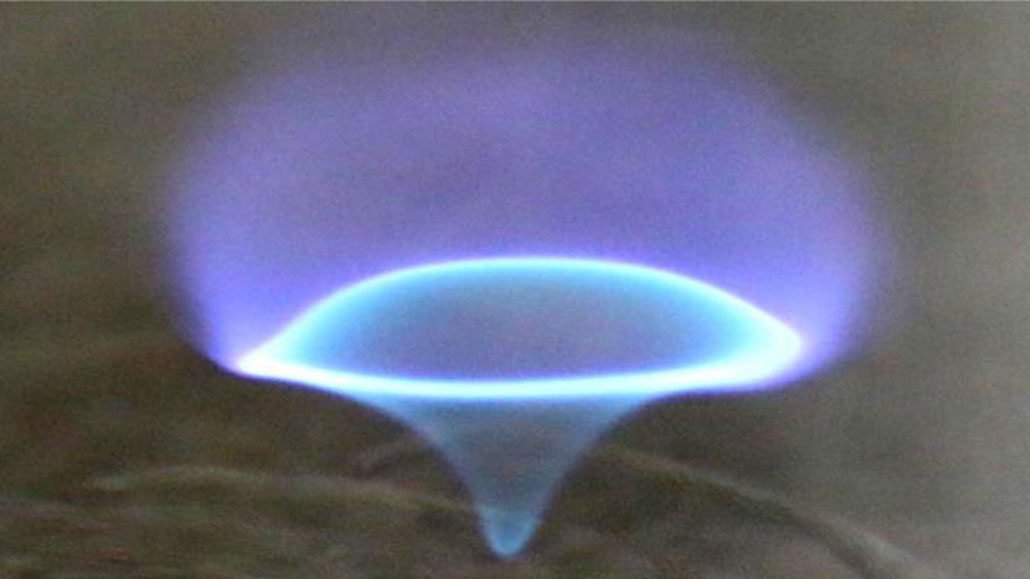
    Several years ago, researchers discovered a new type of flame, the blue whirl. Now computational simulations have helped them untangle the complex structure of this clean-burning flame. Their work shows that the blue whirl is made up of three types of flames, which meet to form a fourth.

    The conical base of the whirl is a fuel-rich flame in which the fuel and oxygen are initially well-mixed. Above that is a diffusion flame, where the fuel and oxygen are initially separate and the flame’s ability to burn is limited by how readily the two mix. Along the sides of the blue whirl is a third flame type, visible only as a faint wisp. Like the first flame, this one is premixed, but it contains much less fuel than oxygen. Finally, those three flames meet in the bright blue ring of the whirl, where the ratio of fuel and oxygen is just right to burn the fuel completely. (Image and research credit: J. Chung et al.; via Science News; submitted by Kam-Yung Soh)

  • Featured Video Play Icon

    The Blue Whirl

    We wrote earlier this year about the discovery of a new type of fire whirl – the blue whirl – but now the authors have published video of the blue whirl in action! The blue whirl was discovered while investigating the use of fire whirls to more efficiently burn off oil spilled atop water. A tightly spinning yellow fire whirl produces less soot than a non-vortex burn; the blue whirl is even more efficient, producing little to no soot at all. Much remains to be learned about this new type of fire vortex, but in the meantime, enjoy some high-speed video of the blue whirl, particularly from 1:50 onward. (Video credit: M. Gollner et al.)

  • The Blue Whirl

    The Blue Whirl

    Researchers studying the use of fire whirls to burn off oil spills have discovered a new type of fire whirl – the blue whirl. Their results are currently reported in a pre-print paper on arXiv and await peer-review. In their experiment, the scientists ignited a puddle of fuel floating atop water. Compared to a typical flame, they observed that a tightly-spinning fire whirl burns hotter and produces less soot by burning more of the fuel. To the researchers’ surprise, their lab-scale yellow fire whirl evolved into a compact, bright blue whirl. The blue whirl has a laminar flame and makes little to no noise. Its bright blue color indicates even more efficient combustion than the yellow fire whirl. The lack of yellow color means the whirl is burning without producing any soot, a by-product of incomplete combustion. The authors hope a better understanding of blue whirls will lead to better methods for responding to oil spills. (Image credit: H. Xiao et al.)