Tag: bubbles

  • Bursting Bubbles

    Bursting Bubbles

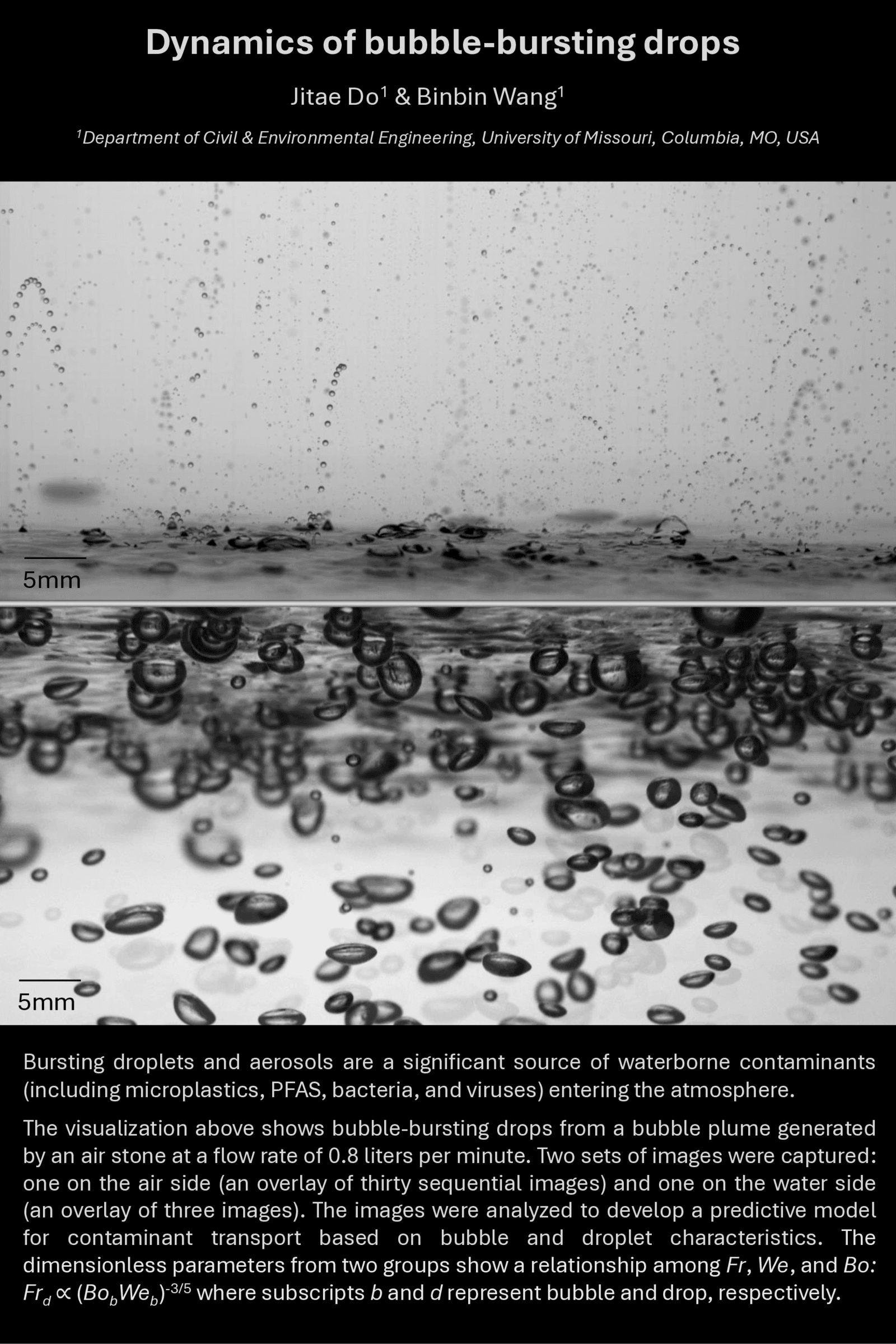
    When air bubbles rise through a liquid, they scavenge dust, viruses, microplastics, and other impurities as they go. Once at the surface, these contaminant-covered bubbles thin and burst, generating many tiny droplets that arc through the air above. You’re likely familiar with the sight and sensation from a glass of champagne or soda.

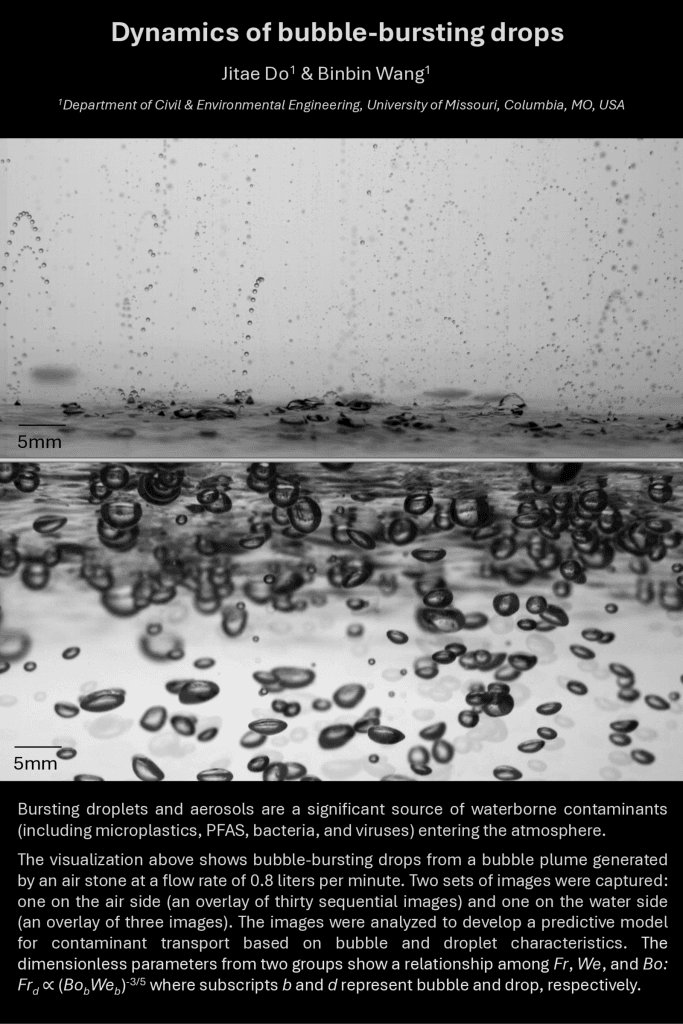
    Here, researchers have stacked two sets of sequential images to illustrate this complicated flowscape. Under the surface, a trio of photos are stacked to show bubbles rising and gathering at the surface. In the air, the researchers have stacked thirty sequential images, which together trace out the parabolic arcs of droplets sprayed by the bursting bubbles. (Image credit: J. Do and B. Wang)

    A research poster showing composite images of bubbles rising to a water-air interface and bursting, sending up a spray of microdroplets.
    Fediverse Reactions
  • Mixing Bubble Caps

    Mixing Bubble Caps

    When bubbles form atop the ocean or in our cups, they typically live short lives. Although the bubble can exchange fluid with the pool below, this only happens at the foot of the bubble cap. There, thinner patches form and, due to their buoyancy, rise up along the bubble’s surface. Over time, these lighter, thinner patches reduce the amount of fluid in the cap–causing the bubble to thin and eventually burst.

    A research poster showing how external turbulence affects the plumes that thin a bubble cap.

    Here, researchers show that thinning–visible in the dark blue plumes rising up the bubble cap–when there’s no turbulence in the surrounding air. But as turbulence outside the bubble increases, the thinner patches stretch and deform across the cap. In the image series, turbulence increases moving from top to bottom. (Image credit: T. Aurégan and L. Deike)

  • Featured Video Play Icon

    Drag Reduction Via Bubbles

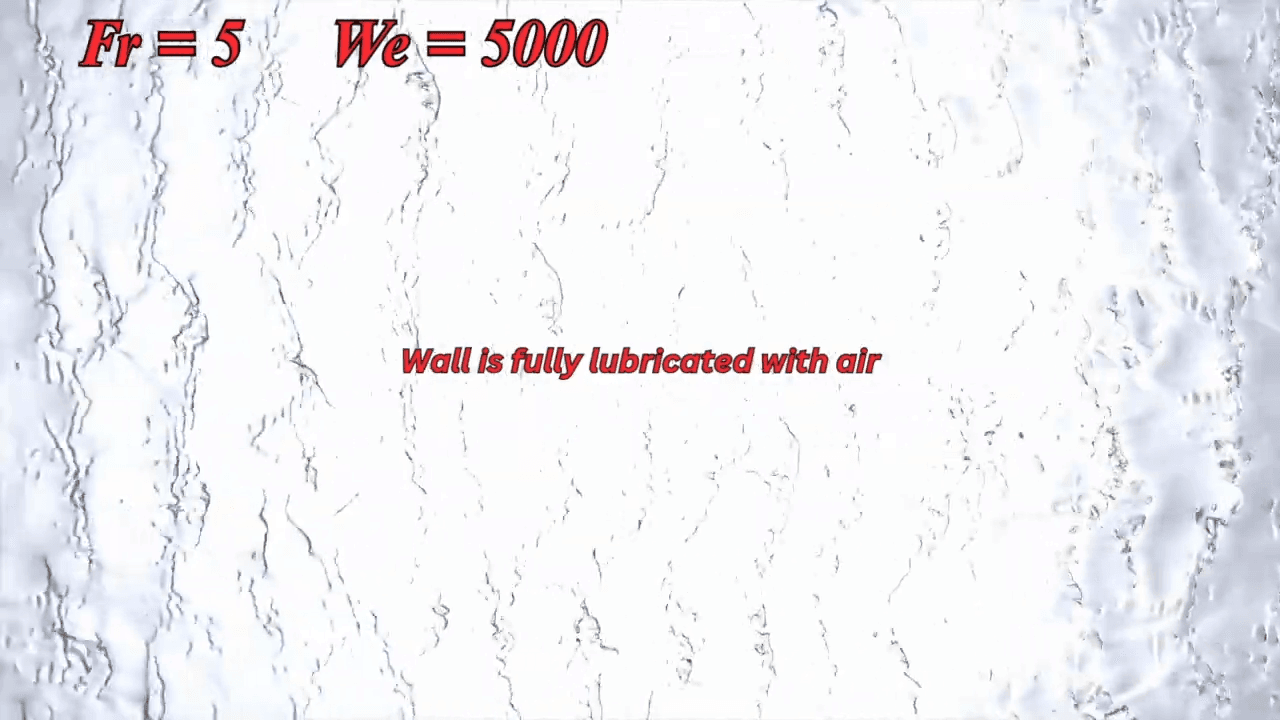
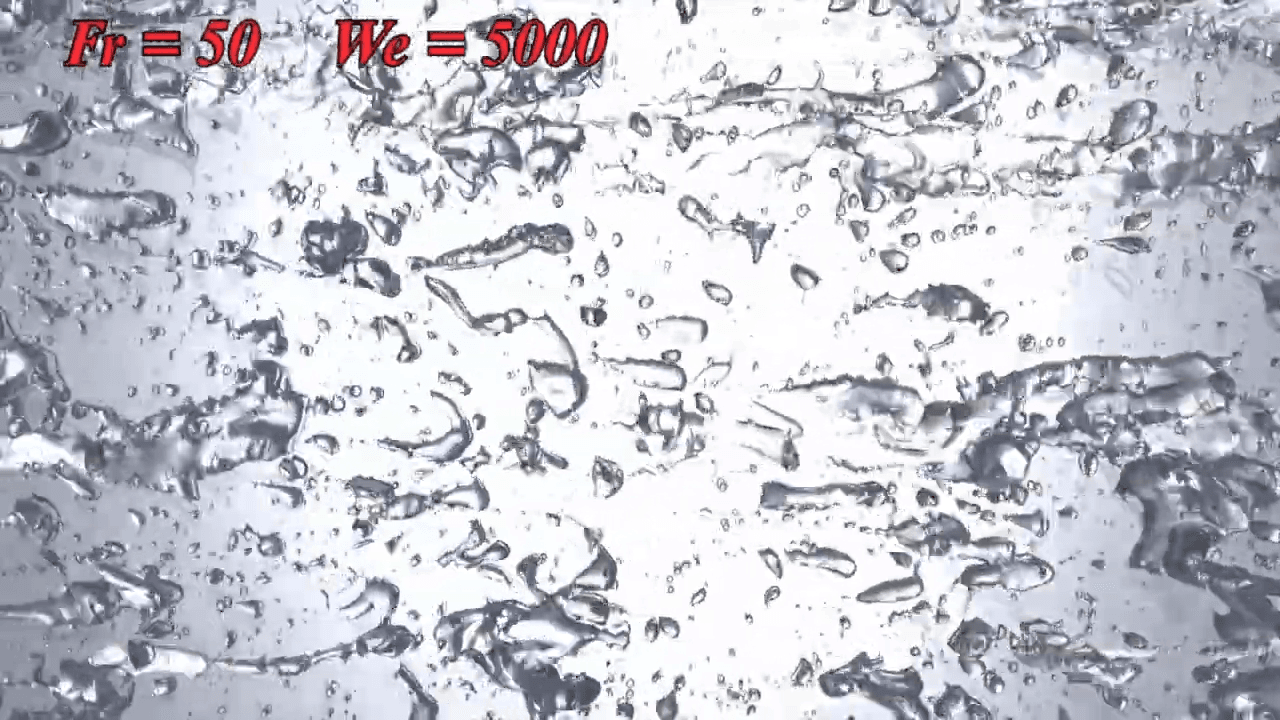
    To help reduce greenhouse emissions, businesses are exploring systems that reduce a container ship’s drag by releasing bubbles beneath them. But how do bubbles reduce drag? To find out, researchers simulated a bubbly flow that mimics the underside of a moving ship. By playing with the balance between inertial forces, buoyancy, and surface tension, they were able to sweep through conditions that the bubbles could experience.

    The best performance comes when bubbles stick together and coat the entire underside of the surface. In that case, they measured a nearly 40% reduction in the drag. But other conditions were not so fortuitous; in fact, with poorly chosen conditions, adding bubbles could actually increase the drag. (Video and image credit: S. Di Georgio et al.)

  • Featured Video Play Icon

    Swirling Without Blades

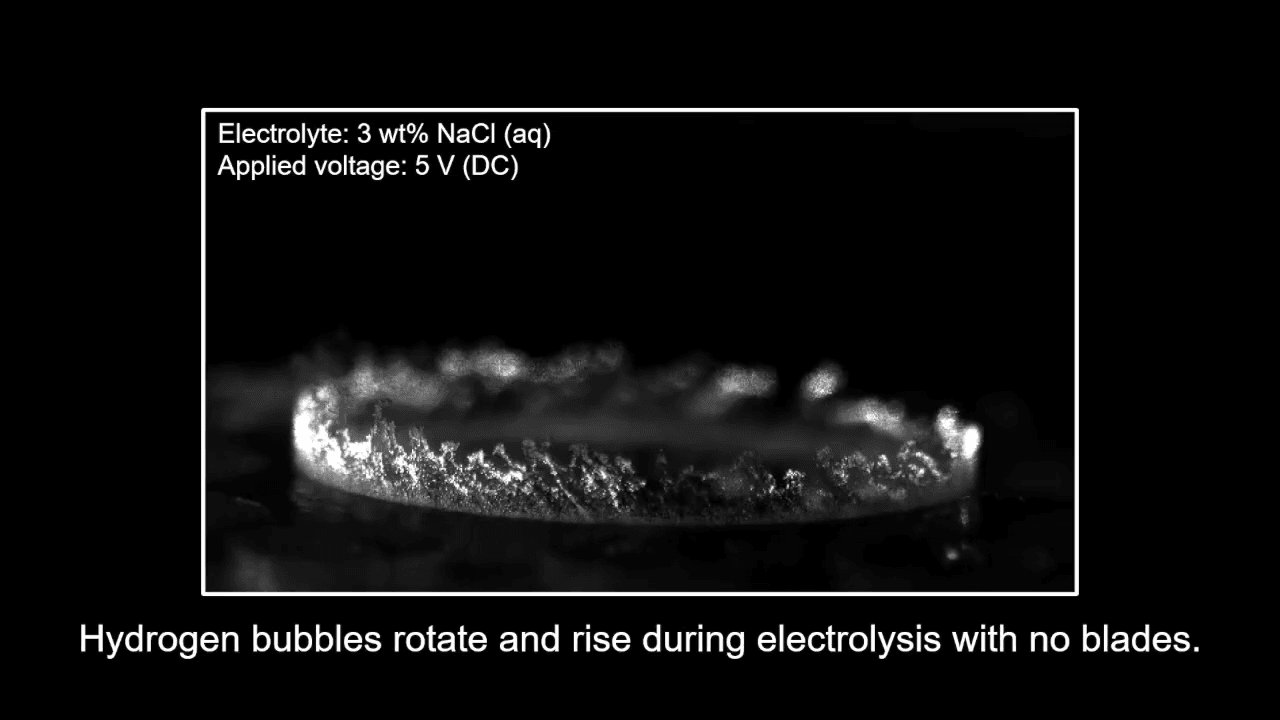
    A ring of hydrogen bubbles rises, rotating clockwise, in this video of electrolysis. But there are no fan blades to cause this swirl, so why do the bubbles rotate? The answer is a Lorentz force induced by the electromagnetic set-up of the experiment. Watch to see how researchers manipulate the Lorentz force to affect the flow. (Video and image credit: Y. Cho et al.)

  • A Bubbly Heart

    A Bubbly Heart

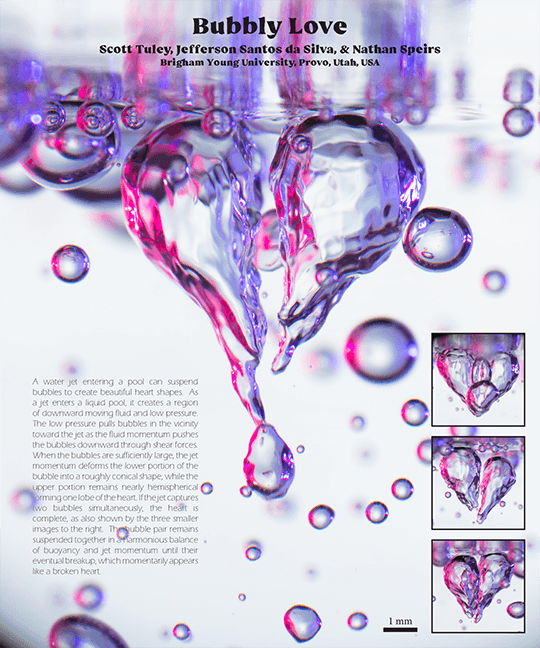
    Next time you fill your water bottle, watch closely and see if you can spot a bubble heart like these. When a jet falls into a pool, it pulls air in with it. The low pressure of the jet pulls bubbles inward, even as shear pulls the bubbles downward with the sinking liquid. If the bubbles are large and there’s enough momentum in the jet, the lower portion of the bubble will get pulled into a conical shape, while the upper portion remains a hemisphere. That forms one lobe of the heart. The other half requires a second bubble. But with a little patience and luck, you can form a complete heart. Happy Valentine’s Day! (Image credit: S. Tuley et al.)

    Fediverse Reactions
  • Making Bubbles in Magma

    Making Bubbles in Magma

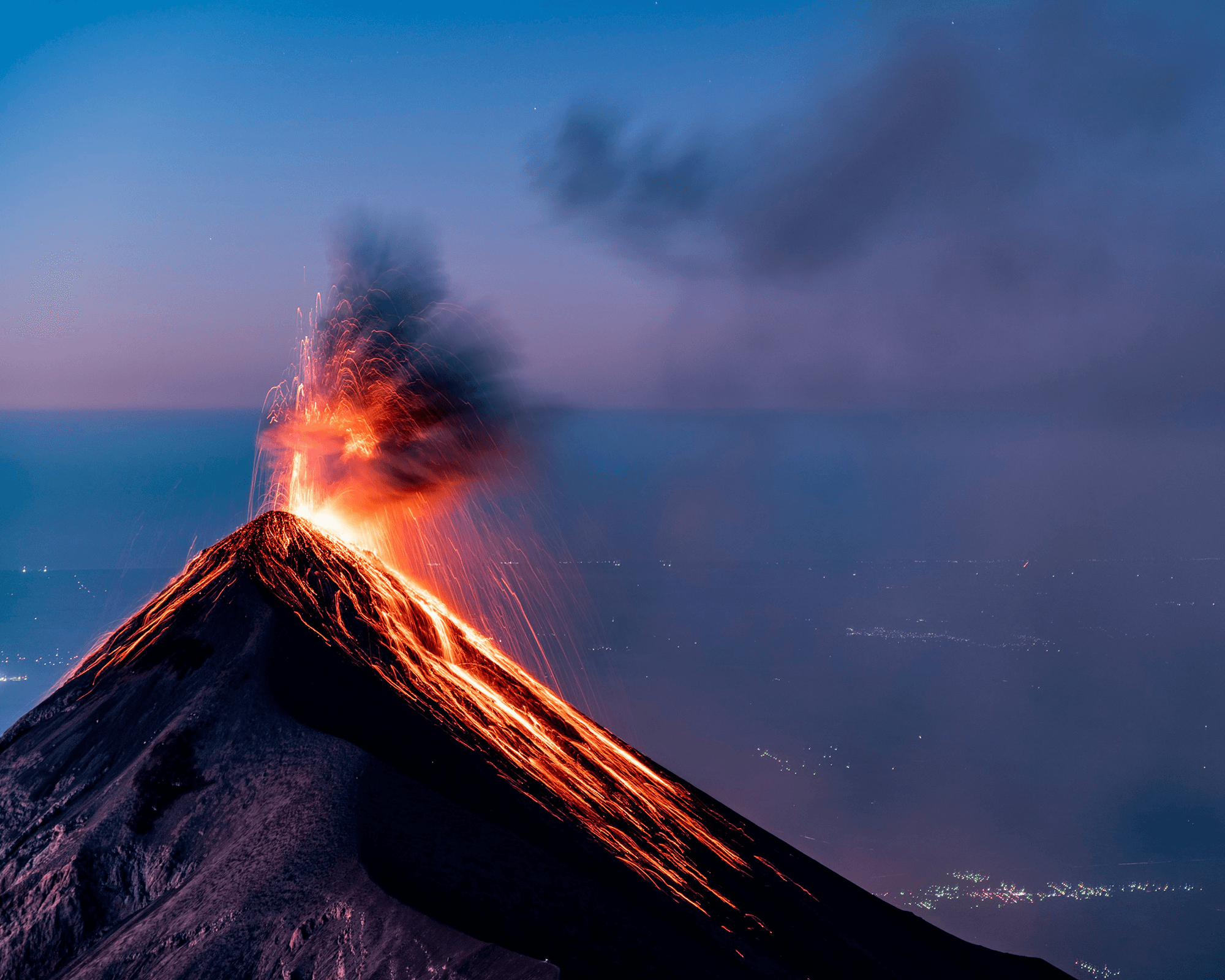
    When bubbles form in magma deep below the earth, volcanic eruptions follow. Scientists believe this happens when decompression of the magma allows volatile compounds to come out of solution and form bubbles–just as opening a bottle of seltzer allows carbon dioxide to bubble out. But a new study indicates that decompression may not be the only source of bubbles.

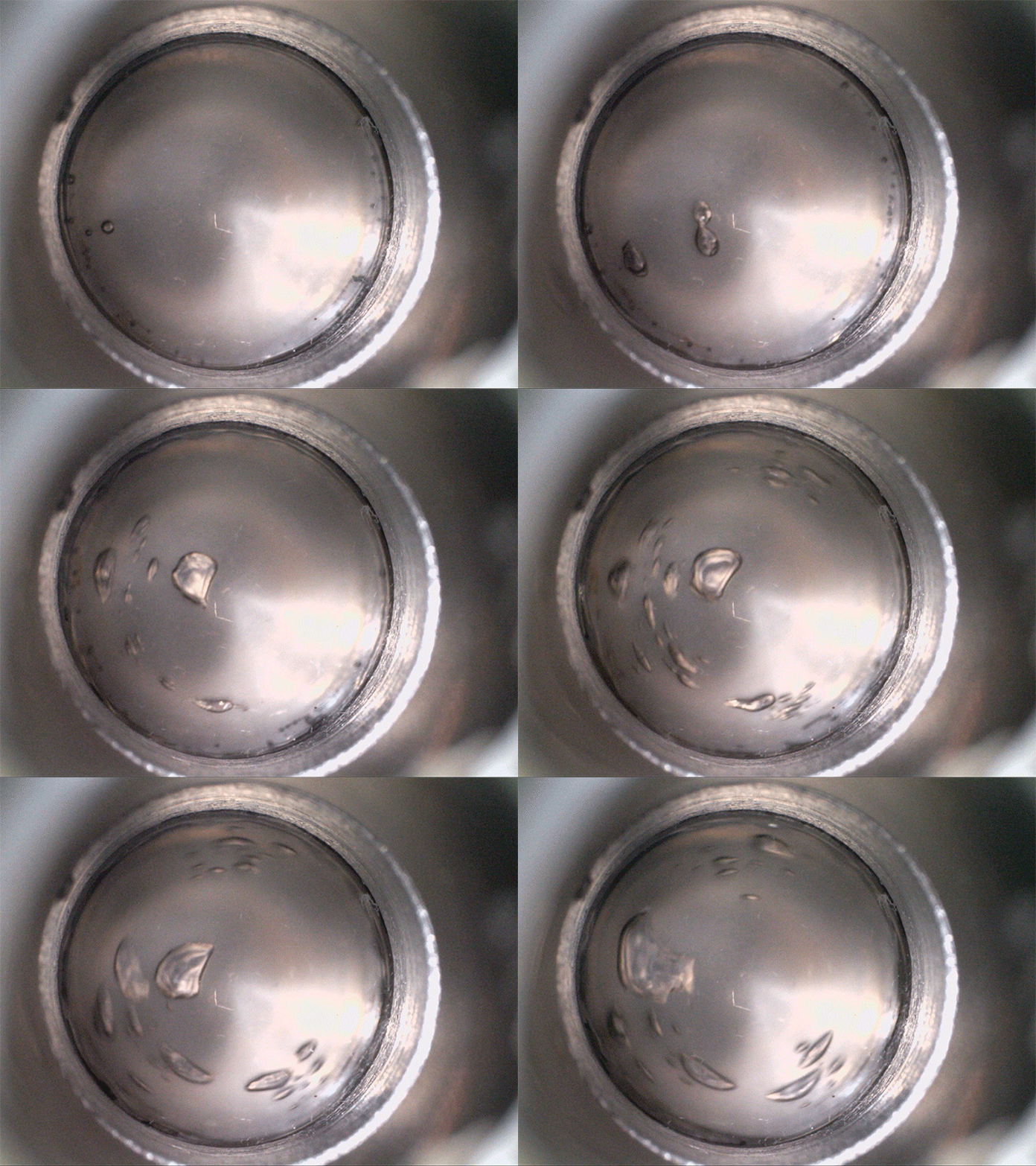
    Video of bubbles nucleating when a magma analog supersaturated with CO2 gets sheared.

    The team found that supersaturated fluids can nucleate bubbles when they’re sheared–even without decompression. They demonstrated this in the lab, not with magma but with a low-temperature magma analog, seen above. The more saturated with volatiles the fluid is, the less shear is needed to trigger bubbles.

    Viscous shear is everywhere for magma, so this bubble formation mechanism is likely common. Better understanding how and when bubbles form in magma directly affects predictions for eruptions–especially for determining whether they’re likely to be explosive or effusive. (Image credit: volcano – A. Bonnerdeaux, experiment – O. Roche et al.; research credit: O. Roche et al.; via Physics World)

    Fediverse Reactions
  • Featured Video Play Icon

    Inside a Bubble’s Burst

    When bubbles burst at an interface, both their exterior and interior get spread into the air. Here, researchers watch as a fog-filled bubble rises through silicone oil and settles as the surface. Instabilities ripple down the bubble’s cap as it thins, and, once the bubble bursts, the fog from within is pushed upward, curling into a vortex as it goes. (Video and image credit: R. Shabtay and I. Jacobi; via GFM)

  • “Moment of Creation”

    “Moment of Creation”

    Bubbles caught in ice resemble the growth of a cellular organism in this photograph of Tatiewa Lake in Japan, taken by Soichiro Moriyama. When water freezes, gases dissolved in it come out of solution, but depending on the speed and direction of freezing, these bubbles do not always escape before ice forms around them, freezing pockets of gas within the ice’s structure. (Image credit: S. Moriyama; via ILPOTY)

    Fediverse Reactions
  • Featured Video Play Icon

    Entraining Bubbles

    Every time I fill a glass at my refrigerator, I watch how the falling jet creates a cloud of bubbles. The bubbles form when the impacting water jet pulls air in with it, though, as this video shows, the exact origins can vary. Here, researchers take a closer, slowed-down look at the situation; they connect disturbances in the jet and waves at its base to the entrained bubbles that form. (Video and image credit: S. Relph and K. Kiger)

    Fediverse Reactions
  • Featured Video Play Icon

    Protecting Wildlife from Underwater Construction

    The loud noises of construction are not just an issue for humans. Sound and pressure waves from underwater construction are a problem for water-dwellers, too. So engineers use bubble curtains around a construction site to help reduce the amount of sound that escapes. Water and air transmit sound very differently; in acoustic terms, they have very different impedance. You’ve probably experienced this yourself if you’ve ever compared the sounds of a swimming pool above and below the surface. Because some of a sound’s intensity gets lost in the water –> air –> water transition, a bubble curtain can halve the sound pressure transmitted from equipment. (Video and image credit: Practical Engineering)