Videos

  • Featured Video Play Icon

    Pelican Diving

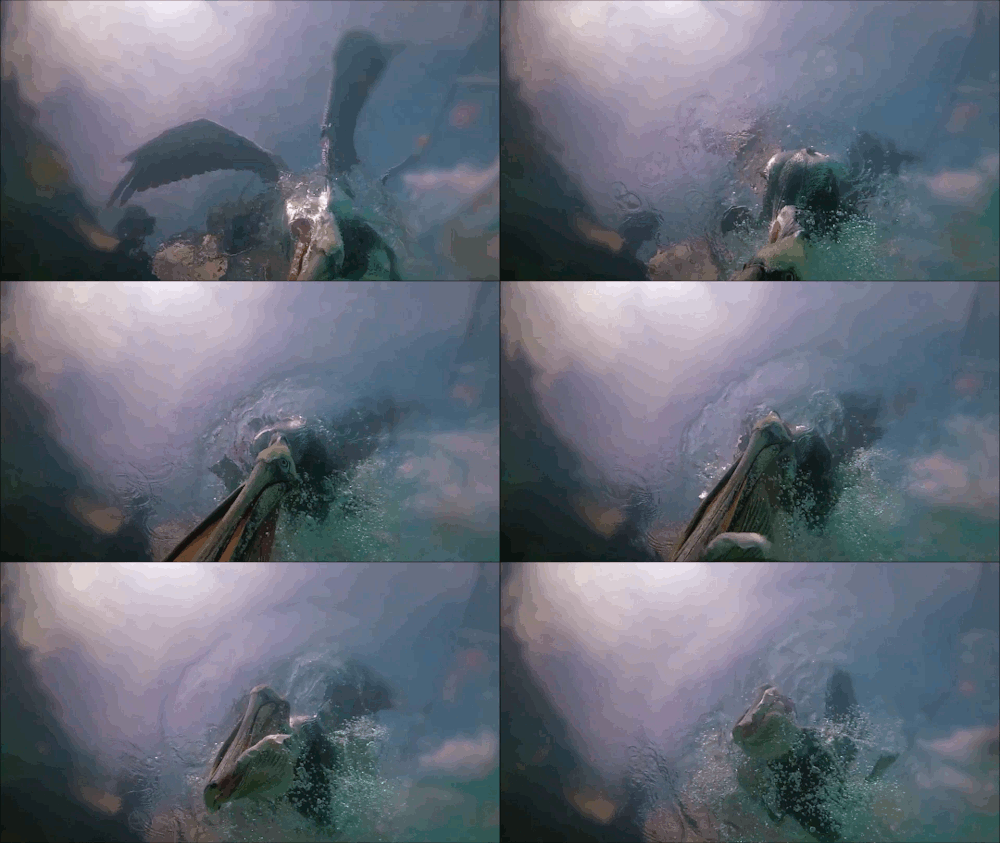
    Pelicans, like many sea birds, are aerial divers. They spot their prey from high above, bank, and dive into the water to catch the fish. Although they hit the water at high speeds, pelican diving techniques differ somewhat from plunge divers like gannets or boobies. Pelicans are only aiming for a shallow dive, so they have features – like their expandable neck pouch – that help them decelerate quickly instead of taking a full-body plunge. The goal is to increase drag after the head enters, slowing everything down. That can add more stress to the bird’s neck – the rest of the body is still moving quickly even after the head begins to slow. To counter this compression, the birds must have strong neck muscles to stabilize their spines during the impact process. (Video and image credit: Deep Look)
  • Featured Video Play Icon

    Dam Failure

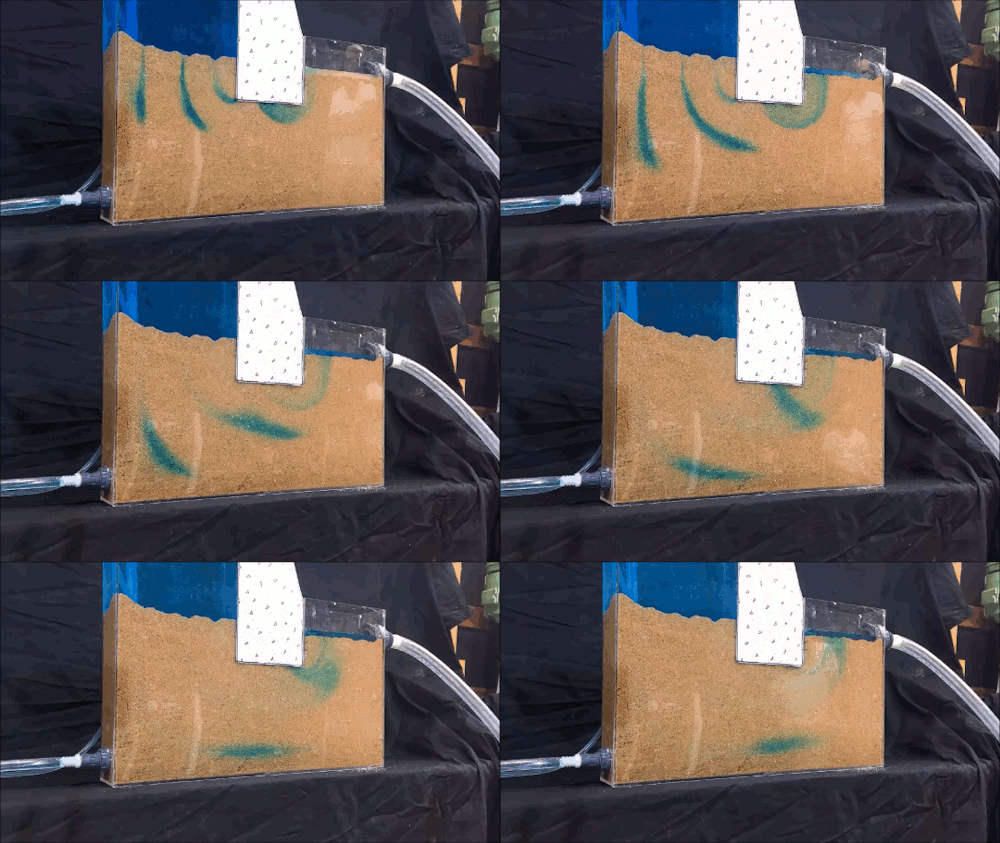
    In a recent video, Practical Engineering tackles an important and often-overlooked challenge in civil engineering: dam failure. At its simplest, a levee or dam is a wall built to hold back water, and the higher that water is, the greater the pressure at its base. That pressure can drive water to seep between the grains of soil beneath the dam. As you can see in the demo below, seeping water can take a curving path through the soil beneath a dam in order to get to the other side. When too much water makes it into the soil, it pushes grains apart and makes them slip easily; this is known as liquefaction. As the name suggests, the sediment begins behaving like a fluid, quickly leading to a complete failure of the dam as its foundation flows away. With older infrastructure and increased flooding from extreme weather events, this is a serious problem facing many communities. (Video and image credit: Practical Engineering)

  • Featured Video Play Icon

    Flames in Freefall

    Gravity is such an omnipresent force in our lives that we frequently forget how strongly it affects our daily experiences and how differently nature behaves without it. A wonderful example of this is the simple flame of a candle. On Earth, a candle flame is tear-drop-shaped and elongated, burning hotter near the bottom and glowing yellow from soot at the top. But, as Dianna demonstrates with her free-fall experiment, this shape is due entirely to the effects of gravity. Buoyant forces make the hot air near the candle rise, pulling in cooler air and fresh oxygen at the base while stretching out the flame. In microgravity – or free-fall – flames are instead spherical, their shape driven by molecular and chemical diffusion. Check out the full video to see more effects of acceleration on flames. (Video credit: Physics Girl)

  • Featured Video Play Icon

    Lift Over Wings

    One of the most vexing topics for fluid dynamicists and their audiences is the subject of how wings generate lift. As discussed in the video above, there are a number of common but flawed explanations for this. Perhaps the most common one argues that the shape of the wing requires air moving over the top to move farther in the same amount of time, therefore moving faster. The flaw here, as my advisor used to say, is that there is no Conservation of Who-You-Were-Sitting-Next-To-When-You-Started. Nothing requires that air moving over the top and bottom of a wing meet up again. In fact, the air moving over the top of the wing outpaces air moving underneath it.

    In the Sixty Symbols video, the conclusion presented is that any complete explanation requires use of three conservation principles: mass, momentum, and energy. In essence, though, this is like saying that airplanes fly because the Navier-Stokes equations say they do. It’s not a terribly satisfying answer to someone uninterested in the mathematics.

    Part of the reason that so many explanations exist – here’s one the video didn’t touch on using circulation – is that no one has presented a simple, intuitive, and complete explanation. This is not to say that we don’t understand lift on fixed wings – we do! It’s just tough to simplify without oversimplifying.

    Here’s the bottom line, though: the shape of the wing forces air moving around it to change direction and move downward. By Newton’s 3rd law (equal and opposite reactions), that means the air pushes the wing up, thereby creating lift. (Video credit: Sixty Symbols)

  • Featured Video Play Icon

    Life at the Interface

    Water striders are masters of life at the interface of water and air. Their spindly legs are skinnier than the capillary length of water, meaning that, at their size, surface tension is strong enough to overcome gravitational effects. Thus, their feet leave dimples on the interface, but the water itself holds them up. To keep from getting accidentally drenched (and thus weighed down), the striders are covered in tiny hairs that trap a layer of air that makes them hydrophobic or water-repellent. To get around, these masters of the interface use their middle legs in a manner similar to oars. They push against the dimple around their legs, which generates vortices under the surface and helps propel them. Even more impressive, the water strider can jump off the surface, a feat that requires remarkable adaptation in order to maximize the jump without breaking surface tension. (Video credit: Deep Look)

  • Featured Video Play Icon

    Inside Earth’s Core

    Without our magnetic field, life as we know it could not exist on Earth. Instead, our atmosphere would be stripped away and the surface would be bombarded by charged particles in the solar wind. Relatively little is known about the dynamo process that governs our magnetic field, though it’s thought to be the result of liquid iron moving in the Earth’s outer core. The video above shows a slice of a recent 3D simulation of this liquid iron segment of our core. The colors show variations in the temperature, revealing vigorous convection in the core. This motion, combined with the spinning of the Earth, is the likely source of our magnetic field. Researchers hope that simulations like these can help us understand features we observe in our magnetic field – like local variations in field strength and the pole reversals in our geological record. (Video credit: N. Schaeffer et al.; CNRS via Gizmodo)

  • Featured Video Play Icon

    Songs in Soap

    There are many beautiful ways to visualize sound and music – Chris Stanford’s fantastic “Cymatics” music video comes to mind – but this is one I haven’t seen. This visualization uses a soap film on the end of an open tube with music playing from the other end. You can see the set-up here. The result is a fascinating interplay of acoustics, fluid dynamics, and optics. As sound travels through the tube, certain frequencies resonant, vibrating the soap film with a standing wave pattern (3:20). At the same time, interference between light waves reflecting off the front and back of the soap film create vibrant colors that show the film’s thickness and flow.

    When the frequency and amplitude are just right, the sound excites counter-rotating vortex pairs in the film (0:05), mixing areas of different thicknesses. With just a single note, the vortex pairs appear and disappear, but with the music, their disappearance comes from the changing tones. Watching the patterns shift as the film drains and the black areas grow is pretty fascinating, but one of the coolest behaviors is how the acoustic interactions are actually able to replenish the draining film (2:15). Because the tube was dipped in soap solution, some fluid is still inside the tube, lining the walls. With the right acoustic forcing, that fresh fluid actually gets driven into the soap film, thickening it.

    There are several more videos with different songs here – “Carmen Bizet” is particularly neat – as well as a short article summarizing the relevant physics for those who are interested. (Video and research credit: C. Gaulon et al.; more videos here)

  • Featured Video Play Icon

    Flowing Ice

    Glaciers are kind of bizarre. Despite being very solid, they still flow, sometimes on the order of a meter a day. This flow is driven by gravity and the incredible weight of the dense ice. Near the base of the glacier, the pressure is great enough to cause some localized melting. (Very high pressures actually decrease the melting point of water.) Glaciers also move through plastic deformation – this is the internal slippage Joe refers to in the video when he compares glaciers to a deck of cards. Despite their vast differences from typical fluid flows, glacial flows are often still described by the same equations of motion used in the rest of fluid dynamics! (Video credit: It’s Okay to Be Smart; via PBS Digital Studios)

  • Featured Video Play Icon

    The Mantis Shrimp’s Left Hook

    The mantis shrimp is a tiny, clown-colored juggernaut of underwater physics. Some species have modified claws that serve as clubs for punching their prey, and the mantis shrimp swings that club fast – its acceleration is comparable to a bullet’s! Moving that quickly in water causes a drastic drop in local pressure, low enough to form a cavitation bubble. Such low-pressure bubbles themselves are not particularly dangerous, but their collapse is incredibly violent, especially near a solid surface, like the shell of the shrimp’s prey. Collapsing cavitation bubbles can send out shock waves, shatter glass, and even generate light. In the case of the mantis shrimp, it’s more than enough to stun, if not outright kill, its prey. (Video credit: Physics Girl)

  • Featured Video Play Icon

    “Pursuit”

    Photographer Mike Olbinski has released yet another breathtaking timelapse film of weather over the Great Plains. This one has a little bit of everything: storms, tornadoes, incredible cloud formations, and even sunny days. Olbinski’s work is a reminder that there’s a constant beautiful drama playing out over our heads if we just take the time to watch. Under blue skies, condensation and turbulence are building towering mountains, and even when the sky is gray, it can be churning like the ocean just over your head. The U.S. Great Plains may be home to particularly dramatic examples of this behavior (thanks largely to the atmospheric influence of the Rocky Mountains), but these same phenomena are going on all the time overhead. (Video and image credits: M. Olbinski)

    image