Tuna are remarkably agile for their size. Many species reach lengths exceeding the height of a human adult, yet they can still make tight turns, especially when hunting. A recent study described one mechanism that aids the fish – a built-in hydraulic system for raising its second dorsal and anal fins. The tuna use fluid from their lymphatic system – which produces and transports white blood cells in both humans and tuna – to pressurize chambers at the base of some fins, causing the fin to rise. The extra support puts the fin in a hydrodynamically advantageous position and helps stabilize the fish when turning quickly, allowing them to change direction without slowing. (Video credit: Science; research credit: V. Pavlov et al.)
Videos

Burning a Rocket Underwater
In a recent video, Warped Perception filmed a model rocket engine firing underwater. Firstly, it’s no surprise that the engine would still operate underwater (after its wax waterproofing). The solid propellant inside the engine is a mixture of fuel and oxidizer, so it has all the oxygen it needs. Fluid dynamically speaking, though, this high-speed footage is just gorgeous.
Ignition starts at about 3:22 with some cavitation as the exhaust gases start flowing. Notice how that initial bubble dimples the surface when it rises (3:48). At the same time, the expanding exhaust on the right side of the tank is forcing the water level higher on that side, triggering an overflow starting at about 3:55. At this point, the splashes start to obscure the engine somewhat, but that’s okay. Watch that sheet of liquid; it develops a thicker rim edge and starts forming ligaments around 4:10. Thanks to surface tension and the Plateau-Rayleigh instability, those ligaments start breaking into droplets (4:20). A couple seconds later, holes form in the liquid sheet, triggering a larger breakdown. By 4:45, you can see smoke-filled bubbles getting swept along by the splash, and larger holes are nucleating in that sheet.

The second set of fireworks comes around 5:42, when the parachute ejection charge triggers. That second explosive triggers a big cavitation bubble and shock wave that utterly destroys the tank. If you look closely, you can see the cavitation bubble collapse and rebound as the pressure tries to adjust, but by that point, the tank is already falling. Really spectacular stuff! (Video and image credit: Warped Perception)
How Smoke Rings Work
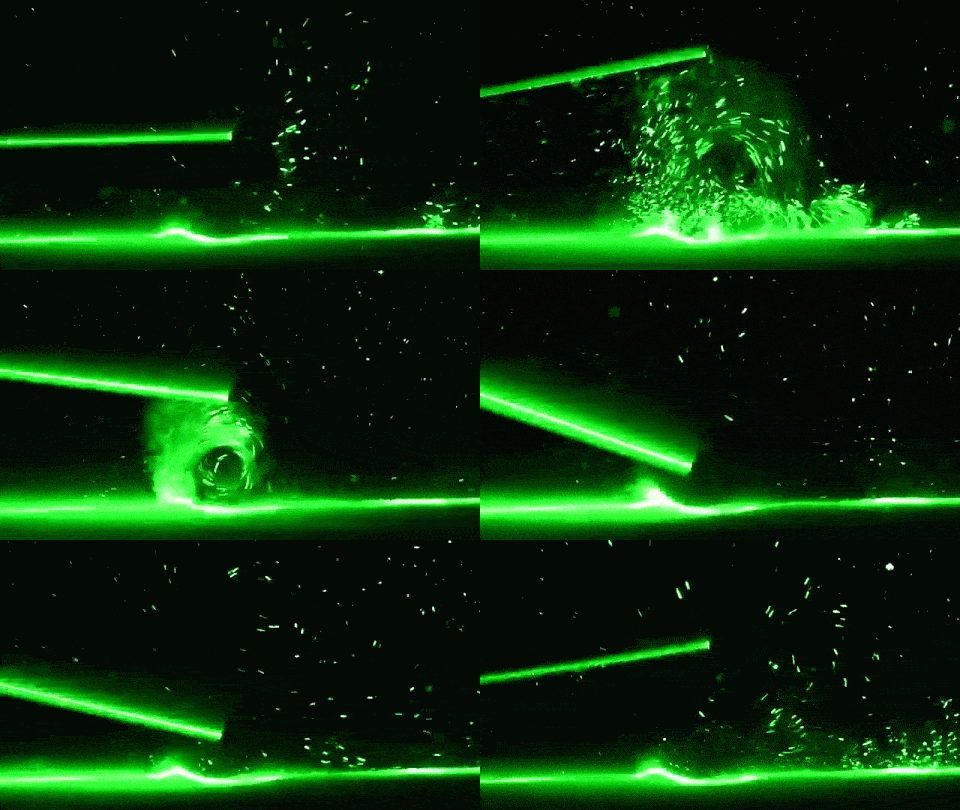
Vortices are a ubiquitous part of life, whether they’re draining down your bathtub or propelling underwater robots. In the latest video from the Lib Lab project, you can learn about how vortex rings form, what makes them last so long, and even make a vortex generator of your own. I can personally attest that vortex cannons are good for hours of entertainment, no matter your age. They’re even more fun with friends, as the Oregon State drumline demonstrates in the video. Want even more vortex fun? Check out leapfrogging vortices, vortex rings colliding head-on, and a giant 3 meter wide vortex cannon in action. (Video and image credit: Lib Lab)
When Walls Chirp
If you’ve ever clapped near a wall with a corrugated surface, you may have noticed some strange echoes. Surfaces like these can cause a chirping sound to observers. The reason, as Nick Moore explains in the video above, is that the original sound reflects off the corrugations at different times and travels back to the observer such that the first reflections to arrive are closely spaced (and thus higher pitched) while the later reflections are spread further out. This creates a chirp that starts at a high pitch and then falls to lower ones. Have you ever come across structures that do this? (Video credit: N. Moore)
“Fractal”
Timelapses are a wonderful way to capture the power and majesty of storms like the supercell thunderstorms featured in Chad Cowan’s “Fractal”. The video contains snapshots from six years’ worth of storms over the US’s Great Plains. The highlights include some spectacular mammatus clouds (0:30) and excellent billowing cloud formation (1:27) with turbulence every bit as towering as that of a volcanic plume. June is one of the best months for amazing storms in the Great Plains, largely thanks to the atmospheric mixing that occurs over the Rocky Mountains. If you have the opportunity to witness these amazing natural displays, enjoy it, but be safe! (Video credit: C. Cowan; image via Colossal)
“Galaxy Gates”


Viewing fluids through a macro lens makes for an incredible playground. In “Galaxy Gates”, Thomas Blanchard and the artists of Oilhack explore a colorful and dynamic landscape of paint, oil, and glitter. The nucleation of holes and the breakdown of sheets to filaments and droplets plays a major role in the visuals. The surface layer is constantly peeling away to reveal what’s going on underneath. In many cases this initial motion settles into a field of oil-rimmed droplets floating like planets against a colorful galactic backdrop. Watch carefully in the second half of the video, and you can even catch a few instances of a stretched ligament of fluid breaking into a string of satellite drops, like at 1:51. Check out some of Blanchard’s previous work here and here. (Video credit: Oilhack and T. Blanchard; GIFs and h/t to Colossal)
Shadows of Flow
In the latest Veritasium video, Derek demonstrates how to see gas motions that are normally invisible using a schlieren photography set-up. Schlieren techniques have been important in fluid dynamics for well over a century, and Derek’s set-up is one of the two most common ways to set up the technique. (The other method uses two collimating mirrors instead of a single spherical or parabolic one.) As explained in the video, the schlieren optical set-up is sensitive to small changes in the refractive index, making density changes or differences in a gas visible. This makes it possible to distinguish gases of different temperatures or compositions and even lets you see shock waves in supersonic flows. (Video and image credit: Veritasium; submitted by Paul)

The Japanese Pufferfish
[original media no longer available]
If you’ve ever dived or snorkeled over a sandy lake or ocean bottom, you’ve probably seen some neat patterns there. But it’s hard to compete with the Japanese pufferfish for pure artistry. This small fish creates enormous and elaborate designs in the sand in order to attract a mate. The male fish moves the sand into place by flapping his fins very close to the surface. Above a critical flapping velocity, his fins generate vortices capable of picking up sand, as seen below. With repeated passes, the fish is able to excavate the trough that is key to his creation. It’s a constant fight against the current, though.
Puffers aren’t the only ones who flap their fins to move the sands. Rays and flounders use this technique to bury themselves and hide (Video credit: BBC Earth; image credit: A. Sauret, source; research credit: A. Sauret et al.)
Asperitas Sunset


Asperitas clouds, previously known as undulatus asperatus, are the most recently recognized cloud type. These clouds make the sky look like the ocean rolling in waves. Photographer Mike Olbinski, on a recent storm chase earlier this month, caught these spectacular asperitas clouds near sunset. The clouds’ effect is unusual under normal circumstances and completely surreal with this lighting. Check out the video for the full effect. Olbinski caught the clouds on the outskirts of a dying storm cell. That’s a common place to see these formations; despite their ominous appearance, they do not develop storms and are more often seen as storms are ending. (Video and image credit: M. Olbinski; h/t to Paul vdB)
Perijove
The Juno spacecraft continues to send back incredible photos of Jupiter’s atmosphere. This video animates images from the sixth close pass of Jupiter to give you a sense of what Juno sees as it swoops by our system’s largest planet. The trajectory passes from the north pole to the south, showing Jupiter’s whitish zones, dark belts, and massive storms. Up close Jupiter looks like an Impressionist painting, all vortices and shear instabilities. The large white spots you see are enormous counterclockwise rotating vortices known as anticyclones – many of them larger than our entire planet. (Video credit: NASA / SwRI / MSSS / G. Eichstädt / S. Doran)