Videos

  • Featured Video Play Icon

    A Hot Tub, Turned Fluidized Bed

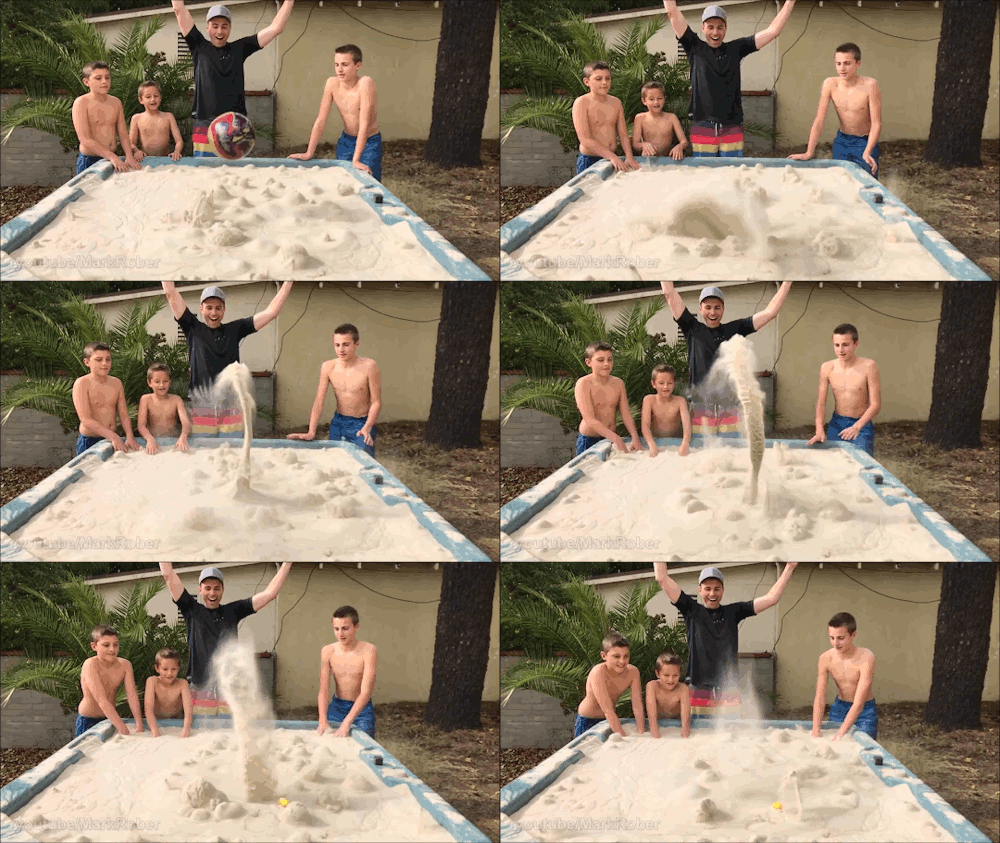
    Fluidized beds continue to be all the rage among science YouTubers, but Mark Rober supersizes his by turning a broken hot tub into a massive bath of bubbling sand. His video includes a nice explanation of how a granular material like sand gets fluidized as well as how to make your own miniature bed. One of my favorite moments is shown in the animation below. When Mark drops a bowling ball into the fluidized bed, it creates a remarkably liquid-like splash. The ball sprays a splash curtain of sand up on impact and sinks into its own cavity. When the cavity seals behind the ball, it shoots up a tall jet of sand, just like a Worthington jet in water. Even with air fluidizing it, the sand doesn’t have surface tension, though, so the jet breaks up quite differently than water! (Video and image credit: M. Rober; submitted by clogwog)
  • Featured Video Play Icon

    Water Music of Vanuatu

    In the Pacific Island nation of Vanuatu, women have a tradition of water music, accompanying their singing with a percussive use of water. This video explores the physics behind this music. Performers use three basic motions – a slap, a plunge, and a plow – that each have distinctive acoustics thanks to the interaction of hand, water, and air. High pitches come from the initial impact on the water, whereas lower pitches come mostly from the collapse of the air cavity in the hand’s wake. By altering the rhythms and patterns of these three building blocks, the musicians create a rich harmony to accompany their singing. (Video credit: R. Hurd et al.)

  • Featured Video Play Icon

    Solving Mazes

    Earlier this fall, I attempted my first corn maze. It didn’t work out very well. Early on I unknowingly cut through an area meant to be impassable and thus ended up missing the majority of the maze. Soap, as it turns out, is a much better maze-solver, taking nary a false turn as it heads inexorably to the exit. The secret to soap’s maze-solving prowess is the Marangoni effect.

    Soap has a lower surface tension than the milk that makes up the maze, which causes an imbalance in the forces at the surface of the liquid. That imbalance causes a flow in the direction of higher surface tension; in other words, it tends to pull the soap molecules in the direction of the highest milk concentration. But that explains why the soap moves, not how it knows the right path to take. It turns out that there’s another factor at work. Balancing gravitational forces and surface tension forces shows that the soap tends to spread toward the path with the largest surface area ahead. That’s the maze exit, so Marangoni forces pull the soap right to the way out! (Video credit: F. Temprano-Coleto et al.; research credit: F. Peaudecerf et al.)

    ETA: Based on the latest research results, gravity may play less of a role than originally thought. Instead, it seems as though the soap chooses its path in part through pre-existing background levels of surfactant. As the dye advances, it compresses the background surfactant, decreasing the local surface tension until it is in equilibrium with dyed area. Because longer paths take longer to reach that equilibrium, the dye spreads preferentially toward the largest surface area.

  • Featured Video Play Icon

    Building with Sand

    Sand and water make a remarkable team when it comes to building. But the substrate – the surface you build on – makes a big difference as well. Take a syringe of wet sand and drip it onto a waterproof surface (bottom right), and you’ll get a wet heap that flows like a viscous liquid. Drop the same wet sand onto a surface covered in dry sand (bottom left), and the drops pile up into a tower. Watch the sand drop tower closely, and you’ll see how new drops first glisten with moisture and then lose their shine. The excess water in each drop is being drawn downward and into the surrounding sand through capillary action. This lets the sand grains settle against one another instead of sliding past, giving the sand pile the strength to hold its weight upright. (Video and image credit: amàco et al.)

  • Featured Video Play Icon

    Plate Tectonics

    We don’t typically think of the ground beneath our feet as anything but solid, but over geologically long time scales, even mountains can flow. Buoyant convection inside the Earth’s mantle is thought to drive the plate tectonics that have shaped the Earth as we know it. The video above explains some of the major processes and events that shaped the modern North American continent, including collisions, subduction, volcanism, and erosion. (Video credit: Ted-Ed)

  • Featured Video Play Icon

    “Monsoon IV”

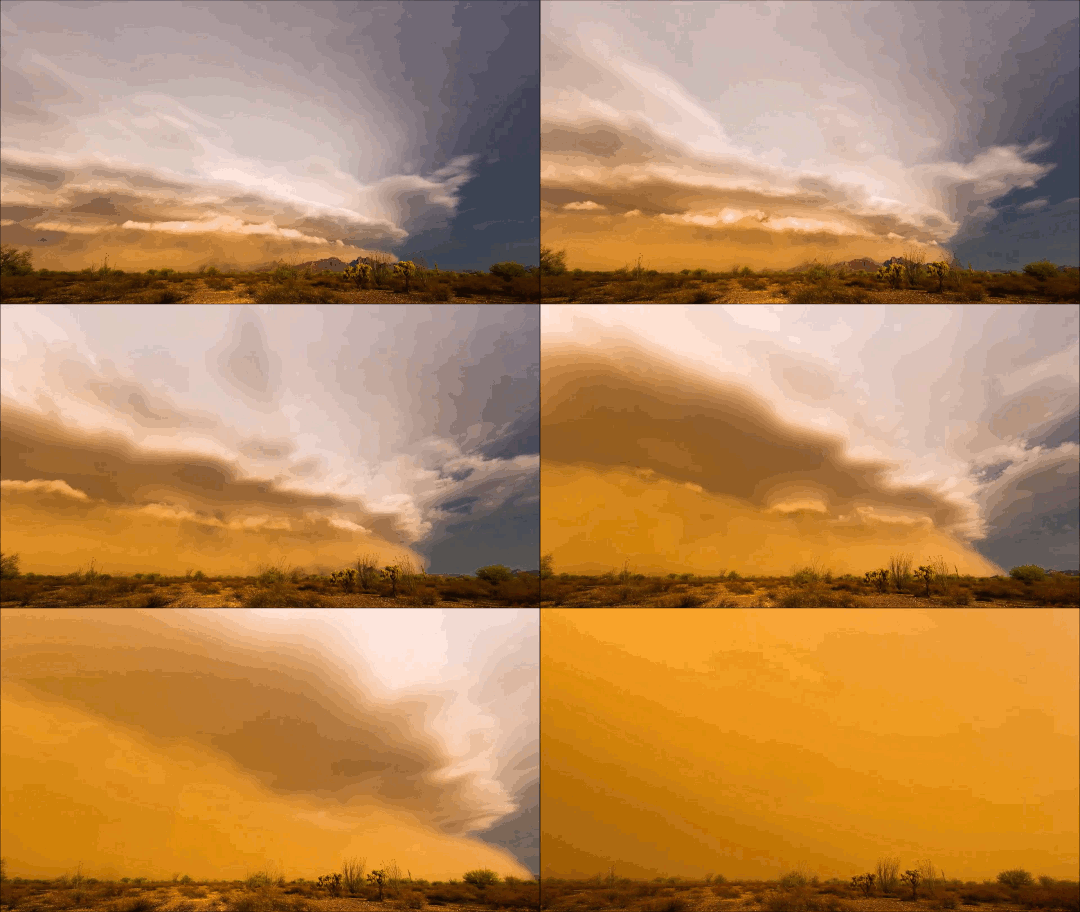
    It’s a cliché to claim that the sky is bigger in the American West, but the wide, open views in that region do offer a very different perspective on weather. Photographer Mike Olbinski’s works give viewers a taste of that perspective of far-off thunderstorms, towering anvil clouds, and massive downpours in the distance. At the same time, many of his sequences illustrate the birth and death of these massive storms. As warm, moist air rises, a puffy cumulus cloud (below) swells upward as fresh moisture condenses. When it reaches a thermal cap and can rise no further, precipitation begins to fall, dragging surrounding air with it. This is the mature stage of a storm, when both updrafts and downdrafts exist simultaneously.

    Eventually, the storm’s power begins to wane as the downdrafts cut off the updrafts that feed the storm. Sometimes this occurs in a massive downdraft where cool air sinks straight down and, upon encountering the ground, spreads radially outward. In dry regions, this outward burst of ground-level winds can pick up dirt, dust, and sand, forming a wall-like haboob (below) that advances past the remains of the storm. Watch the entire video to see some examples in their full glory! (Video and image credit: M. Olbinski, source; via Rex W.)

    image
  • Featured Video Play Icon

    Pigeon Flutter

    Birds are well-known for their vocalizations, but this isn’t their only way to produce noise. A new study on crested pigeons finds that the birds’ wings produce distinctive high and low notes during take-off. A low note takes place during each upstroke, and a high note is heard during the downstroke. A major source of the noise is the highly modified P8 feather. When airflow over the feather is fast enough, it sets off twisting and torsion in the feather through aeroelastic flutter. It’s this vibration that causes the noise. By playing back the notes at different speeds, researchers found that the crested pigeons use the notes’ timing as an alarm. When the cycle of high and low repeats in quick succession, they respond by taking off to escape the perceived danger.

    Other bird species are also known to use aeroelastic flutter to make noise. Check out these hummingbirds, which use flutter in their mating displays.   (Video credit: Science; research credit: T. Murray et al.)

  • Featured Video Play Icon

    Build Your Own Fluidized Bed

    Previously, we featured some GIFs of bubbling, fluidized sand (below). Inspired by the same video, Dianna from Physics Girl decided to build her own set-up, discovering along the way that it’s a little tougher than you might think. To work well, you’ll need very fine, dry particles and a good way to uniformly distribute the air so it doesn’t simply bubble up in one spot. And if you accidentally apply too much air pressure, you may get a face full of sand. The final results are very fun, though, and hopefully Dianna’s lessons learned will help any other DIYers interested in trying this experiment at home. For a little more on the physics here and in related topics, check out some of our previous posts on fluidization, soil liquefaction, quicksand, and dam failures. (Video credit: Physics Girl; image credit: R. Cheng, source)

  • Featured Video Play Icon

    “Macrocosm”

    In “Macrocosm” artist Susi Sie explores a liquid world of black and white. The two colors diffuse and mix to a soundtrack of “space sounds” recorded by NASA. (Most of these are probably ionic sound rather than sound as we’re used to, but even that is somewhat fluid dynamical.) The result is beautiful, surreal, and more than a little creepy. Happy Halloween! (Video and image credit: S. Sie)

    image
  • Featured Video Play Icon

    The Cheerios Effect

    You’ve probably noticed that cereal clumps together in your breakfast bowl, but you may not have given much thought as to why. This tendency for objects at an interface to attract is known as the Cheerios effect, although it happens in more than just cereal, as Joe Hanson from It’s Okay to Be Smart explains. The effect is a combination of buoyancy, gravity, and surface tension acting in concert.

    When air, a liquid, and a solid meet, they form a meniscus, the curvature of which depends on characteristics of their interaction. Light, buoyant cereal and the walls of your bowl both have upward-curving menisci. Denser objects, like the tacks shown below, stay at the surface only because surface tension holds them up. Their meniscus curves downward.

    Objects with a similar meniscus curvature will attract. For cereal approaching a wall, the light Cheerio is buoyant enough that there’s an upward force on it, but it’s constrained to stay at the interface. It cannot rise, but that buoyancy is enough to let it climb the meniscus at the wall. The two tacks attract one another for similar reasons, except this time their weight helps them fall into one another. Check out the full video to see more examples of this effect in nature! (Video and image credit: It’s Okay to Be Smart; research credit: D. Vella and L. Mahadevan, pdf)

    image