These days artificial snow-making is a standard practice for ski resorts, allowing them to jump-start the early part of the season. Snow guns continuously spray a mixture of cold water and particulates 5 or more meters in the air to generate artificial snow. The tiny droplet size helps the water freeze faster and the particles provide nucleation sites for snow crystals to form. As with natural snow, the shape and consistency of the snow depends on humidity and temperature conditions. Pyeongchang is generally cold and dry, so even the artificial snow there tends to be similar to snow in the Colorado Rockies. Recreational skiers tend to look down on artificial snow, but Olympic course designers actually prefer it. With artificial snow, they can control every aspect of an alpine course. For them, natural snowfall is a disruption that puts their design at risk. (Video credit: Reactions/American Chemical Society)
Videos

The Drinking Bird
At first glance, the drinking bird is a simple desk toy, but the physics and engineering behind the device is clever enough to have challenged many great minds. In this video, Bill Hammack dissects the drinking bird, revealing the heat engine beneath the felt and feathers. The bird’s drinking is driven by thermodynamics and the relative pressures of fluids in its head and body. When the beak is wetted, fluid wicks up the felted head and slowly evaporates, thereby cooling the vapor inside the head. Some of that vapor condenses, lowering the vapor pressure in the head and allowing liquid to rise from the body. When enough fluid reaches the head, the bird tips forward. This allows vapor to rise up the liquid column into the head, equalizing the pressure between the two ends. The bird sits up with a freshly wetted head and starts the cycle over. Check out the full video for more detail, including a look at what other methods can drive the bird, including bourbon and light bulbs. (Video and image credit: B. Hammack; via J. Ouellette)

Jumping Larvae
Gall midge larvae, despite their lack of legs, are prodigious jumpers. These worm-like creatures use hydrostatic pressure to jump more than 30 body lengths. To do so, the larva curls itself into a loop, latching its mouth to its tail. It then shifts the fluids inside its body, flattening itself as the pressure builds. When the larva releases its tail, it flies into the air at about 1 m/s. The human equivalent of a gall midge larva’s jump would be about 60 meters, far beyond the world record long jump of less than 9 meters (with a running start). The larva’s technique is a relatively simple but highly effective one that might be useful in applications like soft robotics. (Video credit: Science; research credit: G. Farley et al.)
Water Walking, Exploding Droplets, and Colliding Vortices


Every year I look forward to the APS DFD conference in November. It brings thousands of researchers together to share the latest in fluid dynamics. So much goes on in those three days that it’s impossible to capture, but last year I teamed up with Tom Crawford and the Journal of Fluid Mechanics to attempt just that. We interviewed 50 researchers on their projects, and we’ll be bringing you their work, in their words, each month leading up to the 2018 APS DFD meeting.
This first video focuses on some of the awesome entries to the 2017 Gallery of Fluid Motion. Watch to learn about oil droplets that go flying everywhere when you’re cooking, balls that walk on water, the water music of Vanuatu and more! To see the videos we discuss and all the other entries, go to gfm.aps.org. (Video credit: N. Sharp and T. Crawford)
The Foggy Grand Canyon
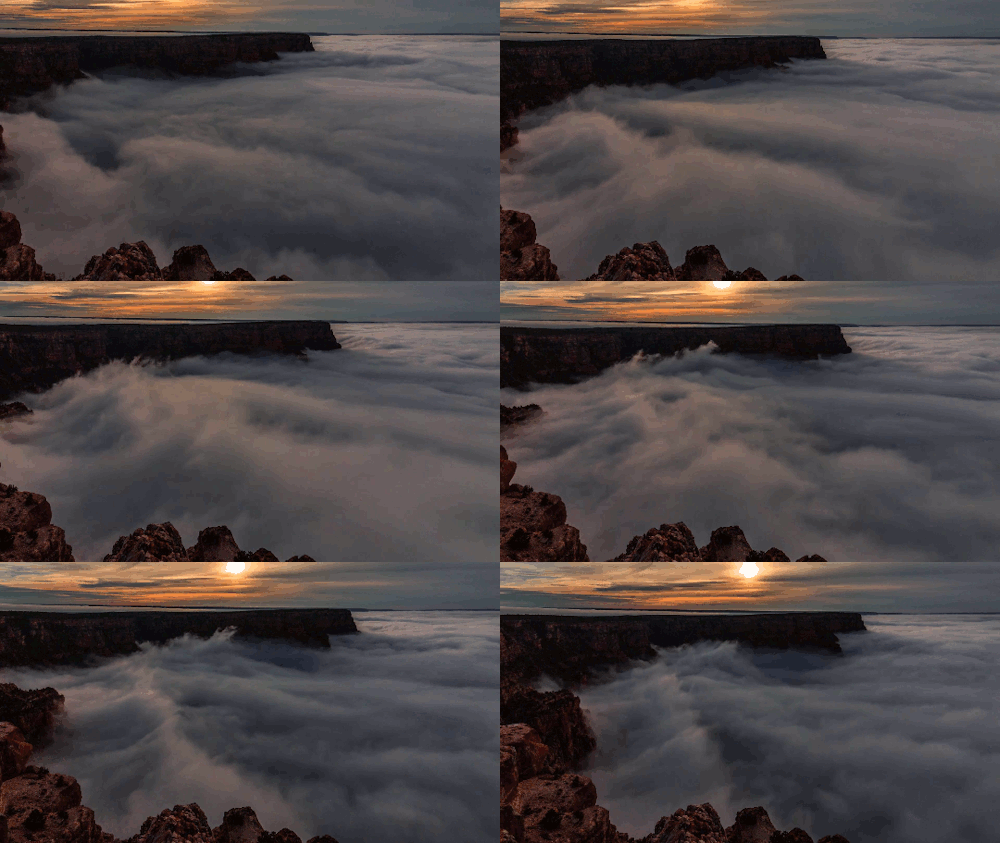
On occasion in the late fall and early winter, the Grand Canyon can fill with clouds of fog. This occurs when a layer of warm air traps cold, moist air inside the canyon, creating what’s known as a temperature inversion. The trapped air’s moisture condenses into fog, creating the appearance of a cloud sea lapping at the canyon walls. Such inversions often proceed a big snowstorm, as shown in this video. (Video and image credit: H. Mehmedinovic / SKYGLOWPROJECT; via Gizmodo)
Jumping Droplets
Condensation, which removes heat by changing a vapor into a liquid, is a common feature in industrial heat transfer. When droplets form on surfaces, they typically have to grow to millimeter size before gravity causes them to slide off and open up the surface to new droplet formation. Hydrophobic surfaces can shed droplets a little sooner. Droplets only 100 micrometers in size will spontaneously jump off hydrophobic surfaces due to the release of excess surface energy during droplet coalescence, but this only happens when those droplets have a small contact area with the surface. Defects in the nanoscale structure of the surface can allow water to squeeze in between posts and hold on.
To counter this, new experiments packed copper nanowires into a dense 3D array. This permits fewer defects and helps condensing droplets leap from the surface sooner. Each droplet carries away a bit of the surface’s heat. The new method is impressively efficient at it. Researchers found the new heat exchanger could remove 100% more heat than previous hydrophobic designs. (Video credit: Science; research credit: R. Wen et al.)
Hair-Washing in Microgravity
I imagine that the most common questions astronauts get come in the form, “How do you do X in space?” In this video, astronaut Karen Nyberg demonstrates how she washes her hair in space. Using no-rinse shampoo, the process is not terribly different from on Earth: wet the hair, work in the shampoo, add a little more water, and use a towel and comb to work it through all the hair. The big difference is that Nyberg’s hair sticks almost straight up the whole time. That’s an effect of microgravity, obviously, but there are fluid forces at play, too, namely elastocapillarity.
Hair typically feels quite different when it’s wet. Strands bunch together and feel stiffer. This is because of the water trapped in the narrow space between individual hairs. The water’s fluid characteristics (capillarity) affect the solid hairs and change their elastic properties – hence elastocapillarity. We see this on Earth, of course, but the effect is especially noticeable without gravity pulling the wet hair down. (Video credit: K. Nyberg/NASA; via APOD; submitted by Guillaume D.)
DIY Acoustic Levitation
Acoustic levitation is a technique where multiple speakers are positioned to create standing waves that can levitate small objects using sound. It’s even possible to manipulate the levitating objects in three-dimensions with the right set-up, but until now, the technology has been confined to the laboratory. Now a group from the University of Bristol has created kits and instructions allowing the curious to build their own acoustic levitators at home. In the video, Dianna shares some of her own adventures in building and playing with these DIY levitators and travels to the U.K. to see more from the creators.
I know what I’m adding to my list of electronics projects to try out! (Video credit: Physics Girl)
Swimming Microdroplets
Simple systems can sometimes have surprisingly complex behaviors. In this video, the Lutetium Project outlines a scheme for swimming microdroplets. Most of the droplets shown are just water, but they’re released into a chamber filled with a mixture of oil and surfactants. All flow through the chamber is shut off, but the droplets swim around in complicated, disordered patterns anyway. To see why, we have to zoom way in. The surfactant molecules in the oil cluster around the droplets, orienting so that their hydrophobic parts are in the oil and their hydrophilic parts point toward the water. They actually draw some of the water out of the droplets. This creates a variation in surface tension that causes Marangoni flow, making the droplets swim. Over time, the droplets shrink and slow down as the surfactants pull away more and more of their water and the variations in surface tension get smaller. (Image and video credit: The Lutetium Project; research credit: Z. Izri et al.)
Singularities
Black holes, like the collapse of a cavity in a fluid, are a singularity – a point where the mathematical rules we use to describe physical systems break down. No one knows what exists in a black hole, but the short film “Intra” explores one theory – that the exit to a black hole is a white hole, a singularity from which time and space themselves are born. The journey from one to the other is illustrated in the film with CGI visualizations of a black hole (a la Interstellar) and with fluid dynamical sequences depicting diffusion and chemical reactions driving flows. Although no true white holes have ever been observed, there are fluid dynamical analogs for them, namely circular hydraulic jumps, like the one you can make in your kitchen sink! (Video credit: T. Vanz et al.)