In her ongoing quest to explore natural resonance, Dianna has enlisted some very nice, very expensive speakers to find out just what happens when the bass drops. If you ever wondered what the natural frequency of your eyeballs is, then this one’s for you.
Human infrastructure like dams have the challenge of standing up to whatever nature can throw at them. It’s expensive, if not outright impossible, to build to every single contingency, so engineers have developed methods of dealing with problems like excess flow caused by a storm. For dams, one of the ways of dealing with this are spillways, which allow a method of controlled release from a reservoir.
Spillways come in many shapes and sizes, as seen in the video, but there are two general types: those that are actively managed and those that are automatic. An automatic spillway is like the “morning glory” type seen in the middle animation. There’s no on or off for a spillway like this. Instead, once the water level is high enough, water naturally flows out. In that sense, it’s like the overflow holes found in many bathroom sinks.
Controlled spillways are usually managed with gates that can be opened or closed as operators need them. This technique gives more granular control and can even end up being cheaper in some situations because it requires less space to implement. (Video and image credit: Practical Engineering)
A jet of falling liquid doesn’t remain a uniform cylinder; instead, it breaks into droplets. In this video, Bill Hammack explores why this is and what engineers have learned to do to control the size of the droplets formed.
The technical name for this phenomenon is the Plateau-Rayleigh instability. It begins (like many instabilities) with a tiny perturbation, a wobble in the falling jet. This begins a game of tug of war. One of the competitors, surface tension, is trying to minimize the surface area of the liquid, which means breaking it into spherical droplets. But doing so requires forcing some of the the liquid to flow upward, against both gravity and the liquid’s inertia. The battle takes some time, but eventually surface tension wins and the jet breaks up.
That’s not necessary a bad thing. It’s actually key to many engineering processes, like ink-jet printing and rocket combustion, as Bill explains in the full video. (Video and image credit: B. Hammack; submitted by @eclecticca)
Geometrically, biological tissues and two-dimensional layers of foam share a lot of similarities. To try and understand how active changes in one cell affect neighbors, researchers are studying how foams shift when air is injected (below) at one or more sites. When a foam cell expands, it forces topological changes in neighboring cells, which researchers built an algorithm to track in real-time.
With some processing, they can actually visualize the radially-expanding waves of strain that pass through the foam (bottom image). This allows them to visualize the effects and interaction of multiple injection sites at once, hopefully helping unlock the mechanics behind both the foam’s shifts and those that occur in tissues. (Image and video credit: L. Kroo and M. Prakash)
Hey FYFD, could you do some analysis/explanations behind the physics of this vortex stuff? I love when you do spots on Slow Mo Guys vids and figured I’d share a recent one w you
I enjoy doing that, too! So let’s talk a little about vortices. What Dan’s tea stirrer is doing is creating a low-pressure core for a vortex. We can see just how strong that low pressure region is by the way it sucks the air-water interface down toward the spinning arms. Eventually the interface and stirrer meet, and what was once a single, smooth(ish) surface gets torn into a myriad of bubbles. (As an aside, those bubbles get loud.)
I also like the sequence of sugar cube drops because they make for some very cool splashes. Notice how the orientation of the cube’s edges as it hits determines the shape of the inital splash curtain. The asymmetry borne out of that impact actually follows through all the way through the seal of the cavity behind the cube. It reminds me of this oldie-but-goodie video on drops hitting different shapes. (Video and image credit: The Slow Mo Guys; submitted by embersofkymillo)
You probably don’t give much thought to the forces involved in drinking here on Earth. That’s because gravity’s effects dominate over everything else. Our cups are designed to hold a liquid until we use gravity to pour it into our mouths. But that technique doesn’t work in microgravity. There other forces govern how liquids flow: specifically surface tension and capillary action.
Both of these forces are the result of intermolecular attractions. In the case of surface tension, it’s the attraction that the molecules of a liquid feel for one another that keeps them in a cohesive bunch. Capillary action is similar, but it’s an attraction between the liquid molecules and those of the solid they’re wetting. When you combine them both, you get the ability for liquids to climb up a narrow gap and pull more liquid up behind them. That’s the key science behind every version of the “space cup” developed by astronaut Don Pettit and his collaborators.
To hear more about the development and engineering of the cup (and exactly why it makes drinking coffee so much more enjoyable in space than it would be otherwise) check out the full video. And, in case you’re wondering, there’s a special microgravity champagne flute, too! (Image and video credit: It’s Okay to Be Smart)
Resonance is a funny creature, as Dianna discovered when she tried to sing a rising scale through a tube. At certain notes, everyone who attempted to do it had their voices crack. Tracking down the source of the mystery means digging into what exactly resonance is and what the differences are between driving a system just before, at, and after resonance. Check out the video for the full acoustic story. (Video credit: Physics Girl)
Beautiful as a splash is, why only enjoy it from a single angle? In this video, the artists behind Macro Room offer a 360-degree perspective on various splashes and fluid collisions. I especially enjoy watching the splash crowns falling back over and out of the various containers they use. What’s your favorite part? (Image and video credit: Macro Room)
Known as ebru in Turkey and suminagashi in Japan, the art of paper marbling has flourished in cultures around the world since medieval times. The details of methods vary, but in general, the technique uses a base of oily water to float various dyes and pigments. Artists then use brushes, wires, and other tools to manipulate the dyes into the desired pattern. Paper is spread over the top to soak up the color pattern before being hung to dry. Every print made in this manner is a unique result of buoyancy, surface tension variation, and viscous manipulation. Check out the video above to watch a timelapse video showing the technique in action. (Video and image credit: Royal Hali)
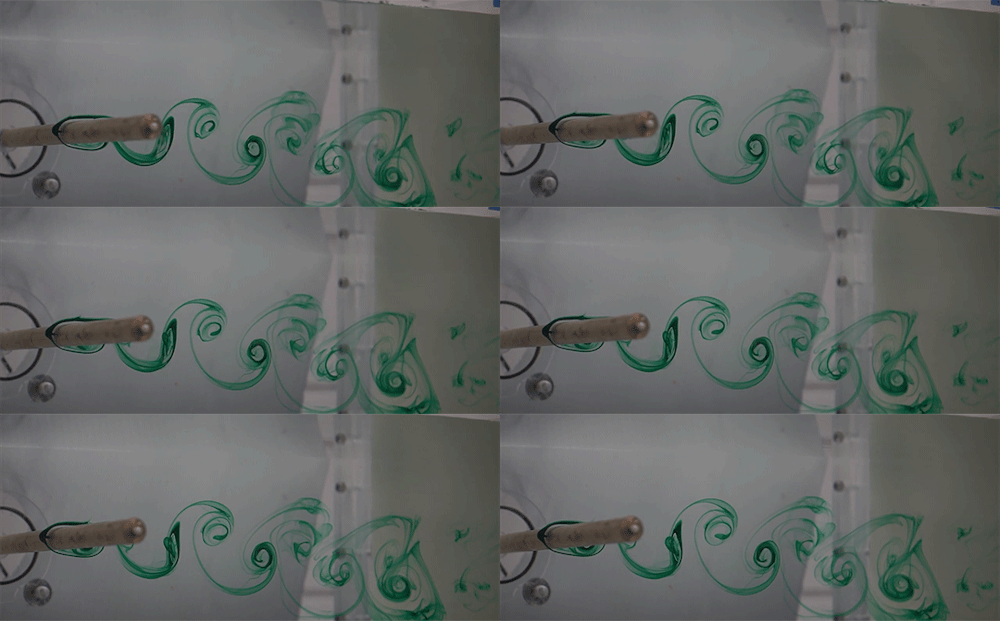
For many engineering students, their first experience with flow visualization comes in undergraduate labs, where dye introduced into a flume demonstrates basic flow features around airfoils, cylinders, and spheres. This short video by undergraduate Nick Di Guigno and partners quietly illustrates that experience, from the introduction to the equipment to loading the dye and watching the flow develop under the commentary of one’s professor. For those of you who have done this, I suspect it may ignite a bit of nostalgia. For those who haven’t, I think it captures some of the magical feeling of stepping into the lab the first time, even when you’re just recreating a phenomenon others have seen a thousand times before. (Image and video credit: N. Di Guigno et al.)