Tag: viscoelasticity

  • Featured Video Play Icon

    A Fractal Raft From a Spinning Top

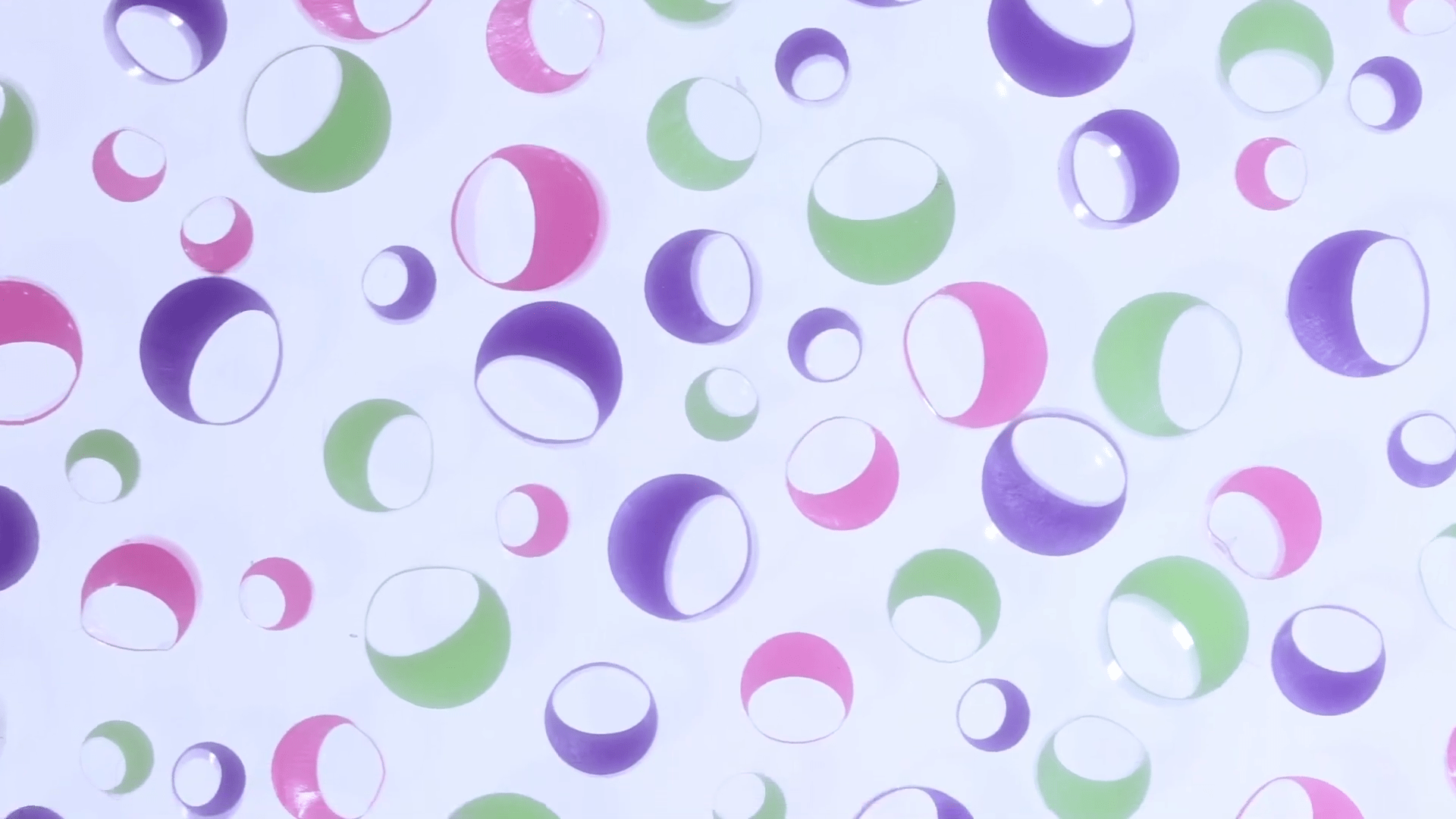
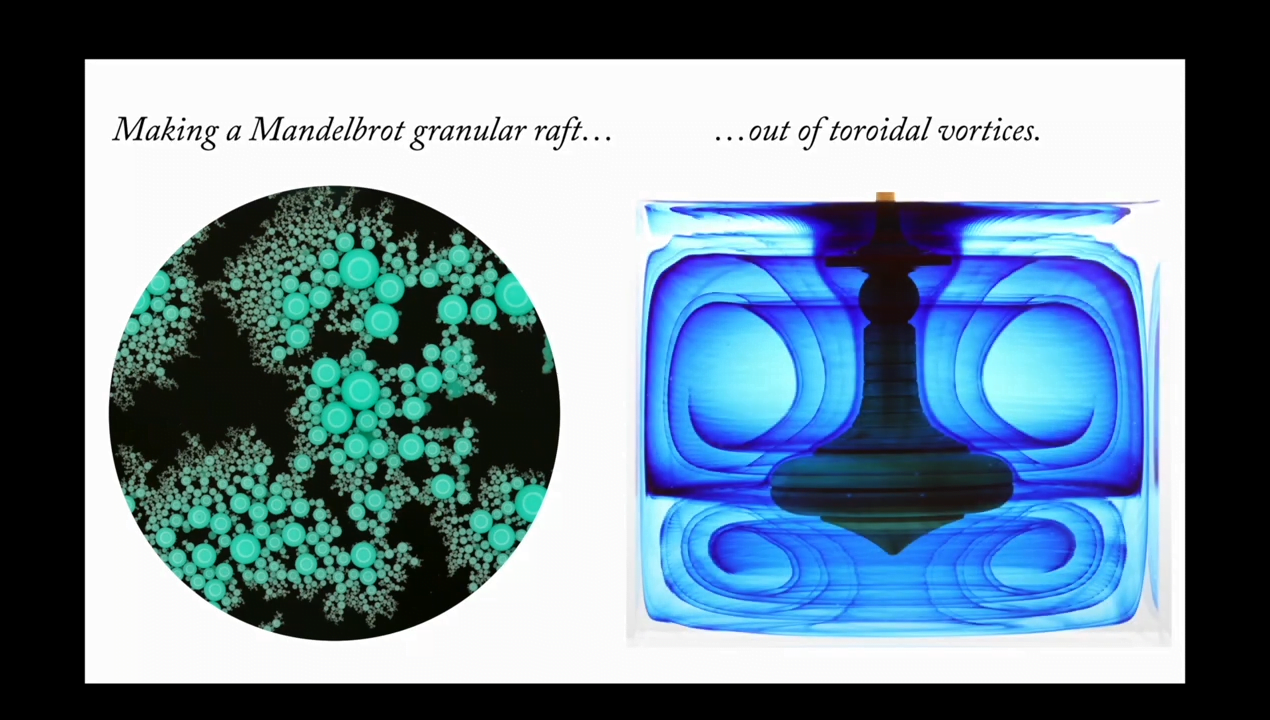
    File this one under Cool Things I Would Have Never Thought Of. In this video, researchers play around with the flow around a spinning top and end up creating a fractal, granular raft. By immersing a top in dyed fluid, they show the toroidal vortices that form around the spinning toy. Then, instead of dye, they add a stretchy elastomer compound that cures over time. The elastomer stretches into thin ligaments in the swirling flow around the top. Eventually, it breaks apart into spherical drops of all different sizes.

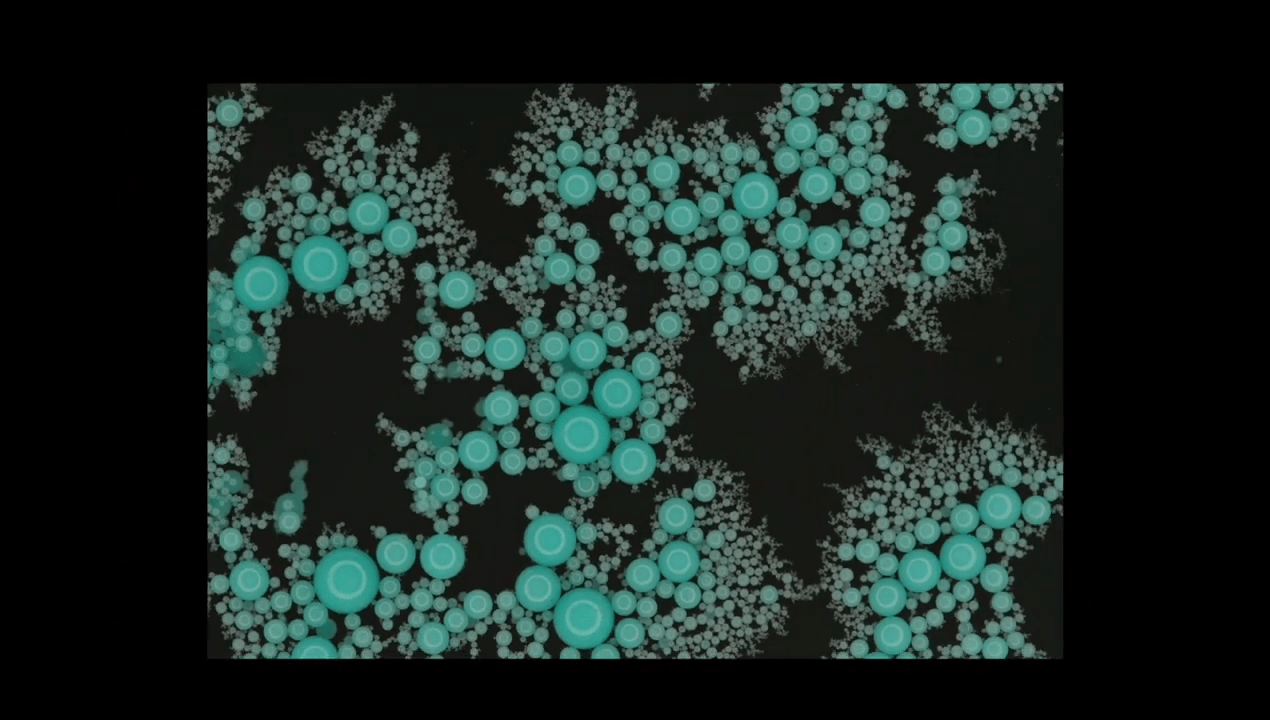
    Once the top is removed, the elastomer drops slowly float to the surface. Surface tension and the Cheerios effect draw the drops together, and because of their many sizes, the rafts that form are fractal. (Image and video credit: B. Keshavarz and M. Geri)

  • Liquid-in-Liquid Printing

    Liquid-in-Liquid Printing

    With 3D printing and other recent technologies, manufacturing options are always in flux. Here, researchers explore a method for printing a liquid inside of a liquid. Their materials are specially chosen such that the injected liquid forms an emulsion at its interface with the surrounding fluid. Once injection ends, the interface forms a wrinkly, viscoelastic skin that acts like a tube. As shown below, the tube is robust enough that it can be pumped full of yellow-dyed water without any loss of structure. (Image and research credit: P. Bazazi et al.)

  • Featured Video Play Icon

    Squishy Actuators

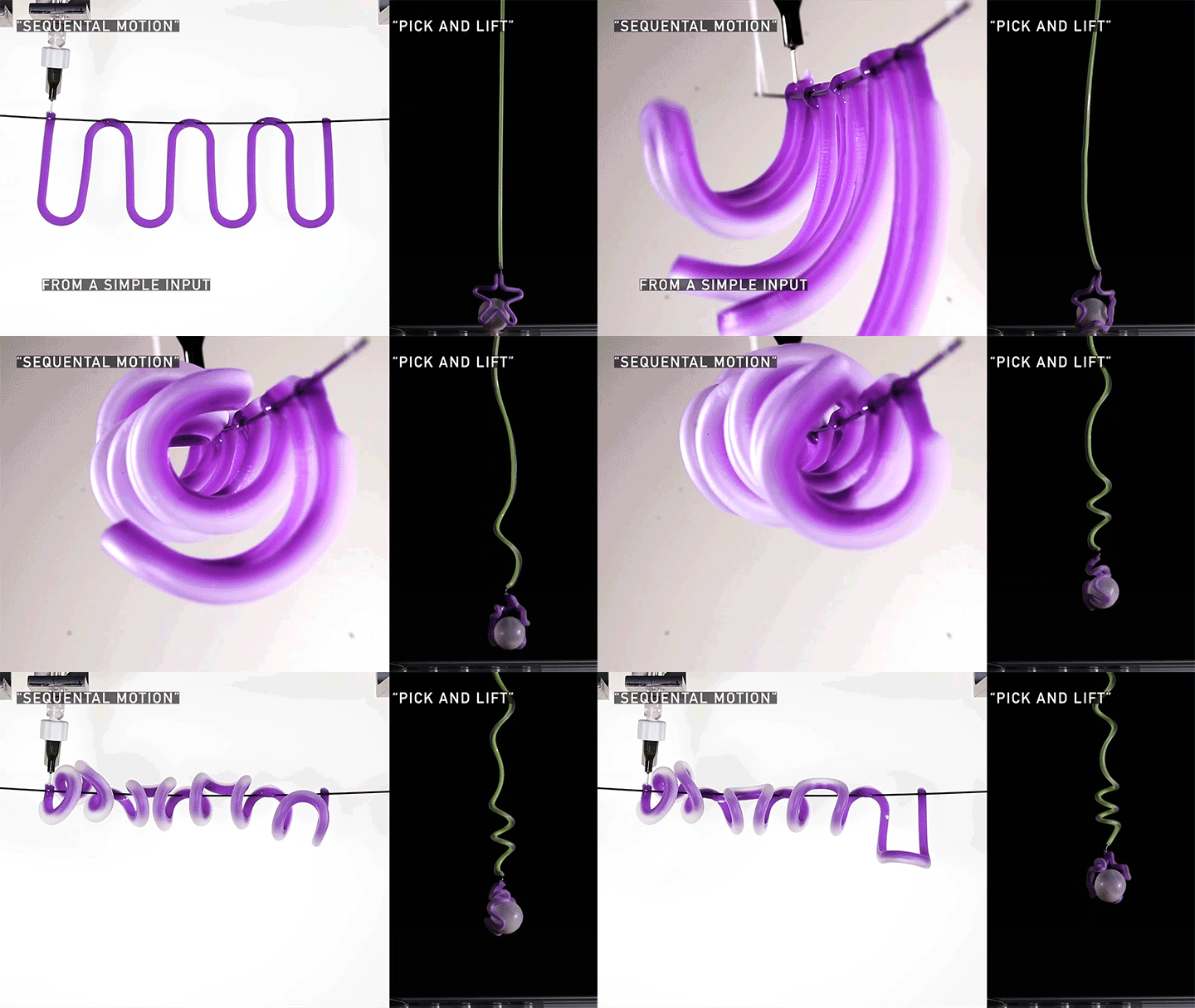
    Hard materials don’t always work well in robotics. Here, researchers build soft actuators that can bend, curl, and tighten in order to manipulate objects. They begin by injecting liquid elastomer into a tube (Image 1), followed by a bubble of air. Buoyancy makes the air bubble rise within the tube, creating an asymmetric cross-section where the solidified elastomer has a thin shell along one side and a thicker wall along the other (Image 2). When high-pressure air is pumped into the soft tubes, their asymmetric cross-section makes them bend and twist (Image 3). The team found that they can tune the elastomer tubes to form complex shapes good for gripping and flexing — perfect for a soft robot! (Video and image credit: T. Jones et al.; research credit: T. Jones et al.)

  • Spinning Tops

    Spinning Tops

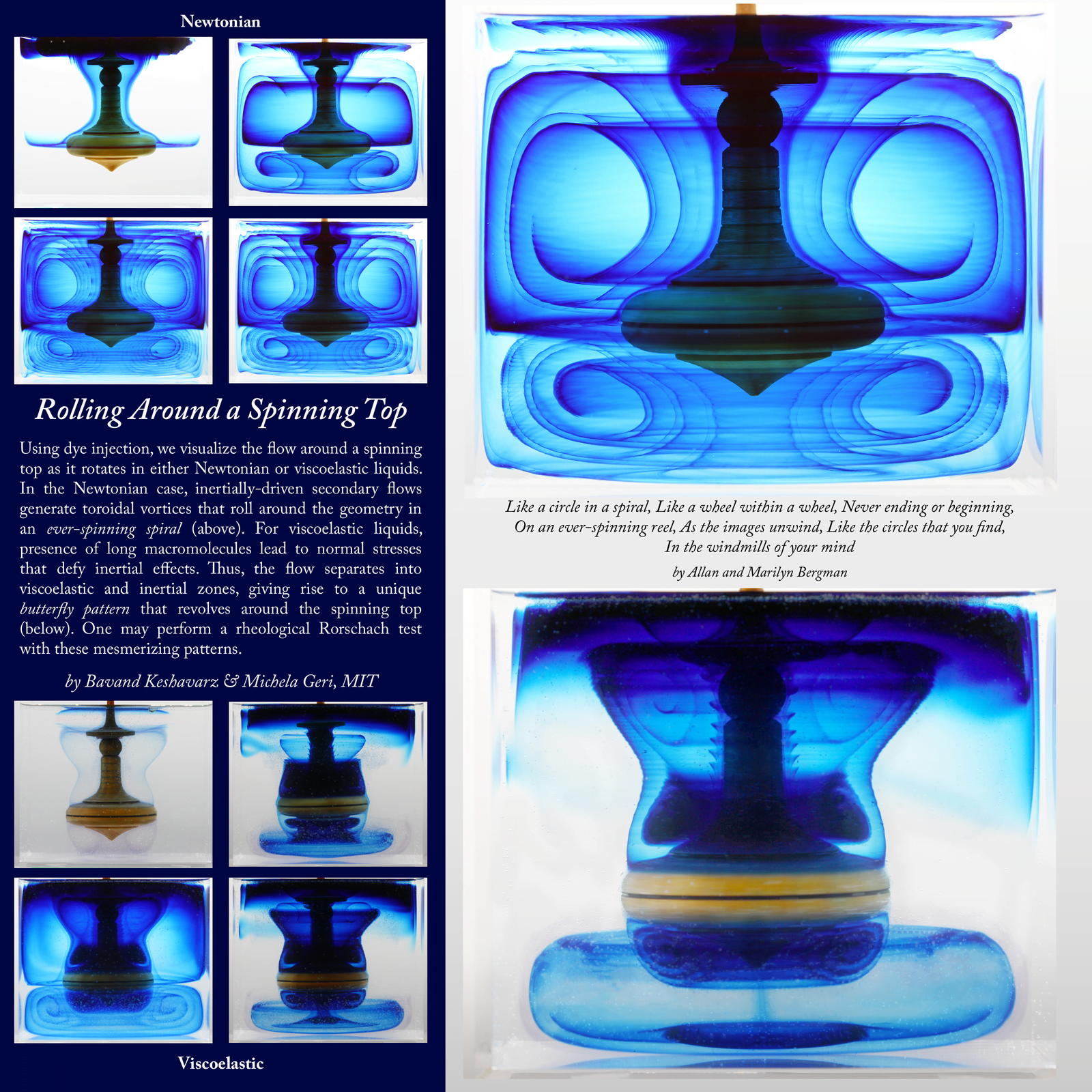
    What does the flow look like around a spinning top? Here, researchers used dye to visualize what happens in a Newtonian fluid (like air or water) as well as a viscoelastic fluid. The Newtonian fluid (upper images) divides into two circulating zones, one below the top and one above. They both take the shape of a toroidal, or donut-shaped, vortex, visible here in cross-section.

    The long molecules of the viscoelastic fluid lend it elasticity to resist stretching. The result is a very different flow field. Beneath the top, there’s still a toroidal vortex, though it appears tighter. But around the upper part of the top, there’s a butterfly-like region of recirculation! (Image credit: B. Keshavarz and M. Geri)
  • Elastic Turbulence

    Elastic Turbulence

    Decades ago, engineers pumping polymer-filled drilling liquids into porous rock noticed sudden and dramatic increases in the viscosity of the liquid. Within the tiny pores of the rock, conventional (i.e., inertial) turbulent flow should be impossible — the Reynolds number is simply too low. Now a new experiment points to the source of the high viscosity: elastic turbulence.

    To observe the phenomenon, researchers watched flow in the spaces between glass beads packed into a narrow channel. Videos of flow through one of these pores — roughly 250 microns across — are shown below. When flow rates are low (left), the fluid moves smoothly through the pore, but at higher flow rates (right), chaotic fluctuations emerge, creating the dramatic increase in apparent viscosity. In their analysis, the researchers found that the polymers’ motions generated the flow fluctuations, but most of the viscosity increase was inherent to the fluid’s movement, not to the polymers’ resistance to stretching. (Image credit: top – M. van den Bos, pore flow – Datta Lab; research credit: C. Browne and S. Datta; via Quanta Magazine; submitted by Kam-Yung Soh)

    Video of smooth flow through a pore (left) and flow with elastic turbulence (right).
    At low flow rates (left), the fluid moves smoothly through the tiny pores, but at higher flow rates (right), the polymers in the flow generate elastic turbulence that greater increases the fluid’s apparent viscosity.
  • Featured Video Play Icon

    “The Green Reapers”

    This short film from artist Thomas Blanchard focuses on carnivorous plants and their prey. These plants — including Venus fly traps, sundews, and pitcher plants — rely on fluids both to attract and capture their prey. Plants like the Venus fly trap build turgor pressure in their cells to move and prop open their leaves. Once triggered, a mechanical release allows the fluid pressure to snap the trap closed. Sweet-smelling fluids invite insects in, only to become nightmarishly difficult to escape once prey try to unstick themselves from the highly viscoelastic liquids. (Video and image credit: T. Blanchard; via Colossal)

  • Hagfish Slime

    Hagfish Slime

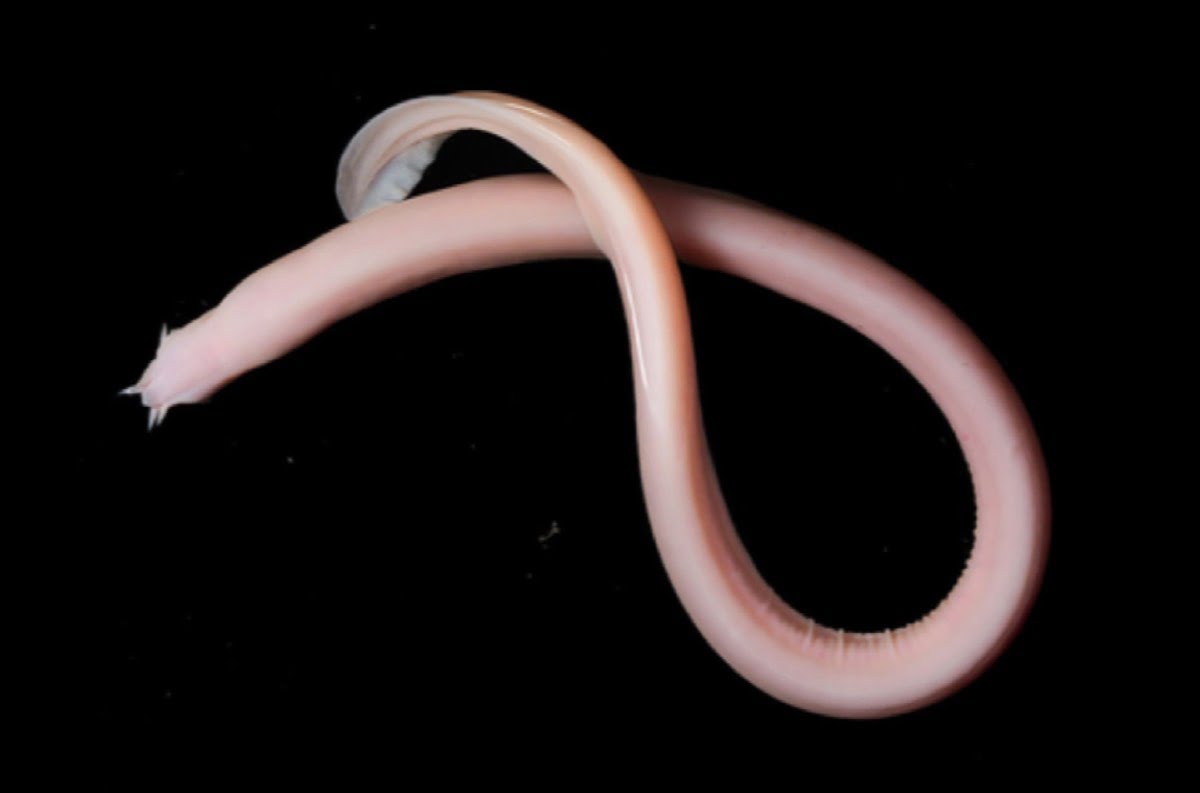
    The eel-like hagfish is a superpowered escape artist, thanks to its slime. When threatened, the hagfish releases long protein-rich threads that, when combined with turbulent sea water, unravel to form large volumes of viscoelastic slime that clog the gills of its predators. A new study shows that larger hagfish produce longer and thicker threads in their slime, enabling them to escape larger predators than their smaller brethren can.

    The properties of hagfish slime are tuned for defense. When stretched, the long protein threads resist, making the slime more viscous. Since most fish use suction methods to catch prey, that means a predator attacking a hagfish will quickly exacerbate its slimy problems. But the hagfish itself can easily escape its slime by tying itself in a knot. The threads inside the slime collapse when sheared, so the knot-tying of the hagfish slips the slime right off. (Image credit: T. Winegard; research credit: Y. Zeng et al.; via Ars Technica; submitted by Kam-Yung Soh)

  • Twisting Free

    Twisting Free

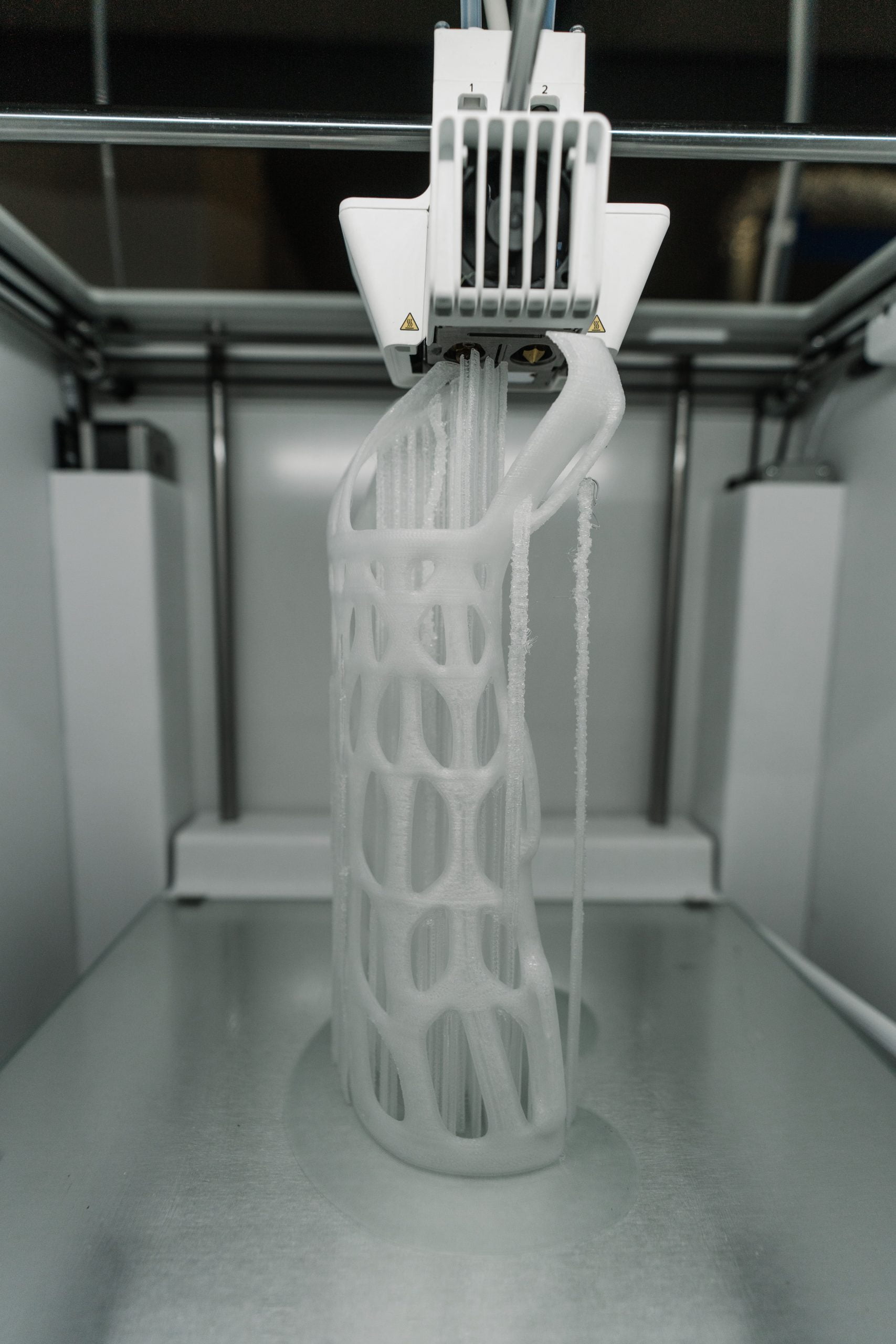
    Anyone who’s dealt with hot glue guns is familiar with the long, thin tails of glue they leave behind. 3D printers suffer from a similar problem with the nozzle pulls away from viscoelastic materials like plastics and polymers. Little tails, like the ones seen above, are left behind on the part and must be cleaned away by hand. The source of the trouble is the elasticity of the fluid. Pulling on these liquids stretches them into long thin strands as the molecules inside the fluid resist. But researchers have found an alternate method to break the liquid cleanly: twisting.

    When a viscoelastic liquid bridge gets twisted, the liquid undergoes what’s known as edge fracture, an elastic effect that creates an indentation that forces its way inward and breaks the bridge’s connection cleanly. Since the technique only requires spinning the 3D printer’s nozzle when detaching, it should be relatively easy for printer manufacturers to implement! (Image credit: 3D-print – T. Claes, illustration – H. Hill/Physics Today, animation – S. Chan et al.; research credit: S. Chan et al.; via Physics Today)

  • Microjets and Needle-Free Injection

    Microjets and Needle-Free Injection

    Some people don’t mind needles, and others absolutely detest them. But to replace needles with needle-free injections, we have to understand how high-speed microjets pass through skin. Given skin’s opacity, that’s tough, so researchers are instead using droplets as a model. If we can understand the dynamics of a microjet passing through different kinds of droplets, getting jets of medicine into arms becomes easier.

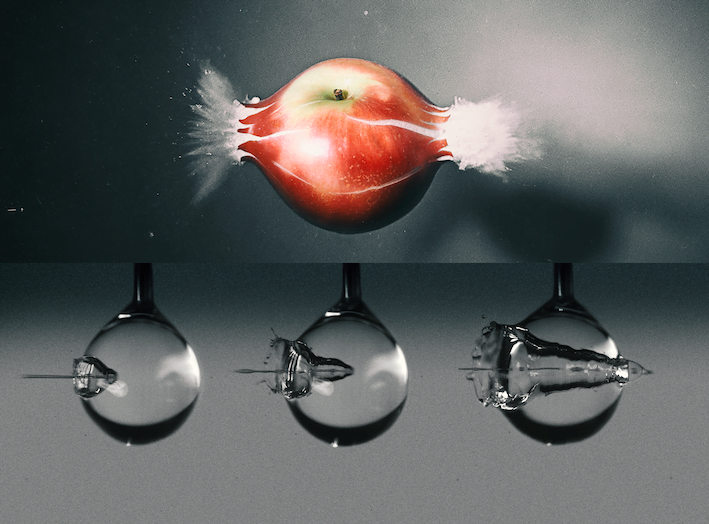
    Researchers found that jets passed completely through a droplet if they impacted above a critical velocity. For Newtonian droplets, the jet creates a cavity and shoots straight through because the inertia of the impact outweighs the countering force of surface tension. But with viscoelastic drops, the jet goes through, slows down, and gets sucked back into the droplet. In this case, the combination of surface tension and viscoelasticity can, eventually, overpower the jet’s inertia. (Image, research, and submission credit: M. Quetzeri-Santiago et al.)

  • Dripping With Particles

    Dripping With Particles

    Adding just a little polymer to a fluid can make it viscoelastic and drastically change how it drips. A pure, viscoelastic fluid (left) necks down to a thin filament thanks to the polymers’ resistance to being stretched. But what happens when you add particles, too?

    That’s the focus of this recent study, which adds particles of different sizes to dripping viscoelastic fluids. The researchers found that particles sped up how quickly the filament thinned and formed bead-like droplets. And larger particles (right) made the process even faster than small ones (middle), in experiments where the overall volume fraction of particles within the fluid matched. (Image and research credit: V. Thiévenaz and A. Sauret)