Tag: viscoelasticity

  • Microjets and Needle-Free Injection

    Microjets and Needle-Free Injection

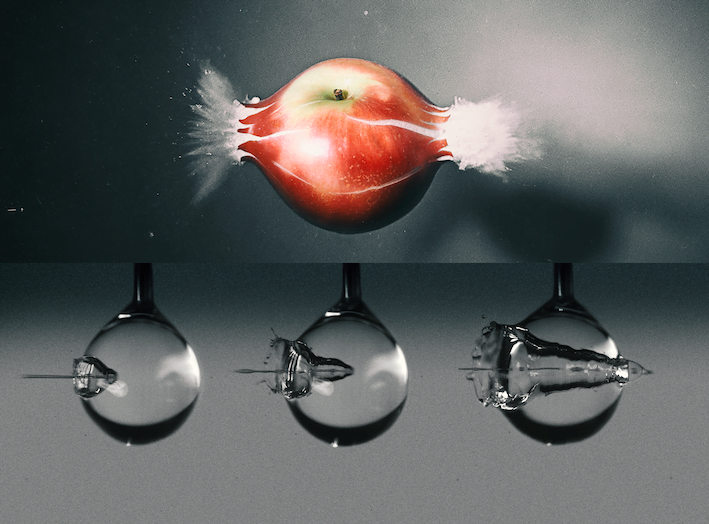
    Some people don’t mind needles, and others absolutely detest them. But to replace needles with needle-free injections, we have to understand how high-speed microjets pass through skin. Given skin’s opacity, that’s tough, so researchers are instead using droplets as a model. If we can understand the dynamics of a microjet passing through different kinds of droplets, getting jets of medicine into arms becomes easier.

    Researchers found that jets passed completely through a droplet if they impacted above a critical velocity. For Newtonian droplets, the jet creates a cavity and shoots straight through because the inertia of the impact outweighs the countering force of surface tension. But with viscoelastic drops, the jet goes through, slows down, and gets sucked back into the droplet. In this case, the combination of surface tension and viscoelasticity can, eventually, overpower the jet’s inertia. (Image, research, and submission credit: M. Quetzeri-Santiago et al.)

  • Dripping With Particles

    Dripping With Particles

    Adding just a little polymer to a fluid can make it viscoelastic and drastically change how it drips. A pure, viscoelastic fluid (left) necks down to a thin filament thanks to the polymers’ resistance to being stretched. But what happens when you add particles, too?

    That’s the focus of this recent study, which adds particles of different sizes to dripping viscoelastic fluids. The researchers found that particles sped up how quickly the filament thinned and formed bead-like droplets. And larger particles (right) made the process even faster than small ones (middle), in experiments where the overall volume fraction of particles within the fluid matched. (Image and research credit: V. Thiévenaz and A. Sauret)

  • Snail Locomotion

    Snail Locomotion

    Snails and other gastropods move using their single muscular foot and a viscoelastic fluid they secrete. Muscular waves in the foot run from tail to head and are transmitted to the ground through the thin, sticky mucus layer without the snail ever fully detaching from the surface. The characteristics of this mucus layer are critical to the snail’s locomotion. As a movement cycle begins, the mucus behaves like an elastic solid. As the muscular wave approaches, it shears the fluid, increasing its stress and ultimately reaching the yield point, where the gel begins to flow. Once the wave passes, the mucus quickly transitions back to its elastic solid behavior. The net result of each cycle is an asymmetric force that propels the snail forward while keeping it adhered to whatever surface it’s crawling on.

    Many animals rely on similarly complex fluids to move, attack prey, defend against predators, or enable their reproduction. Check out this review article for more examples. (Image credit: A. Perry; see also P. Rühs et al.; submitted by Pascal B.)

  • Reader Question: Kinetic Sand

    Reader Question: Kinetic Sand

    An inquiring reader wants to know:

    How does kinetic sand work to make it flow like a liquid?  Thanks!

    – 3 Year Olds Everywhere

    I confess I don’t have any firsthand experience with Kinetic Sand, but it certainly looks fun. It’s a colorful, moldable sand toy that holds together far better than your typical pile of sand. From what I’ve been able to find, the secret ingredients are a little bit of polydimethylsiloxane (PDMS) — a type of silicon-based polymer — and olive oil, which coats the sand and keeps it from drying out.

    PDMS is viscoelastic, which is what gives the Kinetic Sand its unique properties. When a force is applied quickly, the material reacts like a solid, which is why you can mold or cut the sand and have it maintain its shape. But when left alone for awhile under gravity’s influence, the sand will flow like a liquid. This combination of behaviors usually comes down to the polymers in the material. When forces try to stretch these long molecules quickly, they resist; that’s what creates the elasticity of the material. On the other hand, when a force is gradual, the complex molecules have the time to untangle and relax, allowing the material to flow. (Image credit: Kinetic Sand, source)

  • Viscoelastic Coiling

    Viscoelastic Coiling

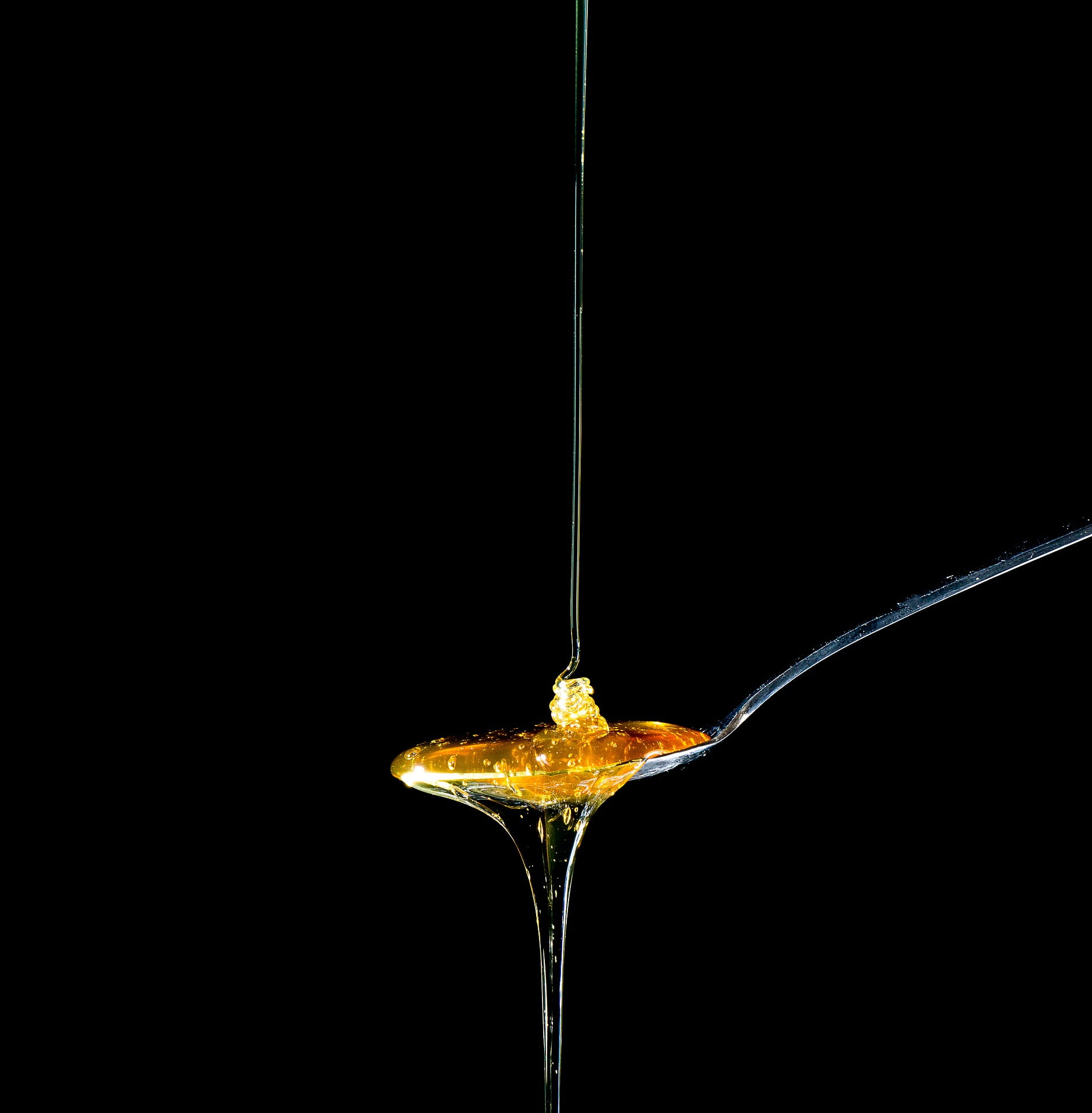
    Drizzle honey or syrup from high enough, and you’ll see it coil like a liquid rope. This feature of viscous fluids also extends to polymer-filled viscoelastic fluids. But recent work shows that the elasticity of these fluids delays the onset of coiling; put differently, if you pour two fluids of comparable viscosity, the viscoelastic one will have to fall farther before it will start coiling. The authors also found that the coiling frequency for a viscoelastic fluid is smaller than a viscous one, given the same experimental conditions. (Image credit: flo222; research credit: Y. Su et al.)

  • The Fluidity of Worm Blobs

    The Fluidity of Worm Blobs

    The aquatic blackworm forms blobs composed of thousands of individual worms for protection against evaporation, light, and heat. The worms braid themselves together (Image 1). Once a blob forms, it is extremely viscoelastic, displaying properties both solid and fluid in nature (Image 2).

    The worm blobs act like a collective; they bunch up to prevent evaporation that would desiccate the worms. Under intense light, the blob contracts (Image 3). The worms also prefer colder temperatures (again, to prevent evaporation) and will move toward the colder side of a temperature gradient. Under dim light, they’ll move individually, but in brighter light, the worms move collectively as a blob (Image 4).

    To do so, worms on the colder side of the blob pull toward the cold, whereas worms elsewhere in the blob wiggle (Image 5). Their wiggling helps lift the blob and reduce its friction so that the pulling worms can move the blob in the right direction. For more, check out this excellent thread by one of the authors. (Image and research credit: Y. Ozkan-Aydin et al.; via S. Bhamla; submitted by Maximilian S.)

  • Featured Video Play Icon

    Sundews Weaponize Viscoelasticity

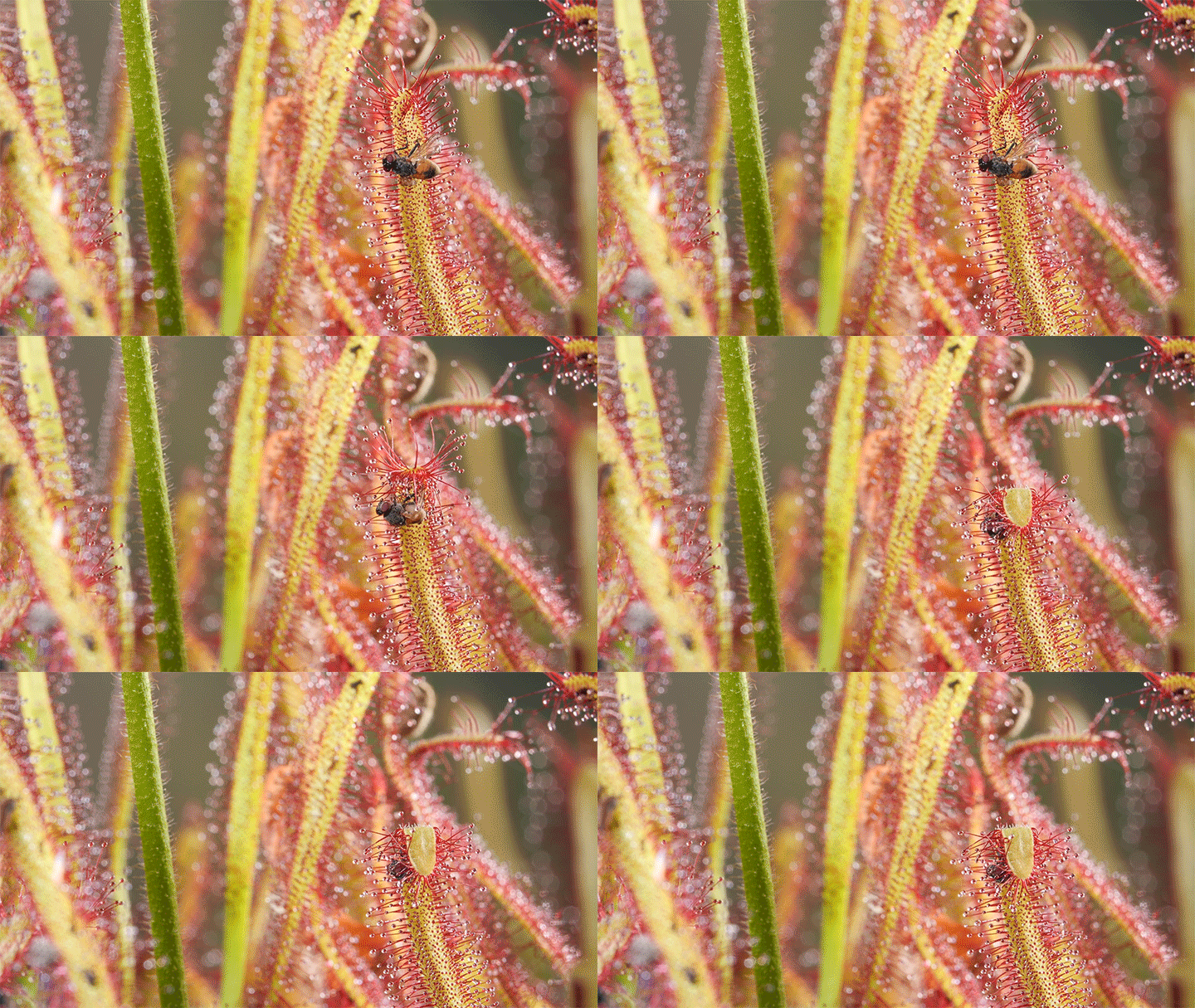
    In nutrient-poor soils, carnivorous plants like the cape sundew supplement their diets by eating insects. To entice their prey, the cape sundew secretes droplets of sugary water. But unwary insects who land to feed soon find themselves unable to pull away from this viscoelastic liquid. Complex molecules in the fluid grant it elasticity, so when insects pull against it, the liquid stretches and pulls back instead of breaking up. Other carnivorous plants, like the pitcher plant, use similar non-Newtonian tricks to trap insects. (Video and image credit: Deep Look)

  • Spin Cycle

    Spin Cycle

    Rotational motion is a great way to break up liquids, as anyone who’s watched a dog shake itself dry can attest. That same centrifugal force is what allows this rotary atomizer to break liquids into droplets. Relative to the photos above, the atomizer spins in a counter-clockwise direction. This motion stretches the fluid flowing off it into skinny, equally-spaced ligaments, which eventually break down into droplets.

    Just how and when that break-up occurs depends on the fluid, as well as the characteristics of the spin. For Newtonian fluids like silicone oil — shown in the first two pictures — the break-up is driven by surface tension and happens relatively quickly. But with a viscoelastic fluid — shown in the last image — the elasticity of polymers in the fluid allow it to resist break-up for much longer. Instead, the ligaments form the beads-on-a-string instability. See more flows in action in the video below. (Video, image, and research credit: B. Keshavarz et al., video)

  • Perfecting Giant Bubbles

    Perfecting Giant Bubbles

    Whether young or old, everyone enjoys blowing soap bubbles, and the bigger the bubble, the more impressive it is. Researchers have been on a quest to discover how bubbles can survive with volumes measured in the tens of meters and thicknesses of mere microns.

    The key to these behemoth bubbles are the polymer chains inside them. The long molecules of polymers get entangled with one another and resist further stretching, which strengthens the soap film. The researchers found that a mixture of polymer lengths are even better for long-lasting bubbles because they entangle more fully than polymers that are all the same size.

    But if what you really want are practical results, I have good news for you: the researchers have released their recommended recipe for making the best giant soap bubbles. It’s included in the video below, but I’ve also reproduced it in text for easier recreation (with thanks to Ars Technica):

    Giant Soap Bubble Solution
    From the Burton Lab, via Ars Technica

    Ingredients
    1 liter of water (about 2 pints)
    50 milliliters of Dawn Professional Detergent (a little over 3 TBSP)
    2-3 grams of guar powder, a food thickener (about 1/2 heaping TSP)
    50 milliliters of rubbing alcohol (a little more than 3 TBSP)
    2 grams of baking powder (about 1/2 TSP)

    Directions
    Mix the guar powder with the alcohol and stir until there are no clumps.

    Combine the alcohol/guar slurry with the water and mix gently for 10 minutes. Let it sit for a bit so the guar hydrates. Then mix again. The water should thicken slightly, like thin soup or unset gelatin.

    Add the baking powder and stir.

    Add the Dawn Professional Detergent and stir gently to avoid causing the mixture to foam.

    Dip a giant bubble wand with a fibrous string into the mixture until it isf fully immersed and slowly pull the string out. Wave the wand slowly or blow on it to create giant soap bubbles.

    Happy bubble making! (Image credit: Burton Lab; video credit: Emory University; research credit: S. Frazier et al.; via Ars Technica; submitted by Kam-Yung Soh)

  • Featured Video Play Icon

    “Viscoelasticity Gives You Wings!”

    What happens when you drop a hydrogel bead on a water droplet? Because of the hydrogel’s viscoelasticity and its hydrophilic nature, the rebounding bead carries the droplet with it. As seen in the video above, when the impact energy is small enough, the droplet forms a reverse crown during lift-off, kind of like giving the hydrogel bead a skirt. The key feature for lift-off is the bead’s deformation on impact. Because the hydrogel widens at its base, it is sometimes able to push the entire droplet off its initial footprint and detach it from the surface. (Image, research, and video credit: R. Rabbi et al.)