Bioaerosols–tiny airborne fluid droplets generated by coughing or sneezing–are a major concern for the spread of contagions like influenza. It may be possible, however, to mitigate some of these effects by manipulating biological fluid properties. The video above shows an experimental model of a cough, complete with the generation of bioaerosols from some fake human lung mucus. Contrast this with a cough where the model’s mucus has been treated to increase its viscoelasticity. The treated mucus generates substantially fewer droplets during a cough. The results suggest that drugs that increase viscoselasticity of biofluids may help stem the spread of disease. (Video credit: K. Argue et al.; research credit: M. D. A. Hasan et al.)
Tag: viscoelasticity

Shocking Droplets
Typical liquid drops will break apart into long, stretched ligaments and a spray of tiny droplets when deformed. But with just a small addition of polymers, these same liquids become viscoelastic and capable of some pretty incredible behaviors. This video shows a viscoelastic drop being struck by a shock wave that passes from right to left. The droplet is smashed and deformed, then stretches into jellyfish-like sheet of liquid. But incredibly, the elastic forces in the droplet are enough to hold it together. Researchers are interested in understanding these behaviors for many applications, including preventing accidental explosions caused by explosive fuels atomizing in air. (Video credit: T. Theofanous et al.)

Fishbones
When two liquid jets collide, they can form an array of shapes ranging from a chain-like stream or a liquid sheet to a fishbone-type structure of periodic droplets. This series of images show the collision of two viscoelastic jets–in which polymer additives give the fluids elasticity properties unlike those of familiar Newtonian fluids like water. The jet velocities increase with each image, changing the behavior from a fluid chain (a and b); to a fishbone structure (c and d); to a smooth liquid sheet (e); to a fluttering sheet (f and g); to a disintegrating ruffled sheet (h), and finally a violently flapping sheet (i and j). The behavior of such jets is of particular interest in problems of atomization, where it can be desirable to break an incoming stream of liquid up into droplets as quickly as possible. (Photo credit: S. Jung et al.)
Viscoelastic Jets
Unlike Newtonian fluids, such as air and water, viscoelastic fluids exhibit non-uniform reactions to deformation. In this video, researchers explore the effects of this behavior when a liquid jet falls into another fluid. When fluids move past one another at different speeds in this manner, there is a shearing force which often leads to the wave-like Kelvin-Helmholtz instability between the fluids. Here we see for a variety of wavelengths how the breakdown of a Newtonian and viscoelastic jet differ. The Newtonian jets form clean lines and complicated tulip-like shapes, but the viscoelasticity of the non-Newtonian jets inhibits the growth of these instabilities, surrounding the central jet with wisps of escaping fluid. For more, see Keshavarz and McKinley. (Video credit: B. Keshavarz and G. McKinley)

Viscoelastic Fingers
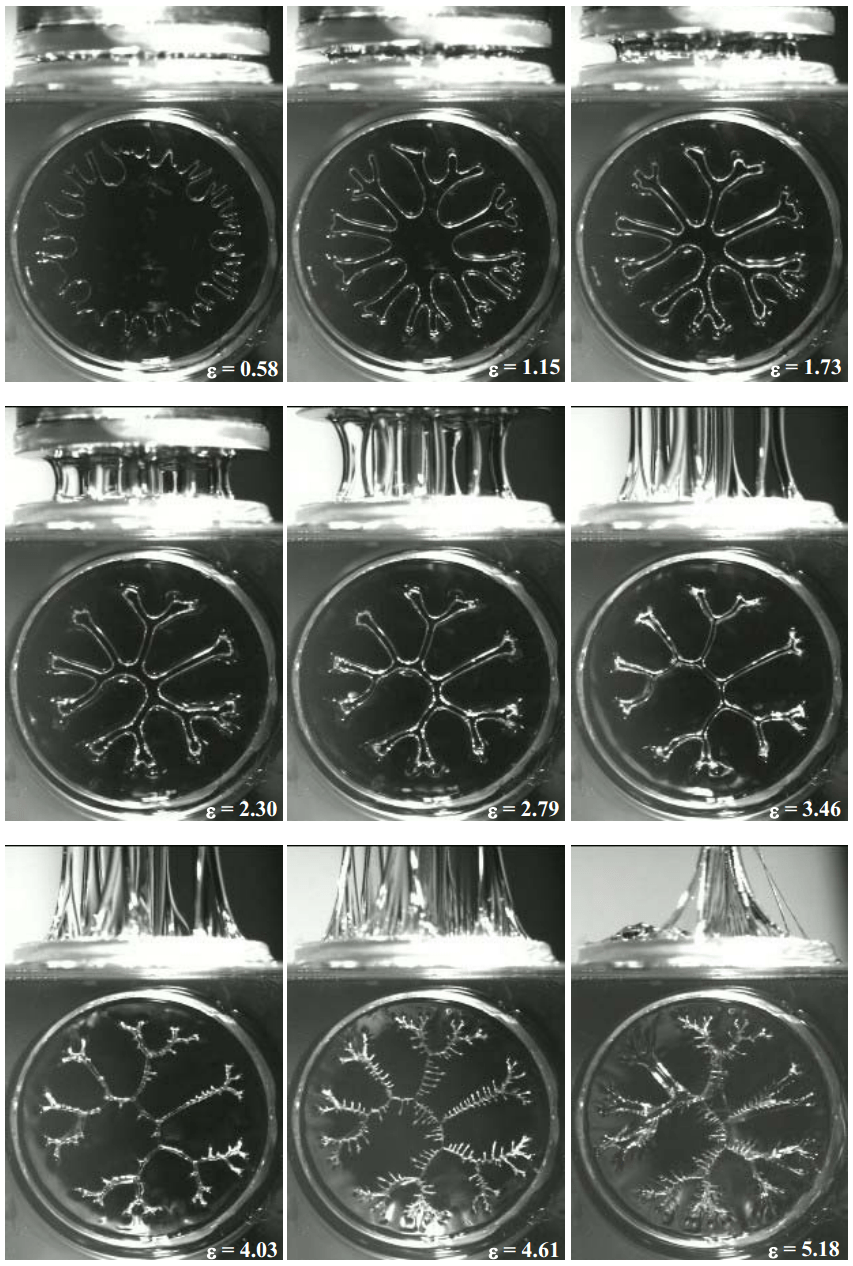
This series of photos shows two plates with a thin layer of polymer-laced, viscoelastic liquid. As the two plates are separated, complex instabilities form. The lower section of each photograph shows the fluid on the plate, with finger-like Saffman-Taylor instabilities forming as air rushes in between the gap in the plates. As the separation increases, the polymers in the liquid stretch under the increased strain, inducing elastic stresses in the fluid that cause the formation of secondary structures. (Photo credit: R. Welsh, J. Bico, and G. McKinley)
Squeezing Bubbles
An air bubble trapped inside a viscoelastic fluid is squeezed between two plates in this video, revealing a Saffman-Taylor-like fingering instability stemming from local stress concentrations. (Video credit: Baudouin Saintyves)
The Gobbling Drop
A little polymer goes a long way when it comes to changing a fluid’s behavior. Normally, a falling jet of fluid will develop waviness and be driven by surface tension and the Plateau-Rayleigh instability to break up into a stream of droplets. We see this at our water faucets all the time. But when traces of a polymer are dissolved in water, the behavior is much different. The viscoelasticity of the polymer chains creates a force that opposes the thinning effects caused by surface tension. So, instead of thinning to the point of breaking into droplets, a drop is able to climb back up the jet until it reaches a critical mass where it reverses direction, accelerates downward due to gravity and eventually breaks off the jet. Then the whole process begins again with a new terminal drop. (Video credit: C. Clasen et al)
Viscoelastic Fluids in Space
In honor of astronaut Don Pettit’s launch to the International Space Station (and in the hope that he’ll do more neat microgravity fluids demonstrations while in space!), here’s a look a the behavior of viscoelastic fluids in microgravity. The elasticity of these fluids means that, when strained, the fluid deforms instantaneously and then returns to its initial shape when the strain is removed. Pettit demonstrates both Plateau-Rayleigh instability behavior, where a column of fluid breaks apart due to surface tension variations, and die swell, where a fluid jet expands beyond the diameter of nozzle from which it was extruded. Such swelling is commonly caused by the stretching and relaxation of polymers in the fluid as they react to forces caused by the nozzle opening.

Fishbone Jet Collision
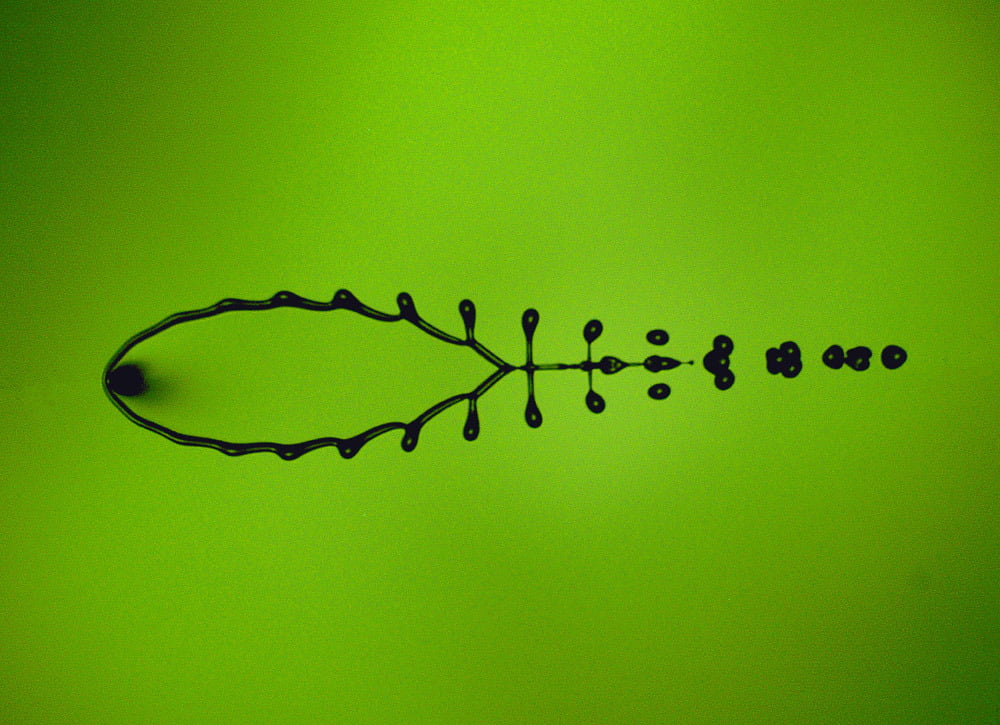
The collision of two jets of radius 420 μm results in a fishbone-like structure. The fluid contains a dilute polymer mixture whose viscoelastic effects resist the tendency of the droplets to detach from the ligaments. The breakup of the jets into droplets is important for applications in inkjet printing. The photo has been rotated 90-degrees for effect. (Photo credit: Sungjune Jung)
The Barus Effect
Non-Newtonian fluids are full of all kinds of unusual behaviors. Here a highly viscoelastic non-Newtonian fluid exhibits the Barus effect, in which extruding the fluid causes the falling jet to swell to several times larger than the diameter of the opening through which it was extruded. This is caused by the stretching and relaxation of polymers in the fluid as it passes through the opening.