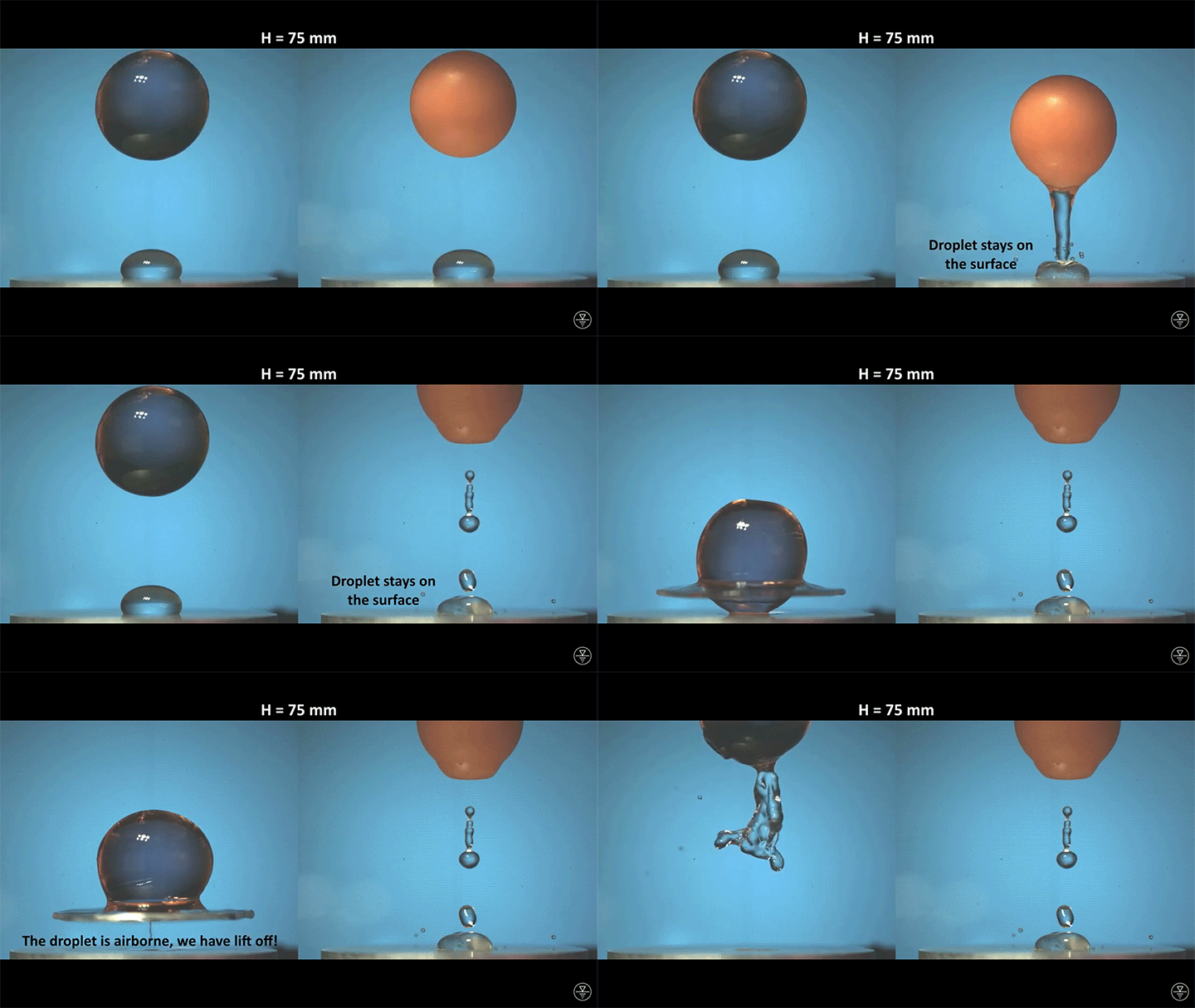
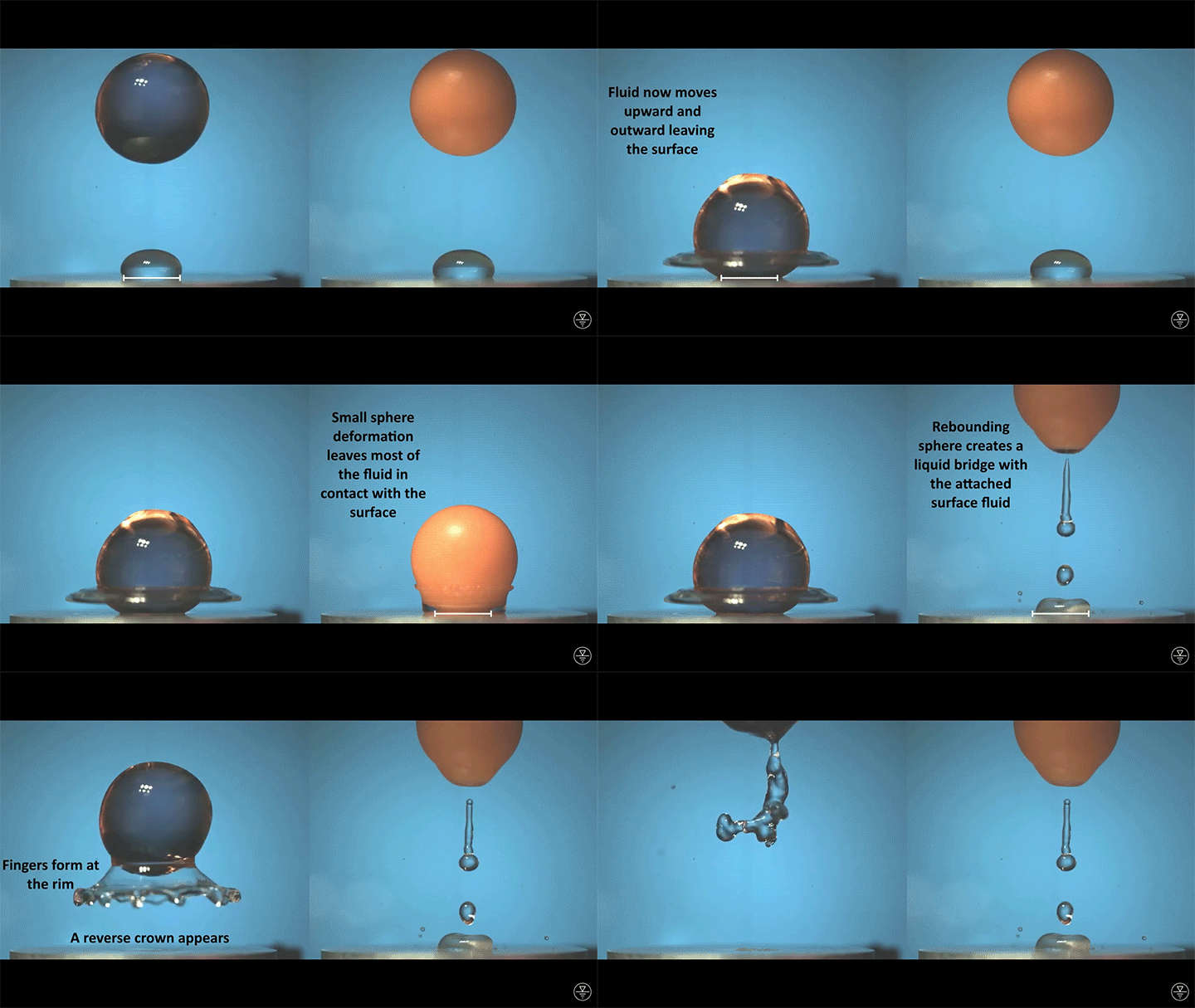
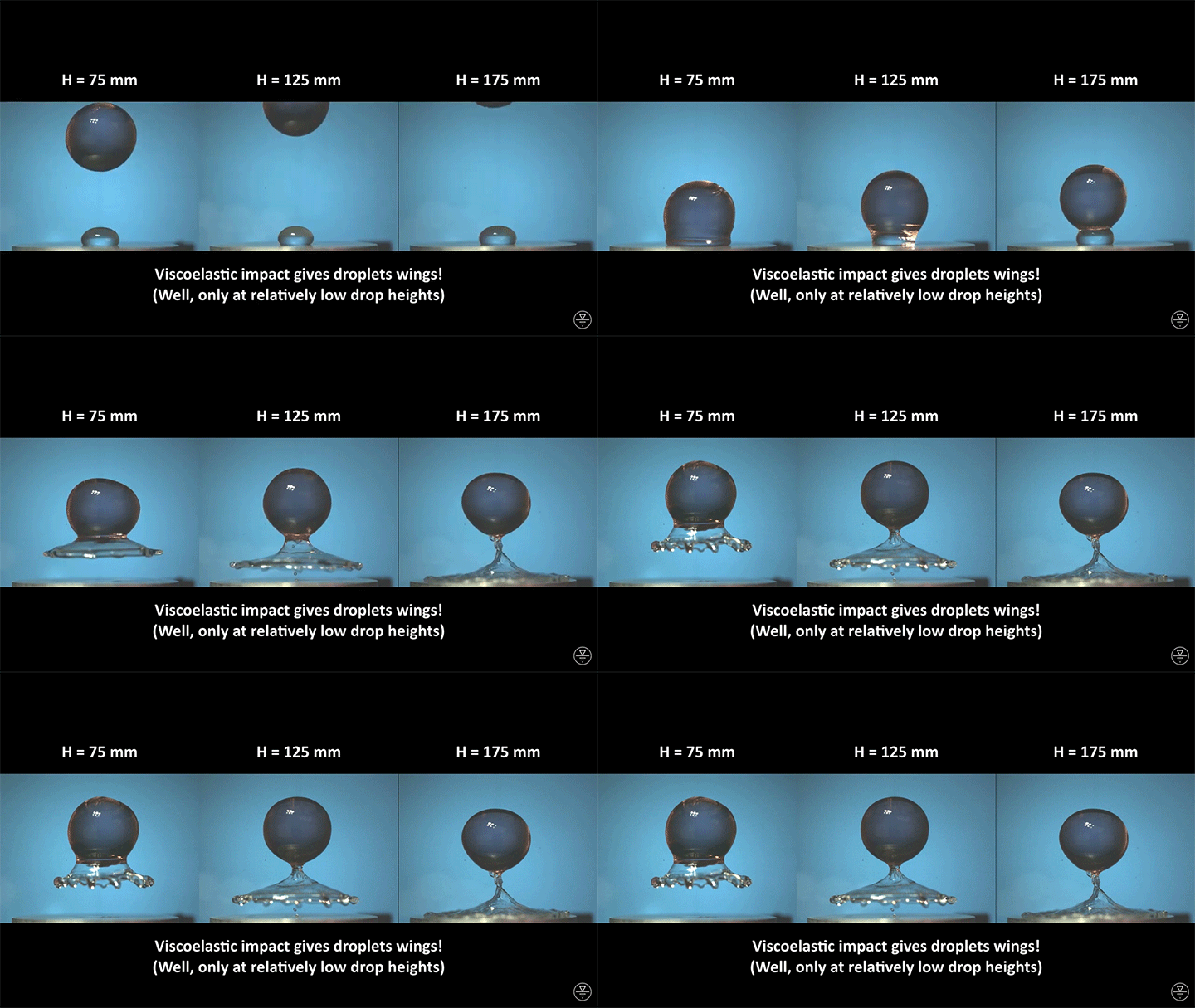
What happens when you drop a hydrogel bead on a water droplet? Because of the hydrogel’s viscoelasticity and its hydrophilic nature, the rebounding bead carries the droplet with it. As seen in the video above, when the impact energy is small enough, the droplet forms a reverse crown during lift-off, kind of like giving the hydrogel bead a skirt. The key feature for lift-off is the bead’s deformation on impact. Because the hydrogel widens at its base, it is sometimes able to push the entire droplet off its initial footprint and detach it from the surface. (Image, research, and video credit: R. Rabbi et al.)
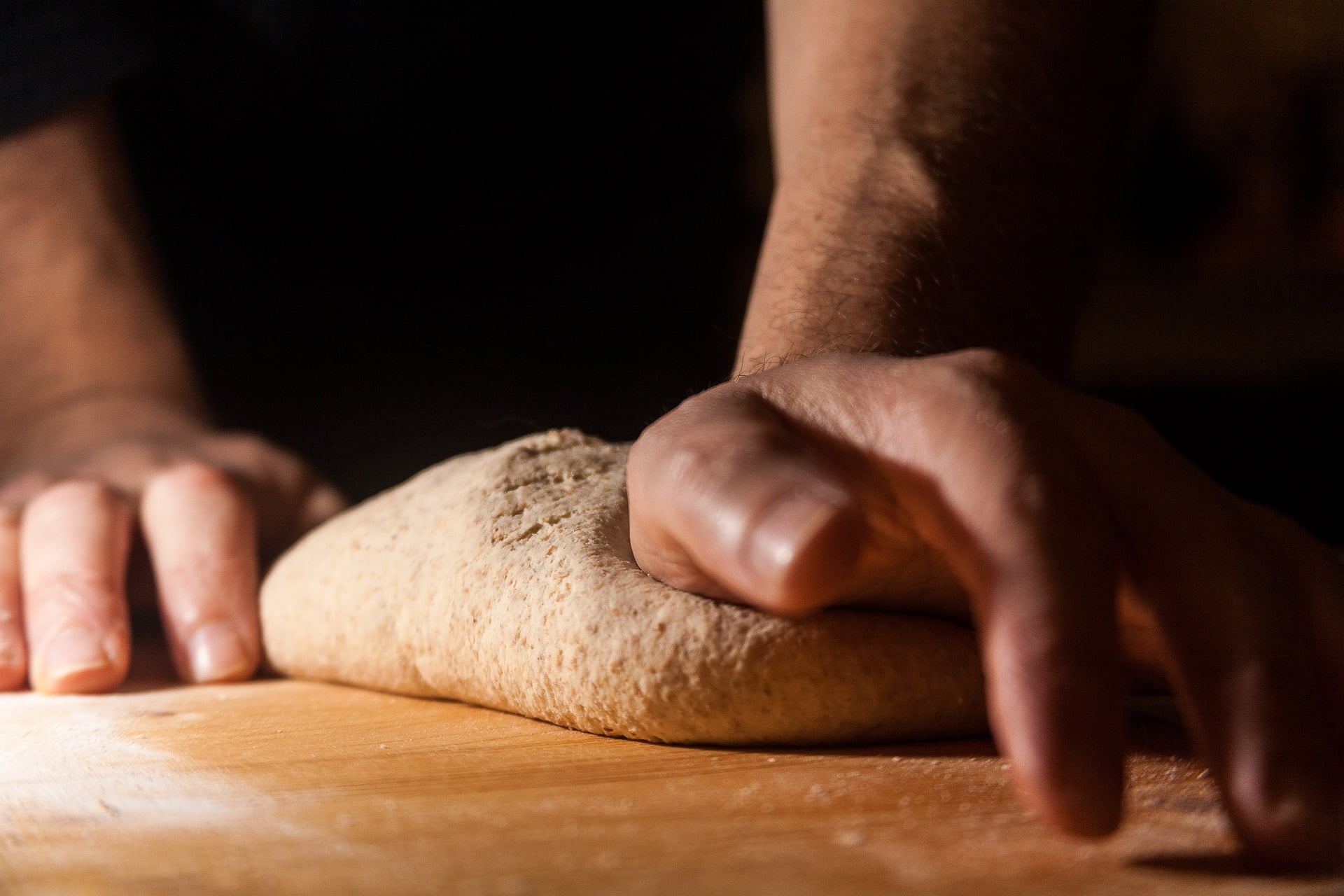
Kneading bread dough is something of an art. The process binds flour, water, salt, and yeast into a network that is both elastic and viscous. It also traps pockets of air that will determine the texture of the final loaf. Underknead and the bubbles won’t form; overknead and the result will be a dense loaf that doesn’t rise in the oven.
Capturing all of that physics in a realistic model is tough, but researchers have done so and validated their digital dough against experiments. The group focused on simulating industrial mixers, which knead dough with a moving, spiral-shaped rod rotating around a stationary vertical one. They found the industrial set-up did not mix as well as kneading by hand, but that could be improved by swapping the stationary rod for a second spiral one. (Image credit: G. Perricone; research credit: L. Abu-Farah et al.; via Physics World; submitted by Kam-Yung Soh)
As you may have noticed when washing vegetables, many plants have superhydrophobic leaves. Water just beads up on their surface and slides right off. This is a useful feature for plants that want to direct that water toward their roots, but it’s a frustration in agriculture, where that superhydrophobicity means extra spraying of pesticides in order to get enough to stick to the plant.
But that may not be the case for much longer. Researchers have found that adding a little polymer to water droplets (right) can suppress their ability to rebound (left) from superhydrophobic surfaces. Above a critical concentration, the high shear rate of the droplet as it tries to detach activates the viscoelastic properties of the polymer. That viscoelasticity suppresses the rebound, keeping the droplet attached. That’s good news for everyone, since it means less spraying is needed to protect crops. (Image and research credit: P. Dhar et al.)
Making soap bubbles is fun, but there’s something about gigantic soap bubbles that brings out the child in everyone. The world’s largest freestanding soap bubble had more than 100 square meters of surface area, which begs an important question: how can such a thin film stay stable at that size?
The solutions used for giant bubbles have a few main ingredients: water, naturally; detergent, used for its surfactants; and polymers like polyethylene glycol that help stabilize the soap film. Exactly why polymers helped was a bit of mystery, but a new pre-print study aims to answer that.
Researchers studied how polymer concentrations affected 1) how much solution could be drawn in as bubbles formed, and 2) how long a film of solution lasted before gravity and evaporation thinned it to breaking. They found that intermediate polymer concentrations actually worked best. This gave the solution the viscoelasticity needed to draw in more solution as bubbles grew without having so much polymer that it negatively affected film lifetime. (Image credit: Pixabay; research credit: S. Frazier et al.; via MIT Tech Review; submitted by Kam-Yung Soh)
Hagfish – an eel-like species – are known for their prodigious slime production, which helps them escape predators (and, in some cases, seriously muck up highways). Part of the hagfish’s slime consists of ~10 cm fibers that the creature deploys in tiny skeins (bottom) only a hundred microns across. To form the viscoelastic slime that thwarts its predators, those skeins of fiber have to unravel and do so in only tenths of a second. A new study shows that viscous drag plays a major role in that unraveling.
Most fish use a suction method to catch prey. In the hagfish’s case, that does the predator more harm than good because the very flow it creates to try and catch the hagfish pulls the slime skein apart and helps the slime expand 10,000 times in volume, creating a mess that chokes the gills of the attacking fish. (Image credit: top – L. Böni et al.; bottom – G. Choudhary et al., source; research credit: G. Choudhary et al.; via Ars Technica; submitted by Kam Yung Soh)
One proposed method for improving bulletproof armor is adding a layer of non-Newtonian fluid that can help absorb and dissipate the kinetic energy of impact. Thus far researchers have focused on shear-thickening fluids – like cornstarch-based oobleck – filled with particles that jam together if anything tries to deform them quickly. But is it really the shear-thickening properties that matter for high-speed impacts?
To test this, researchers studied projectile impact on three fluids: water (left), a cornstarch mixture (not shown), and a shear-thinning polymer mixture (right). Water is Newtonian, and it slows down the projectile but doesn’t stop it. Both the shear-thickening cornstarch and the shear-thinning polymer mixture do stop the projectile. And by modeling the impacts, researchers concluded that the key to that energy dissipation isn’t their shear-related behaviors: it’s the fact that both fluids are viscoelastic.
That means that these fluids show both viscous (fluid-like) and elastic (solid-like) responses depending on the timescale of an impact. The high speed of the impact triggered a strong viscous response in both fluids, bringing the projectile to a halt. And if, as the researchers suggest, it’s a fluid’s viscoelasticity that matters most, that widens the field of candidates when it comes to developing a fluid-based armor. (Image and research credit: T. de Goede et al.)
Although most animals are more solid than fluid, what happens when you put many of them together can be strikingly fluidic. Above you see the black aquatic worm, Lumbriculus variegatus, which must keep moist to stay alive. An individual worm will die within an hour of being removed from the water, but, in a group, the worms can survive far longer. They do so, in part, by acting like a viscoelastic fluid, a material with both solid (elastic) and fluid (viscous) properties.
In small groups, the worms squirm tightly together to minimize their collective surface area and prevent themselves from drying out. But in larger groups, the worm blobs begin sending out feelers, searching for more advantageous circumstances. In the top image, you can see this causes three of the blobs to ultimately merge into an even bigger one. The worm collective can also “liquify”, allowing the blob to change shape and tackle obstacles like flowing through a pipe. (Image and research credit: Y. Ozkan-Aydin et al.; via Science)
This is the second post in our series on collective motion. Check out the first post here.
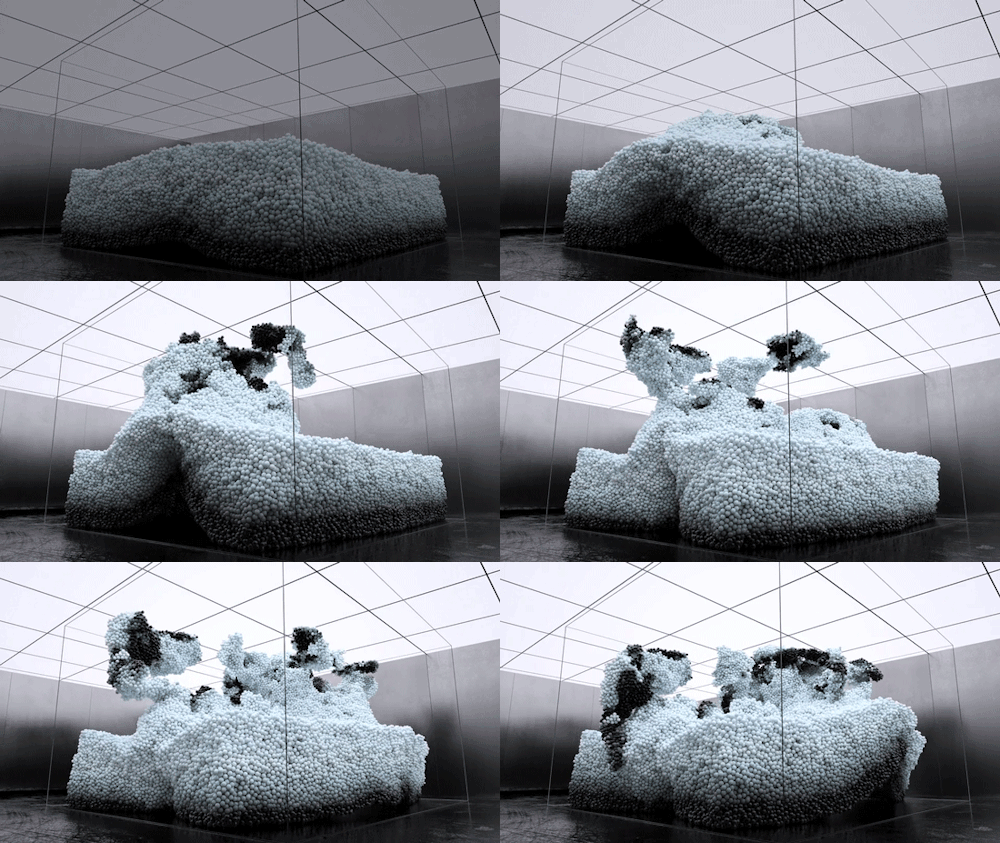
“Volumes” is an experimental art film by Maxim Zhestkov using physics-based particle animation. Waves and unseen forces send billions of color-changing particles aloft in the film. The motions – especially the way the particles seem to tear themselves – are reminiscent of a complex fluid, like yogurt. These substances have both liquid-like (viscous) and solid-like (elastic) properties depending on the forces they experience. Zhestkov’s particles are similar; they move like a fluid but tear more like a solid.
I particularly like the sequence beginning at 1:30. The upwelling of particles leaves behind a lower layer that looks like a snapshot of convection in a planetary mantle while the upper layer resembles the clash of ocean waves. The whole film is quite mesmerizing. Check it out! (Video and image credit: M. Zhestkov; GIFs via Colossal)
For many fluids, the relationship between force and deformation is not simple. The catch-all name for these materials is non-Newtonian fluids. In a recent episode, the Hydraulic Press Channel did some experiments extruding a couple non-Newtonian fluids: oobleck and a temperature-sensitive putty. What they demonstrated is that a fluid’s response to the forces it experiences can change depending on the rate at which force is applied.
Take their putty example from the latter half of the video. When the hydraulic press pushes the putty slowly, it extrudes in a smooth, semi-solid string. When they increase the pressure driving the hydraulic press, it pushes the putty more quickly, causing it to spray out of the die in a shredded mess. What they actually did here is surpass a threshold for what’s known in manufacturing as the sharkskin instability. This behavior occurs due to long-chain polymer molecules in the fluid. Inside the die, flow near the walls is slowed down by friction but moves freely in the middle of the pipe. When the walls are suddenly gone, flow at the outside accelerates to match the inside of the stream, which stretches the polymers until they can snap free of the die. The result is the rough, saw-tooth-like pattern seen here. (Video and image credit: Hydraulic Press Channel, source)
Substances don’t have to be a liquid or a gas to behave like a fluid. Swarms of fire ants display viscoelastic properties, meaning they can act like both a liquid and a solid. Like a spring, a ball of fire ants is elastic, bouncing back after being squished (top image). But the group can also act like a viscous liquid. A ball of ants can flow and diffuse outward (middle image). The ants are excellent at linking with one another, which allows them to survive floods by forming rafts and to escape containers by building towers.
Researchers found the key characteristic is that ants will only maintain links with nearby ants as long as they themselves experience no more than 3 times their own weight in load. In practice, the ants can easily withstand 100 times that load without injury, but that lower threshold describes the transition point between ants as a solid and ants as a fluid. If an ant in a structure is loaded with more force, she’ll let go of her neighbors and start moving around.
When they’re linked, the fire ants are close enough together to be water-repellent. Even if an ant raft gets submerged (bottom image), the space between ants is small enough that water can’t get in and the air around them can’t get out. This coats the submerged ants in their own little bubble, which the ants use to breathe while they float out a flood. For more, check out the video below and the full (fun and readable!) research paper linked in the credits. (Video and image credits: Vox/Georgia Tech; research credit: S. Phonekeo et al., pdf; submitted by Joyce S., Rebecca S., and possibly others)
ETA: Updated after senoritafish rightfully pointed out that worker ants are females, not males.