When viewed at the right pace, clouds can flow. This timelapse of fog over Mt. Tamalpais State Park near San Francisco shows clouds moving over the hills there. Physically, this flow is an example of a familiar phenomenon known as a hydraulic jump. It happens when a fast-moving flow moves into a region of slower flow. The kinetic energy of the incoming flow gets transferred into potential energy, causing the flow to suddenly rise in height. It can also trigger turbulence, as seen on the right side of the animation. Watch carefully along a river, and you’ll see the same thing happening. Or, if your kitchen sink has a flat bottom, you can create a circular hydraulic jump just by turning on the faucet. You’ll get a region of fast flow right where the water impacts the basin, and a little ways out, you’ll see a circular jump where the water is suddenly taller and slower. That’s a hydraulic jump, too! (Image credit: Nicholas Steinberg Photography, source; submitted by Madi R.)
Tag: timelapse

“Monsoon IV”
It’s a cliché to claim that the sky is bigger in the American West, but the wide, open views in that region do offer a very different perspective on weather. Photographer Mike Olbinski’s works give viewers a taste of that perspective of far-off thunderstorms, towering anvil clouds, and massive downpours in the distance. At the same time, many of his sequences illustrate the birth and death of these massive storms. As warm, moist air rises, a puffy cumulus cloud (below) swells upward as fresh moisture condenses. When it reaches a thermal cap and can rise no further, precipitation begins to fall, dragging surrounding air with it. This is the mature stage of a storm, when both updrafts and downdrafts exist simultaneously.
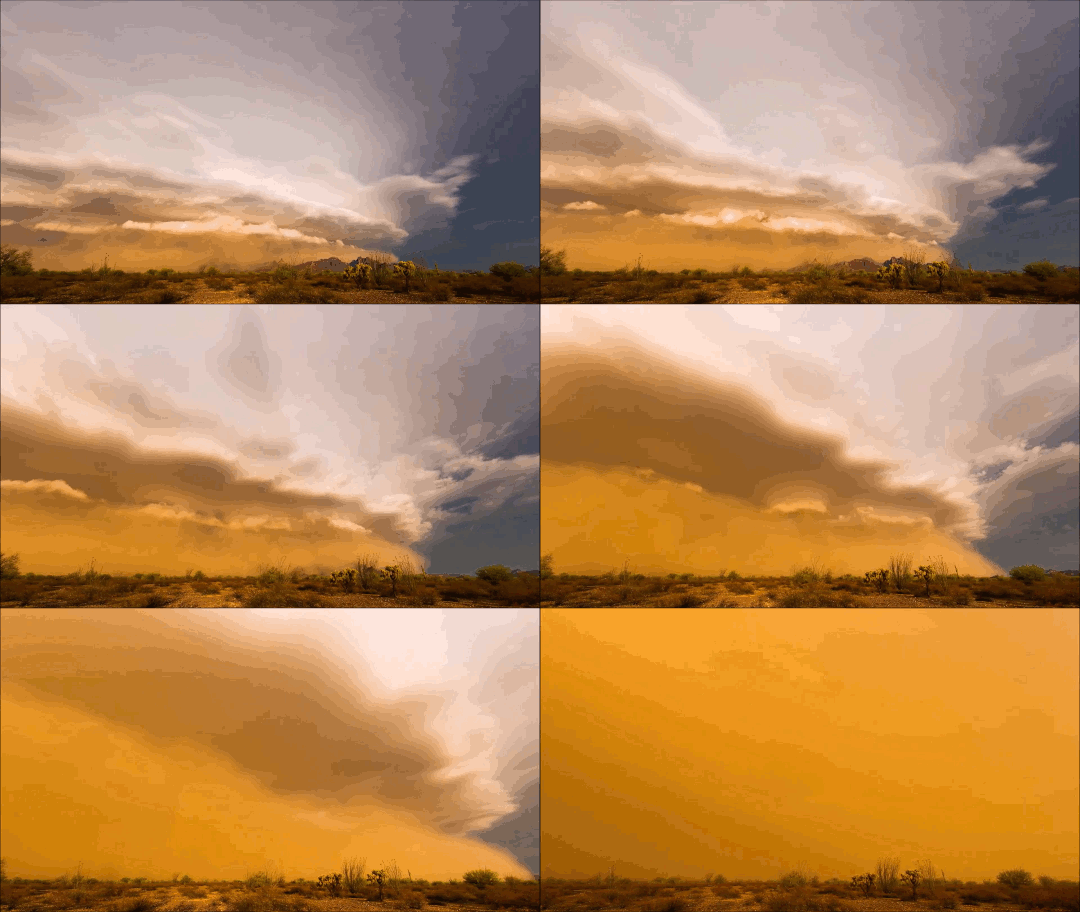
Eventually, the storm’s power begins to wane as the downdrafts cut off the updrafts that feed the storm. Sometimes this occurs in a massive downdraft where cool air sinks straight down and, upon encountering the ground, spreads radially outward. In dry regions, this outward burst of ground-level winds can pick up dirt, dust, and sand, forming a wall-like haboob (below) that advances past the remains of the storm. Watch the entire video to see some examples in their full glory! (Video and image credit: M. Olbinski, source; via Rex W.)

Oceans of Clouds
One of the most amazing things about fluid dynamics, in my opinion, is that the same rules apply across an incredible array of situations. The equations of motion are the same whether your fluid is water, air, or honey. Your flier can be a Cessna airplane or a fruit fly; again, the equations are the same. This is part of the reason that patterns in flows are repeated whether in the laboratory or out in nature – and it’s the reason why a timelapse of fog clouds can look just like ocean waves. Ultimately, the physics is the same; clouds just move slower than ocean waves! (Image credit: L. Leber, source; via James H.)
“Pursuit”
Photographer Mike Olbinski has released yet another breathtaking timelapse film of weather over the Great Plains. This one has a little bit of everything: storms, tornadoes, incredible cloud formations, and even sunny days. Olbinski’s work is a reminder that there’s a constant beautiful drama playing out over our heads if we just take the time to watch. Under blue skies, condensation and turbulence are building towering mountains, and even when the sky is gray, it can be churning like the ocean just over your head. The U.S. Great Plains may be home to particularly dramatic examples of this behavior (thanks largely to the atmospheric influence of the Rocky Mountains), but these same phenomena are going on all the time overhead. (Video and image credits: M. Olbinski)
“Fractal”
Timelapses are a wonderful way to capture the power and majesty of storms like the supercell thunderstorms featured in Chad Cowan’s “Fractal”. The video contains snapshots from six years’ worth of storms over the US’s Great Plains. The highlights include some spectacular mammatus clouds (0:30) and excellent billowing cloud formation (1:27) with turbulence every bit as towering as that of a volcanic plume. June is one of the best months for amazing storms in the Great Plains, largely thanks to the atmospheric mixing that occurs over the Rocky Mountains. If you have the opportunity to witness these amazing natural displays, enjoy it, but be safe! (Video credit: C. Cowan; image via Colossal)

Sky Glow


This short but spectacular timelapse video shows the Grand Canyon filled with fog. This phenomenon, known as a temperature inversion, occurs when a warm layer of air traps cold, moist air near the ground. As the inversion develops in the video, you can see wisps of clouds popping up in the canyon, seemingly out of nowhere, as moisture evaporated from the surface condenses in the cool air. Once fog fills the canyon, it flows and laps against the canyon’s sides, much like waves on the ocean. In fact, the physics here is quite similar, just at a much slower speed. (Video and image credit: H. Mehmedinovic / SKYGLOWPROJECT; via Gizmodo; submitted by Ian S.)
Hawaii’s Lava
Sometimes the best way to appreciate a flow is standing still. In “Hawaii – The Pace of Formation” filmmakers explore how the Big Island is constantly changing, from fresh lava flows to towering waterfalls. Much of the footage presented is timelapse, which gives viewers a different perspective on familiar subjects; it highlights the similarities between clouds and the ocean, and it reminds us that a lava flow and the syrup flowing down a stack of pancakes have a lot in common. To me, this is one of the most beautiful parts of fluid dynamics: physics of flows on different length-scales and time-scales – even in different fluids – are still very much the same. (Video credit: A. Mendez et al.)
“Pulse”
Photographer Mike Olbinski returns with another incredible storm-chasing timelapse video, this time all in black-and-white. To me, that choice helps “Pulse” emphasize the ominous majesty of these supercells and tornadoes by highlighting the textures that make up the clouds. Watching clouds in timelapse, they seem to materialize from nowhere as moisture drawn up from the land cools and condenses. Sped up, suddenly the convective rotation and the roiling turbulence inside clouds is perfectly clear. I especially love the sequence beginning at 2:25, where a distant black line slowly transforms into an incredible landscape marked with successive waves of rolling, turbulent clouds. Watch this one on a large screen at a high resolution, if you can. You won’t regret it! (Video credit: M. Olbinski)
“Monsoon II”
Every child learns about the water cycle in school, but an academic description of the process often lacks nature’s grandeur. In “Monsoon II” photographer Mike Olbinski captures the majesty of cloud formation and rainfall in a way that rekindles awe for the scale of the process. It begins with bright clouds popping up, the result of warm moist air rising from the ground and cooling at altitude. As more water vapor evaporates, rises, and condenses, water droplets collide in these clouds, coalescing and growing until they grow too large and heavy to stay aloft. These are the droplets that fall in sheets of rain, blurring the air beneath them. There’s an incredible beauty to watching rain fall from a distance; it looks calm and localized in a way that’s utterly at odds with the experience from inside the storm. (Video credit: M. Olbinski; submitted by jshoer)
“The Chase”
Sometimes it takes timelapse photography to truly appreciate the dynamic behavior of our atmosphere. In “The Chase” Mike Olbinski, whose work we’ve featured previously, has captured some of the most incredible and stunning weather timelapse footage I have ever seen. Despite watching it repeatedly, I continue to be awed to the point that I have no words. Seriously, just watch it. Be amazed by the drama of our sky. (Video credit: M. Olbinski)