Tag: timelapse

  • Featured Video Play Icon

    Even Mountains Flow

    Over about 5 months of 2018, the summit of Mount Kilauea slowly collapsed as the volcano erupted. Seen in timelapse, it’s a remarkable reminder of the ancient Greek philosopher Heraclitus’s observation, “Everything flows.” All things change, so given enough time, just about everything can flow.

    Fluid dynamicists actually capture this concept in a dimensionless ratio known as the Deborah number. Named for a Biblical prophet who states, “The mountains flow before the Lord,” the Deborah number is defined as the ratio between the time needed for a material to respond applied stress and the time over which the process is observed. In practice, a lower Deborah number indicates a more fluid-like material while a higher one represents more solid-like behavior.

    Be sure to check out the full video. There’s some spectacular lava flow footage near the end – definitely a small Deborah number! (Video and image credit: USGS via Science; research credit: C. Neal et al.)

  • Featured Video Play Icon

    “Haboob”

    Mike Olbinski’s latest storm chasing timelapse, “Monsoon V,” is once again spectacular. Although I do think the name could have been “Haboob” instead, given how many sweeping dust clouds encroach on the viewer. These towering wall clouds of dust can form from downdrafts at the leading edge of a cold front, or from the fading remains of a thunderstorm. In dry, dusty regions like Arizona, the strong downward winds spread outward as they near the ground, picking up dust and sand. Below you can see two examples of haboobs racing ahead of fronts. 

    The middle image shows a microburst, where a sudden, localized downdraft falls out of the storm. Notice how the wind and rain sweep outward as they near the ground. This is typical of any flow heading straight toward a wall! Check out the full video for lots more gorgeous fluid dynamics in action. (Video and image credit: M. Olbinski)

  • Bubbling

    Bubbling

    Many chemical reactions produce gases as a stream of bubbles out of a solution. Here we see the electrolysis of an aqueous sodium hydroxide solution (NaOH), which produces hydrogen gas on the cathode (left) and oxygen gas on the anode (right). In timelapse, the gas bubbles nucleate on the electrode, slowly growing larger. Once the the bubbles are large enough to detach, though, they rise so quickly they look like they disappear! The large buoyant forces on them drive that brief journey to the surface. By contrast, the smaller bubbles rise slowly, held back by their lesser buoyancy and the viscous drag they experience. (Video and image credit: Beauty of Science)

  • Featured Video Play Icon

    The Show in the Sky

    There is a constant drama playing out overhead, though most of us do not take the time to watch. Fortunately, a few, like Blaž Šter, do and make timelapse videos that allow us to enjoy hours of atmospheric drama in only a few minutes. This timelapse shows a cloudy and rainy mid-July day in Slovenia, where an unstable atmosphere leads to turbulent and dramatic clouds. In an unstable atmosphere, it’s easier for vertical motion to take place between altitudes. For example, a parcel of warm air displaced upward will continue to rise because it will be lighter and more buoyant than the surrounding air. This is key to the strong convection that can generate thunderstorms. (Image and video credit: B. Šter, source)

  • Pyrocumulus on the Horizon

    The Cranston wildfire in California is intense enough that it’s creating its own weather. This timelapse video shows the formation and growth of a pyrocumulus cloud, also associated with volcanoes, over the wildfire. In both instances, the extreme heat causes a massive column of hot, turbulent air to rise. Because ash and smoke are carried upward as well, there are many places for any moisture in the atmosphere to nucleate, forming the cloud we see. In timelapse, the roiling nature of the air’s motion is especially apparent. This turbulence can be dangerous, as it may contribute to high winds and even lightning, both of which can spread the fire further. (Video credit: J. Morris; via James H.)

  • Skyglow

    Skyglow

    Timelapse can be a beautiful way to highlight slow-moving flows like those in the sky. But it can also be valuable in showing differences in speed, as in the latest SKYGLOW Project video, “Colorado Serenade”, which shows the Colorado River and the skies overhead simultaneously. Timelapse highlights the difference in time scales between the fast-moving river and slower-moving clouds.

    This mirrors an important phenomenon in fluid dynamics known as “separation of scales”. In a flow, there are often multiple effects at play and they may occur on different time (or length) scales. Which matters most in a given situation will depend on those scales. Consider a rocket engine. Combustion inside the engine ignites fuel and oxidizer, releasing heat. At the same time, the flow in the engine is key to mixing that fuel and oxidizer together so that all of the fuel and oxidizer ignites before it is sent downstream into the rocket nozzle. There are two important time scales here: the time it takes for the flow to mix fuel and oxidizer together and the time it takes for the combustive chemical reaction to take place. In an ideal world, engineers can balance those two time scales to maximize efficiency. But in the (admittedly less ideal) real world, this is not always possible. (Video and image credit: H. Mehmedinovic/SKYGLOW)

  • Featured Video Play Icon

    “Dance Dance”

    Artist Thomas Blanchard is no stranger to fluid dynamics. His previous short films focused on mixtures of oil and paint, but in “Dance Dance,” flowers are front and center. There are obvious splashes of color and clouds of diffusion toward the end of the video, but fluid dynamics are there throughout. The oozing, inexorable march of ice crystallizing over petals and leaves has a fluidity that’s heightened by timelapse. It’s a reminder that this phase change is unsteady and full of shifts too subtle to notice in real-time. In the second act, we see flowers blossoming in timelapse, bursting open dramatically before settling in with a subtle shift of their stamens. Motions like these are driven by the flow of fluids inside the plant. By shifting small concentrations of chemicals, plants drive the water in their cells via osmosis. This pumps up cells that cause the petals to spread and unfurl. (Video and image credit: T. Blanchard; via Colossal)

  • Featured Video Play Icon

    “Breathe”

    In black and white, the towering power of a thunderstorm looks almost apocalyptic. Photographer Mike Olbinski’s latest storm timelapse, “Breathe,” features roiling turbulence, distant downpours, and eerie mammatus clouds. Supercell thunderstorms churn and rotate over empty horizons. Billowing cumulus clouds condense from bright skies. Flashes of lightning reveal the outlines of massive thunderheads. It’s a beautiful glimpse of atmospheric fluid dynamics in action, with every texture magnified and enhanced by the stark black and white palette. (Video and image credit: M. Olbinski; via Gizmodo)

  • Featured Video Play Icon

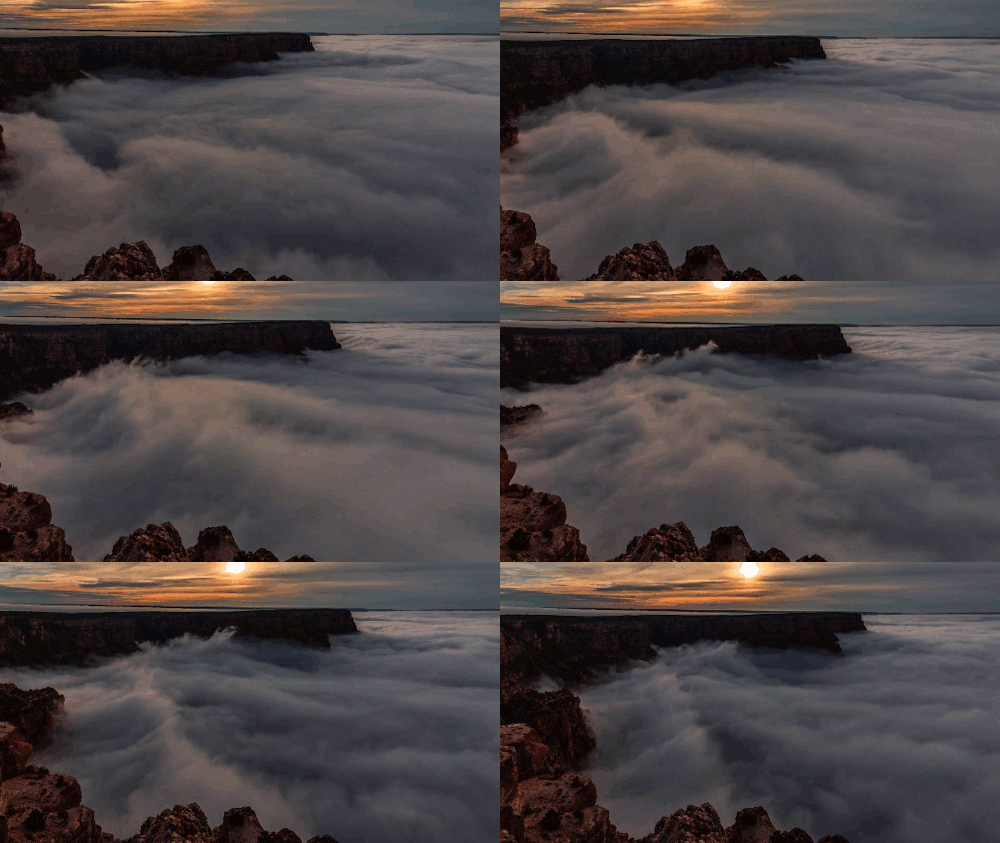
    The Foggy Grand Canyon

    On occasion in the late fall and early winter, the Grand Canyon can fill with clouds of fog. This occurs when a layer of warm air traps cold, moist air inside the canyon, creating what’s known as a temperature inversion. The trapped air’s moisture condenses into fog, creating the appearance of a cloud sea lapping at the canyon walls. Such inversions often proceed a big snowstorm, as shown in this video. (Video and image credit: H. Mehmedinovic / SKYGLOWPROJECT; via Gizmodo)

  • Cloud Flows

    Cloud Flows

    When viewed at the right pace, clouds can flow. This timelapse of fog over Mt. Tamalpais State Park near San Francisco shows clouds moving over the hills there. Physically, this flow is an example of a familiar phenomenon known as a hydraulic jump. It happens when a fast-moving flow moves into a region of slower flow. The kinetic energy of the incoming flow gets transferred into potential energy, causing the flow to suddenly rise in height. It can also trigger turbulence, as seen on the right side of the animation. Watch carefully along a river, and you’ll see the same thing happening. Or, if your kitchen sink has a flat bottom, you can create a circular hydraulic jump just by turning on the faucet. You’ll get a region of fast flow right where the water impacts the basin, and a little ways out, you’ll see a circular jump where the water is suddenly taller and slower. That’s a hydraulic jump, too! (Image credit: Nicholas Steinberg Photography, source; submitted by Madi R.)