The schlieren optical technique is ideal for visualizing differences in fluid density and is an important tool for revealing flows humans cannot see with their naked eyes. In this high speed video, a professor lights a match. The initial strike generates friction and heat sufficient to convert some of the red phosphorus in the match head to its more volatile white phosphorus form. We see this in the schlieren as the cloud-like burst in the first several seconds. The heat from the phosphorus combustion ignites the sulfur fuel and potassium chlorate oxidizer in the match head to create a more sustained flame. During this period, wavy, smoke-like whorls of hot air rise from around the flame as buoyancy takes over. The upward movement of hot air draws in cooler air from the surroundings, providing the flame with an ongoing source of oxygen and allowing it to grow. (Video credit: RMIT University)
Tag: physics

The Capillary Channel Flow Experiment

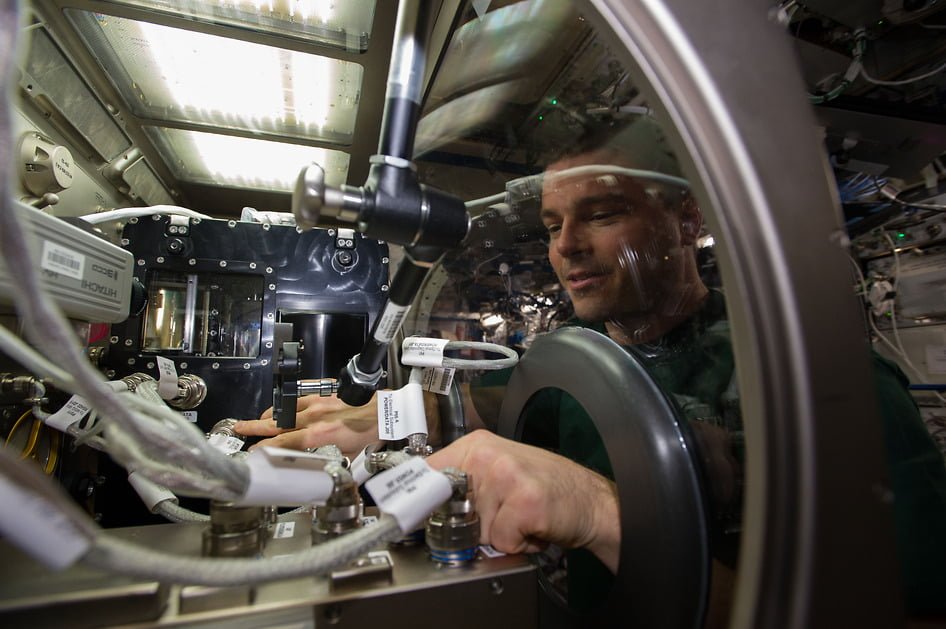
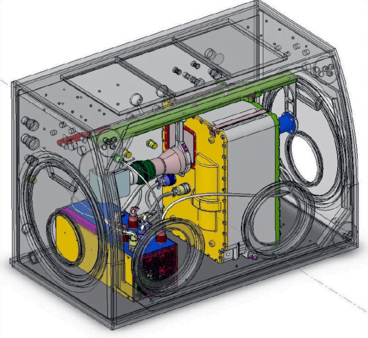
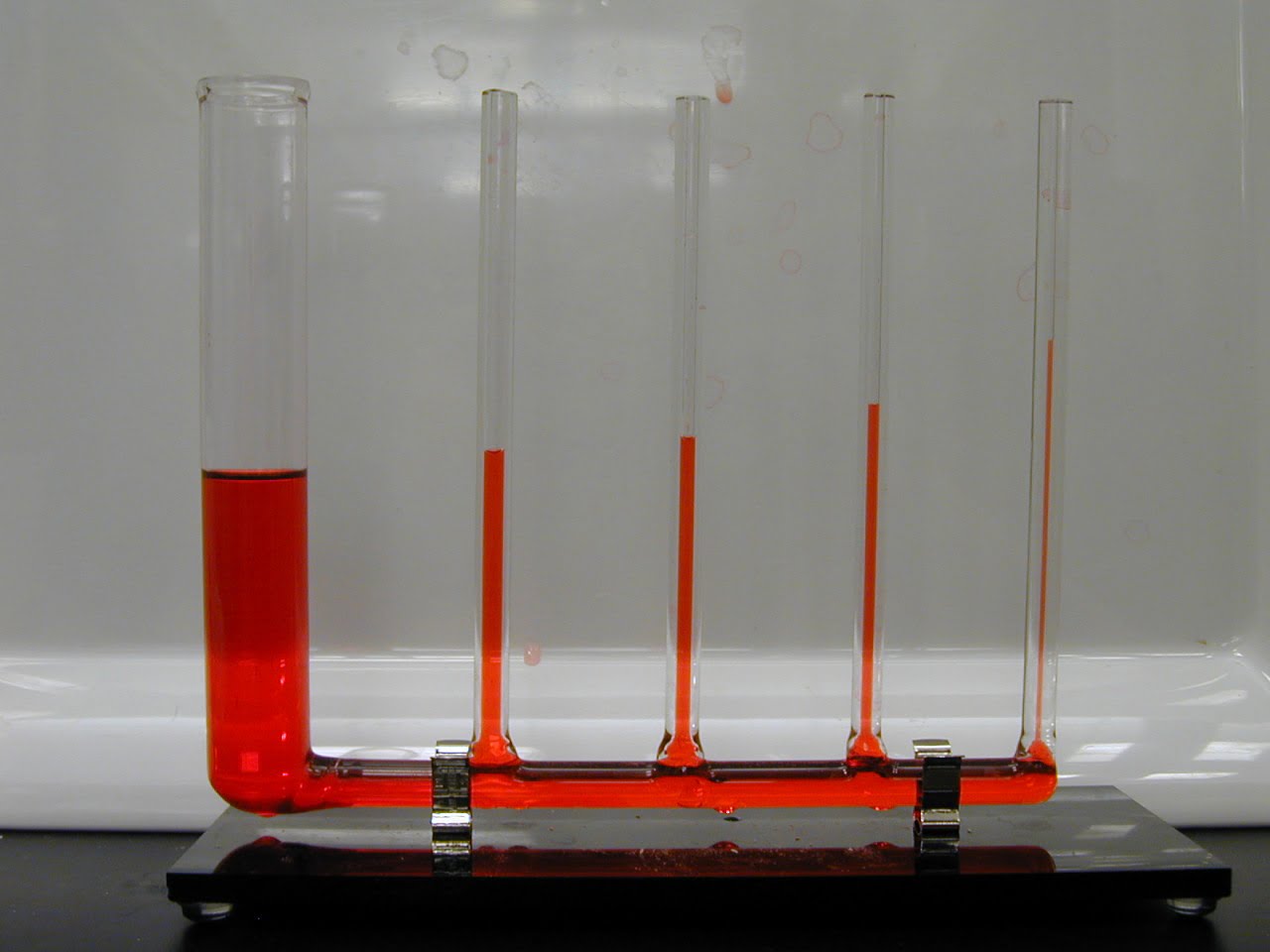
Moving fluids around in microgravity can be a challenge. On Earth we experience buoyancy and other gravitational effects that dominate how fluids move. In space, on the other hand, the only options are to move fluids mechanically with pumps or fans or to use capillary action. Even on earth, adhesive forces between a liquid and its solid container can draw fluids in narrow tubes upward against the force of gravity. In microgravity, this capillary flow can be even more effective. But the best way to study and understand this flow regime is to do so in space. The Capillary Channel Flow experiment and similar studies have allowed astronauts on the space station and researchers back on Earth to explore the effects of capillary action on microgravity fluid transport. The results will be used to improve propulsion systems, heat exchangers, and life support systems used in space. (Photo credits: NASA, M. Dreyer et al., and A. Agrawala; submitted by jshoer)

Fluid Fingers
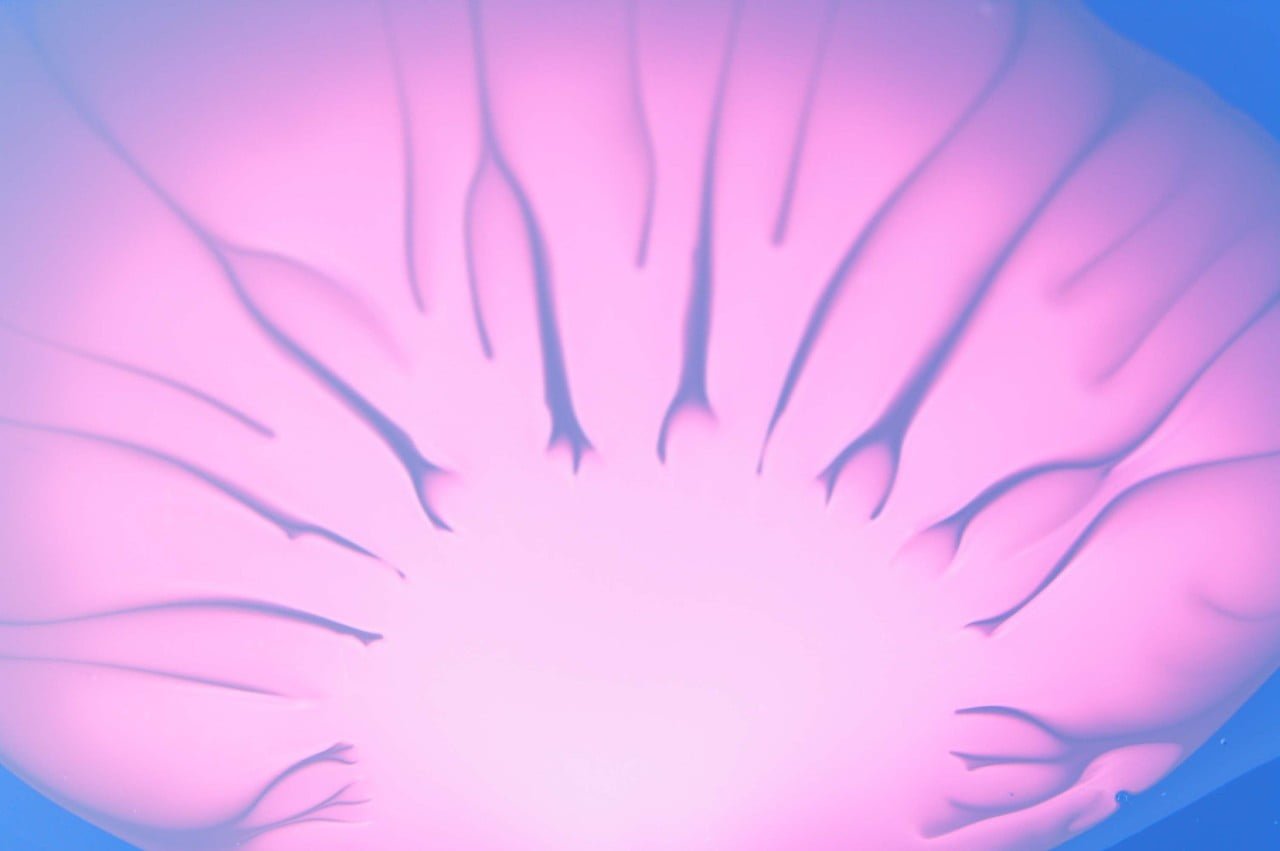
Differences in viscosity or surface tension between two fluids can lead to finger-like instabilities. Here food dye placed on corn syrup forms narrow tendrils driven by the differing surface tensions of the two liquids. Similar dendritic shapes can be generated by injecting a low viscosity fluid into a high viscosity one (Saffmann-Taylor instability) or by pulling apart glass plates sandwiched around a high viscosity fluid. (Photo credit: T. Gaskill et al.)

What’s in a Splash?
A droplet falling onto a solid, dry surface seems like a simple situation, one that would be easy to understand. But splashes can be unpredictable. Velocity, viscosity, and surface tension all play clear roles, but the surrounding air also has an impact – drop the air pressure low enough and a droplet won’t splash. A new paper has tackled the problem, producing a mathematical model in agreement with experimental results. So why do some drops splash and others don’t? When a drop falls, its momentum flattens it into a pancake shape while surface tension struggles to hold it together. The spreading edge, called the lamella, can pull away from the surface. When it does, a pocket of high pressure forms beneath it due to lubrication effects, and the faster airflow over the top of the lamella creates a suction effect. This is analogous to a wing producing lift. Like the momentum that spread the droplet, the lift force pulls the lamella and ejecta sheet further up and outward, overcoming the restoring force of surface tension and tearing the droplet apart. For more on the effect, check out the research paper or this Inside Science article. (Video credit: G. Riboux and J. Gordillo; via Inside Science)

Champagne Bubble Physics
Champagne is well-known for its effervescence, but its tiny bubbles do more than affect your sensation when sipping. Champagne bubbles form when carbon dioxide dissolved in the wine nucleates along imperfections in the glass. Buoyancy causes them to flow upwards, growing as they pull more carbon dioxide from the surrounding champagne. When the bubbles reach the surface, they pop, sending an almost imperceptible fountain of tiny droplets into the air, as seen in the photo above. You can sometimes feel the droplets if you hold a glass near your face. The droplets released from the bursting champagne bubbles spread the aroma of the wine, imparting additional flavor through our olfactory sense. (Photo credit: F. Beaumont et al.)
Healing Bubbles
Soap bubbles are ephemeral creations. The slightest prick will send them tearing apart in the blink of an eye. It may come as a surprise, therefore, that dropping a water droplet through a bubble will not break it. Instead, the bubble will heal itself using the Marangoni effect. In a soap bubble, the soap molecules act as a surfactant, lowering the surface tension of the water and allowing the fragile structure to hold together. When the water drop impacts the bubble, the local surface tension increases because of the relative lack of soap molecules. This increase in surface tension pulls at the rest of the bubble, drawing more soap molecules toward the point of contact. The effect evens out surface tension across the surface and stabilizes the bubble. You can test the effect at home, too. If you wet your finger, you can poke a soap bubble without popping it. (Video credit: G. Mitchell; via io9)

Pyrocumulus Clouds

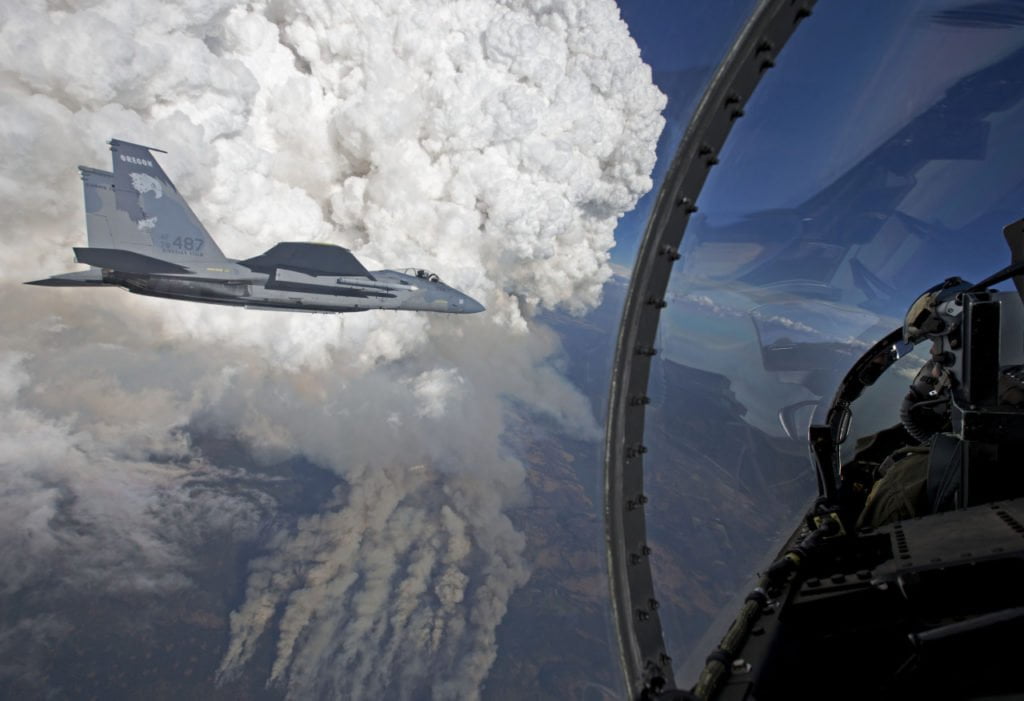
Pyrocumulus clouds tower tall above a wildfire in these photos taken last week from an Oregon National Guard F-15C. Most cumulus clouds form when the sun-warmed surface heats air, causing it to rise and carry moisture upward where it condenses to form clouds. In pyrocumulus clouds, the driving heat is supplied by a forest fire or volcanic eruption. The hot, rising air carries smoke and soot particles upward, where they become nucleation sites for condensation. Pyrocumulus clouds can be especially turbulent, and the gusting winds they produce can exacerbate wildfires. In some cases, the clouds can even develop into a pyrocumulonimbus thunderstorm with rain and lightning. (Photo credit: J. Haseltine; via NASA Earth Observatory)
How Patterns Repel Water
Superhydrophobic surfaces repel water. Both naturally occurring and manmade materials with this property share a common feature: micro- or nanoscale structures on their surface. Lotus and lily leaves are coated with tiny hairs, and synthetic coatings or micro-manufactured surfaces like the one in the video above can be made in the lab. This nanoscale roughness traps air between the surface and the water, preventing adhesion to the surface and enabling the water-repelling behavior we observe at the human scale. Although effective, these nanoscale structures are also extremely delicate, which makes widespread application of superhydrophobic coatings and textures difficult. (Video credit: G. Azimi et al.)

Does Liquid in a Vacuum Boil or Freeze?
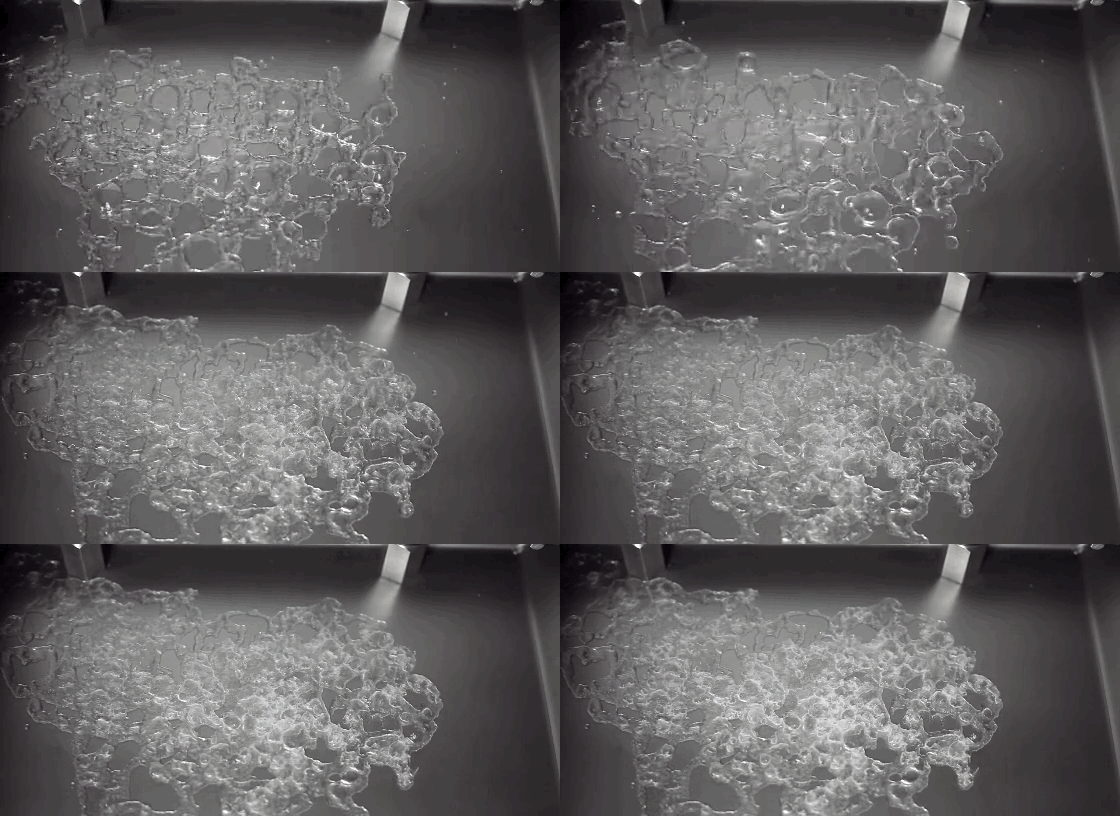


What happens to a liquid in a cold vacuum? Does it boil or freeze? These animations of liquid nitrogen (LN2) in a vacuum chamber demonstrate the answer: first one, then the other! The top image shows an overview of the process. At standard conditions, liquid nitrogen has a boiling point of 77 Kelvin, about 200 degrees C below room temperature; as a result, LN2 boils at room temperature. As pressure is lowered in the vacuum chamber, LN2’s boiling point also decreases. In response, the boiling becomes more vigorous, as seen in the second row of images. This increased boiling hastens the evaporation of the nitrogen, causing the temperature of the remaining LN2 to drop, the same way sweat evaporating cools our bodies. When the temperature drops low enough, the nitrogen freezes, as seen in the third row of images. This freezing happens so quickly that the nitrogen molecules do not form a crystalline lattice. Instead they are an amorphous solid, like glass. As the residual heat of the metal surface warms the solid nitrogen, the molecules realign into a crystalline lattice, causing the snow-like flakes and transition seen in the last image. Water can also form an amorphous ice if frozen quickly enough. In fact, scientists suspect this to be the most common form of water ice in the interstellar medium. (GIF credit: scientificvisuals; original source: Chef Steps, video; h/t to freshphotons)
Paint on Speakers


Paint seems to dance and leap when vibrated on a speaker. Propelled upward, the liquid stretches into thin sheets and thicker ligaments until surface tension can no longer hold the the fluid together and droplets erupt from the fountain. Often paints are shear-thinning, non-Newtonian fluids, meaning that their ability to resist deformation decreases as they are deformed. This behavior allows them to flow freely off a brush but then remain without running after application. In the context of vibration, though, shear-thinning properties cause the paint to jump and leap more readily. For more images, see photographer Linden Gledhill’s website. (Photo credit: L. Gledhill; submitted by pinfire)