
Joint popping is one of those things some people revel in and others detest. What you may not have realized, though, is that fluid dynamics are responsible for the sound. Joints contain a non-Newtonian liquid called synovial fluid to lubricate them. When you manipulate the joint to stretch it, pressure in the fluid drops and gases dissolved in the synovial fluid are released, forming a cavitation bubble. The creation and collapse of this bubble are what cause the audible popping. (Video credit: SciShow)
Tag: physics

Reader Question: Winglets
Reader tvargo writes:
First off… love your blog! I know very little about physics, but love reading about it. Could you potentially explain what the little upturned ends of wings do? looking on wikipedia is see this: “There are several types of wingtip devices, and although they function in different manners, the intended effect is always to reduce the aircraft’s drag by partial recovery of the tip vortex energy.” huh?
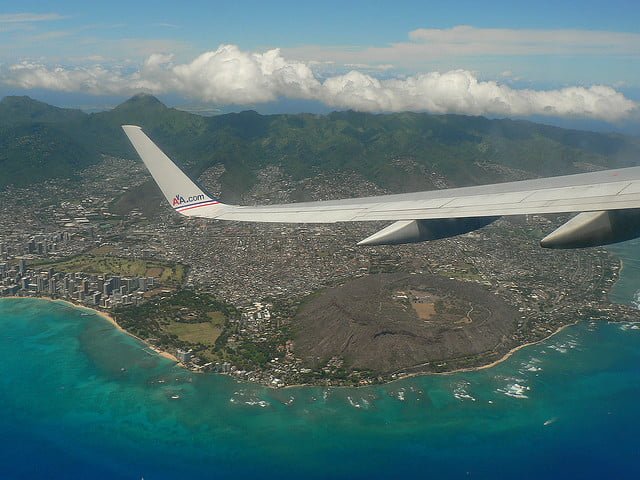
Thanks! That’s a great question. Winglets are very common, especially on commercial airliners. To understand what they do, it’s helpful to first think about a winglet-less airplane wing. Each section of the wing produces lift. For a uniform, infinite wing, the lift produced at each spanwise location would be the same. In reality, though, wings are finite and wingtip vortices at their ends distort the flow. The vortices’ upward flow around the ends of the wing reduces the lift produced at the wing’s outermost sections, making the finite wing less efficient (though obviously more practical) than an infinite wing.
Adding a winglet modifies the end conditions, both by redirecting the wingtip vortices away from the underside of the wing and by reducing the strength of the vortex. Both actions cause the winglet-equipped wing to produce more lift near the outboard ends than a wing without winglets.
But why, you might ask, does the Wikipedia explanation talk about reducing drag? Since a finite wing produces less lift than an infinite one, finite wings must be flown at a higher angle of attack to produce equivalent lift. Increasing the angle of attack also increases drag on the wing. (If you’ve ever stuck a tilted hand out a car window at speed, then you’re familiar with this effect.) Because the winglet recovers some of the lift that would otherwise be lost, it allows the wing to be flown at a lower angle of attack, thereby reducing the drag. Thus, overall, adding winglets improves a wing’s efficiency. (Photo credit: C. Castro)

The Real Shape of Raindrops
We often think of raindrops as spherical or tear-shaped, but, in reality, a falling droplet’s shape can be much more complicated. Large drops are likely to break up into smaller droplets before reaching the ground. This process is shown in the collage above. The initially spherical drops on the left are exposed to a continuous horizontal jet of air, similar to the situation they would experience if falling at terminal velocity. The drops first flatten into a pancake, then billow into a shape called a bag. The bags consists of a thin liquid sheet with a thicker rim of fluid around the edge. Like a soap bubble, a bag’s surface sheet ruptures quickly, producing a spray of fine droplets as surface tension pulls the damaged sheet apart. The thicker rim survives slightly longer until the Plateau-Rayleigh instability breaks it into droplets as well. (Image credit: V. Kulkarni and P. Sojka)

Rotational Effects
Rotation can cause non-intuitive effects in fluid dynamical systems. UCLA Spinlab’s newest video tackles the problem using four demonstrations. The first two deal with droplets released in air, first in a non-rotating environment and then in a rotating one. As one would expect, in a non-rotating environment, droplets fall through the tank in a straight line. When rotating, though, the droplets follow a deflected, straight-line path due to centrifugal effects. This is the same as the way passengers in a car feel like they’re being thrown to the outside of a turn on a curvy road. When the experiment is repeated with a tank of water instead of air, the results are different. The densities of the creamer and water are much closer to one another, so the droplet falls much slower than before. The tank now rotates faster than time it takes the drop to fall. This smaller timescale means that the droplet experiences more acceleration from Coriolis forces than centrifugal forces in the rotating tank of water. Thus, instead of being thrown outward, the drop now forms a column aligned with the axis of rotation. (Video credit: UCLA Spinlab; submitted by Jon B.)
4th Birthday: Mantis Shrimp
Undoubtedly one of the most mind-boggling instances of fluid dynamics I’ve learned about in writing FYFD is that of sonoluminescence – an effect in which light is produced from imploding cavitation bubbles. In a laboratory, the effect is usually initiated with acoustic waves. A bubble can be forced to oscillate and collapse periodically when forced by the sound. During the collapse, the vapor inside the bubble reaches temperatures of the order of thousands of Kelvin, and light is produced. What is far more wild, though, is that the effect occurs in nature as well. Both the pistol shrimp and the mantis shrimp produce the effect. As shown in the video above, the mantis shrimp swings its club-like arm with such speed that the local pressure drops below the vapor pressure, causing a cavitation bubble to form and sonoluminescence to occur. Some real Mortal Kombat finishing move s&#% there, indeed. (Video credit: Z. Frank)

Nautilus Article
Spend an hour watching the clouds roll overhead and no two of them will be the same. The complexity and dynamic motion of turbulence make these flows fascinating, even mesmerizing, to watch. Humans are a pattern-seeking species. We like to seek order in apparent chaos, and this, perhaps, is what makes turbulence such a captivating subject for scientists and artists alike.
Nicole Sharp, “The Beautiful Unpredictability of Coffee, Clouds, and Fire”
Something a little different today. I have a guest post over at Nautilus about looking for patterns in turbulence. Go check it out!
4th Birthday: Rogue Waves
Rogue waves—individual, isolated waves far larger than the surrounding waves—were reported for centuries by sailors. But their stories of massive walls of water appearing in the open ocean were not corroborated until 1995 when a rogue wave struck an offshore platform. How these giant waves form is still under active research, but one leading theory is that nonlinear interactions between waves allow one wave to sap energy from surrounding waves and focus it into one much larger, short-lived wave. I first learned of rogue waves during a seminar in graduate school. At the time, this idea of nonlinear focusing had only been explored in simulation, but a few years later a research group was able to demonstrate the effect in a wave tank, as shown in the video above. Wait for the end, and you’ll notice how the rogue wave that takes down the ship is much larger than its predecessors. For more on rogue waves and their mind-boggling behavior, be sure to check my previous post on the subject. (Video credit: A. Chabchoub, N. Hoffmann, and N. Akhmediev)
4th Birthday: The Kaye Effect
Today’s post continues my retrospective on mind-boggling fluid dynamics in honor of FYFD’s birthday. This video on the Kaye effect was one of the earliest submissions I ever received–if you’re reading this, thanks, Belisle!–and it completely amazed me. Judging from the frequency with which it appears in my inbox, it’s delighted a lot of you guys as well. The Kaye effect is observed in shear-thinning, non-Newtonian fluids, like shampoo or dish soap, where viscosity decreases as the fluid is deformed. Like many viscous liquids, a falling stream of these fluids creates a heap. But, when a dimple forms on the heap, a drop in the local viscosity can cause the incoming fluid jet to slip off the heap and rebound upward. As demonstrated in the video, it’s even possible to create a stable Kaye effect cascade down an incline. (Video credit: D. Lohse et al.)

4th Birthday: Wingtip Vortices


Wingtip vortices are a result of the finite length of a wing. Airplanes generate lift by having low-pressure air travelling over the top of the wing and higher pressure air along the bottom. If the wing were infinite, the two flows would remain separate. Instead, the high-pressure air from under the wing sneaks around the wingtip to reach the lower pressure region. This creates the vorticity that trails behind the aircraft. I was first introduced to the concept of wingtip vortices in my junior year during introductory fluid dynamics. As I recall, the concept was utterly bizarre and so difficult to wrap our heads around that everyone, including the TA, had trouble figuring out which way the vortices were supposed to spin. A few good photos and videos would have helped, I’m sure. (Photo credits: U.S. Coast Guard, S. Morris, Nat. Geo/BBC2)
4th Birthday: Intro
Next week marks FYFD’s 4th birthday! It’s hard to believe that it’s been so long, or that the blog and I have come so far. I set out with the intention of explaining fluid dynamics to a broad audience because it’s a subject we all experience daily and yet one that few learn formally. (I also, as you may have guessed from the blog’s name, didn’t take things too seriously.) Many things have surprised me these past four years, but one of my favorites is how much I’ve learned. In researching and writing FYFD, I am constantly learning new and fascinating physics. I love it every time something new stuns me with its beauty, its cleverness, or its jaw-dropping, mind-blowing awesomeness. In celebration of that feeling, next week’s posts will revisit some of my favorite subjects, especially those that did and do amaze me. In the meantime, try not to let the ice cream melt. Unless you’re into that. (Video credit: I. Yang; submitted by Stuart B.)


.svg)
.svg)