A falling column of liquid, like the water from your faucet, will tend to break up into a series of droplets due to the Plateau-Rayleigh instability. This instability is driven by surface tension. Small variations in the radius of the column occur naturally. Where the radius shrinks, the pressure due to surface tension increases, causing liquid to flow away, which shrinks the column’s radius even further. Eventually the column pinches off and breaks into droplets. What’s especially neat is that the size of the final droplets can be predicted based on the column’s initial radius and the wavelength of its disturbances. (Video credit: BYU Splash Lab)
Tag: jets

Mercedes-Benz Tornado


The world’s most powerful artificial tornado is part of the Mercedes-Benz Museum in Stuttgart, Germany. Though popular enough with visitors that the staff will bring out smoke generators to make it visible, the tornado was not built as an attraction – It’s actually part of the building’s fire protection system. The modern open design of the museum meant that conventional smoke removal systems were inadequate. Instead vorticity is generated in the central lobby with 144 wall-mounted jets. The angular velocity created by the jets is strongest at the middle, in the vortex core, due to conservation of angular momentum – exactly the way a spinning ice skater speeds up by pulling his arms in. The core of the vortex is a low pressure area, which draws outside air toward it – this is how the tornado pulls in smoke when there is a fire. The fan on the ceiling provides the pressure draw necessary for the smoke to be pulled up and out of the building at a supposed rate of 4 tons per minute. See the tornado in action here. (Photo credit: Mercedes-Benz Passion; submitted by Ivan)

Bottle Rocket Shock Waves
This high speed video shows schlieren photography of a bottle rocket’s exhaust. The supersonic CO2 leaving the nozzle is underexpanded, meaning its pressure is still higher than the ambient atmosphere. As a result, a series of diamond-shaped shock waves and expansion fans appear in the exhaust jet. Each shock and expansion changes the pressure of the exhaust until it ultimately reaches the same pressure as the ambient air. This distinctive pattern, also known as Mach diamonds or shock diamonds, often occurs in wake of rockets. (Video credit: P. Peterson and P. Taylor)

Egg-Spinning Fun
If you have any leftover hard-boiled eggs, you can recreate this bit of fluid dynamical fun. Spin the egg through a puddle of milk, and you’ll find that the egg draws liquid up from the puddle and flights it out in a series of jets. As the egg spins, it drags the milk it touches with it. Points closer to the egg’s equator have a higher velocity because they travel a larger distance with each rotation. This variation in velocities creates a favorable pressure gradient that draws milk up the sides of the egg as it spins, creating a simple pump. To see the effect in action check out this Science Friday video or the BYU Splash Lab’s Easter-themed video. (Photo credit: BYU Splash Lab)
Gravity’s Effect on Bursting Bubbles
In a gravitational field, the pressure in a fluid increases with depth. You can consider it due to the weight of the fluid above. Outside of scuba diving or hiking at altitude, this effect is not one typically given much thought. But what effect can it have at a smaller scale? This video shows the collapse and rebound of three initially spherical cavitation bubbles inside a liquid. Each bubble is created in a different gravitational field – one in microgravity, one in normal gravity, and one at 1.8x Earth gravity. The bubble in microgravity remains axisymmetric and spherical, but the two bubbles recorded in gravitational fields develop jets during rebound. Even at a scale of only a few millimeters, gravity causes an imbalance in pressure across the bubble that creates asymmetry. (Video credit: D. Obreschkow et al.)
“Frozen” Water Stream
We saw previously how vibrating a falling stream of water and filming it with a matching camera frame rate appears to “freeze” the falling liquid. This video shows the same illusion, now with a 24 Hz sine wave, which the falling water mimics. Vibrating the speaker that drives the water stream slightly slower or slightly faster than the camera frame rate makes the water appear to slowly fall or rise relative to its “frozen” wave state. This is a beat effect caused by the slight difference in frequency between the water and the camera. (Video credit: brusspup; via BoingBoing; submitted by many readers)
Tuning Fork Fluids
This high-speed video shows a liquid crystal fluid vibrating on a tuning fork. As the surface moves, tiny jets shoot upward, sometimes with sufficient energy that the fluid column is stretched beyond surface tension’s ability to keep it intact, resulting in droplet ejection. The jets and surface waves create a mesmerizing pattern of fluid motion. (Video credit: J. Savage)

Fishbones
When two liquid jets collide, they can form an array of shapes ranging from a chain-like stream or a liquid sheet to a fishbone-type structure of periodic droplets. This series of images show the collision of two viscoelastic jets–in which polymer additives give the fluids elasticity properties unlike those of familiar Newtonian fluids like water. The jet velocities increase with each image, changing the behavior from a fluid chain (a and b); to a fishbone structure (c and d); to a smooth liquid sheet (e); to a fluttering sheet (f and g); to a disintegrating ruffled sheet (h), and finally a violently flapping sheet (i and j). The behavior of such jets is of particular interest in problems of atomization, where it can be desirable to break an incoming stream of liquid up into droplets as quickly as possible. (Photo credit: S. Jung et al.)

Plasma Jets
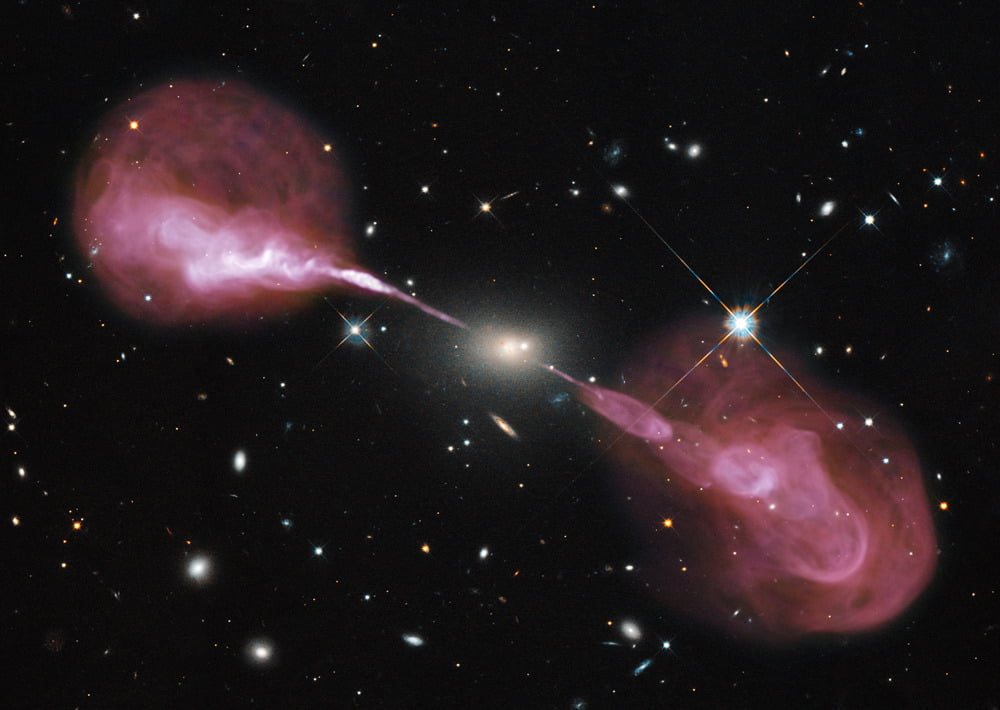
Jets of high-energy plasma and sub-atomic particles explode outward from the Hercules A elliptical galaxy at the center of this photo. The jets are driven to speeds close to that of light due to the gravitation of the supermassive black hole at the center of the elliptical galaxy. Relativistic effects mask the innermost portions of the jets from our view, but, as the jets slow, they become unstable, billowing out into rings and wisps whose turbulent shapes suggest multiple outbursts originating from Hercules A. (Photo credit:NASA, ESA, S. Baum and C. O’Dea (RIT), R. Perley and W. Cotton (NRAO/AUI/NSF), and the Hubble HeritageTeam (STScI/AURA); via Discovery)
Surface Explosions
Underwater explosions often behave non-intuitively. Here researchers explore the effects of surface explosions by setting off charges at the air/water interface. Initially, an unconfined explosion’s blast wave expands a cavity radially into the water. This cavity collapses back toward the surface from the bottom up, ultimately resulting in a free jet that rebounds above the water level. Confined explosions behave very differently, expanding down the glass tube containing them in a one-dimensional fashion. The cavity never extends beyond the end of the glass tube, likely due to hydrostatic pressure. (Video credit: Adrien Benusiglio, David Quéré, Christophe Clanet)