When a liquid jet falls into a pool, air is often entrained along with the liquid, creating a cavity and, often, bubbles. Shown above is video of a low-speed laminar jet entering a quiescent pool. The jet appears to entrain a thin film of gas, which then breaks up in a three-dimensional fashion, despite the symmetry of the incoming jet. As the speed of the incoming jet is increased and turbulence is introduced, the resulting air entrainment becomes violent and chaotic. For additional information and videos, see Kiger and Duncan 2012 and their supplemental videos. (Video credit: K. Kiger and J. Duncan)
Tag: jets

Rocket Exhaust
A fiery jet of exhaust remains amid plumes of smoke as a Soyuz rocket lifts off from Baikonur Cosmodrome bound for the International Space Station. The lengthscales of such turbulence range from tens of meters to only millimeters, highlighting the incredible difficulty of accurately capturing and describing the fluid motion of a practical engineering problem. (Photo credit: NASA/Carla Cioffi; via Visual Science)

The Supersonic Plonk
Everyone knows the familiar plonk of a stone falling into a pond but few realize the complexity of the physics. When a solid object falls into a pool, a sheet of liquid, the crown splash, is sent upward. Simultaneously, the object pulls a cavity of air down with it. As the water moves inward, this cavity is pinched, creating an hourglass-like shape reminiscent of the shape of a rocket’s nozzle. As the diameter of that pinched cavity shrinks, the velocity of the upward escaping air increases, resulting in the formation of an air jet moving faster than the speed of sound. This air jet is followed by a slower liquid jet that may rebound to a height higher than then original height of the dropped object. So next time you throw a stone into a pond, enjoy the knowledge that you’ve broken the sound barrier. (Photo credit: D. van der Meer; see also Physics World)

Bubbles and Jets

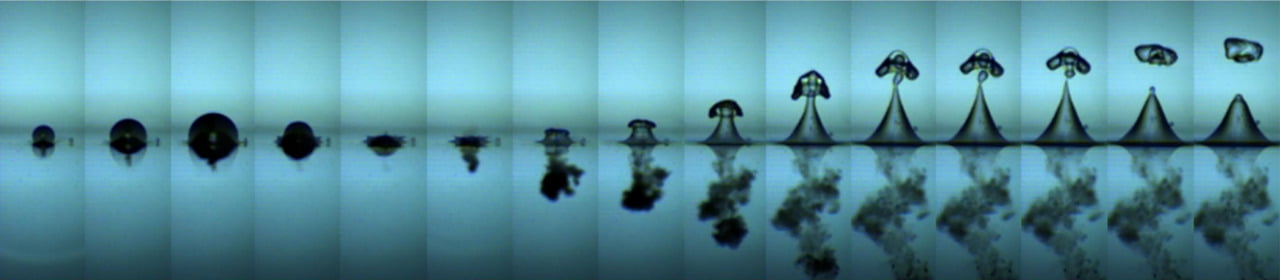
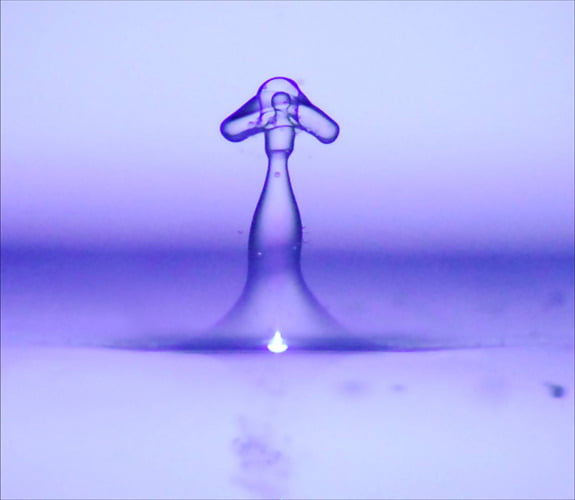
In the photo sequence above, a bubble is created at the interface between two immiscible liquids–water on top and denser hydrofluroether (HFE) below. Initially, the bubble expands explosively due to the vaporization of water generated by a short laser pulse. As the bubble collapses, a jet forms and accelerates into the HFE. After collapse, the bubble remnants injected in the HFE cause the formation of a jet that shoots back into the water above. Surface instabilities make the jet assume a mushroom or crown-like structure that detaches from the jet. Eventually gravity will return the system to its initial undisturbed fluid-fluid interface. (Photo credit: S. Avila et al. 1,2)

Astro Puffs
Microgravity continues to be a fascinating playground for observing surface tension effects on the macroscale without pesky gravity getting in the way. Here astronaut Don Pettit has created a sphere of water, which he then strikes with a jet of air from a syringe. Initially, the momentum from the jet of air creates a sharp cavity in the water, which rebounds into a jet of water that ejects one or more satellite drops. Surface waves and inertial waves (inside the water sphere) reflect back and forth until the fluid comes to rest as a sphere once more. Note how similar the behavior is to the pinch-off of a water column. Both effects are dominated by surface tension, but on Earth we can only see this behavior with extremely small droplets and high-speed cameras! (Video credit: Don Pettit, Science Off the Sphere)
Pinch-Off
This high-speed video reveals a fascinating bit of kitchen sink physics. When a water droplet pinches off from the nozzle, the thin filament of fluid that connected the droplet to the water on the nozzle often breaks off as well. Surface tension snaps the filament together into a sphere, causing wild oscillations and even ejection of microjets in the tiny satellite droplet. (Video from S. Thoroddsen et al. 2008’s Annual Review)

Splash Rebound
A ball dropped onto a puddle loses some of its rebound momentum to fluid motion. On impact, a splash curtain and radial jet form as the fluid is displaced by the ball. As the ball rebounds, the splash curtain is drawn inward into a column of fluid drawn up by the ball, reminiscent of the way cats and dogs drink. Eventually, when the gravity’s force on the fluid column overcomes the force of the ball’s inertia, the fluid column pinches off and falls back downwards, leaving the ball free to utilize its remaining kinetic energy as it flies upward. (Photo credit: T. Killian, K. Langley, and T. Truscott)

Floral Still Life


Fluid motion is captured as a floral still life in these high-speed photos by Jack Long. The artist keeps mum about his set-up but notes that these are single capture events, not constructed composites. It looks as if the blossoms are created from the impact of a falling fluid with the upward jet that forms the stem. The leaves and vase appear to be created from upward splashes, but whether those are generated by vibration or dropping an object is unclear. See Long’s Flickr page for more. (Photo credit: Jack Long via Gizmodo)
Jet Collisions
When two jets of liquid collide, they form a sheet of fluid. As the speeds of the jets change, the sheet can become unstable, forming a set of liquid ligaments and droplets that look like a fish’s bones. This is shown in the video above. For purposes of orienting yourself, flow in the video is moving right to left and the video has been rotated 90-degrees clockwise (i.e. the two out-of-frame jets forming the flow seen are falling due to gravity). (Video credit: Sungjune Jung, University of Cambridge)
Bursting Bubbles
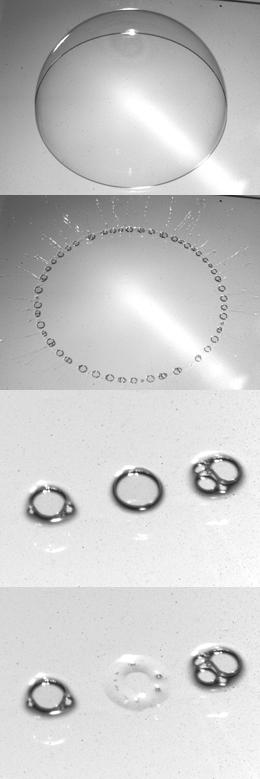
Sometimes bursting one bubble just leads to more bubbles. This high-speed video shows how popping a bubble sitting on a fluid surface can lead to a ring of daughter bubbles. When the surface of the bubble is ruptured, filaments of the liquid that made up the surface are drawn back toward the pool by surface tension, trapping small pockets of the air that had been inside the bubble. A dimple forms on the surface and rebounds as a jet that lacks the kinetic energy to eject droplets. Watch as the jet returns to the interface, and you will notice the tiny bubbles around it. At 56 ms, one of the daughter bubbles on the left bursts. See Nature for more. (Video credit: J. Bird et al)