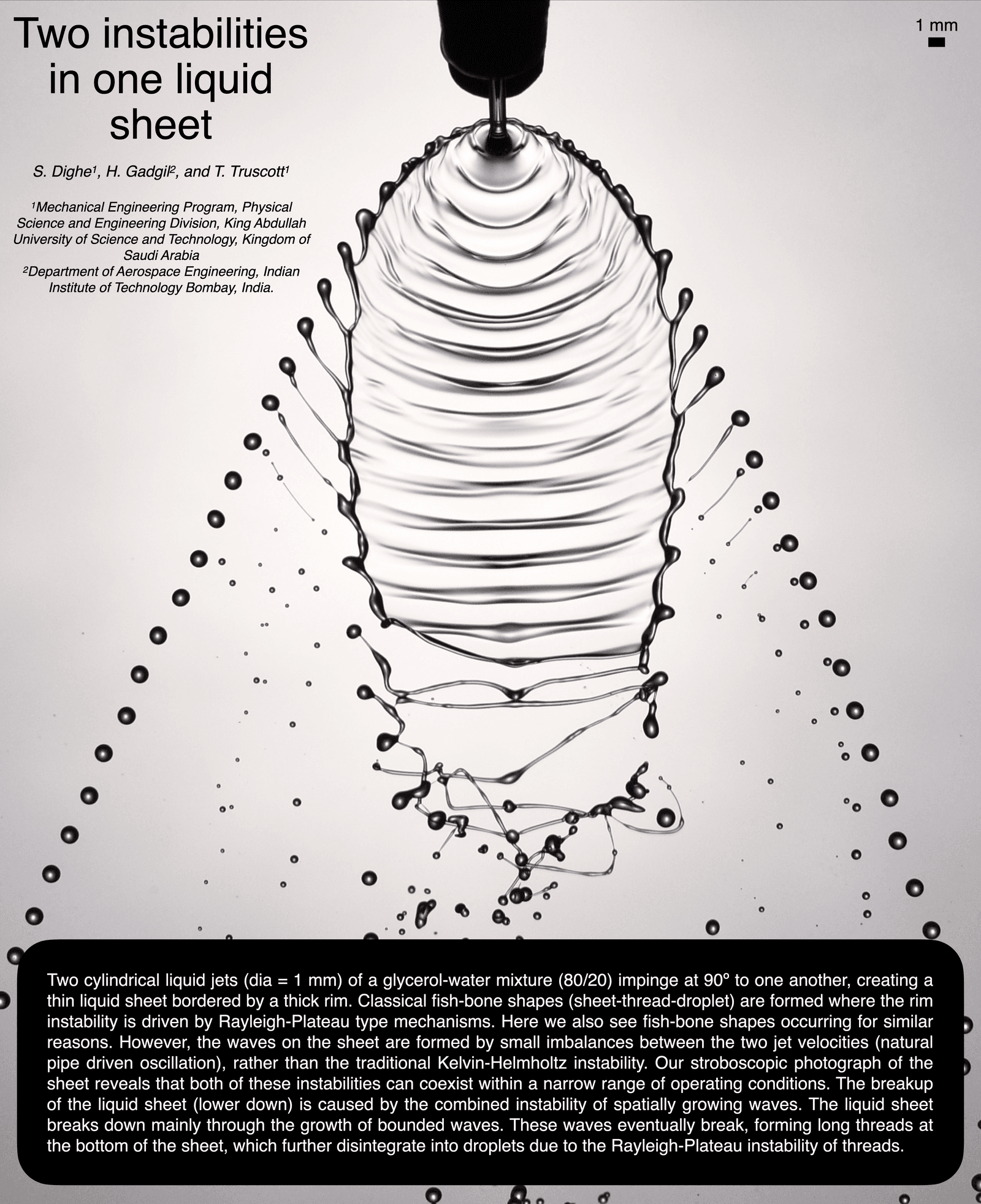
When two liquid jets collide, they form a thin liquid sheet with a thicker rim. That rim breaks into threads and then droplets, forming a well-known fishbone pattern as the Plateau-Rayleigh instability breaks up the flow. This poster shows a twist on that set-up: here, the two colliding jets vary slightly in their velocities. That variability adds a second instability to the system, visible as the wavy pattern on the central liquid sheet. The sheet’s rim still breaks apart in the usual fishbone pattern, but the growing waves in the center of the sheet eventually that structure apart as well. (Image credit: S. Dighe et al.)
Tag: fishbone

Fluid Chains


In this video, Steve Mould tackles a question many of us have likely wondered: just why does falling water make this chain-like shape? When pouring from a slit-like orifice, water jets take on this undulating pattern. While I have no issue with Steve’s explanation of surface tension oscillations driving the shape, I’ll quibble a little bit with the idea that this hasn’t been studied. Personally, I’d connect it to the fishbone instability, which classically occurs when two jets collide. At low flow rates, though, the colliding jets form a pattern very much like this one. And if you look just past the initial conditions at the container opening, all of these flows have thicker jet-like rims colliding. I think the flows in these videos are just a slightly messier version of the low-flow-rate fishbone. What do you think? (Video and image credit: S. Mould)

The Fishbone
The simple collision of two liquid jets can form striking and beautiful patterns. Here the two jets strike one another diagonally near the top of the animation. One is slanted into the screen; the other slants outward. At their point of contact, the liquid spreads into a sheet and forms what’s known as a fishbone pattern. The water forms a thicker rim at the edge of the sheet, and this rim destabilizes when surface tension can no longer balance the momentum of the fluid. Fingers of liquid form along the edge, stretching outward until they break apart into droplets. Ultimately, this instability tears the liquid sheet apart. Under the right conditions, all kinds of beautiful shapes form in a system like this. (Image credit: V. Sanjay et al., source)
When Jets Collide
When two jets of a viscous liquid collide, they can form a chain-like stream or even a fishbone pattern, depending on the flow rate. This video demonstrates the menagerie of shapes that form not only with changing flow rates but by changing how the jets collide – from a glancing impingement to direct collision. When just touching, the viscous jets generate long threads of fluid that tear off and form tiny satellite droplets. At low flow rates, continuing to bring the jets closer causes them to twist around one another, releasing a series of pinched-off droplets. At higher flow rates, bringing the jets closer to each other creates a thin webbing of fluid between the jets that ultimately becomes a full fishbone pattern when the jets fully collide. The surface-tension-driven Plateau-Rayleigh instability helps drive the pinch-off and break-up into droplets. (Video credit: B. Keshavarz and G. McKinley)
Bubbles With Tails
In water and other Newtonian fluids, a rising bubble is typically spherical, but for non-Newtonian fluids things are a different story. In non-Newtonian fluids the viscosity–the fluid’s resistance to deformation–is dependent on the shear rate and history–how and how much deformation is being applied. For rising bubbles, this can mean a teardrop shape or even a long tail that breaks up into fishbone-like ligaments. The patterns shown here vary with the bubble’s volume, which affects the velocity at which it rises (due to buoyancy) and thus the shear force the bubble and surrounding non-Newtonian fluid experience. (Video credit: E. Soto, R. Zenit, and O. Manero)

Fishbones
When two liquid jets collide, they can form an array of shapes ranging from a chain-like stream or a liquid sheet to a fishbone-type structure of periodic droplets. This series of images show the collision of two viscoelastic jets–in which polymer additives give the fluids elasticity properties unlike those of familiar Newtonian fluids like water. The jet velocities increase with each image, changing the behavior from a fluid chain (a and b); to a fishbone structure (c and d); to a smooth liquid sheet (e); to a fluttering sheet (f and g); to a disintegrating ruffled sheet (h), and finally a violently flapping sheet (i and j). The behavior of such jets is of particular interest in problems of atomization, where it can be desirable to break an incoming stream of liquid up into droplets as quickly as possible. (Photo credit: S. Jung et al.)
Jet Collisions
When two jets of liquid collide, they form a sheet of fluid. As the speeds of the jets change, the sheet can become unstable, forming a set of liquid ligaments and droplets that look like a fish’s bones. This is shown in the video above. For purposes of orienting yourself, flow in the video is moving right to left and the video has been rotated 90-degrees clockwise (i.e. the two out-of-frame jets forming the flow seen are falling due to gravity). (Video credit: Sungjune Jung, University of Cambridge)

Colliding Jets


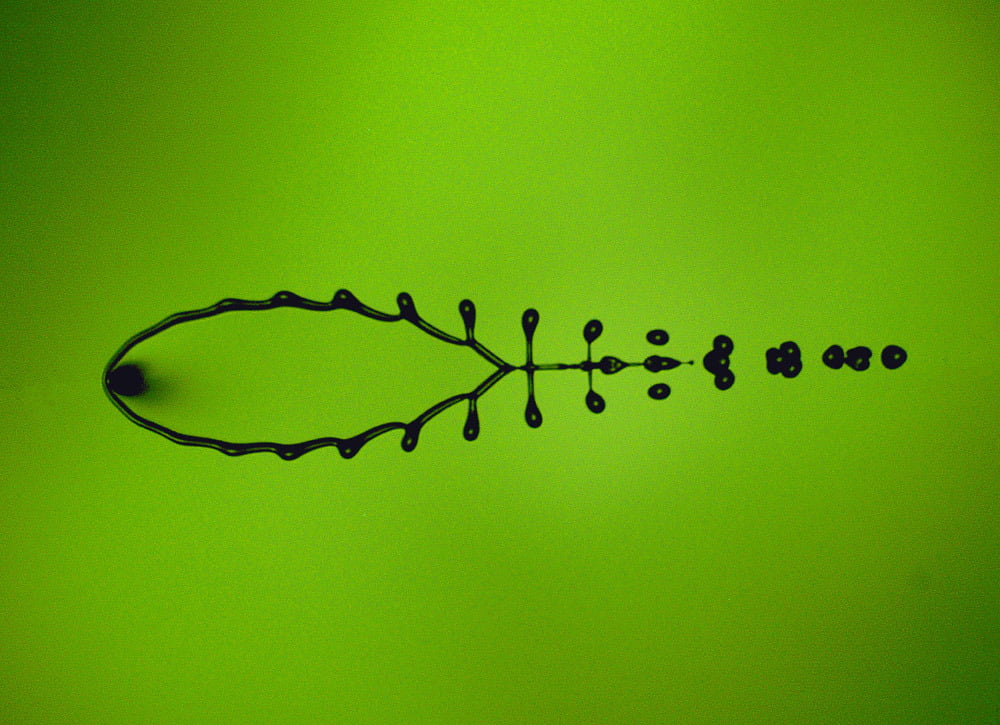
Two jets colliding can form a chain-like fluid structure. With increasing flow rate, the rim of the chains becomes wavy and unstable, forming a fishbone structure where droplets extend outward from the fluid sheet via tiny ligaments. Eventually, the droplets break off in a pattern as beautiful as it is consistent. (Photo credits: A. Hasha and J. Bush)

Colliding Jets
Two jets of sugar syrup collide and interact to form very different patterns. On the left, the two jets have a low flow rate and create a chain-like wake. The jets on the right have a higher flow rate and produce a liquid sheet that breaks down into filaments and droplets. The result is often likened to fish bones. (Photo credit: Rebecca Ing)

Fishbone Jet Collision
The collision of two jets of radius 420 μm results in a fishbone-like structure. The fluid contains a dilute polymer mixture whose viscoelastic effects resist the tendency of the droplets to detach from the ligaments. The breakup of the jets into droplets is important for applications in inkjet printing. The photo has been rotated 90-degrees for effect. (Photo credit: Sungjune Jung)