The pistol shrimp (or pistol crab) is a finger-sized crustacean with a fluid dynamical superpower. When it snaps its claw, a jet of water shoots out so quickly (62 mph) that a low-pressure bubble forms in its wake. When the bubble collapses, it emits a bang and a flash of light in a process known as sonoluminescence. The whole event takes less than 300 microseconds. The light emitted suggests that temperatures inside the bubble reach 5,000 degrees Kelvin, around the temperature of the surface of the sun. #
Tag: jets

Instability in a Jet
This photo shows the development of a flow instability in an axisymmetric jet. On the left, the jet is smooth and fully laminar, but, by the center of the photo, disturbances in the jet have grown large enough to distort the laminar profile. The jet is then in transition; by the right side of the frame, it has reached a turbulent state, as evidenced by the increased mixing (which causes the smoke to disperse more quickly) and intermittency of the flow. #

Colorful Computational Combustion
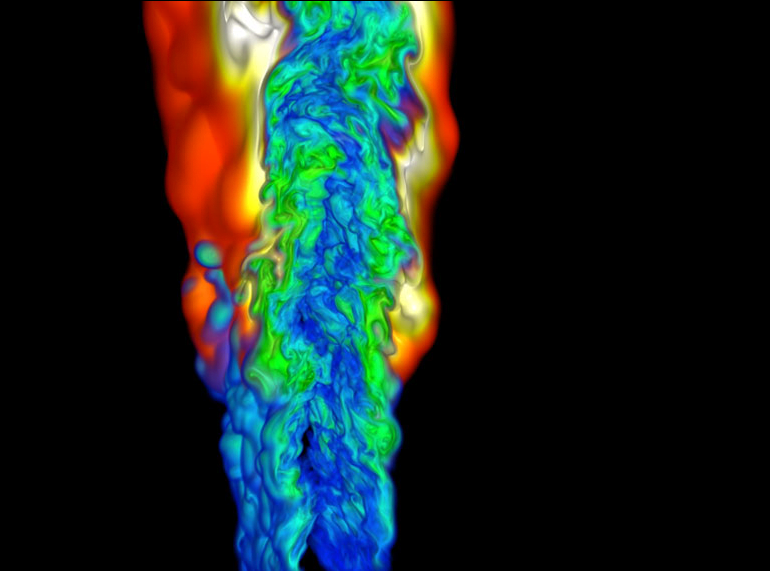
Many fluid dynamics problems are so complicated that they require supercomputers to calculate the mathematical and physical details. This image shows a computer simulation of a cold ethylene jet combusting in hot air. Different colors indicate different combustion by-products. Researchers use simulations like this one to investigate ideal flames that improve efficiency in applications like cars or jet engines. #
Effects of Viscosity
[original media no longer available]
Today’s video demonstrates the effect of viscosity, which measures a fluid’s resistance to deformation. On the left is a column of highly viscous fluid; the fluids become less viscous as one moves right. When a jet of dye is released into the highly viscous fluid, the jet is very slow to penetrate, whereas, in the rightmost column, the dye expands quickly into a turbulent jet. Between these extremes, we see a laminar dye jet entering the liquid. The mushroom-like shape the laminar jet takes is the result of the Rayleigh-Taylor instability, which occurs when a denser fluid is on top of a lighter fluid in a gravitational field.

The White Hole in Your Sink
Ever notice the distinctive ring that forms in your kitchen sink when you turn the water on? This phenomenon is known as a hydraulic jump; it occurs when a fast moving fluid (the water just discharged from the faucet) runs into a slow moving fluid (the water that’s been sitting in the sink) and transfers some of its kinetic energy into potential energy by increasing its elevation. Researchers have recently shown that this everyday occurrence is actually a physical analog to a white hole, the cosmological inverse of a black hole. (In theory, a white hole cannot be entered, but light and matter can escape it.) Check out Wired’s article for an explanation of the clever experiment that showed the equivalence of the two. #

Breaking up in Crossflow
This video shows some instabilities that occur when a liquid jet impinges on a flowing cross stream. Note how the jet breaks down into droplets in a fashion similar to the Plateau-Rayleigh instability but the broken tip remains stable for some time thereafter. #
Whipping Instabilities
When jets of liquid are introduced into an electrified medium in a process known as electrospinning, they can exhibit behavior known as whipping instabilities.
Dripping into Droplets
The Plateau-Rayleigh instability is one that just about everyone has witnessed. It describes how a liquid jet breaks up into droplets. Notice the waviness in the jet before breakdown. The tiniest curvature in the jet causes an imbalance in the liquid’s pressure due to surface tension. Because the system is unstable, any small changes will become larger, ultimately resulting in the jet breaking into droplets.
Can a Squid Fly?
Evidence is mounting that several kinds of squid will use jets of water to propel themselves into the air where they can actively fly some 50 times their body length.