The Kaye effect is an instability particular to a falling stream of non-Newtonian fluids with shear-thinning properties. When these fluids are deformed, their viscosity decreases; this, for example, is why ketchup flows out of a bottle more easily once it’s moving. Like most fluids, the falling shampoo creates a heap on the surface. The Kaye effect is kicked off when the incoming jet creates enough shear on part of the heap that the local viscosity decreases, causing the streamer–or outgoing jet–to slip off the side of the heap. As the incoming jet continues, a dimple forms in the heap where the streamer originates. As the dimple deepens, the streamer will rise until it strikes the incoming jet. This perturbation to the system collapses the streamer and ends the Kaye effect. This video also has a good explanation of the physics, along with demonstrations of a stable form of the Kaye effect in which the streamer cascades down an incline. (Video credit: Minute Laboratory; inspired by infplusplus)
Tag: jets

Laminar Fountain
In the midst of holiday travels, take a moment (particularly if you’re flying through Detroit) to enjoy the simple beauty of WET Design’s fountain in the McNamara Terminal. Laminar jets arc through the air almost like perfect crystalline columns of fluid. Watch closely and you’ll see a few wavy variations–like a Plateau-Rayleigh instability creeping in–but there will be no turbulence to distress passengers and passers-by. (Video credit: WET Design)

Bouncing Jet
For the right flow speeds and incidence angles, a jet of Newtonian fluid can bounce off the surface of a bath of the same fluid. This is shown in the photo above with a laser incorporated in the jet to show its integrity throughout the bounce. The walls of the jet direct the laser much the way an optical fiber does. The jet stays separated from the bath by a thin layer of air, which is constantly replenished by the air being entrained by the flowing jet. The rebound is a result of the surface tension of the bath providing force for the bounce. (Photo credit: T. Lockhart et al.)

Swirling Jets
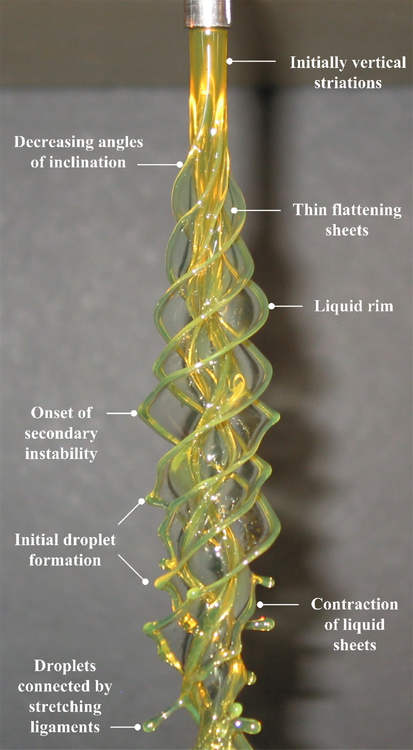
In fluid dynamics, we like to classify flows as laminar–smooth and orderly–or turbulent–chaotic and seemingly random–but rarely is any given flow one or the other. Many flows start out laminar and then transition to turbulence. Often this is due to the introduction of a tiny perturbation which grows due to the flow’s instability and ultimately provokes transition. An instability can typically take more than one form in a given flow, based on the characteristic lengths, velocities, etc. of the flow, and we classify these as instability modes. In the case of the vertical rotating viscous liquid jet shown above, the rotation rate separates one mode (n) from another. As the mode and rotation rate increase, the shape assumed by the rotating liquid becomes more complicated. Within each of these columns, though, we can also observe the transition process. Key features are labeled in the still photograph of the n=4 mode shown below. Initially, the column is smooth and uniform, then small vertical striations appear, developing into sheets that wrap around the jet. But this shape is also unstable and a secondary instability forms on the liquid rim, which causes the formation of droplets that stretch outward on ligaments. Ultimately, these droplets will overcome the surface tension holding them to the jet and the flow will atomize. (Video and photo credits: J. P. Kubitschek and P. D. Weidman)
Sandy Jets
When a fluid is vibrated, instabilities can form along its surface. With a sufficient amplitude, voids form inside the fluid and their collapse leads to a jet that shoots out from the fluid. A very different process leads to air cavities forming in a vibrated granular medium, but the jets produced are remarkably similar, as seen in this video. (Video credit: M. Sandtke et al.)
Jets from Hollows
Bubbles rising through a viscous fluid deform and interact. As they collapse into one another, the lower bubble induces a gravity-driven jet that projects upward into the higher bubble. The more elongated the bubble, the faster the jet. The same behavior is seen in the rebound of a cavity at the free surface of a liquid. The authors suggest a universal scaling law for this behavior. (Video credit: T. Seon et al.)
Viscoelastic Jets
Unlike Newtonian fluids, such as air and water, viscoelastic fluids exhibit non-uniform reactions to deformation. In this video, researchers explore the effects of this behavior when a liquid jet falls into another fluid. When fluids move past one another at different speeds in this manner, there is a shearing force which often leads to the wave-like Kelvin-Helmholtz instability between the fluids. Here we see for a variety of wavelengths how the breakdown of a Newtonian and viscoelastic jet differ. The Newtonian jets form clean lines and complicated tulip-like shapes, but the viscoelasticity of the non-Newtonian jets inhibits the growth of these instabilities, surrounding the central jet with wisps of escaping fluid. For more, see Keshavarz and McKinley. (Video credit: B. Keshavarz and G. McKinley)

Polygonal Jumps

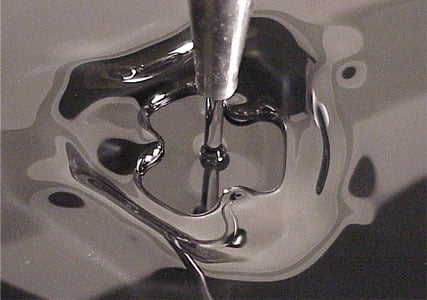
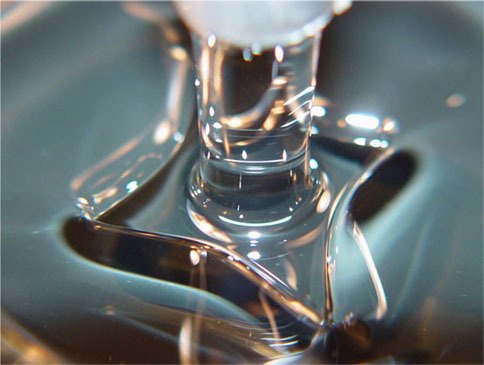
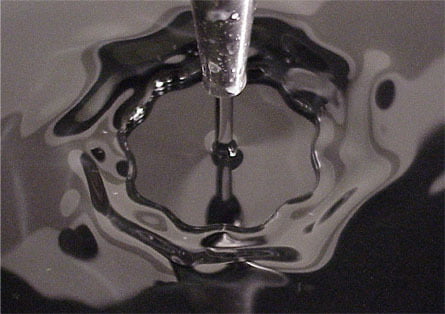
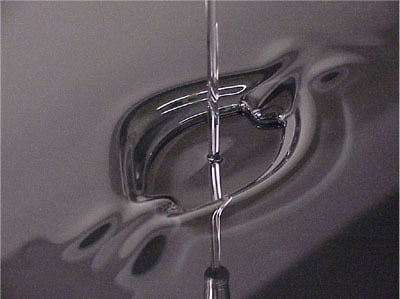
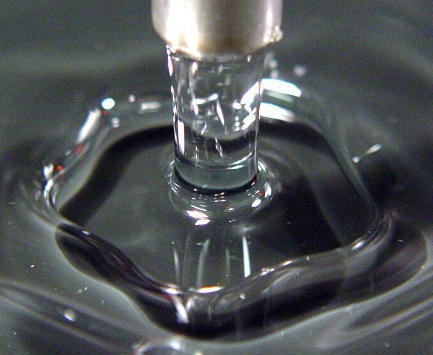
Hydraulic jumps occur when a fast-moving fluid enters a region of slow-moving fluid and transfers its kinetic energy into potential energy by increasing its elevation. For a steady falling jet, this usually causes the formation of a circular hydraulic jump–that distinctive ring you see in the bottom of your kitchen sink. But circles aren’t the only shape a hydraulic jump can take, particularly in more viscous fluids than water. In these fluids, surface tension instabilities can break the symmetry of the hydraulic jump, leading to an array of polygonal and clover-like shapes. (Photo credits: J. W. M. Bush et al.)

The Archer Fish’s Arrows

The archer fish hunts by shooting a jet of water at insects in the leaves above and knocking them into the water. How the fish achieve this feat has been a matter of contention. A study of high-speed video of the archer’s shot shows that fluid dynamics are key. The fish releases a pulsed liquid jet, imparting greater velocity to the tail of the jet than the head. As a result, the tail tends to catch up to the head and increase the jet’s mass on impact while decreasing the duration of impact. Simultaneously, the jet tends to break down into droplets via the Rayleigh-Plateau instability caused by surface tension. Surface tension’s power to hold the water in droplets combined with the inertial effects of the pulsed jet create a ball of fluid that strikes the archer’s prey with more than five times the power than vertebrate muscles alone can impart. For more on archer fish, check out this video and the original research paper by A. Vailati et a. (Photo credits: Scott Linstead and BBC; submitted by Stuart R)

Rebounding
A ping pong ball bounces off a puddle, drawing a liquid column upward behind it. This photo shows the instant after the fluid has disconnected from the ball, allowing it to rebound without further loss of momentum to the fluid. The fluid column begins to fall under gravity, the tiny undulations in its radius growing via the Rayleigh-Plateau instability and eventually causing the column to separate from the puddle. You can see the whole process in action in this high-speed video. (Photo credit: BYU Splash Lab)