
We’ve seen the Faraday instability on vibrating fluids (and granular materials) before. Here researchers explore the effect on a a network of fluid-filled cells. Each square is filled with liquid and small holes near the bottom of each cell ensure the liquid levels are the same throughout the array. Then the entire container is vibrated. Above the threshold frequency, standing waves form but do not interact. When the wave amplitudes grow high enough for fluid to get exchanged from cell to cell, patterns begin to form. The waves in adjacent cells synchronize, eventually resulting in a regular pattern across the entire grid. Order out of chaos.(Video credit: G. Delon et al.)
Tag: instability

Inky Vortex
Ink released into water shows the swirling motion inside a vortex ring as well as its deformation and breakup upon stagnation against a wall. Although humans are known to make such vortex rings with smoke or bubbles, they are common in nature as well. Buoyant plumes often feature vortex rings at their head; dolphins and whales play with bubble rings; volcanoes blow smoke rings; and mosses use them to distribute spores.

Viscous Dripping

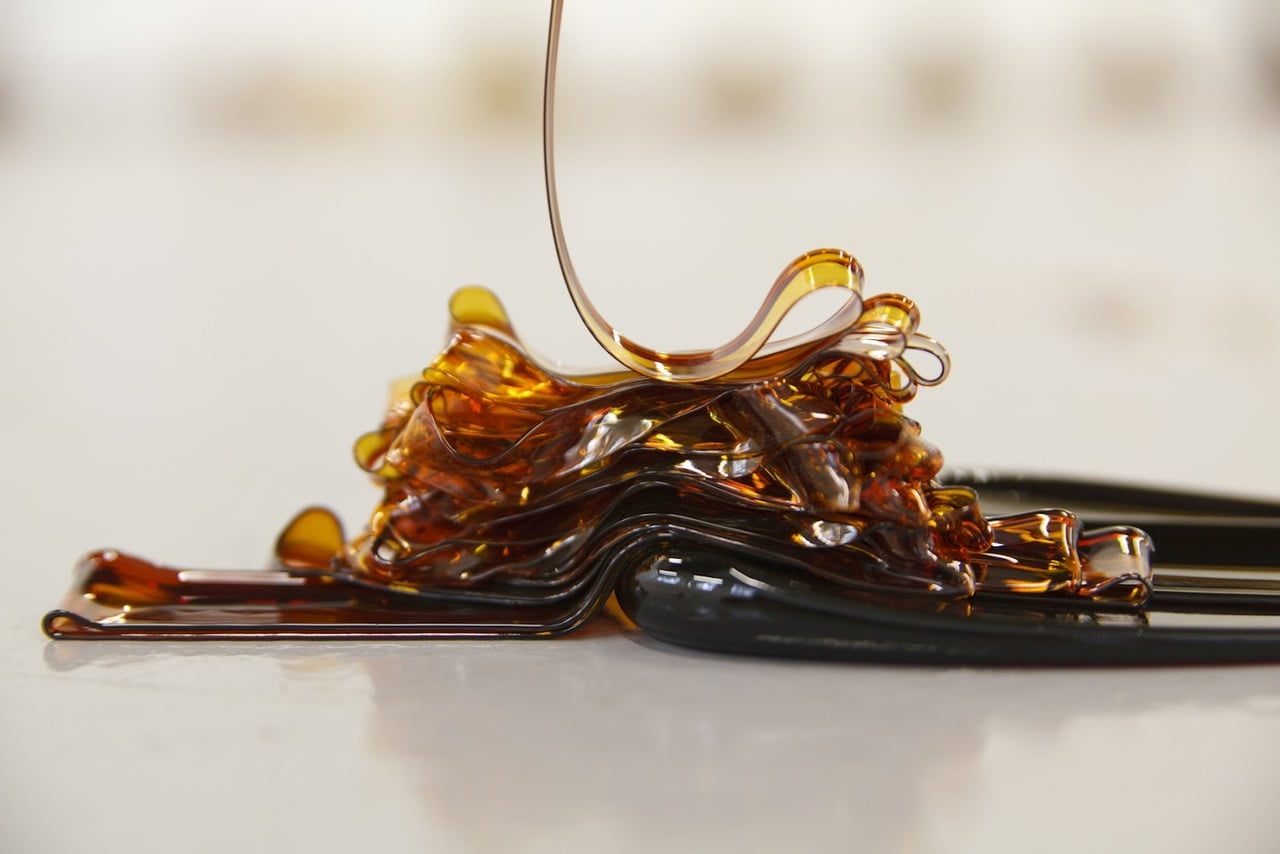


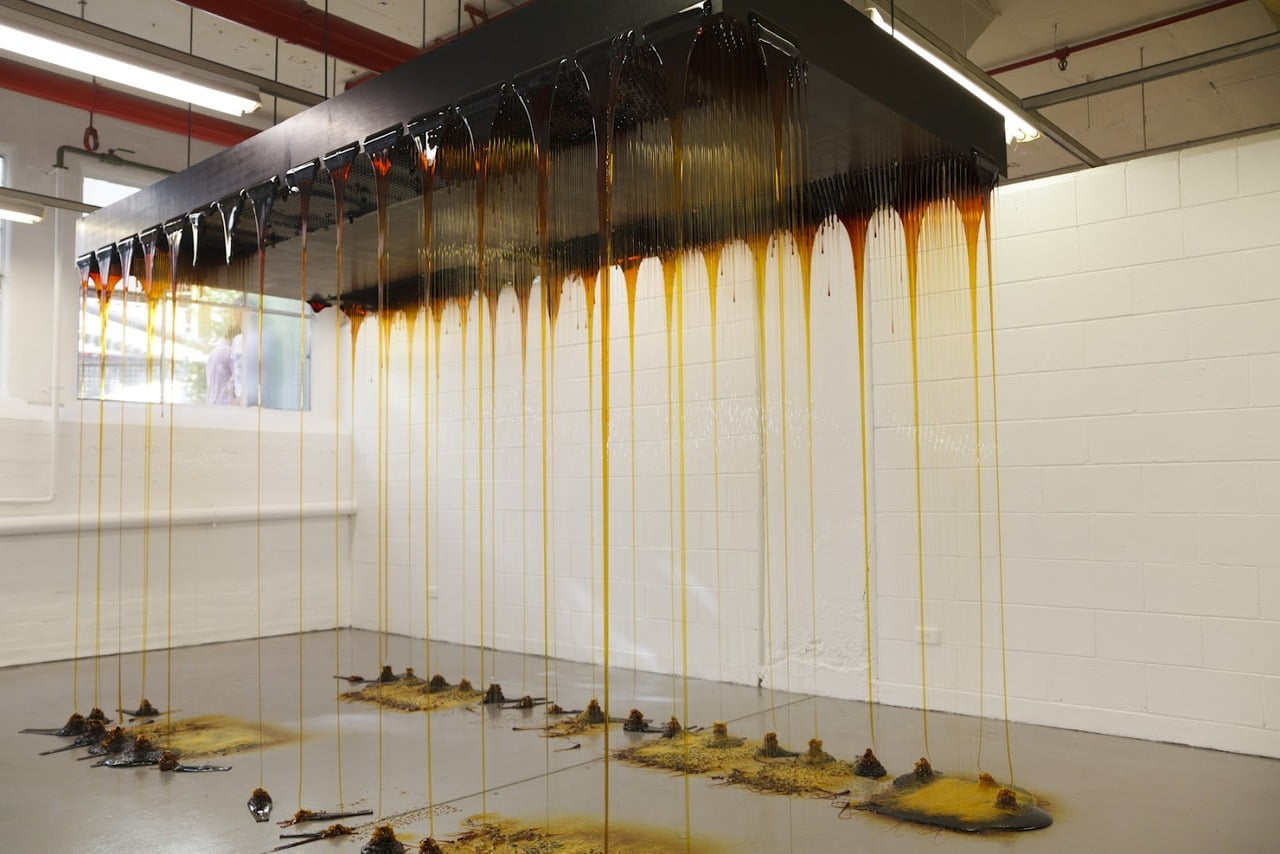

Artist Skye Kelly’s “Creep (strain)” sculpture shown above is made from toffee. The viscous fluid deforms under the force of gravity, resulting in elongated drips and slow jets that buckle and coil upon reaching the floor. (Photo credits: Skye Kelly; via freshphotons)

Fractal Fluids
These images from a numerical simulation of a mixing layer between fluids of different density show the development and breakdown to Kelvin-Helmholtz waves. The black fluid is 3 times denser than the white fluid, and, as the two layers shear past one another, billow-like waves form (Fig 1(a)). Inside those billows, secondary and even tertiary billows form (Fig 1(a) and (b)). Fig 1 (c)-(e) show successive closeups on these waves, showing their beautiful fractal-like structure. (Photo credit: J. Fontane et al, 2008 Gallery of Fluid Motion) #
Dolphin Bubble Rings
Dolphins create vortex rings to play with by exhaling through their blowholes. The sharp impulse of air, combined with the round shape, creates a vortex ring of bubbles. Humans can do this underwater, too, but dolphins aren’t content to lie at the bottom of the pool. Because smaller vortex rings are more coherent and last longer, they will break the growing vortex so that the vortex fragment rejoins as a smaller vortex ring. They also spin the water nearby to cause wave instabilities in the ring.
Viscous Fingers
When less viscous fluids are injected into a more viscous medium, the low-viscosity fluid forms finger-like protrusions into the background fluid. This is known as the Saffman-Taylor instability. The video above shows this effect but in a more dynamic setting. Blue-dyed water and a clear solution of water and glycerol fifty times more viscous than the water are injected in alternating fashion to a microfluidic channel. The blue water spreads into the clear glycerol solution via fingers that quickly diffuse, creating a homogeneous–or uniform–mixture. (Video credit: Juanes Research Group)
Microgravity Cornstarch
We’ve seen the effects of vibration on shear-thickening non-Newtonian fluids here on Earth before in the form of “oobleck fingers” and “cornstarch monsters”, but, to my knowledge, this is the first such video looking at the behavior in space. The vibrations of the speaker cause shear forces on the cornstarch mixture, which causes the viscosity of the fluid to increase. This is what makes it react like a solid to sudden impacts while still flowing like a liquid when left unperturbed. In microgravity there is one less force working against the rise of the cornstarch fingers, so the formations we see in this video are subtly different from those on Earth.

Martian Lava Coils

NASA’s HiRISE spacecraft has sent back images of lava coils left on the surface of Mars. These features form when lava flows of different speeds move past one another; they’re essentially Kelvin-Helmholtz waves–like the ones often seen in clouds–in the lava flow that have solidified into solid rock! On Earth these coils appear about a foot wide; the Martian versions are 100 feet across. (Photo credit: NASA/JPL/University of Arizona; via Wired; submitted by Brian L)
Convective Cells
Convective cells form as fluid is heated from below. As the fluid near the bottom warms, its density decreases and buoyancy causes it to rise while cooler fluid descends to replace it. This fluid motion due to temperature gradients is called Rayleigh-Benard convection and the cells in which the motion occurs are called Benard cells. This particular type of convection is essentially what happens when a pot is placed on a hot stove, so the shapes are familiar. Similar shapes also form on the sun’s photosphere, where they are called granules.
Squeezing Bubbles
An air bubble trapped inside a viscoelastic fluid is squeezed between two plates in this video, revealing a Saffman-Taylor-like fingering instability stemming from local stress concentrations. (Video credit: Baudouin Saintyves)


