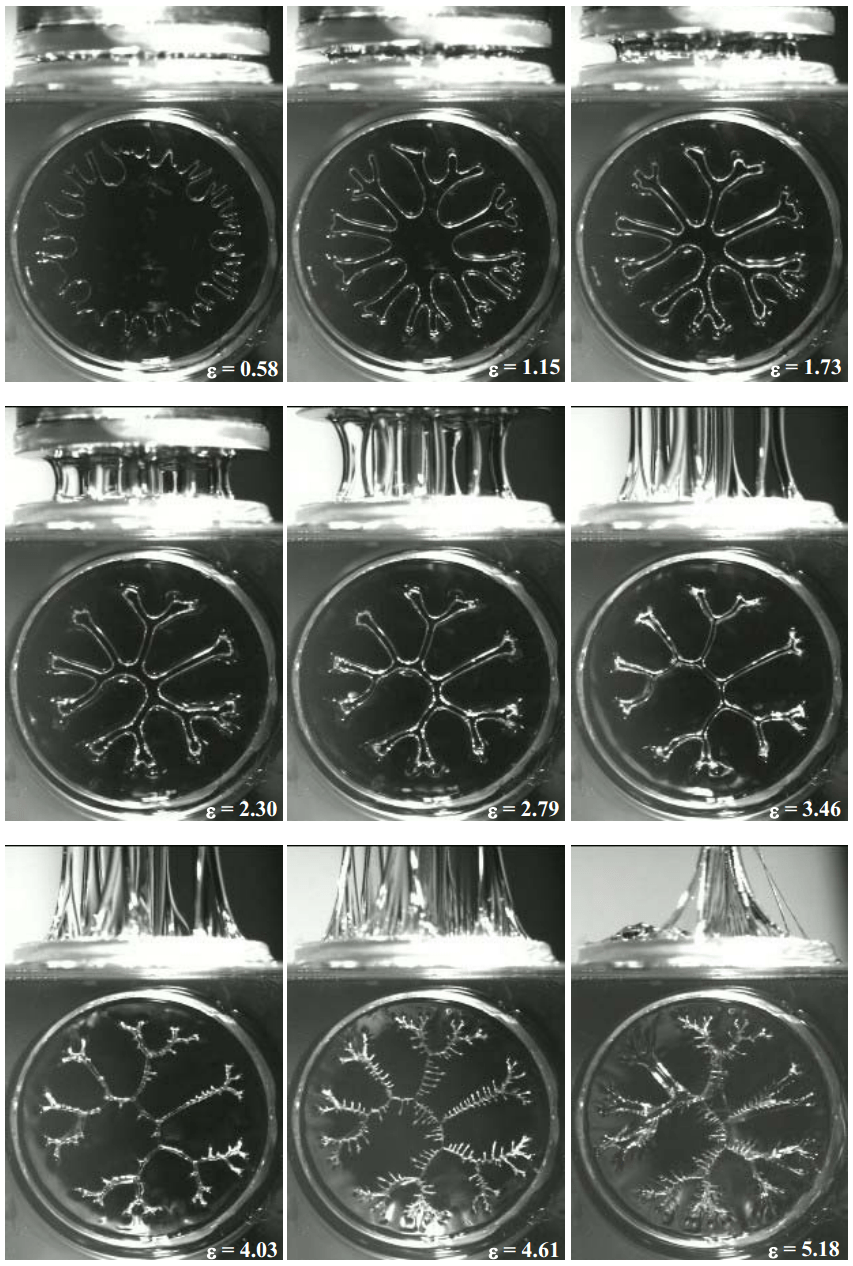
A viscous fluid inside a horizontally rotating circular cylinder forms a shark-tooth-like pattern along the fluid’s free surface. This is one of several patterns observed depending on the fluid’s viscosity and surface tension and the rotational rate of the cylinder. (Photo credit: S. Thoroddsen and L. Mahadevan; for more, see Thoroddsen and Mahadevan 1996 and 1997)
Tag: instability

Chronoscapes

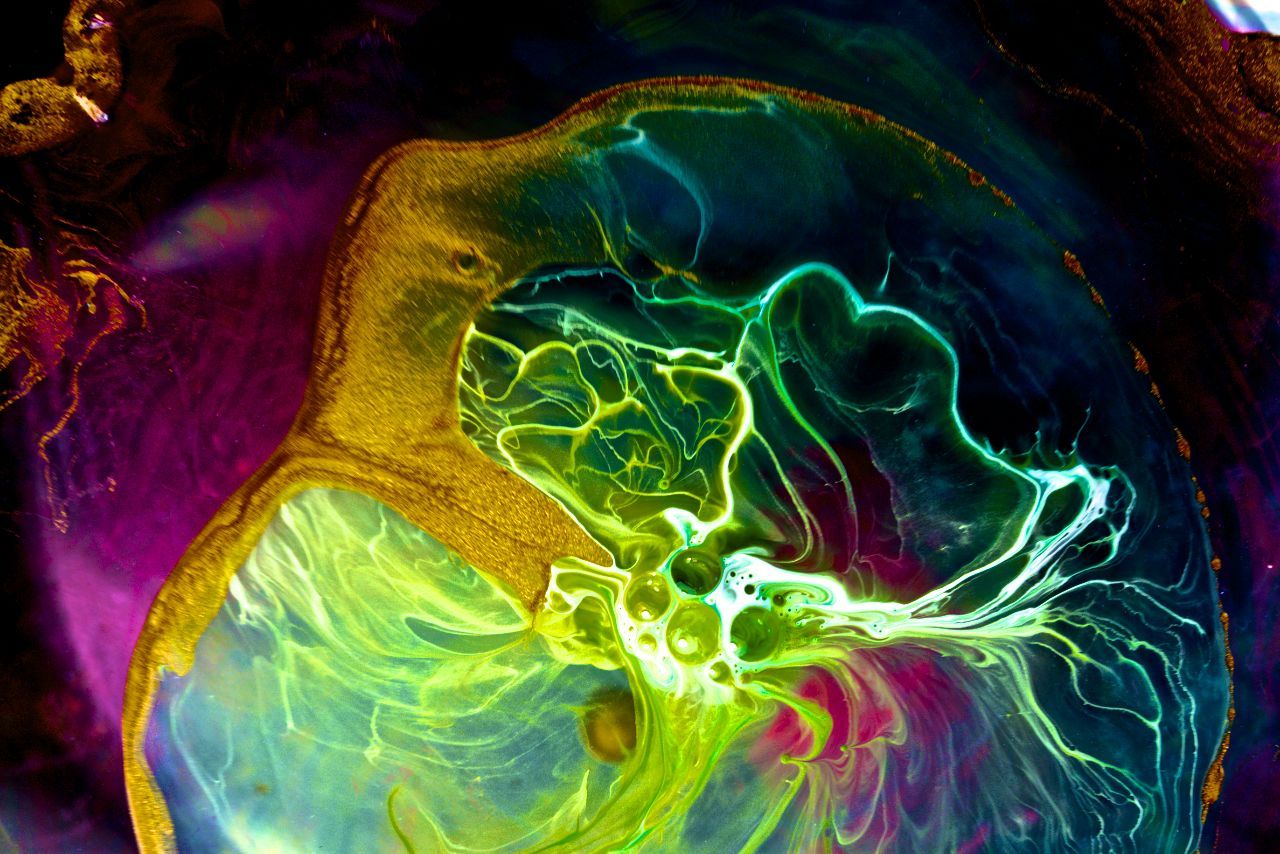
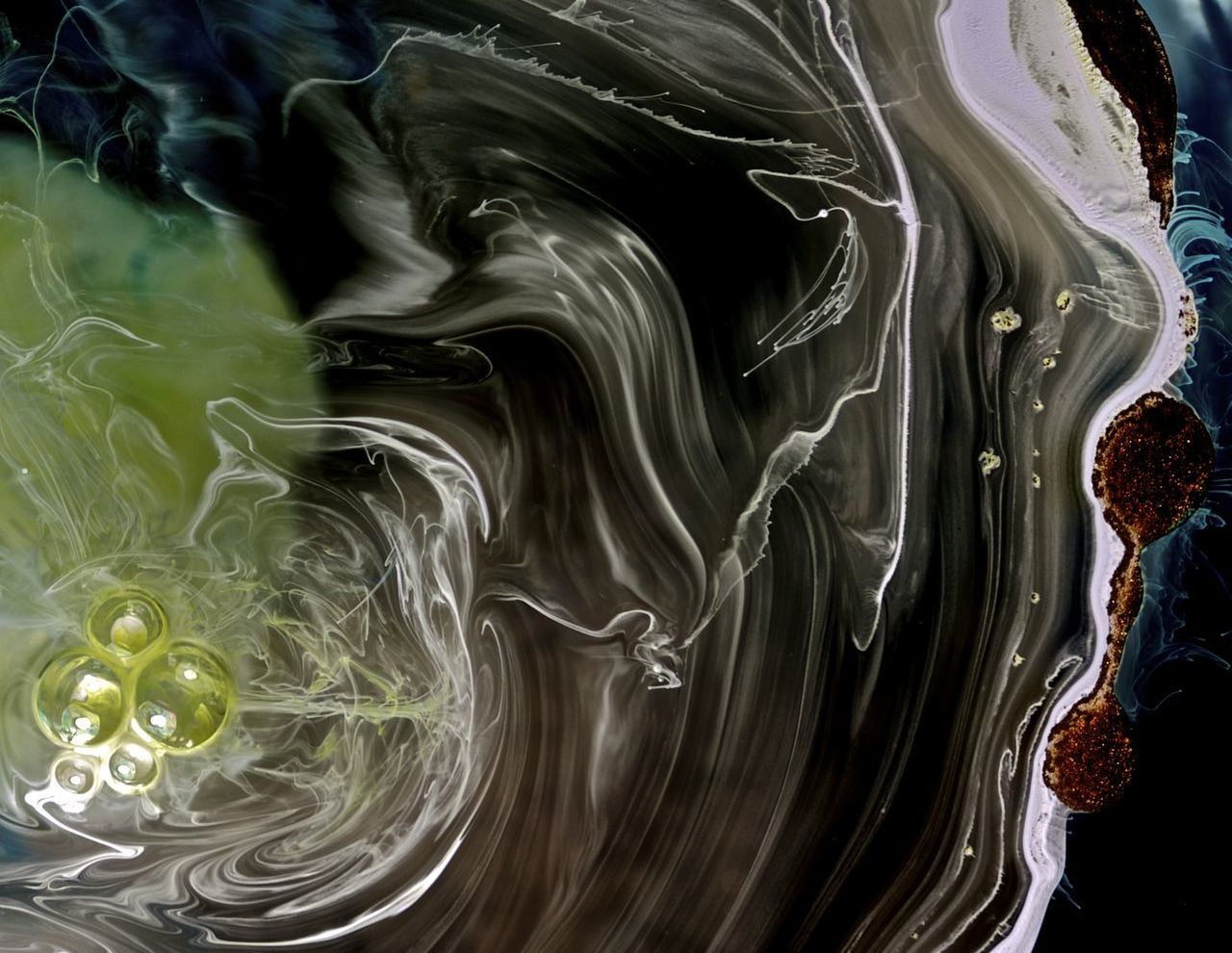
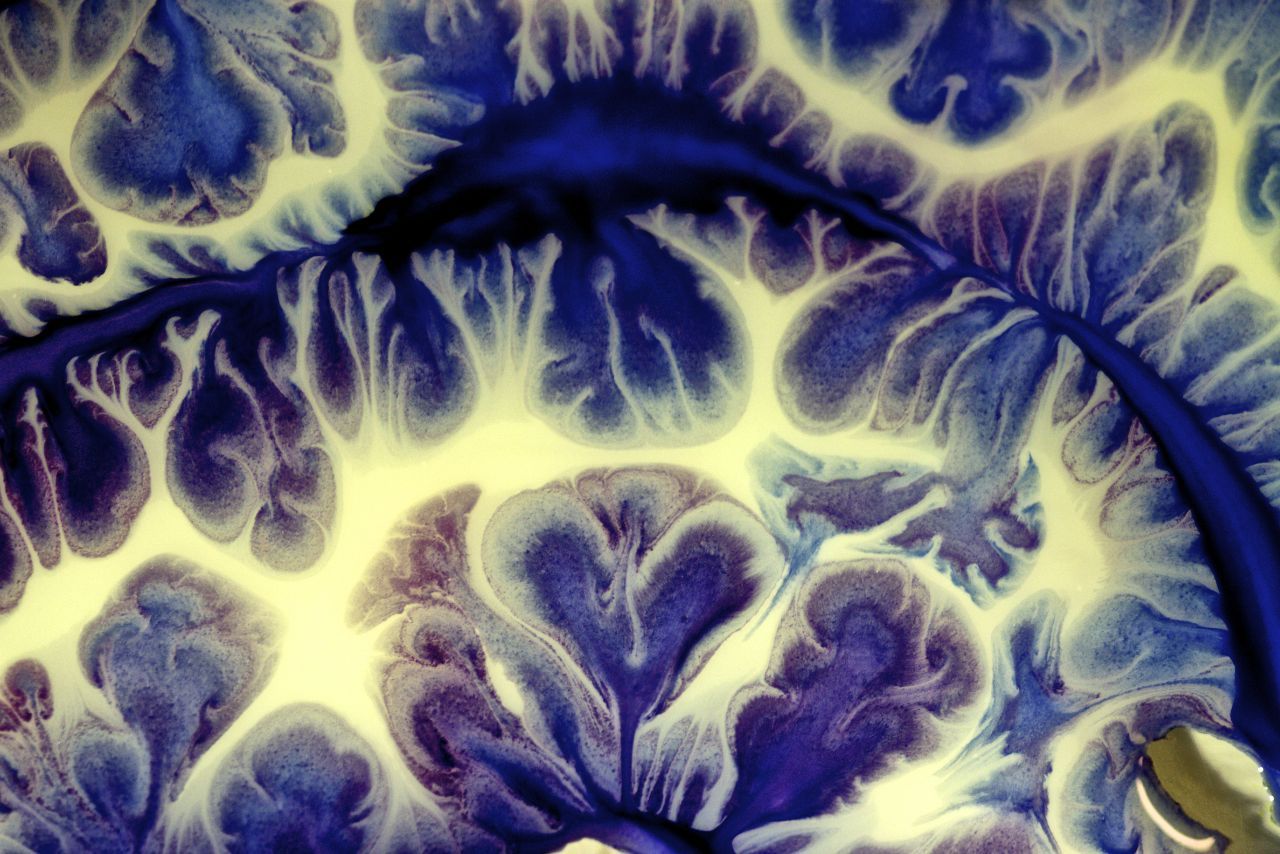
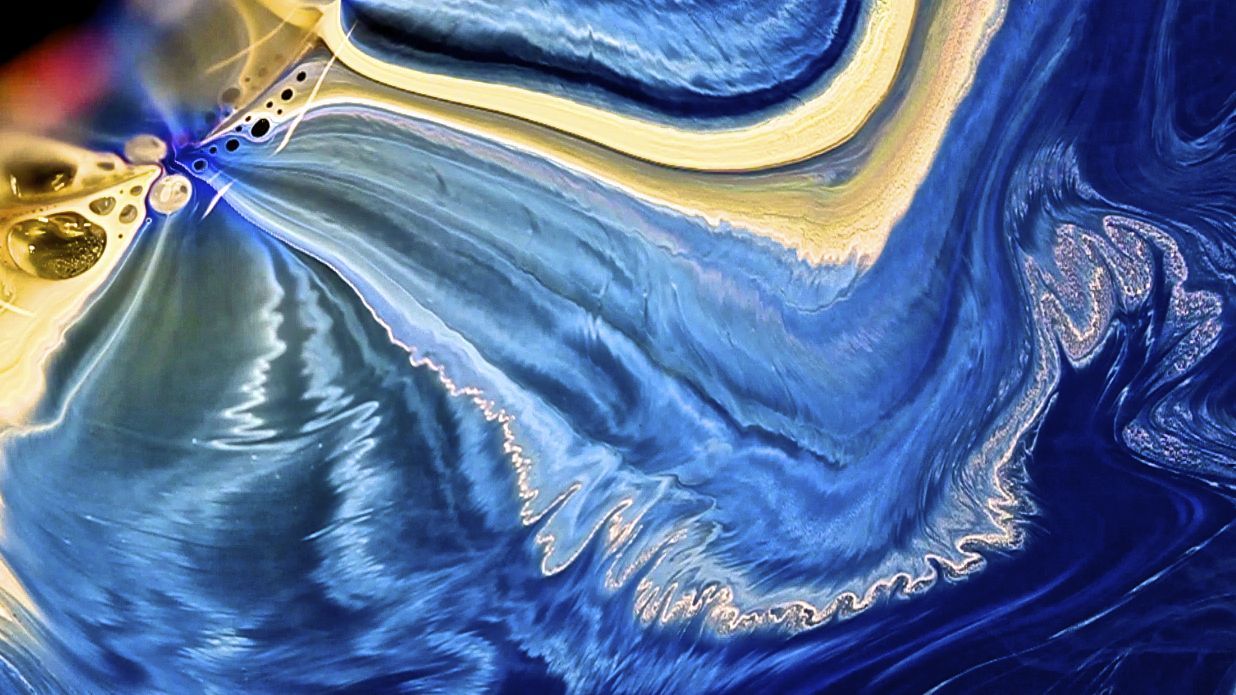
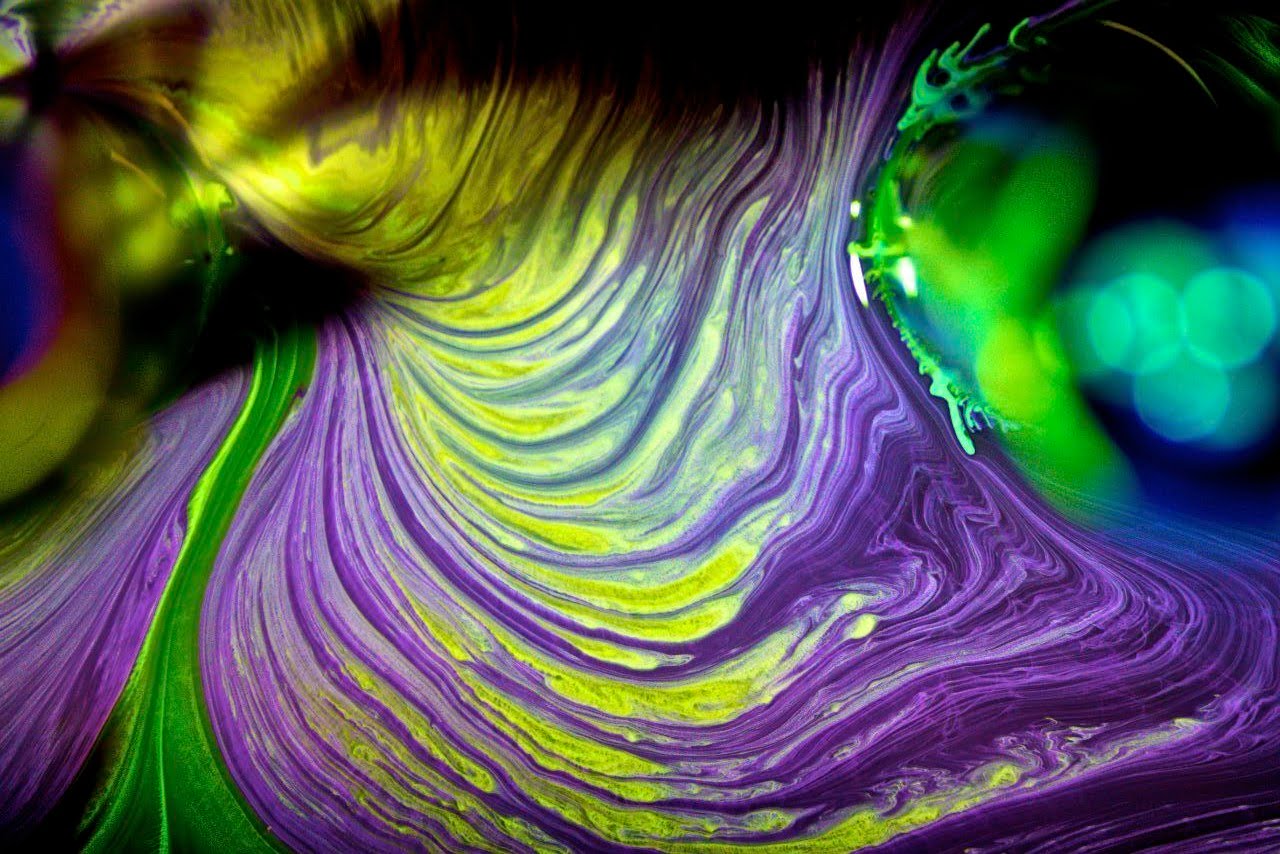
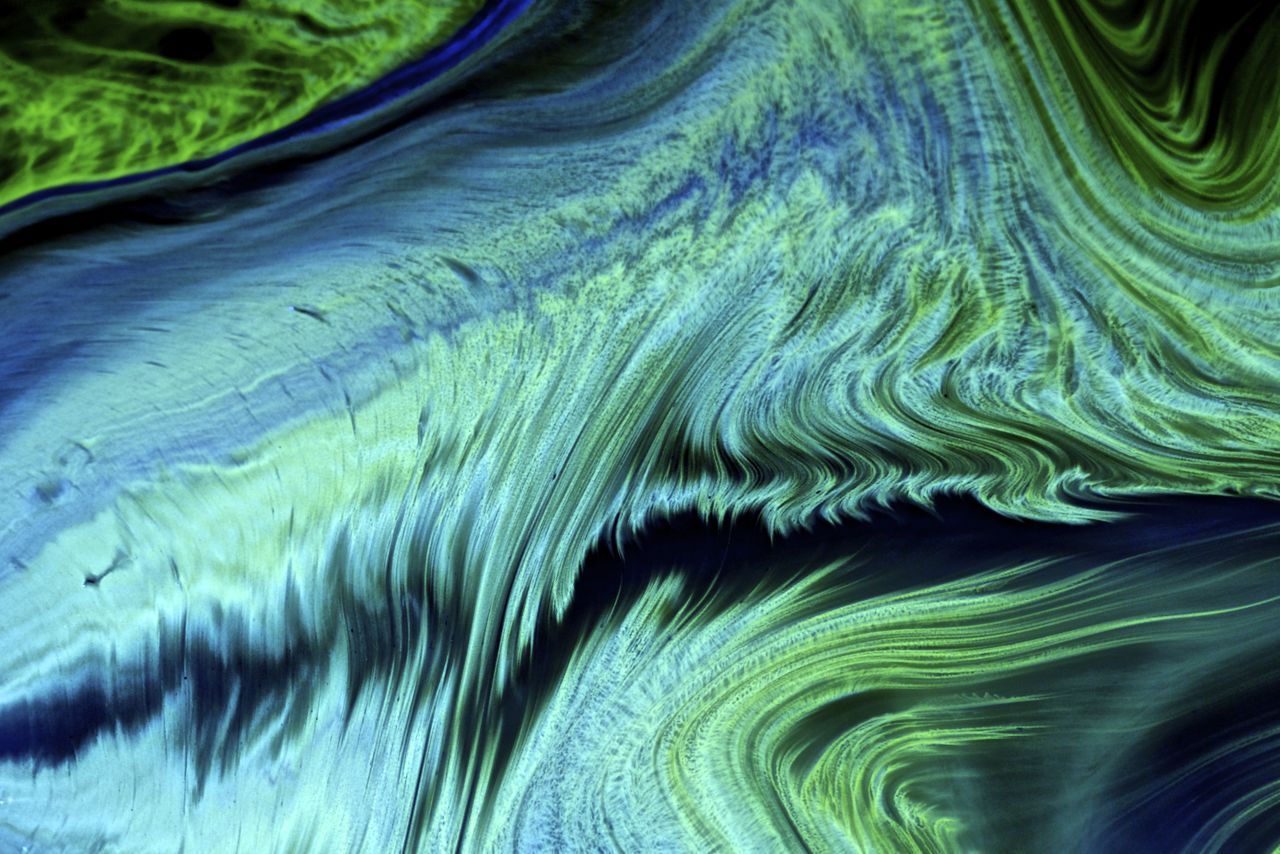
Exeter University artist-in-residence Pery Burge uses ink, water, soap films, and other fluids to create her spectacular “artistic flow visualization”. Looking closely, one sees the influence of bubbles, vortices, diffusion, and many fluid instabilities, all combined to create psychedelic and dream-like landscapes. For more on her work and additional galleries, see her website Chronoscapes. (Photo credit: Pery Burge)

Falling Oil
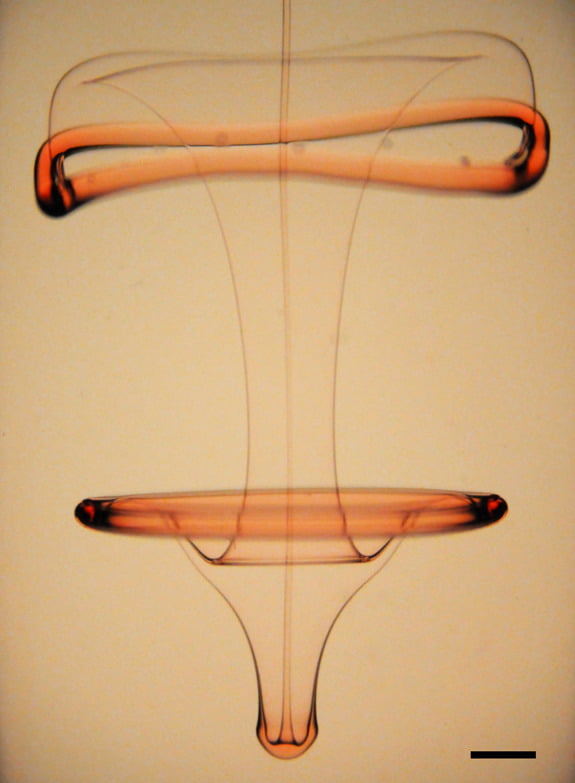
A drop of silicone oil falling through a liquid with lower surface tension distorts into multiple vortex rings connected by thin films. This behavior is caused by the interaction between viscous and capillary forces and is observable for only a narrow range of oil viscosities. (Photo credit: A. Felce and T. Cubaud)

Viscoelastic Fingers
This series of photos shows two plates with a thin layer of polymer-laced, viscoelastic liquid. As the two plates are separated, complex instabilities form. The lower section of each photograph shows the fluid on the plate, with finger-like Saffman-Taylor instabilities forming as air rushes in between the gap in the plates. As the separation increases, the polymers in the liquid stretch under the increased strain, inducing elastic stresses in the fluid that cause the formation of secondary structures. (Photo credit: R. Welsh, J. Bico, and G. McKinley)

Homemade Astronomy


Artist Julia Cuddy uses liquids, soaps, and glitter to create photographs that replicate the look of deep space astronomy. By adding soap to the dyes, she uses Marangoni effects to drive surface tension instabilities that cause swirling colors and motions reminiscent of galaxies and nebulae. Although I’ve seen fluid dynamics used in art before, this may be one of the cleverest usages I’ve seen! (Photo credits: Julia Cuddy)

Bubbles and Jets

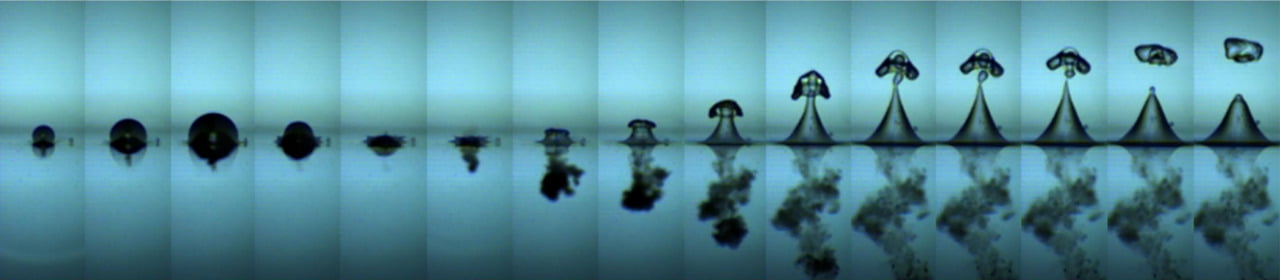
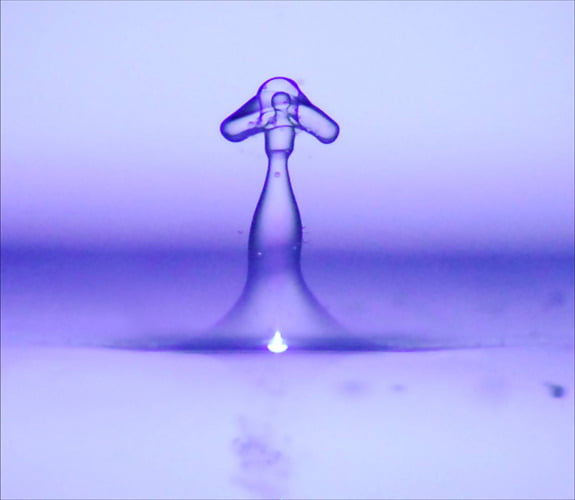
In the photo sequence above, a bubble is created at the interface between two immiscible liquids–water on top and denser hydrofluroether (HFE) below. Initially, the bubble expands explosively due to the vaporization of water generated by a short laser pulse. As the bubble collapses, a jet forms and accelerates into the HFE. After collapse, the bubble remnants injected in the HFE cause the formation of a jet that shoots back into the water above. Surface instabilities make the jet assume a mushroom or crown-like structure that detaches from the jet. Eventually gravity will return the system to its initial undisturbed fluid-fluid interface. (Photo credit: S. Avila et al. 1,2)

Fractal Fluids
Part of the beauty of numerical simulation is its ability to explore the physics of a situation that would difficult or impossible to create experimentally. Here the Rayleigh-Taylor instability–which occurs when a heavier fluid sits atop a lighter fluid–is simulated in two-dimensions. Viscosity and diffusion are set extremely low in the simulation; this is why we see intricate fractal-like structures at many scales rather than the simulation quickly fading into gray. (The low diffusion is also what causes the numerical instabilities in the last couple seconds of video.) The final result is both physics and art. (Video credit: Mark Stock)
Oil in Alcohol
In this video two droplets of oil fall through a bath of isopropyl alcohol. The oil is denser than alcohol, and the two fluids are miscible. The velocity and density gradients where the two fluids meet generate hydrodynamic instabilities that create the distinctive patterns seen in the falling drops. (Video credit: BYU Splash Lab)

The Fluid Dynamical Sewing Machine


Anyone who has poured a viscous fluid like honey or syrup will have noticed its tendency to coil like rope. A similar effect is observed when a viscous fluid stream falls onto a moving belt. The photos above show some of the patterns seen in these “fluid-mechanical sewing machines” depending on the height of the thread and the speed of the moving belt. Notice how some of the patterns are doubles of another (i.e. two coils per side instead of one). This period doubling behavior is often seen in systems on their way to chaos. (Photo credits: S. Chiu-Webster and J. Lister)
The Vibrating Network
We’ve seen the Faraday instability on vibrating fluids (and granular materials) before. Here researchers explore the effect on a a network of fluid-filled cells. Each square is filled with liquid and small holes near the bottom of each cell ensure the liquid levels are the same throughout the array. Then the entire container is vibrated. Above the threshold frequency, standing waves form but do not interact. When the wave amplitudes grow high enough for fluid to get exchanged from cell to cell, patterns begin to form. The waves in adjacent cells synchronize, eventually resulting in a regular pattern across the entire grid. Order out of chaos.(Video credit: G. Delon et al.)