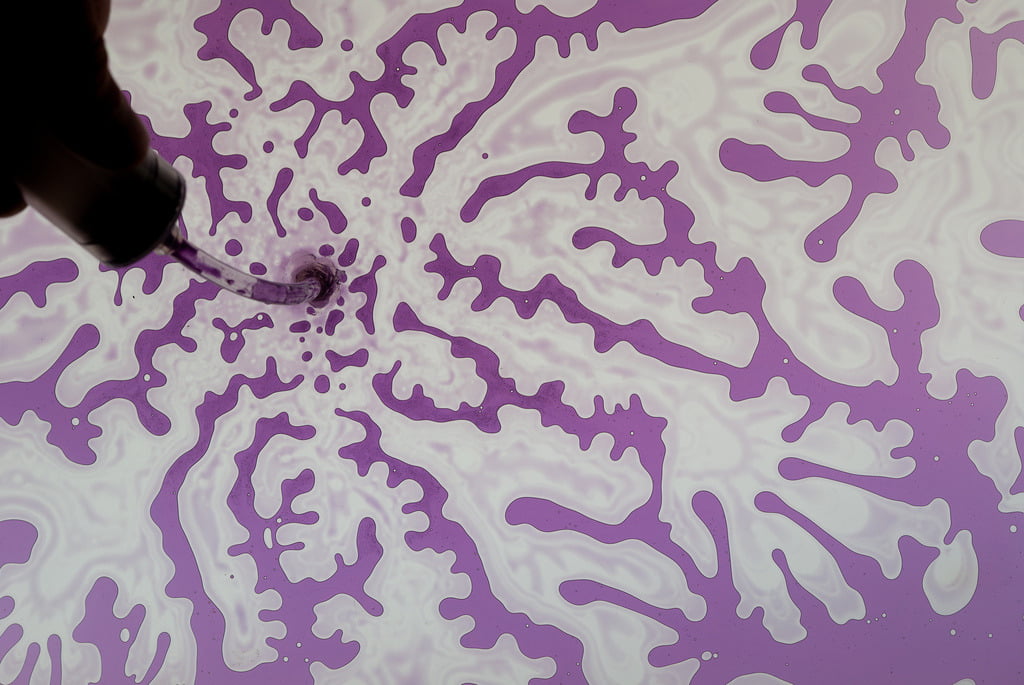
Droplets of oleic acid spread across a thin film of glycerol on a silicon wafer. The shapes here are driven by hydrodynamic instabilities, particularly Marangoni effects due to the differences in surface tension between the two fluids. (Photo credit: A. Darhuber, B. Fischer and S. Troian)
Tag: instability

Ink Sculptures

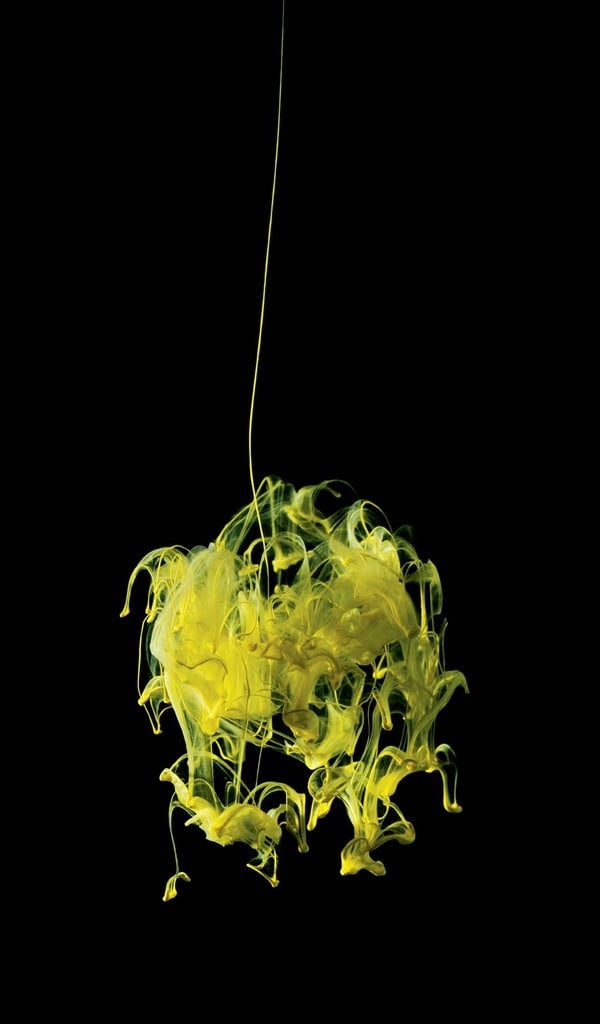
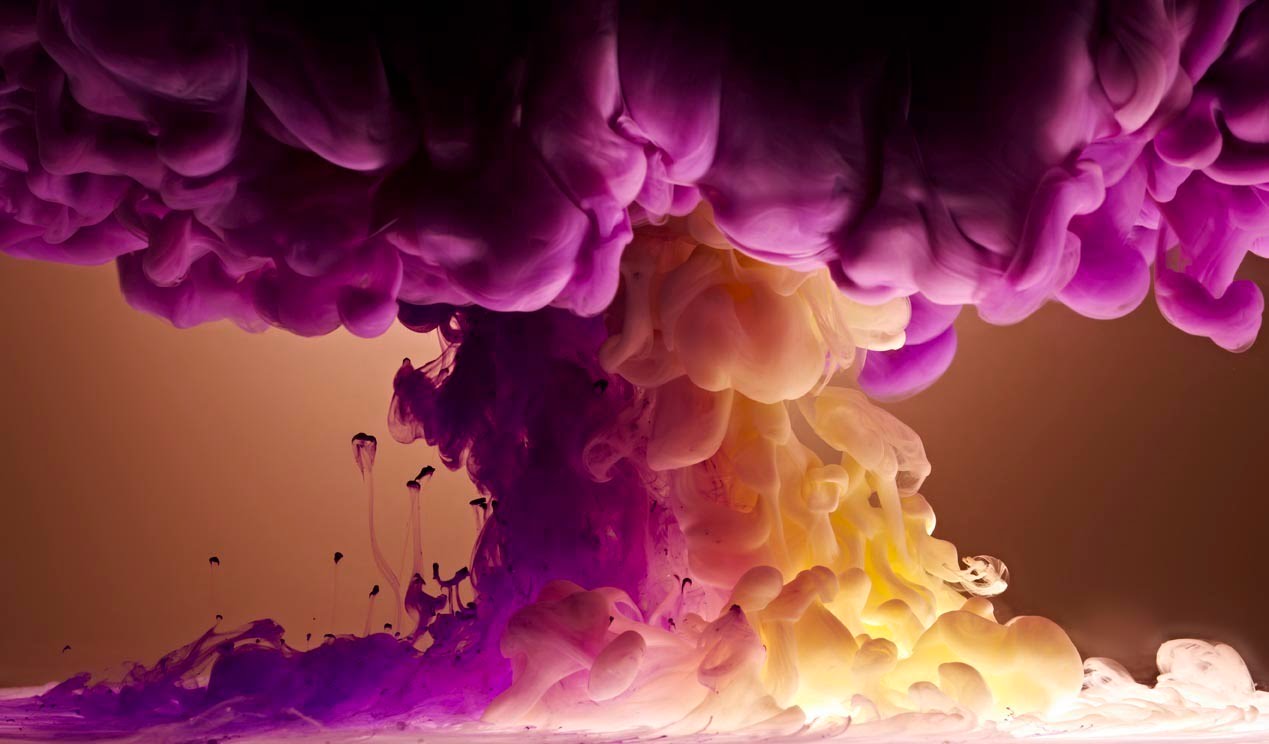
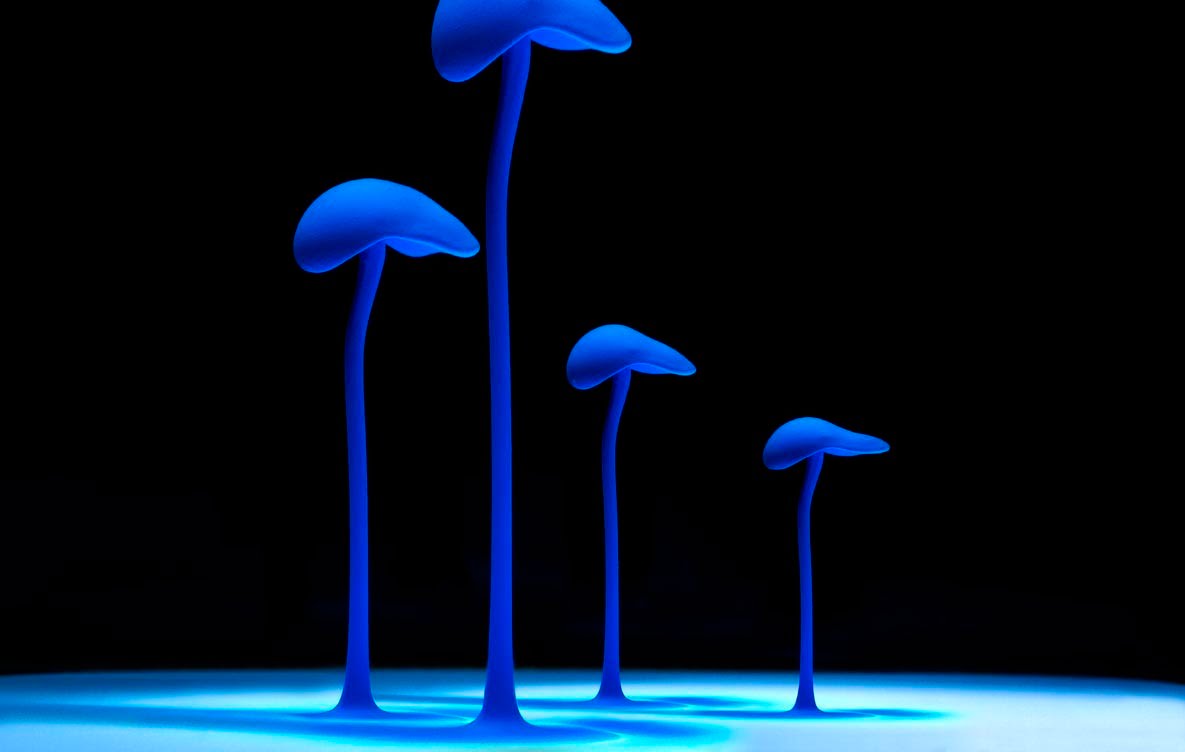
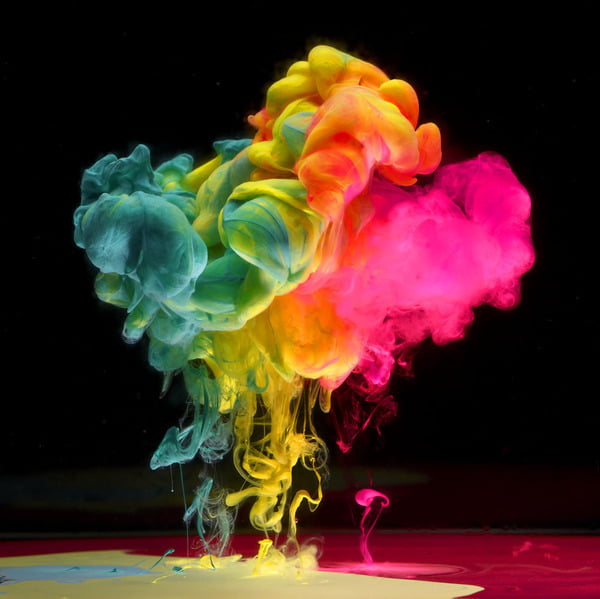
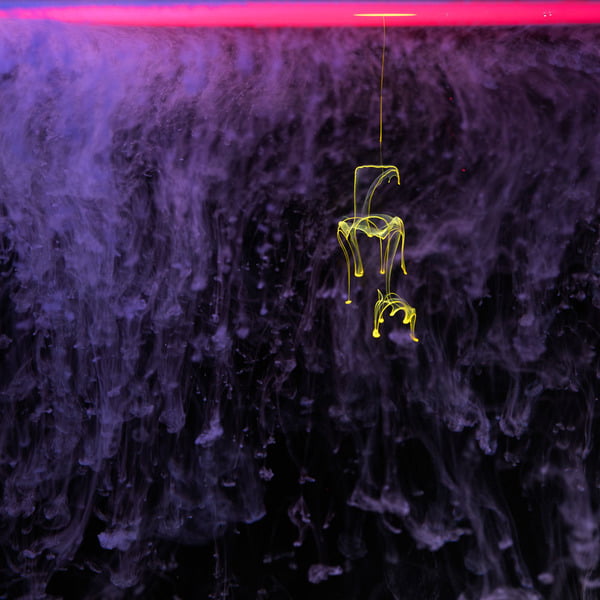
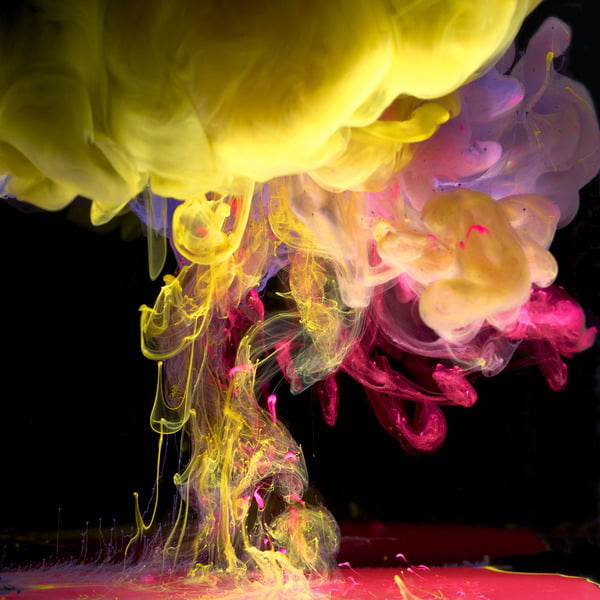
Dripping ink into water can create fantastic structures as the two fluids mix. In this artwork there are numerous complex mixing phenomena: the eddies and multiple scales of turbulence; the long, thin streams of laminar flow; and the wispy mushrooms and umbrellas of the Rayleigh-Taylor instability. (Photo credit: Mark Mawson; via @thinkgeek)
Water Balloon Physics
[original media no longer available]
This video explores some of the physics behind the much-loved bursting water balloon. The first sections show some “canonical” cases–dropping water balloons onto a flat rigid surface. In some cases the balloon will bounce and in others it breaks. The bursting water balloons develop strong capillary waves (like ripples) across the upper surface and have some shear-induced deformation of the water surface as the rubber peals away. Then the authors placed a water balloon underwater and vibrated it before bursting it with a pin. They note that the breakdown of the interface between the balloon water and surrounding water shows evidence of Rayleigh-Taylor and Richtmyer-Meshkov instabilities. The Rayleigh-Taylor instability is the mushroom-like formation observed when stratified fluids of differing densities mix, while the Richtmyer-Meshkov instability is associated with the impulsive acceleration of fluids of differing density.

Transition to Turbulence
Smoke introduced into the boundary layer of a cone rotating in a stream highlights the transition from laminar to turbulent flow. On the left side of the picture, the boundary layer is uniform and steady, i.e. laminar, until environmental disturbances cause the formation of spiral vortices. These vortices remain stable until further growing disturbances cause them to develop a lacy structure, which soon breaks down into fully turbulent flow. Understanding the underlying physics of these disturbances and their growth is part of the field of stability and transition in fluid mechanics. (Photo credit: R. Kobayashi, Y. Kohama, and M. Kurosawa; taken from Van Dyke’s An Album of Fluid Motion)

High-Speed Ferrofluid
High-speed video captures the behavior of a ferrofluid trapped between two magnets. Ferrofluids contain tiny ferromagnetic particles suspended in a carrier fluid like oil or water. The distinctive peaks and valleys of a ferrofluid subject to a strong magnetic field is due to the normal-field instability and is a result of the fluid minimizing its magnetic energy.
Viscous Fingers
A Hele Shaw cell is little more than two glass plates separated by a thin layer of viscous fluid. The cell serves as a good test bed for viscous, low Reynolds number flows such as those found in microfluidics. Here a less viscous fluid is injected into the center of the cell, causing the finger-like protrusions of the less viscous fluid into the more viscous one via the Saffman-Taylor instability.
Convection Visualization
Here on Earth a fascinating form of convection occurs every time we put a pot of water on the stove. As the fluid near the burner warms up, its density decreases compared to the cooler fluid above it. This triggers an instability, causing the cold fluid to drift downward due to gravity while the warm fluid rises. Once the positions are reversed, the formerly cold fluid is being heated by the burner while the formerly hot fluid loses its heat to the air. The process continues, causing the formation of convection cells. The shapes these cells take depend on the fluid and its boundary conditions. For the pot of water on the stove and in the video above, the surface tension of the air/water interface can also play a role in modifying the shapes formed. The effects caused by the temperature gradient are called Rayleigh-Benard convection. The surface tension effects are sometimes called Benard-Marangoni convection.

Flow Vis
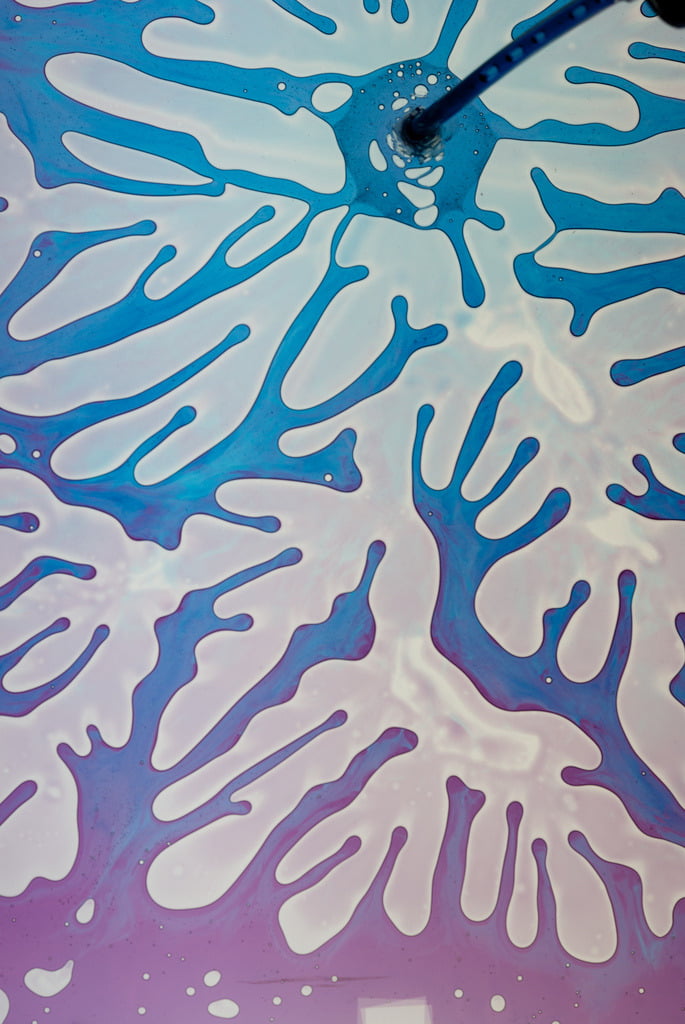
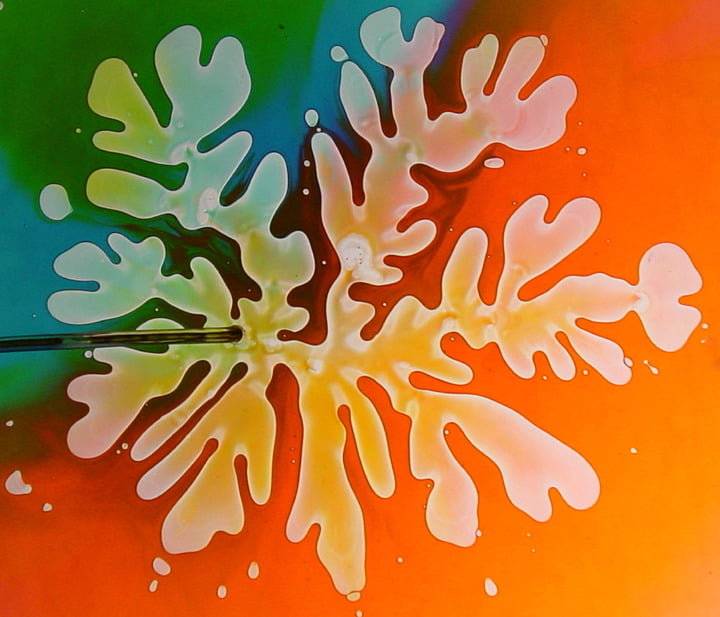
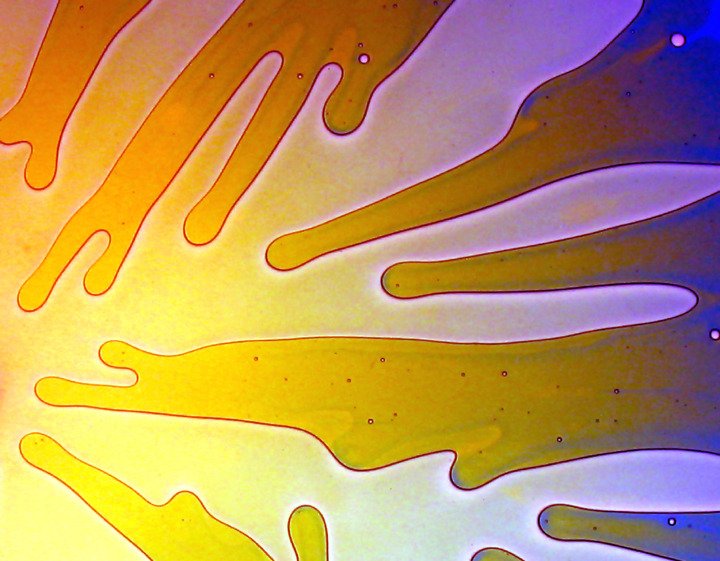
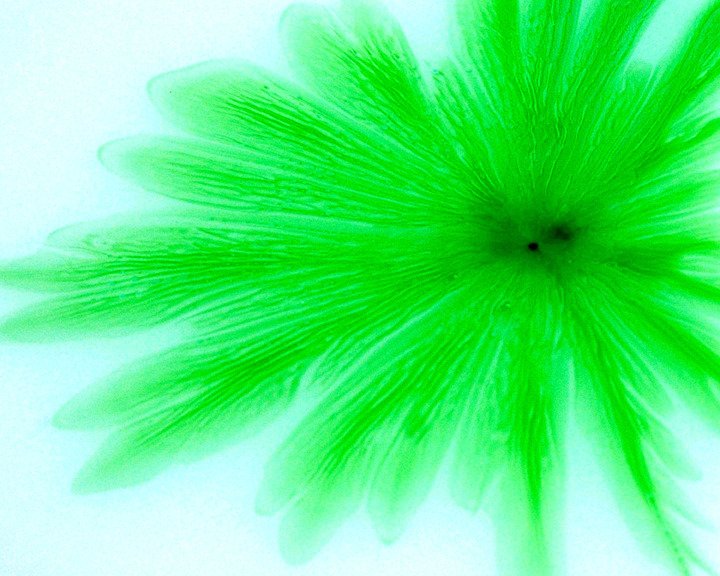
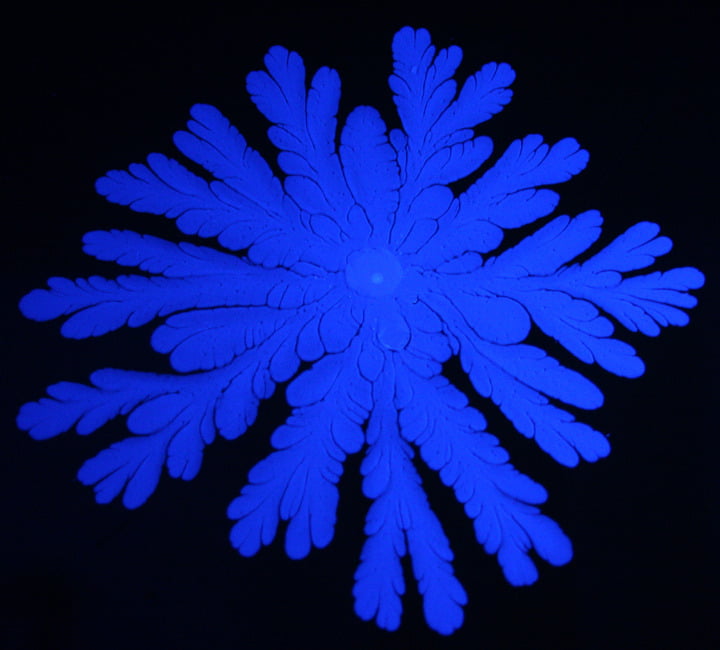
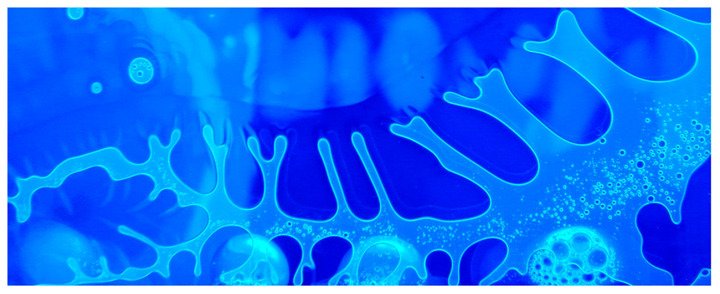
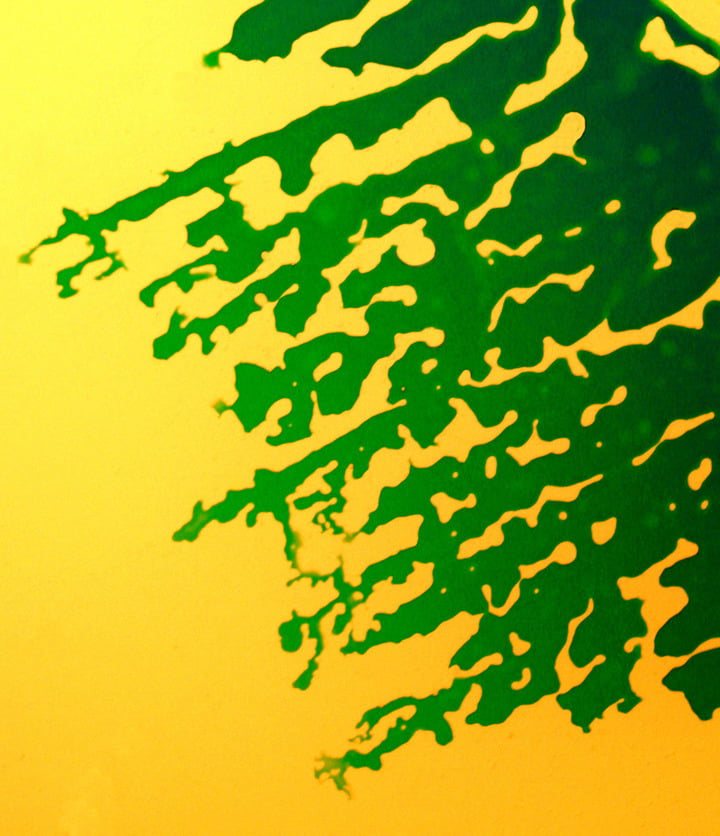
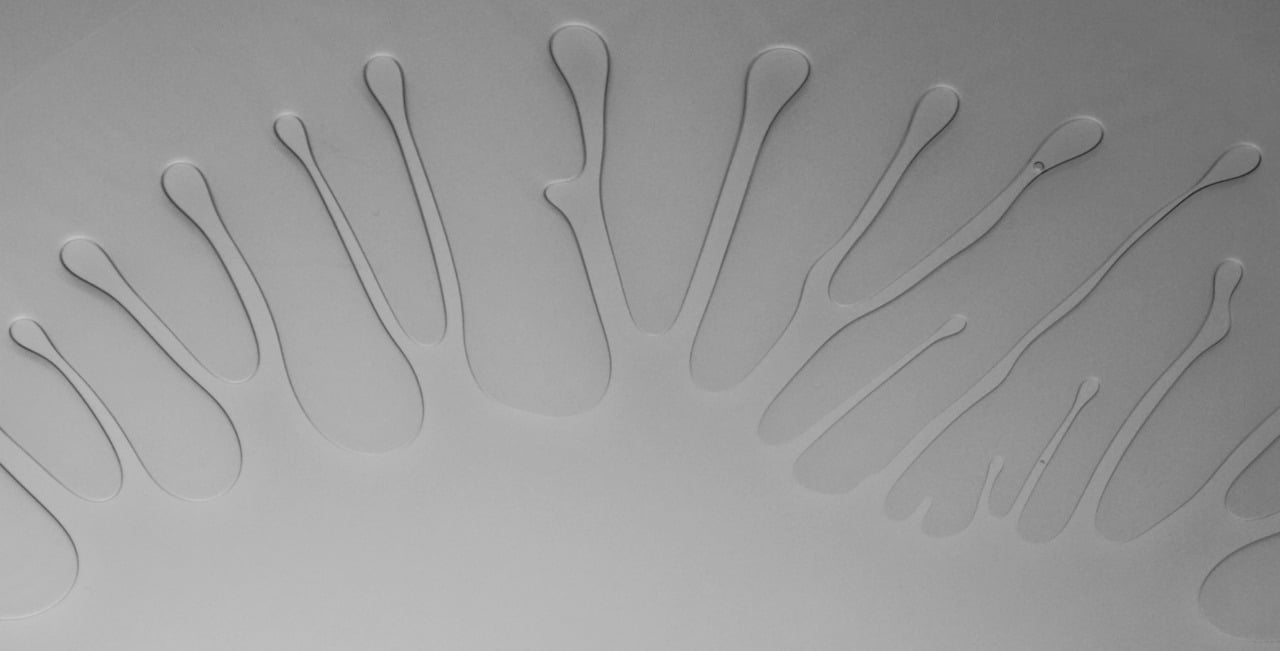
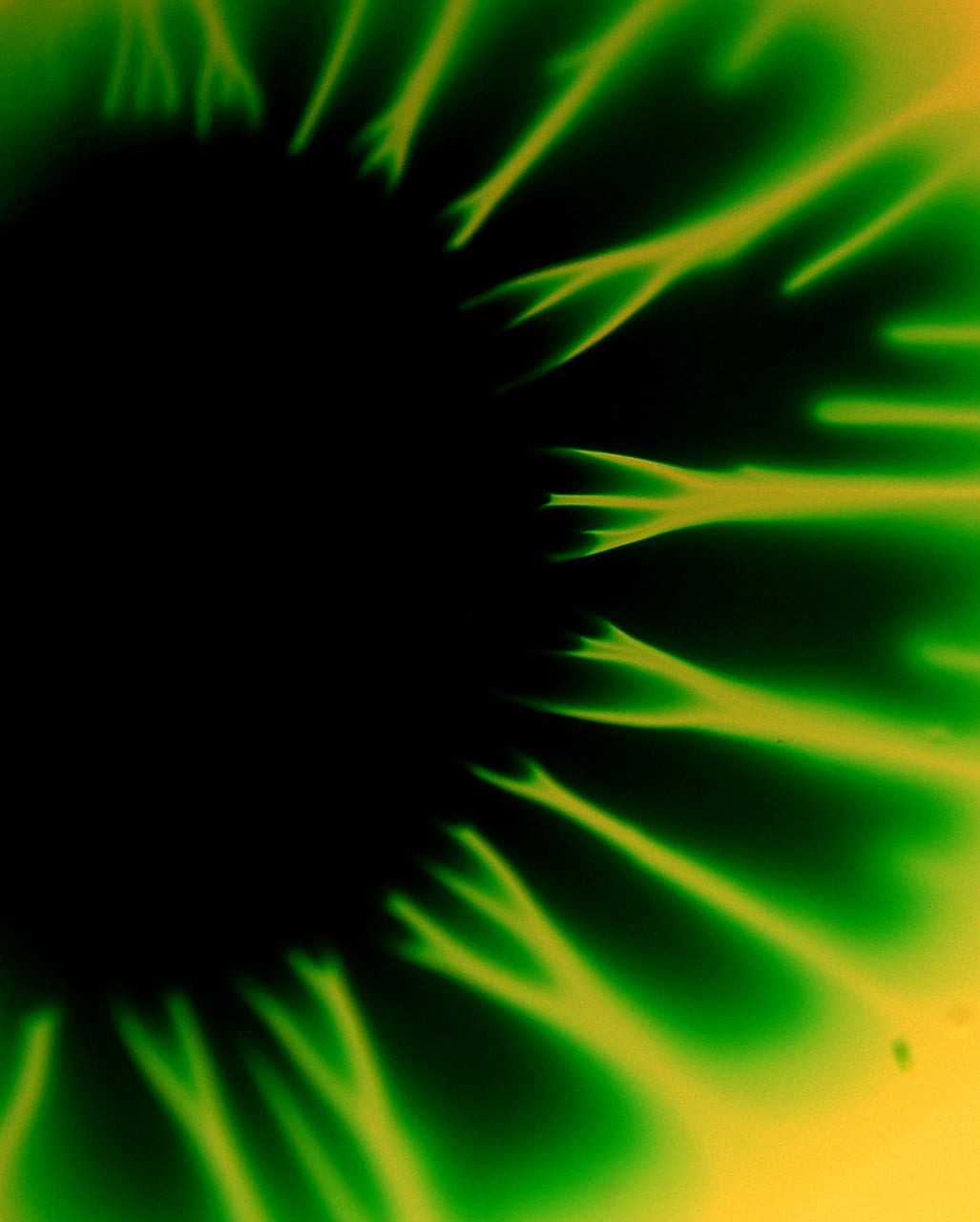
Place a viscous fluid in the gap between two plates of glass and you have created a Hele Shaw cell. If a less viscous fluid is then injected between the plates, a fascinating pattern of finger-like protrusions results. This is known as the Saffman-Taylor instability. Because of the relative simplicity of the set-up, it’s possible to create such experiments at home using common household fluids like glycerin, dish soap, dyed water, or laundry detergent. (Photo credits: Jessica Rosencranz, Jessica Todd, Laurel Swift et al, Andrea Fabri et al, Tanner Ladtkow et al, Mike Demmons et al, Trisha Harrison, Justin Cohee, and Erik Hansen)
2D Convection
This simulation shows 2D Rayleigh-Benard convection in which a fluid of uniform initial temperature is heated from below and cooled from above. This is roughly analogous to the situation of placing a pot of water on a hot stovetop. (In the case of the water on the stove, the upper boundary is the water-air interface, while, in the simulation, the upper boundary is modeled as a no-slip (i.e. solid) interface.) The simulation shows contours of temperature (black = cool, white = hot). In general, the hot fluid rises and the cold fluid sinks due to differences in density, but, as the simulation shows, the actual mixing that occurs is far more complex than that simple axiom indicates.

Cloud Streets

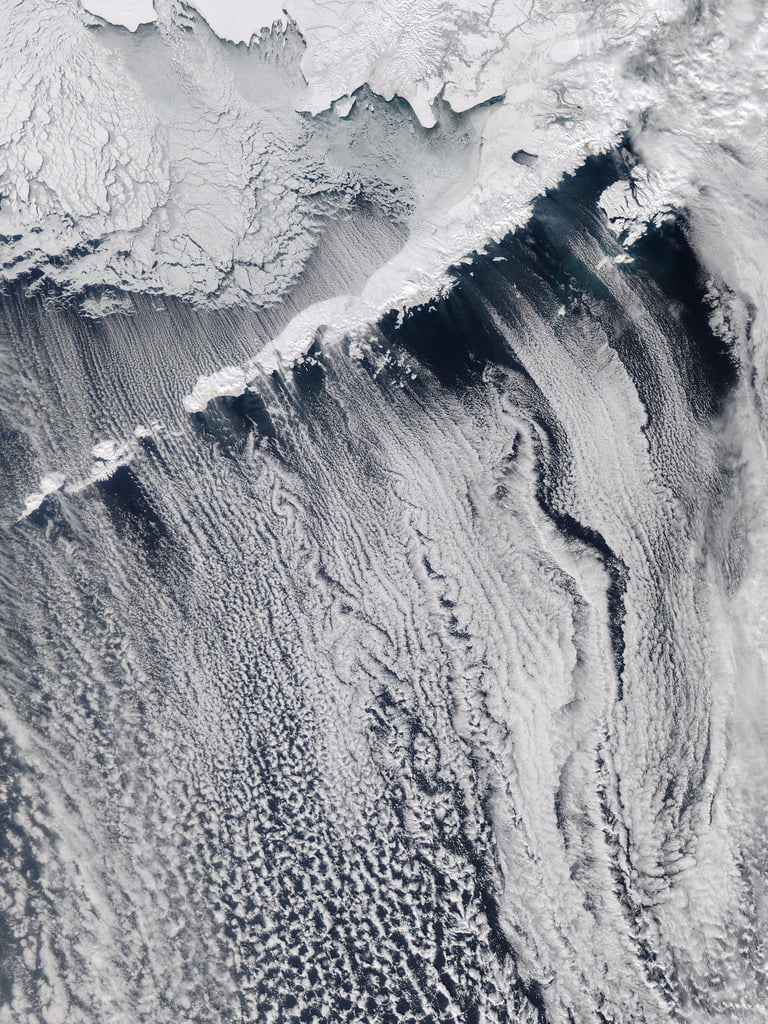
Cloud streets–long rows of counter-rotating air parallel to the ground in the planetary boundary layer–are thought to form as a result of cold air blowing over warm waters while caught beneath a warmer layer of air, a temperature inversion. As moisture evaporates from the warmer water, it creates thermal updrafts that rise through the atmosphere until they hit the temperature inversion. With nowhere to go, the warmer air tends to lose its heat to the surroundings and sink back down, creating a roll-like convective cell. (Photo credits: NASA Terra, NASA Aqua, and Tatiana Gerus)