High-speed video reveals the complexity of fluid instabilities leading to atomization–the breakup of a liquid sheet into droplets. A thin annular liquid sheet is sandwiched between concentric air streams. As the velocity of the air on either side of the liquid sheet varies, shear forces cause the sheet to develop waves that result in mushroom-like shapes that break down into ligaments and droplets. Quick breakup into droplets is important in many applications, most notably combustion, where the size and dispersal of fuel droplets affects the efficiency of an engine. (Video credit: D. Duke, D. Honnery, and J. Soria)
Search results for: “waves”

The Veil Nebula
There is no grander scale for the observation of fluid dynamics than that of the astronomical. Here Hubble astronomers discuss the formation of the Veil Nebula, a supernova remnant formed some 5,000-10,000 years ago. Wisps of gas and plasma remain, creating stunning astronomical landscapes that are the result of shock waves, turbulence, diffusion, and other processes familiar to us here on Earth. (Video credit: ESA/Hubble)
Bouncing Off
A water droplet falling onto a superhydrophobic surface will rebound and bounce without wetting the surface. Capillary and internal waves reflect in the drop until it comes to rest at a high contact angle, formed at the boundary where the liquid, solid, and air meet. Such surfaces can have interesting interactions with water, as when two droplets coalesce on a surface and then begin bouncing or when superhydrophobic objects are dropped into a bath. (Video credit: Gangopadhyay Group, University of Missouri)
Didgeridoo Soap Bubble
This high-speed video shows a soap bubble being blown via didgeridoo, a wind instrument developed by the Indigenous Australians. The oscillations of the capillary waves on the surface of the bubble vary with the frequency of note being played. High frequency notes excite small wavelengths, whereas lower notes create large wavelength oscillations. For more fun, check out what you can do with didgeridoos in space. (submitted by Christopher B)
Astro Puffs
Microgravity continues to be a fascinating playground for observing surface tension effects on the macroscale without pesky gravity getting in the way. Here astronaut Don Pettit has created a sphere of water, which he then strikes with a jet of air from a syringe. Initially, the momentum from the jet of air creates a sharp cavity in the water, which rebounds into a jet of water that ejects one or more satellite drops. Surface waves and inertial waves (inside the water sphere) reflect back and forth until the fluid comes to rest as a sphere once more. Note how similar the behavior is to the pinch-off of a water column. Both effects are dominated by surface tension, but on Earth we can only see this behavior with extremely small droplets and high-speed cameras! (Video credit: Don Pettit, Science Off the Sphere)

London 2012: Rowing Physics
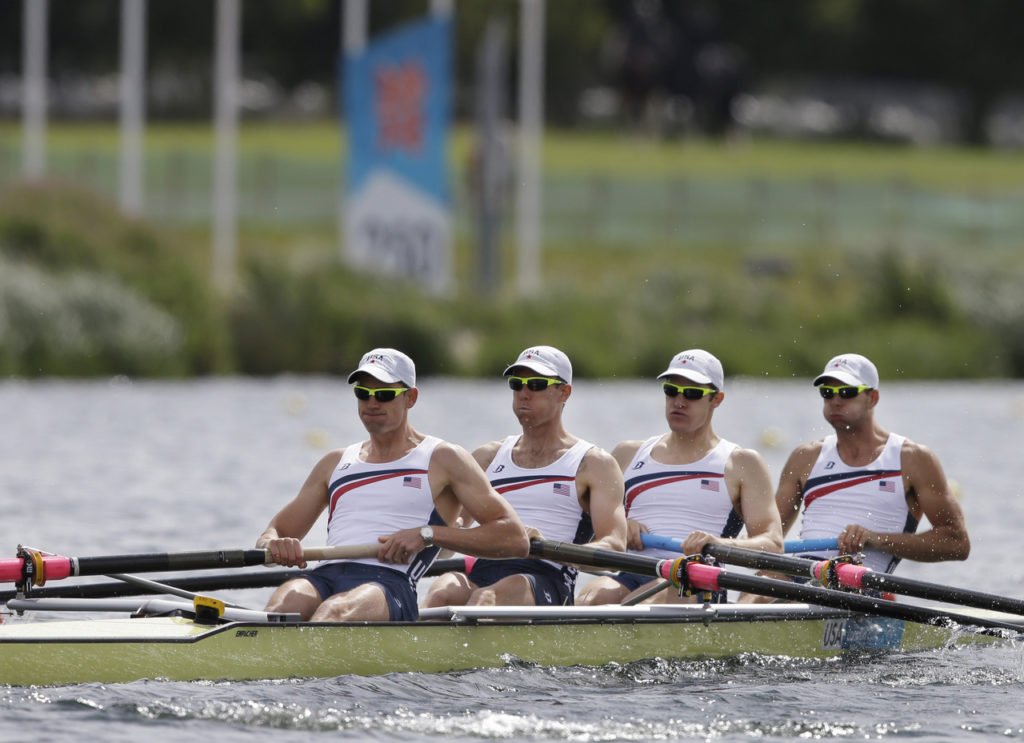


In rowing, as in any water sport, drag comes in three varieties: skin friction, form (or pressure) drag, and wave drag. Skin friction comes from the friction between the hull and water causing the boat to drag water with it as it moves. This can be mitigated with the right materials and surface finish but will never be completely negligible. In fact, the racing shells used in rowing are unusual for boats because skin friction is their major source of resistance. This is because form drag, caused by the shape of the boat cutting through the water, and wave drag, the energy lost due to the waves that form along the hull, are small in racing shells due to their long, narrow, and streamlined shape. Because skin friction dominates among the three types of drag, the force a rower overcomes to move the boat is proportional to the hull’s velocity squared, and the power required to do so is proportional to the hull’s velocity cubed. This means that it is more efficient for rowers to keep a constant hull speed throughout a race than it is to start slow and speed up or start fast and slow down because the work (power x time) needed to keep a constant speed is smaller. For more on the physics of rowing, check out Anu Dudhia’s excellent website or this video from Physics of Life. (Photo credits: Ecouterre, AP)
FYFD is celebrating the Olympics by featuring the fluid dynamics of sport. Check out some of our previous posts, including what makes a pool fast, how divers reduce splash, and the aerodynamics of badminton.

London 2012: Swimming Pool Physics


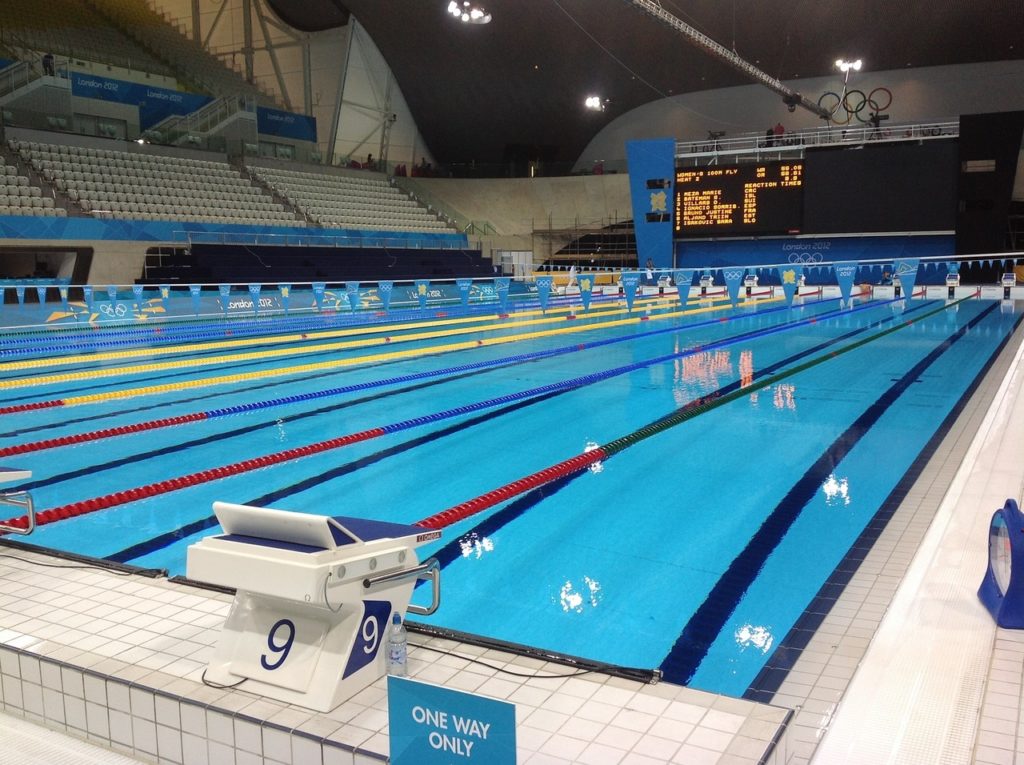
The era of the LZR suit may be over in swimming, but technology is still making an impact when it comes to making swimmers faster. One thing you’ll often hear from commentators is how the London Aquatic Center boasts one of the world’s fastest pools. When swimmers compete, they have to contend with all the turbulence created in the pool by eight people trying to direct as much water behind them as possible as quickly as possible. Like ripples spreading on a pond, these waves travel, reflect, and interfere, ultimately disrupting the swimmers and causing extra drag. In a fast pool, engineers have made adjustments to reduce the impact of these waves on swimmers. Firstly, the pool is 3 meters deep, meaning that vertical disruptions are mostly damped out before they reach the bottom, so any wave reflected off the bottom of the pool will be extremely weak. Along the sides and ends of the pool, a special trough captures surface waves, preventing them from reflecting back out into the pool. The lane lines are also designed to soak up wave energy so that it does not propagate as much between lanes. When waves hit the lines, their links spin, dissipating some of the wave’s energy.
Despite these advances, the outermost lanes–those against the walls–are not used in competition. This helps to equalize the turbulence between lanes. Whether there is any fluid mechanical advantage to being in a particular lane is debatable. The outer lanes have the advantage of only one competitor’s wake to contend with, but they isolate the swimmer so he or she cannot see their competition as well. In the inner lanes, you’ll sometimes see swimmers try to swim close to the lane line if their competition is ahead of them, the idea being that they may be able to draft on their competitor’s bow wave to reduce drag. Generally speaking, the lane positions are determined by seeding going into the event, where the faster swimmers are given the innermost lanes. This is why it’s rare to see gold medals coming from the outermost lanes. For more, check out NBC’s video on designing fast pools (US only, unfortunately). (Photo credits: Associated Press, Reuters, Geoff Caddick)
Mussels
In this video, schlieren imaging is used to make visible the flow field around a mussel. Mussels are filter-feeders, drawing nearby water in to obtain their food and expelling the unneeded fluid once they’ve gathered the plankton they eat. Normally this process is invisible to the naked eye, but schlieren imaging reveals changes in density (and thus refractive index) that make it possible to visualize the outflow from the mussel. The technique is also commonly used in supersonic flows to reveal shock waves. (Video credit: Stephen Allen)
The Cloud Bands of Jupiter
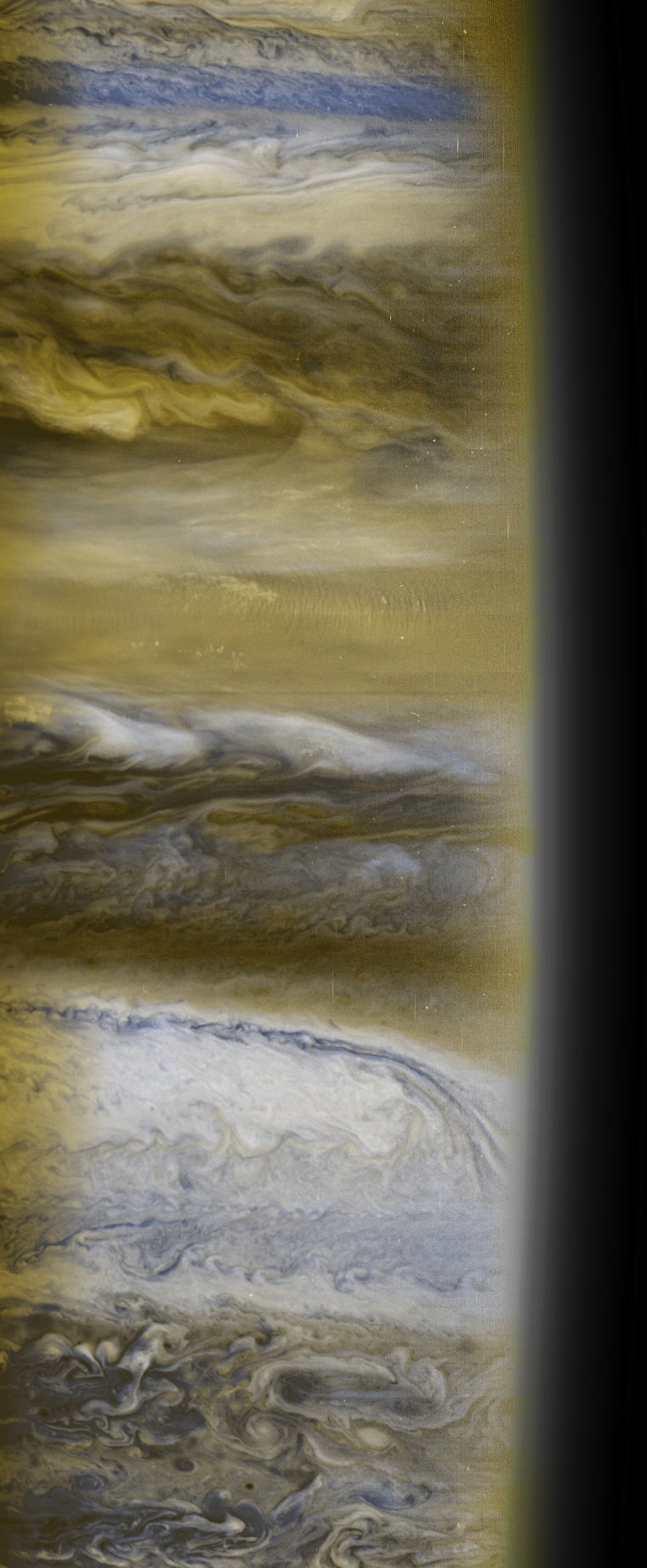
The cloud bands of Jupiter stripe the planet with turbulence. Throughout its upper atmosphere, Jupiter shows signs of gravity waves and complicated wave patterns. Near the equator, the cloud bands are driven by planetary winds that reach speeds of 500 kph, whereas near the poles, the clouds show greater evidence of mottling and convection. At present, the reasons for this patterning are undetermined. (Image Credit: NASA; via APOD)
Schlieren Montage
Dr. Gary Settles, a world-reknown expert in schlieren photography, shows here a montage of some of his lab’s results, including shockwaves from musical instruments, dogs sniffing, guns firing (both sub- and supersonic), and even snapping a wet towel going supersonic. As Settles jokes, schlieren is all mirrors and hot air. Mirrors are used to shine collimated light on the object to be imaged; then the light focused with a lens. By placing a knife-edge at the focal point, part of the light is blocked and the density variations in the final image become visible, thanks to their differing refractive indices. (Video credit: G. Settles et al.)