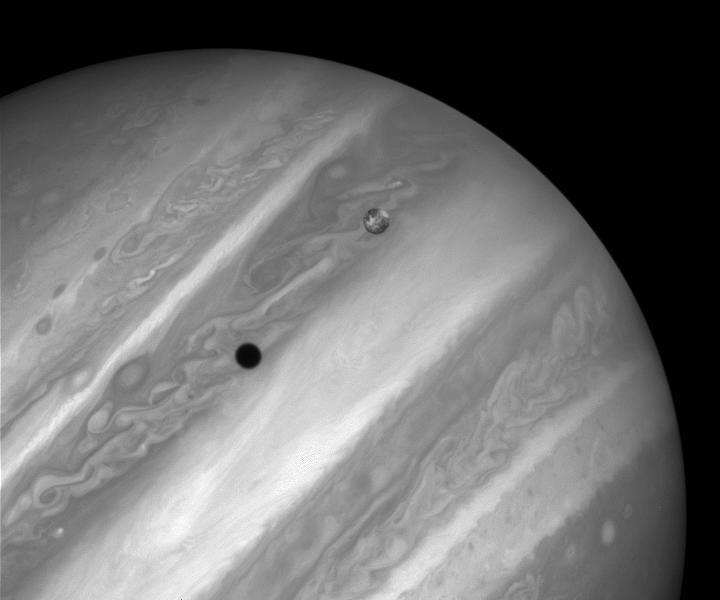
When layers of a fluid are moving at different relative velocities, they shear against one another. This shear can trigger the Kelvin-Helmholtz instability, which develops as a waves along the interface. Here Hubble captures Kelvin-Helmholtz waves along the cloud bands of Jupiter, but such clouds are also not uncommon here on Earth. (Photo credit: J. Spencer and NASA)
Search results for: “waves”

Supersonic Flow Around a Cylinder
This numerical simulation shows unsteady supersonic flow (Mach 2) around a circular cylinder. On the right are contours of density, and on the left is entropy viscosity, used for stability in the computations. After the flow starts, the bow shock in front of the cylinder and its reflections off the walls and the shock waves in the cylinder’s wake relax into a steady-state condition. About halfway through the video, you will notice the von Karman vortex street of alternating vortices shed from the cylinder, much like one sees at low speeds. The simulation is inviscid to simplify the equations, which are solved using tools from the FEniCS project. (Video credit: M. Nazarov)
Ultrasonic Levitation of Drops
This video shows an ultrasonically levitated 3 mm drop of propylene glycol changing shape. A couple of things are happening here. Firstly, the drop is suspended due to the acoustic radiation pressure from intense ultrasonic sound waves being produced by a transducer vibrating at 30kHz. Then the power input to the ultrasonic transducer is increased, which strengthens the acoustic field, and this is what causes the drop to flatten. Currently, acoustic levitation is used for containerless processing of very pure materials or chemicals. As with many methods for levitation, it is currently restricted to objects of relatively light weight. (Video credit: J. R. Saylor et al, Clemson University)
Oceanic Swirls
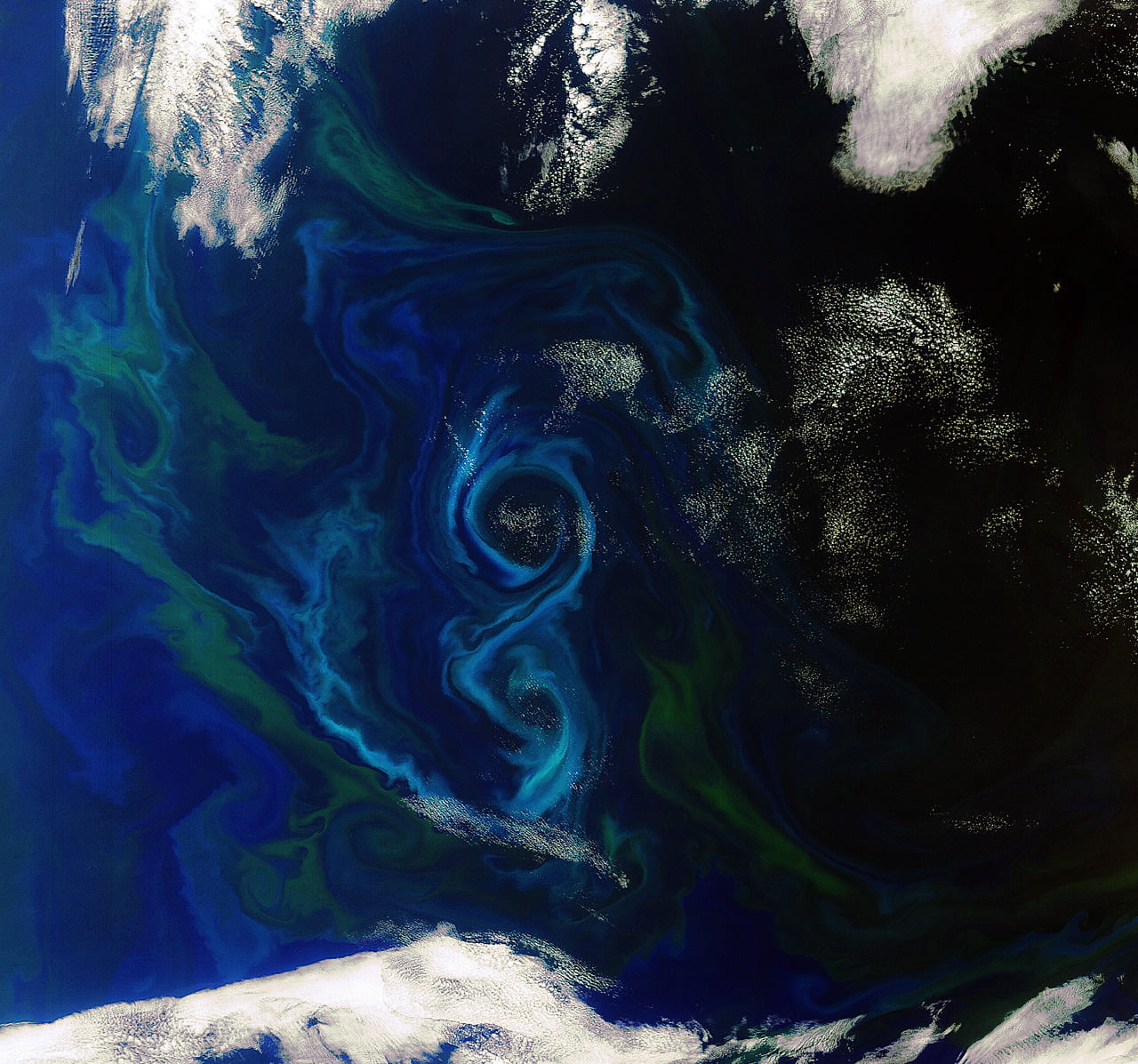
Mixing of surface waters with deeper ocean currents brings together the minerals and nutrients used by phytoplankton, resulting in gorgeous swirls of color in the ocean. These phytoplankton blooms are most common in the spring and summer, and while lovely, can be harmful to other marine life, either through the production of toxins or by depleting the waters of oxygen. Because the phytoplankton move according to the wind and waves, they can also form a sort of natural flow visualization. (Photo credit: ESA)
———-
While FYFD is not blacking out for SOPA/PIPA, we would like to take a moment to register our protest and encourage those of you who are Americans to take a moment to let Congress know that you don’t approve of these bills. Although we agree that protection of copyright holders rights is important, the measures proposed in these bills reach far beyond that line. FYFD, as a site that reposts photos and videos primarily created by others, could be taken down as a result of these bills, despite the purpose of the website as a tool for educational outreach and dissemination of science. Please support a free and uncensored Internet!
The Invisible Forces Behind a Lighter
This high-speed schlieren video reveals the ignition of a butane lighter. The schlieren optical technique exaggerates differences in refractive index caused by density variations, enabling experimentalists to see thermal eddies, shock waves, and other phenomena invisible to the naked eye. Here a jet of butane shoots upward from the lighter as a valve is released. Then the spark from the lighter ignites the butane gas near the bottom of the jet. A flame front the propagates outward and upward, completing the lighting process. (submitted by @Mark_K_Quinn)
Breakup of an Annular Sheet
A thin annular sheet of water is sandwiched between two concentric air streams. This airflow on either side of the water causes shearing and Kelvin-Helmholtz-type instabilities develop, causing the sinuous waves along the water surface. Periodic behavior of the sort observed here is frequently observed in fluid mechanical instabilities. #

Wave Clouds Over Alabama
Last week, Birmingham, Alabama got treated to a special cloudy day, thanks to some Kelvin-Helmholtz waves, shown above. When a layer of faster moving fluid shears a slower moving fluid, this instability can form and cause some spectacular mixing. In this case, the lower, slower fluid was cool and moist enough to contain clouds, enabling us to see the effect with the naked eye. The same mechanism is responsible for the shape of breaking ocean waves and can even be seen in the atmospheres of gas giants like Saturn and Jupiter. (submitted by David B)
Water Balloon Physics
[original media no longer available]
This video explores some of the physics behind the much-loved bursting water balloon. The first sections show some “canonical” cases–dropping water balloons onto a flat rigid surface. In some cases the balloon will bounce and in others it breaks. The bursting water balloons develop strong capillary waves (like ripples) across the upper surface and have some shear-induced deformation of the water surface as the rubber peals away. Then the authors placed a water balloon underwater and vibrated it before bursting it with a pin. They note that the breakdown of the interface between the balloon water and surrounding water shows evidence of Rayleigh-Taylor and Richtmyer-Meshkov instabilities. The Rayleigh-Taylor instability is the mushroom-like formation observed when stratified fluids of differing densities mix, while the Richtmyer-Meshkov instability is associated with the impulsive acceleration of fluids of differing density.

Bow Shock over a Perforated Plate
This schlieren image shows a sphere traveling at Mach 3 over a perforated plate. The bow shock in front of the sphere is clearly visible, as is its reflection off the plate. The pressure caused by the bow shock produces a series of spherical acoustic waves below the plate. A tiny vortex ring moves downward from each hole, followed at the right by a secondary ring moving upward from the holes in the plate. (Photo credit: U.S. Army Ballistic Research Laboratory; reprinted in Van Dyke’s An Album of Fluid Motion)
Vibration-Induced Atomization
Atomization–breaking a liquid into a fine spay of droplets–is common in engines, printers, and in the shower. Here a droplet of water is placed on a thin metal diaphragm that is vibrated at 1 kHz with increasing vibrational amplitude. Capillary waves form on the droplet, and once a critical vibrational amplitude is achieved, tiny droplets are ejected. Full atomization of the original droplet is achieved in about 0.3 seconds real-time. #
