In this video, schlieren imaging is used to make visible the flow field around a mussel. Mussels are filter-feeders, drawing nearby water in to obtain their food and expelling the unneeded fluid once they’ve gathered the plankton they eat. Normally this process is invisible to the naked eye, but schlieren imaging reveals changes in density (and thus refractive index) that make it possible to visualize the outflow from the mussel. The technique is also commonly used in supersonic flows to reveal shock waves. (Video credit: Stephen Allen)
Search results for: “waves”
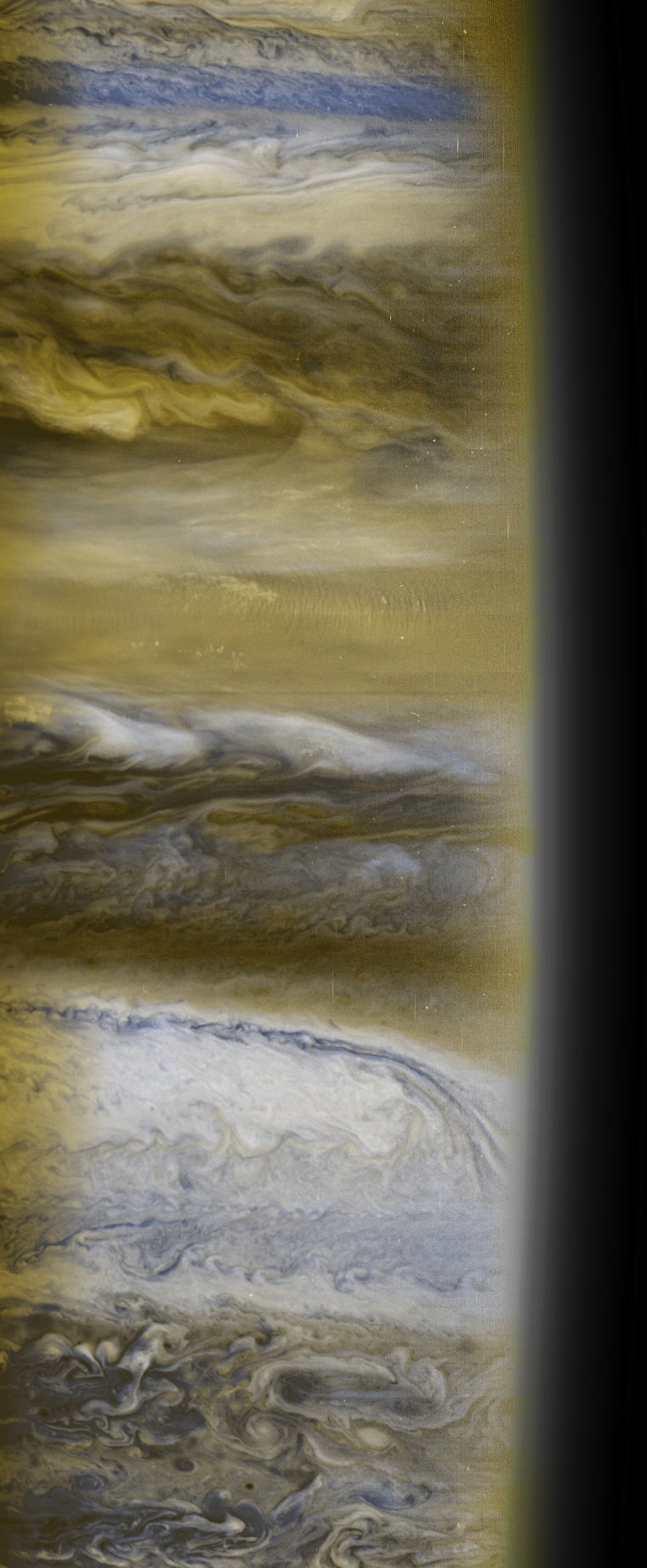
The Cloud Bands of Jupiter
The cloud bands of Jupiter stripe the planet with turbulence. Throughout its upper atmosphere, Jupiter shows signs of gravity waves and complicated wave patterns. Near the equator, the cloud bands are driven by planetary winds that reach speeds of 500 kph, whereas near the poles, the clouds show greater evidence of mottling and convection. At present, the reasons for this patterning are undetermined. (Image Credit: NASA; via APOD)

Schlieren Montage
Dr. Gary Settles, a world-reknown expert in schlieren photography, shows here a montage of some of his lab’s results, including shockwaves from musical instruments, dogs sniffing, guns firing (both sub- and supersonic), and even snapping a wet towel going supersonic. As Settles jokes, schlieren is all mirrors and hot air. Mirrors are used to shine collimated light on the object to be imaged; then the light focused with a lens. By placing a knife-edge at the focal point, part of the light is blocked and the density variations in the final image become visible, thanks to their differing refractive indices. (Video credit: G. Settles et al.)
The Vibrating Network
We’ve seen the Faraday instability on vibrating fluids (and granular materials) before. Here researchers explore the effect on a a network of fluid-filled cells. Each square is filled with liquid and small holes near the bottom of each cell ensure the liquid levels are the same throughout the array. Then the entire container is vibrated. Above the threshold frequency, standing waves form but do not interact. When the wave amplitudes grow high enough for fluid to get exchanged from cell to cell, patterns begin to form. The waves in adjacent cells synchronize, eventually resulting in a regular pattern across the entire grid. Order out of chaos.(Video credit: G. Delon et al.)

Fractal Fluids
These images from a numerical simulation of a mixing layer between fluids of different density show the development and breakdown to Kelvin-Helmholtz waves. The black fluid is 3 times denser than the white fluid, and, as the two layers shear past one another, billow-like waves form (Fig 1(a)). Inside those billows, secondary and even tertiary billows form (Fig 1(a) and (b)). Fig 1 (c)-(e) show successive closeups on these waves, showing their beautiful fractal-like structure. (Photo credit: J. Fontane et al, 2008 Gallery of Fluid Motion) #
Dancing Sands
Here a collection of dry grains are vertically vibrated, creating a series of standing waves on the surface of the sand. The shapes of these Faraday waves are dependent upon the frequency of the vibration. Despite the solid nature of sand particles, this behavior is much the same as the behavior of a vibrated fluid.

Martian Lava Coils

NASA’s HiRISE spacecraft has sent back images of lava coils left on the surface of Mars. These features form when lava flows of different speeds move past one another; they’re essentially Kelvin-Helmholtz waves–like the ones often seen in clouds–in the lava flow that have solidified into solid rock! On Earth these coils appear about a foot wide; the Martian versions are 100 feet across. (Photo credit: NASA/JPL/University of Arizona; via Wired; submitted by Brian L)
Breaking Water with Sound
Previously we saw how vibration could atomize a water droplet, breaking it into a spray of finer droplets. Here astronaut Don Pettit shows us what the process looks like in microgravity using some speakers and large water droplets. At low frequencies the water displays large wavelength capillary waves and vertical vibrations. Higher frequencies–like the earthbound experiment on much smaller droplets–cause fine droplets to eject from the main drop when surface tension can no longer overcome their kinetic energy. (submitted by aggieastronaut, jshoer and Jason C)
(Source: /)Portrait of Gas Giants
[original media no longer available]
Here raw footage from NASA’s Cassini and Voyager missions has been combined in a stunning portrait of Saturn and Jupiter. Watch as tiny moons create gravity waves in the rings of Saturn and observe the complicated relative motion between the cloud bands on Jupiter and the swirls and vortices that result. Fluid dynamics are truly everywhere. (Video credit: Sander van den Berg; submitted by Daniel B)