This video has a fun and simple demonstration of the importance of fluid density in buoyancy and stratification. Fresh water (red) and salt water (blue) are released together into a small tank. Being lighter and less dense, the red water settles on top of the blue water, though some internal waves muddy their interface. After the water settles, a gate is placed between them once more and one side is thoroughly mixed to create a third fluid density (purple), which, when released, settles between the red and blue layers. In addition to displaying buoyancy, this demo does a great job ofaa showing the internal waves that can occur within a fluid, especially one of varying density like the ocean. (Video credit: UVic Climate Modeling Group)
Search results for: “waves”

Inside a Blender
The fluid dynamics of a commercial-quality blender amount to a lot more than just stirring. Here high-speed video shows how the blender’s moving blades create a suction effect that pulls contents down through the middle of the blender, then flings them outward. This motion creates large shear stresses, which help break up the food, as well as turbulence that can mix it. But if you watch carefully, you’ll also see tiny bubbles spinning off the blades. These bubbles, formed by the pressure drop of fluid accelerated over the arms of the blades, are cavitation bubbles. When they collapse, or implode, they create localized shock waves that further break up the blender’s contents. This same effect is responsible for damage to boat propellers and lets you destroy glass bottles. (Video credit: ChefSteps; via Wired; submitted by jshoer)
Tuning Fork Fluids
This high-speed video shows a liquid crystal fluid vibrating on a tuning fork. As the surface moves, tiny jets shoot upward, sometimes with sufficient energy that the fluid column is stretched beyond surface tension’s ability to keep it intact, resulting in droplet ejection. The jets and surface waves create a mesmerizing pattern of fluid motion. (Video credit: J. Savage)

Slapping Sheets
Here fluid is ejected as two flat plates collide, creating a sheet of silicone oil. The initially smooth sheet forms a thicker ligament about the edge. Gravity causes the sheet to bend downward like a curtain, and growing instabilities along the ligament cause the development of a wavy edge. The points of the waves develop droplets that eject outward. Not long after this photograph, the entire liquid sheet will collapse into ligaments and flying droplets. (Photo credit: B. Chang, B. Slama, and S. Jung)
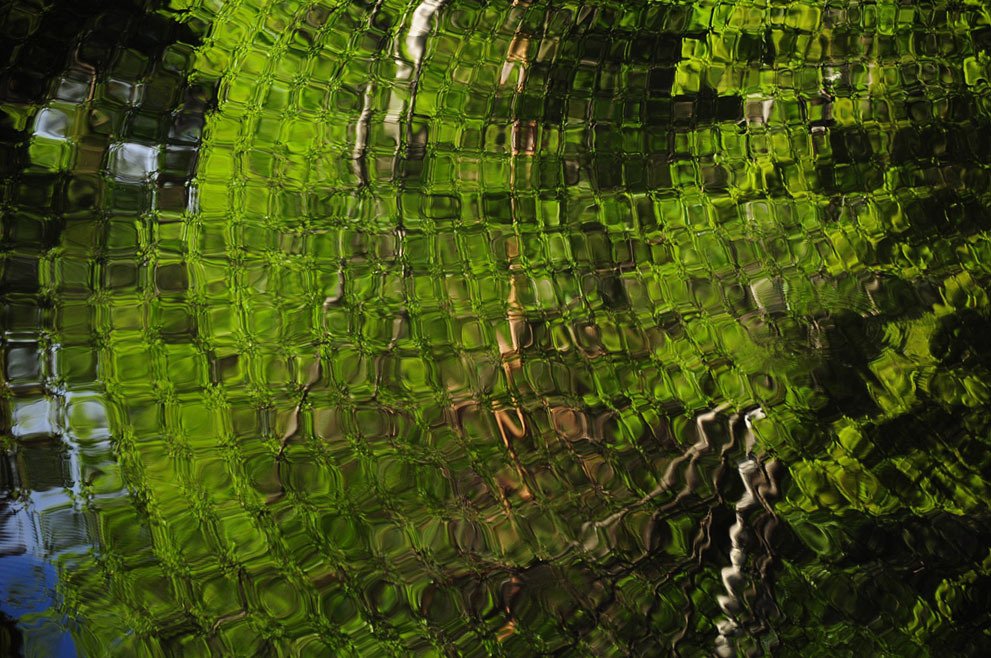
Ripples
Capillary waves–ripples–interfere with one another after the photographer throws objects into a narrow point in a small lake. The reflections of these waves off the lake’s boundaries and against one another creates a mosaic-like geometric effect on the liquid surface. (Photo credit: Jorgen Tharaldsen/National Geographic Photo Contest)
Bouncing in a Corral
About a year ago, we featured a video in which a fluid droplet bouncing on a vibrating pool demonstrated some aspects of the wave-particle duality fundamental to quantum mechanics. Work on this system continues and this new video focuses on studying some of the statistics of such a bouncing droplet–called a walker in the video–when it is confined to a circular corral. Using strobe lighting and capturing one frame per bounce, the vertical motion of these droplets is filtered out and the walking motion and the surface waves that guide it are captured. When the droplet is allowed to walk for an extended time, its path appears complicated and seemingly random, but it is possible to build a statistical picture and a probability density field that describe where the walker is most likely to be, much the way one describes the likelihood of locating a quantum particle. Parallels between the physical macroscale system and quantum-mechanical theory are drawn. (Video credit: D. Harris and J. Bush; submission by D. Harris)
Superfluid Vortices
Cooling helium to a few degrees Kelvin above absolute zero produces superfluid helium, a substance with some very bizarre behaviors caused by a lack of viscosity. Superfluids exhibit quantum mechanical properties on a macroscopic scale; for example, when rotated, a superfluid’s vorticity is quantized into distinct vortex lines, known as quantum vortices. These vortices can be visualized in a superfluid by introducing solid tracer particles, which congregate inside the vortex line, making it appear as a dotted line, as shown in the video above. When these vortex lines approach one another, they can break and reconnect into new vortices. These reconnections provoke helical Kelvin waves, a phenomenon that had not been directly observed until the present work by E. Fonda and colleagues. They are even able to show that the waves they observe match several proposed models for the behavior. (Video credit: E. Fonda et al.)
Dancing Droplet Clusters
When a fluid surface is vibrated, it’s possible to bounce a droplet indefinitely on the surface without the droplet coalescing into the pool. This is because each bounce of the droplet replenishes a thin layer of air that separates the droplet and the pool. If many droplets are added to the surface, as in the video above, a clustering behavior is observed, with many droplets gathering together. There is a limit, however, to the size of the cluster based on the amplitude of vibration. If vibrational amplitudes are pushed to the point of creating Faraday waves–standing waves on the surface of the pool–then large clusters of droplets can be suspended and sustained. (Video credit: P. Cabrera-Garcia and R. Zenit; via io9; submitted by oneheadtoanother)
Following a Breaking Wave
It’s fascinating to sit on the beach and watch the waves roll in and break, but rarely do we get a view like the one in this video. Here researchers have created a breaking wave in a wave tank and recorded the wave as it travels the length of the tank with a high-speed camera moving at the same speed as the wave crest. This perspective, moving alongside the fluid, is a Lagrangian coordinate system; if one instead stood still and watched the wave roll past, it would be an Eulerian measurement. Traveling with the wave, we can see how a lip forms on the wave crest, then rolls down, capturing a tube of air. As water begins to flow over the lip, perturbations grow, causing ripples in the laminar curtain. Then the water strikes the main wave and rebounds turbulently, creating a familiar white cap. In the second half of the video, the process is shown from above, highlighting the entrainment of air and the creation of the bubbles that form the white cap of a breaking wave. (Video credit: R. Liu et al)
Cavitation in a Bottle
Sudden changes in the pressure or temperature in a liquid can create bubbles in a process known as cavitation. Underwater explosions are just one of the ways to induce cavitation in a liquid. As identified in the above video, the shock waves traveling through the liquid force a change in pressure that creates bubbles. When these bubbles collapse, the container is subjected to an enormous oscillation in pressure, which often results in damage. The same phenomenon is responsible for damage on boat propellers as well as this beer bottle smashing trick. Check out these other high-speed videos of cavitation in a bottle: (Video credit: Destin/Smarter Every Day; submitted by Juan S.)
