When a drop falls from a moderate height into a shallow pool, its impact creates a complicated pattern. The photo above is a composite image showing a top-down view 100 ms after such an impact. On the left side, the flow is visualized using dye whereas the right shows a schlieren photograph, in which contrast indicates variations in density. Both methods show the same general structure – an inner vortex ring generated at the edge of the impact crater and formed mostly of drop fluid and an outer vortex ring, consisting primarily of pool fluid, formed by the spreading wave. Both regions show signs of instability and breakdown. (Photo credit: A. Wilkens et al.)
Search results for: “waves”

Reader Question: Energy from Whirlpools?
shiftymctwizz asks:
So I just read your post about vortices, and now I’m wondering if we could build structures similar to the Corryvreckan and put turbines in them for energy production? Would it be any more efficient than hydroelectric dams? Are you the right person to ask?
I can’t give you numbers off the top of my head, but I suspect that your typical hydroelectric dam will be more reliable if not more efficient. The trouble with things like the Corryvreckan, aside from the randomness of where the vortices pop up, is that they aren’t there every single day the way, say, Niagara Falls is.
That said, there is on-going work to effectively harness ocean waves for power, with ideas like buoy generators or sea snake generators. As with most concepts one of the difficulties in implementation is determining a safe and efficient manner to transmit the electricity generated from these offshore sites (we’re generally talking miles from shore) to where it’s needed. This problem is often similarly faced by solar and wind energy producers. There are already wave farms in place around the world, though, and it’s a promising field of renewable energy. (Photo credit: Wikimedia)

SpaceShipTwo Lights It Up

Monday morning Virgin Galactic and their partners at Scaled Composites reached a new milestone in their commercial sub-orbital spaceflight program, firing SpaceShipTwo’s main engine for the first time and accelerating to supersonic speeds. The upper image shows hints of Mach diamonds, formed by a series of shock waves and expansions, in its exhaust. This is very common for rockets since most have a fixed geometry, and, by extension, a fixed Mach number and exhaust pressure. (Photo credits: Virgin Galactic and Mars Scientific)

Internal Wave Demo
This video has a fun and simple demonstration of the importance of fluid density in buoyancy and stratification. Fresh water (red) and salt water (blue) are released together into a small tank. Being lighter and less dense, the red water settles on top of the blue water, though some internal waves muddy their interface. After the water settles, a gate is placed between them once more and one side is thoroughly mixed to create a third fluid density (purple), which, when released, settles between the red and blue layers. In addition to displaying buoyancy, this demo does a great job ofaa showing the internal waves that can occur within a fluid, especially one of varying density like the ocean. (Video credit: UVic Climate Modeling Group)

Inside a Blender
The fluid dynamics of a commercial-quality blender amount to a lot more than just stirring. Here high-speed video shows how the blender’s moving blades create a suction effect that pulls contents down through the middle of the blender, then flings them outward. This motion creates large shear stresses, which help break up the food, as well as turbulence that can mix it. But if you watch carefully, you’ll also see tiny bubbles spinning off the blades. These bubbles, formed by the pressure drop of fluid accelerated over the arms of the blades, are cavitation bubbles. When they collapse, or implode, they create localized shock waves that further break up the blender’s contents. This same effect is responsible for damage to boat propellers and lets you destroy glass bottles. (Video credit: ChefSteps; via Wired; submitted by jshoer)

Tuning Fork Fluids
This high-speed video shows a liquid crystal fluid vibrating on a tuning fork. As the surface moves, tiny jets shoot upward, sometimes with sufficient energy that the fluid column is stretched beyond surface tension’s ability to keep it intact, resulting in droplet ejection. The jets and surface waves create a mesmerizing pattern of fluid motion. (Video credit: J. Savage)

Slapping Sheets
Here fluid is ejected as two flat plates collide, creating a sheet of silicone oil. The initially smooth sheet forms a thicker ligament about the edge. Gravity causes the sheet to bend downward like a curtain, and growing instabilities along the ligament cause the development of a wavy edge. The points of the waves develop droplets that eject outward. Not long after this photograph, the entire liquid sheet will collapse into ligaments and flying droplets. (Photo credit: B. Chang, B. Slama, and S. Jung)

Ripples
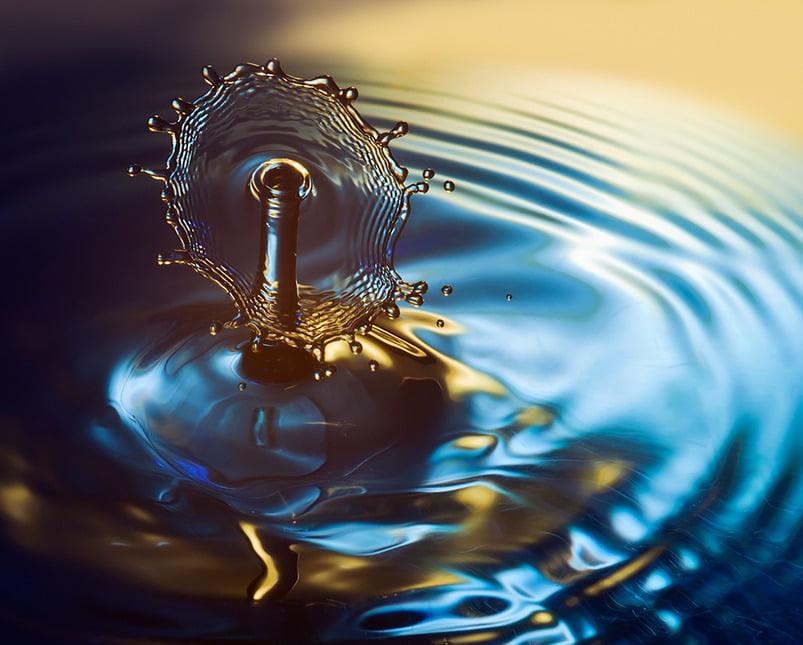
Capillary waves–ripples–interfere with one another after the photographer throws objects into a narrow point in a small lake. The reflections of these waves off the lake’s boundaries and against one another creates a mosaic-like geometric effect on the liquid surface. (Photo credit: Jorgen Tharaldsen/National Geographic Photo Contest)

Bouncing in a Corral
About a year ago, we featured a video in which a fluid droplet bouncing on a vibrating pool demonstrated some aspects of the wave-particle duality fundamental to quantum mechanics. Work on this system continues and this new video focuses on studying some of the statistics of such a bouncing droplet–called a walker in the video–when it is confined to a circular corral. Using strobe lighting and capturing one frame per bounce, the vertical motion of these droplets is filtered out and the walking motion and the surface waves that guide it are captured. When the droplet is allowed to walk for an extended time, its path appears complicated and seemingly random, but it is possible to build a statistical picture and a probability density field that describe where the walker is most likely to be, much the way one describes the likelihood of locating a quantum particle. Parallels between the physical macroscale system and quantum-mechanical theory are drawn. (Video credit: D. Harris and J. Bush; submission by D. Harris)

Superfluid Vortices
Cooling helium to a few degrees Kelvin above absolute zero produces superfluid helium, a substance with some very bizarre behaviors caused by a lack of viscosity. Superfluids exhibit quantum mechanical properties on a macroscopic scale; for example, when rotated, a superfluid’s vorticity is quantized into distinct vortex lines, known as quantum vortices. These vortices can be visualized in a superfluid by introducing solid tracer particles, which congregate inside the vortex line, making it appear as a dotted line, as shown in the video above. When these vortex lines approach one another, they can break and reconnect into new vortices. These reconnections provoke helical Kelvin waves, a phenomenon that had not been directly observed until the present work by E. Fonda and colleagues. They are even able to show that the waves they observe match several proposed models for the behavior. (Video credit: E. Fonda et al.)