
How does water drip, drip, dripping onto stones erode a crater? Water is so much more deformable that it seems impossible for it to wear harder materials away, even over thousands of impacts. To investigate this, a team of researchers developed a new measurement technique: high-speed stress microscopy. In the process, they found that water owes its incredible erosive power to three factors: 1) The drop’s impact creates surface shock waves along the material, which helps increase erosive power; 2) After the shock wave passes, a decompression wave in the material helps loosen surface matter; and 3) The spreading drop sends a non-uniform wave of stress across the material that simultaneously presses and scrubs at the surface. Together, these factors enable simple, repetitive droplet impacts to wear away at hard surfaces. (Image credit: cottonbro; research credit: T. Sun et al.; via Cosmos; submitted by Kam-Yung Soh)
Search results for: “waves”
Coalescence Symmetry
When droplets coalesce, they perform a wiggly dance, gyrating as the capillary waves on their surface interfere. When the droplets have matching surface tensions, like the two water droplets in the animation on the lower left, the coalescence dance is symmetric. But for differing droplets, like the water and ethanol droplets merging on the lower right, coalescence is decidedly asymmetric.

Two water droplets merge symmetrically. 
A water droplet and an ethanol droplet merge asymmetrically. The asymmetry arises from the droplets’ different surface tensions. The size and speed of the capillary waves that form on a droplet depend on surface tension, so droplets of different liquids have inherently different capillary waves. During merger, the interference of these capillary waves causes the asymmetry we see. (Image credit: top – enfantnocta, coalescence – M. Hack et al.; research credit: M. Hack et al.)
Deciphering Krakatau
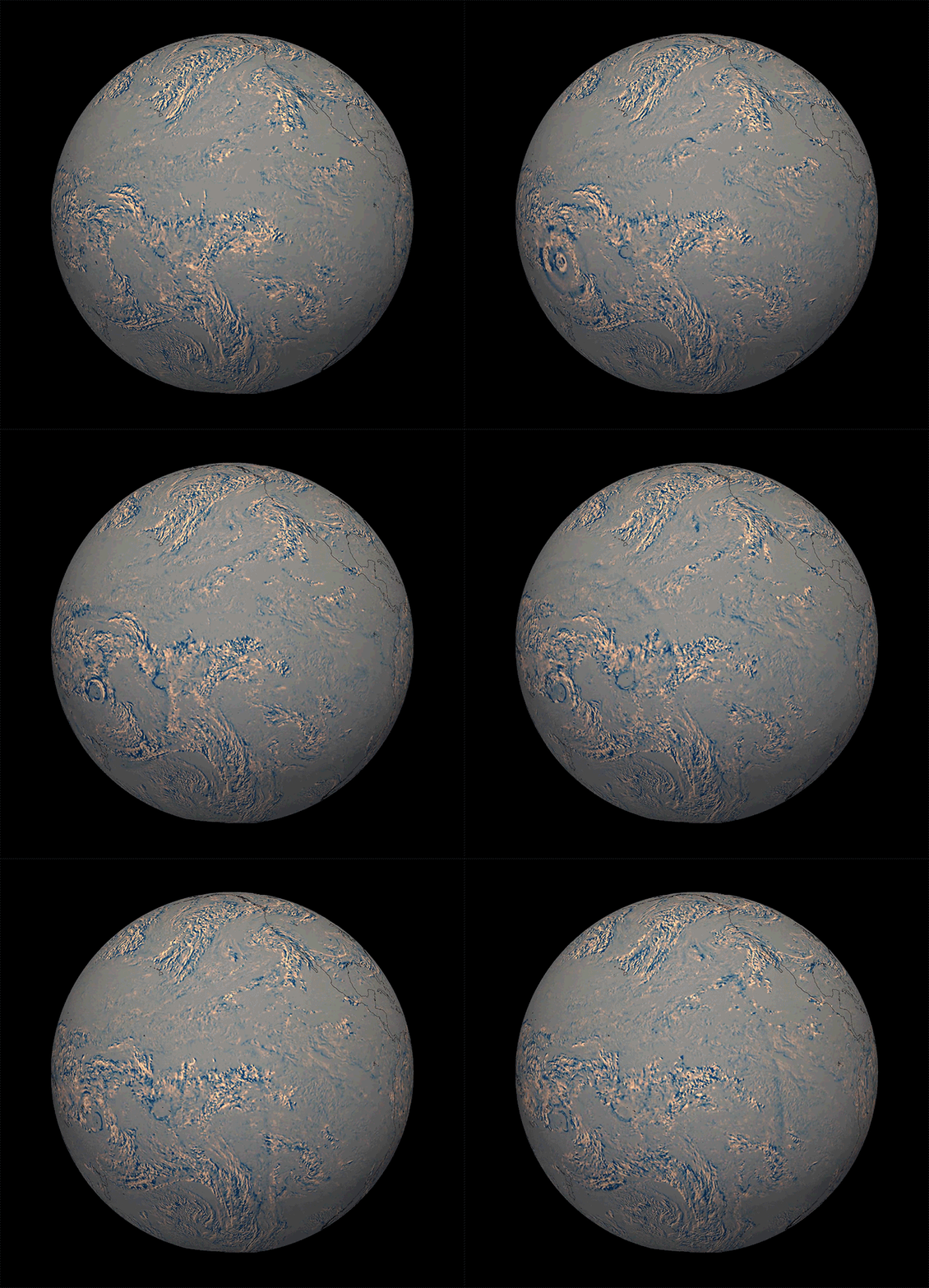
In 1883, the eruption of Krakatau (also called Krakatoa) shook the world, sending shock waves and tsunamis ricocheting across the globe. Some of the smaller waves hit shorelines in the Atlantic and Pacific that were entire continents and ocean basins away from the original explosion. At the time, scientists were so perplexed by the phenomenon that they blamed coincidental earthquakes for the wave action.
Only when Tonga experienced a similarly devastating volcanic eruption earlier this year were scientists able to verify what they’d long suspected: these smaller tsunamis were not caused by solid material displacing water; instead they are the result of atmospheric pressure waves coupling to the ocean. Follow the full story over at Quanta. (Image credit: M. Barlow; via Quanta; submitted by Kam-Yung Soh)

Surf’s Up!


Inspired by honeybees and their ability to surf on capillary waves of their own making, researchers have developed SurferBot, a low-cost, untethered, vibration-driven surf robot. Built on a simple 3D-printed platform, the bot has a vibration motor powered by a simple coin cell battery. As the motor vibrates, it propels the bot forward (Image 2). With the motor placed off-center, the bot’s vibrations create larger capillary waves at the rear of the bot than at the front (Image 3). It’s this asymmetry that drives the robot forward. The flow pattern created by the bot’s propulsion is impressively strong (Image 4) and consists of a pair of counter-rotating vortices trapped ahead of the bot and a strong central jet in its wake.
Best of all: SurferBot is a great platform for educational experimentation, costing <$1 apiece! (Image and submission credit: D. Harris; research credit: E. Rhee et al.)
Coronal Heating
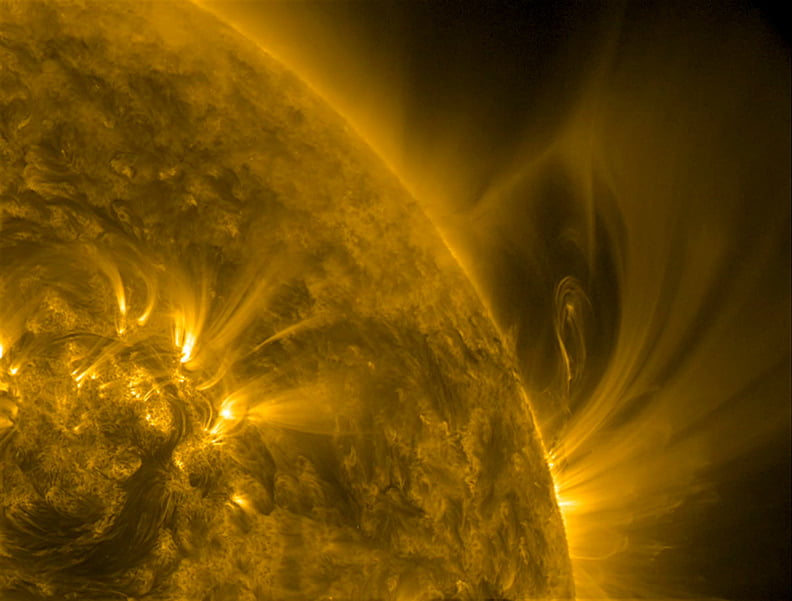
Compared to its interior, the surface of our sun is a cool 6,000 degrees Celsius. But beyond the surface, the sun’s corona heats up dramatically through interactions between plasma and strong magnetic fields. The exact mechanisms of this interaction have been mostly theoretical thus far, but a recent laboratory experiment has validated a part of that theory.
One explanation for coronal heating posits that the strong magnetic fields can accelerate magnetohydrodynamic waves called Alfvén waves to speeds faster than sound, and that at this crossover point, changes occur in the waves’ behavior. Using liquid rubidium, researchers were able to observe this crossover under laboratory conditions, confirming that the Alfvén waves change at the speed of sound in exactly the manner predicted by theory. (Image credit: NASA SDO; research credit: F. Stefani et al.; via Physics World)

Parametric Resonance
At first glance, Steve Mould’s video on parametric resonance has nothing whatsoever to do with fluid dynamics. He uses a pendulum suspended on a spring to demonstrate how driving a system at a frequency that’s a multiple of the system’s natural frequency can add energy through resonance. Although his examples don’t use fluids, this phenomenon happens there, too, especially in vibrated fluid systems. Take, for example, this droplet bouncing on a vibrating pool. Depending on the amplitude of the vibrations driving the system, the droplet may bounce in time with the vibration, in time with the waves, or at a frequency twice that of the vibration. (Image and video credit: S. Mould)
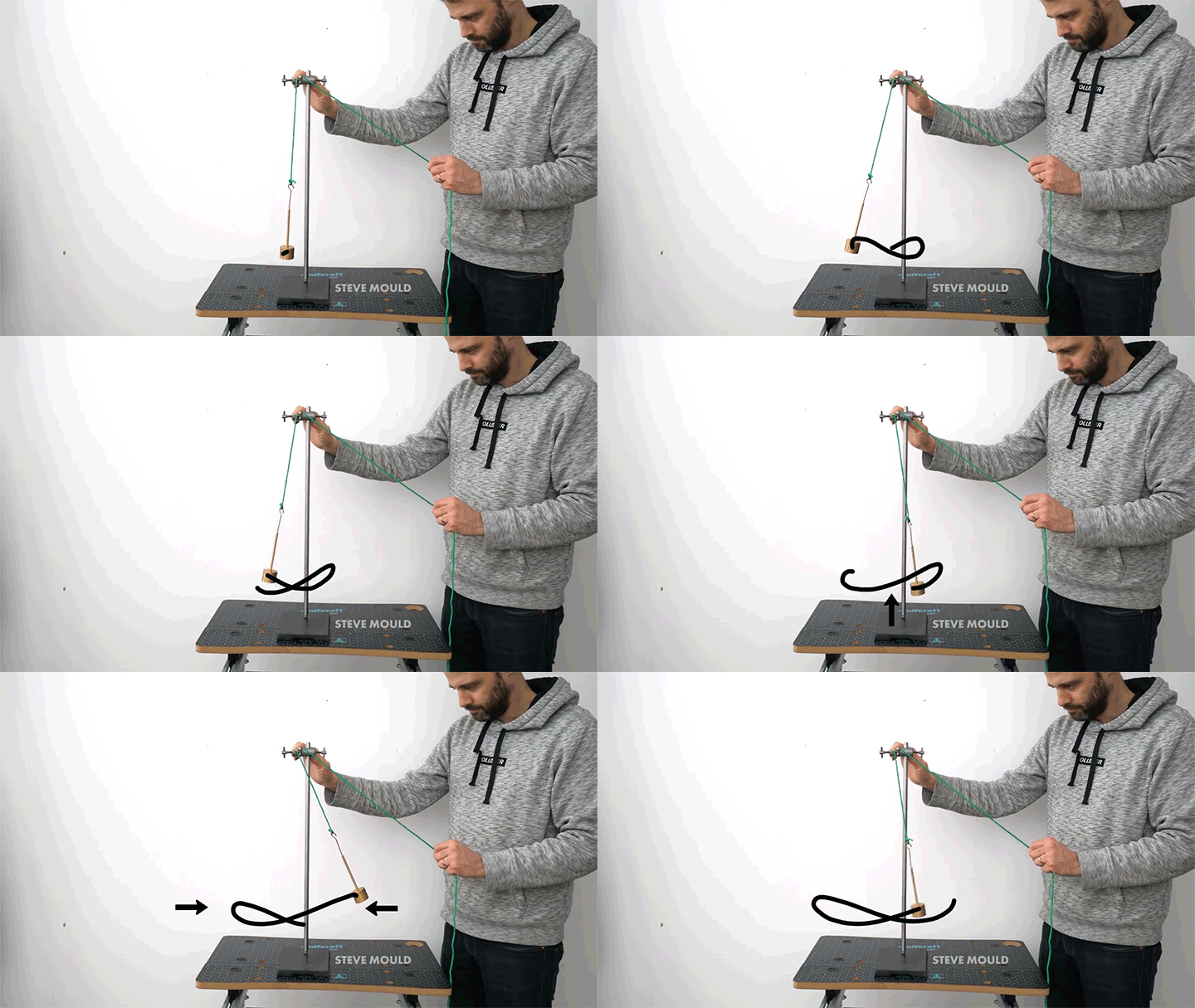
By pulling on the string each time the mass swings through its lowest point (i.e., twice per swing cycle), Steve adds energy to the system, which is reflected in the increasing amplitude of the pendulum’s swing. This is an example of parametric resonance. 
Quantum Instability
In our everyday lives, two fluids moving past one another often form a wave-like pattern thanks to the Kelvin-Helmholtz instability. We see it in the curl of waves on the ocean, in clouds in the sky, and even in spirals of lava on Mars. Here researchers explore an analogous instability in the quantum world.
By spinning a gas of ultracold atoms, the team observed a spontaneous transition from a needle-like configuration to a crystal made up of spirals. It’s a quantum Kelvin-Helmholtz instability! The authors found that wave’s phase is random; it arises purely from quantum interactions between the atoms. (Image, research, and submission credit: B. Mukherjee et al.; see also MIT News)

The spinning cloud of ultracold atoms breaks up into a series of spirals. 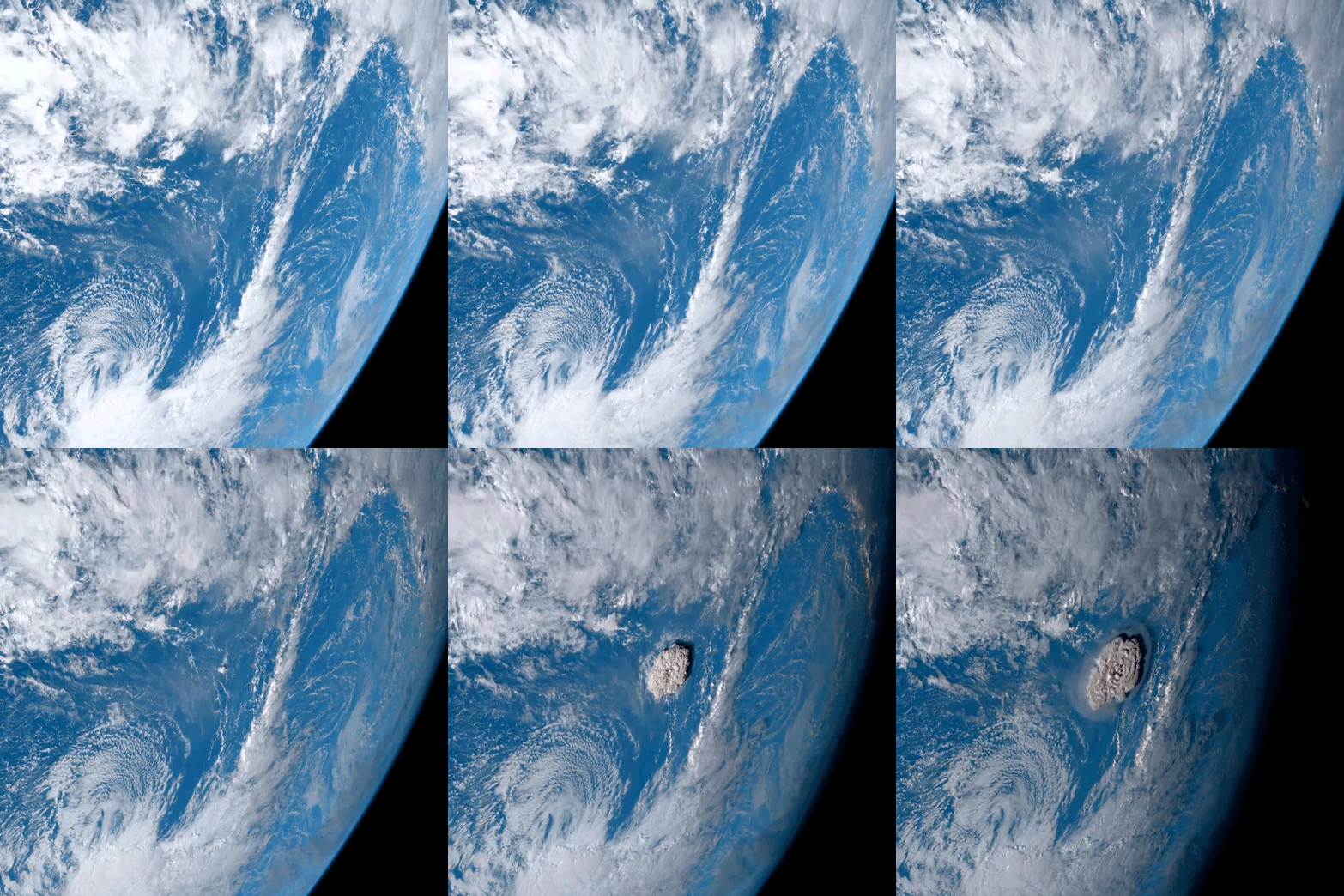
Volcanic Shocks
A violent underwater eruption at the Hunga Tonga-Hunga Ha’apai caldera on January 15th sent literal shock waves around the world. This animation, based on satellite images from Japan’s Himawari 8, shows the fast-moving shock waves and the growing ash plume coming from the uninhabited island. Although most recent eruptions from this volcano have been small, experts suspect that this latest eruption is part of a major event, similar to the volcano’s last big eruption about 1,000 years ago.
The explosiveness of the eruption comes from the interaction of seawater and fresh magma. When the magma erupts quickly underwater, the hot liquid contacts seawater directly rather than forming a protective layer of vapor (as in the Leidenfrost effect). The resulting explosion tears the magma apart, exposing more hot surfaces to the cold water and further driving the chain reaction. (Image credit: S. Doran/Himawari 8; submitted by jpshoer; see also S. Cronin)
Cavitation-Induced Microjets


In cavitation, tiny bubbles of vapor form and collapse in a liquid, often sending shock waves ricocheting. In most occurrences beyond the lab, cavitation bubbles aren’t a solo act; many bubbles can form and interact. This video takes a look at some of the effects of those interactions. When close together, two cavitation bubbles can act to focus the flow during collapse, generating a microjet strong enough to penetrate into nearby surfaces. Researchers hope this technique may one day be used for needle-free injections. (Image, video, and submission credit: A. Mishra et al.)

Where Wind Meets Water
That the wind causes ocean waves is obvious to anyone who has spent time near the water, but the details of that process remain fuzzy. Many of the explanations — like the Kelvin-Helmholtz instability — only explain part of the process, usually the beginning when the waves are very small. As the waves get larger, they affect the wind in turn, complicating matters.
As messy as the theory gets, our ability to measure the wind and water in situ is limited, too. Just look at this wild research platform oceanographers designed to study wind and waves. It’s part of a 355-ft vessel that’s towed out to sea horizontally and then flipped so that 300 feet of it remain underwater to stabilize the remainder for measurements. Even with equipment like this, measuring the turbulent air and water near the ocean-sky interface is incredibly difficult.
This review article gives a nice overview of different historical efforts to explain how wind makes waves and provides a snapshot of the latest research in the area. (Image credit: R. Bilcliff; see also N. Pizzo et al.)
