
Physicist Silke Weinfurtner studies fluids, not for themselves, but for what they can teach us about black holes, cosmic inflation, and quantum gravity. Black holes are notoriously difficult to study directly, but, mathematically speaking, it’s possible to set up a fluid system that behaves in the same way a black hole does. The result is a bathtub-like arrangement with a central vortex, seen above. And within this “bathtub,” Weinfurtner and her colleagues can directly measure sound waves equivalent to Hawking radiation, the theoretical means by which black holes emit heat. Learn more about these analogue gravity experiments in her interview over at Quanta Magazine. (Image credit: P. Ammon; via Quanta Magazine; submitted by clogwog)
Search results for: “waves”

Kelvin-Helmholtz Flows Downhill


Gravity currents carry denser fluids into lighter ones, like cold air drifting under your door in winter or dense fogs flowing downhill in San Francisco. Here, researchers visualize the situation using denser salt water flowing into fresh water. Once the gate separating the two fluids rises, the salt water slides down an artificial slope into the fresh water.
Very quickly the flow forms a Kelvin-Helmholtz instability due to the different flow speeds between the two fluids. Kelvin-Helmholtz waves form distinctive swirls and billows that are reminiscent of a cat’s eye. As the swirls rotate, they can flow over one another, and break up into turbulence. (Image and video credit: C. Troy and J. Koseff)
Little Surfer


Here’s another look at SurferBot, a low-cost, vibration-based robot capable of traversing both water and land. SurferBot’s vibration creates asymmetric ripples on the water surface. Because the waves are bigger at the rear of the robot, it gets propelled forward. But there doesn’t have to be water for SurferBot to get around! It’s actually amphibious, moving on both land and water. It can even transition from land to water on its own. (Image and video credit: E. Rhee et al.; research credit: E. Rhee et al.)
Reflections of the Storm


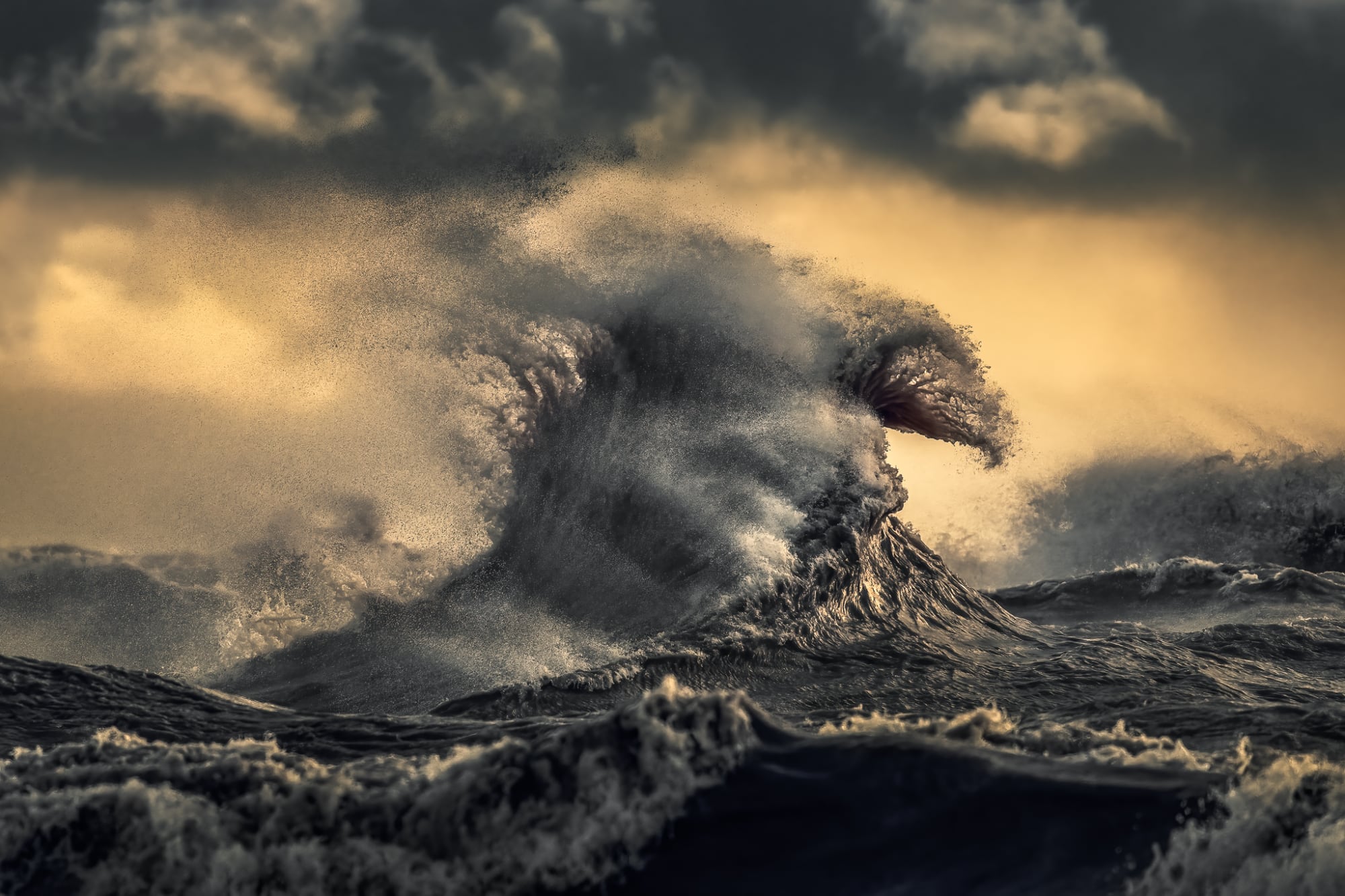
Fall and winter storms rip Lake Erie with violent waves. Photographer Trevor Pottelberg of Ontario captures the dramatic eruptions of mist and spray from these massive, turbulent waves. It’s amazing how many different characters a wave can take on. Just compare Pottelberg’s waves with those caught by Lloyd Meudell or Ray Collins. It’s almost hard to imagine all of these waves growing from the same wind-driven start. See more from Pottelberg on his website and Instagram. (Image credit: T. Pottelberg; via Colossal)
Escaping the Sun
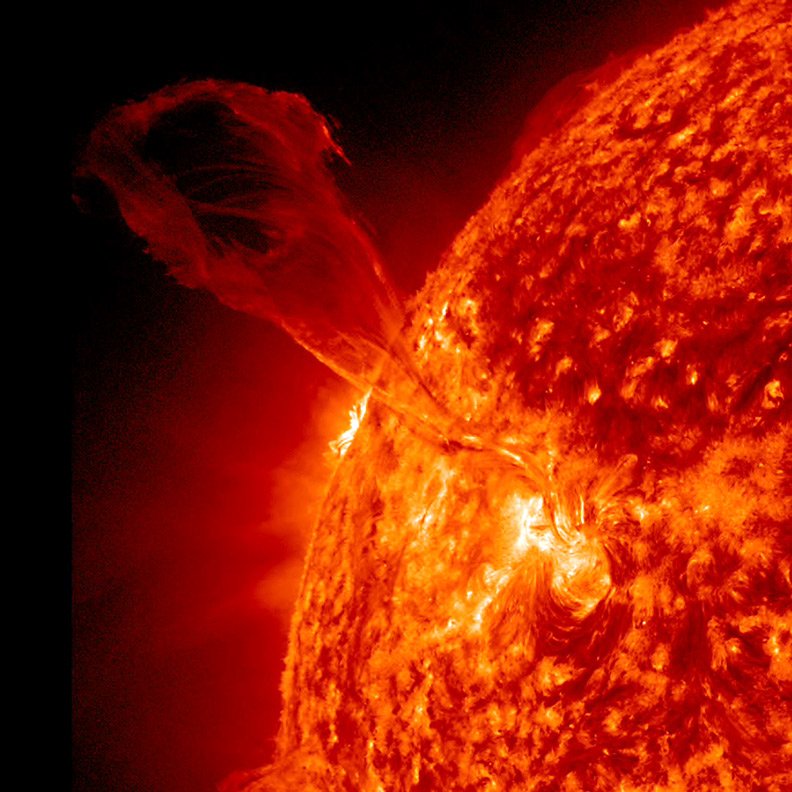
One enduring mystery of the solar wind — a stream of high-energy particles expelled from the sun — is how the particles get accelerated in the first place. The sun frequently belches out spurts of plasma, but without further momentum, that material simply falls back to the sun’s surface under the star’s gravity. Mechanisms like shock waves can further accelerate particles that are already moving quickly, but they cannot explain how the particles get going in the first place.
A recent study used supercomputers to tackle this challenging problem in turbulent plasma physics. Each simulation tracked nearly 200 billion particles, requiring tens of thousands of processors. The results showed that turbulence itself provides the necessary initial acceleration and serves as the first step to getting particles moving fast enough to escape the sun. (Image credit: NASA SDO; research credit: L. Comisso and L. Sironi; via Physics World)
Droplet Bounce
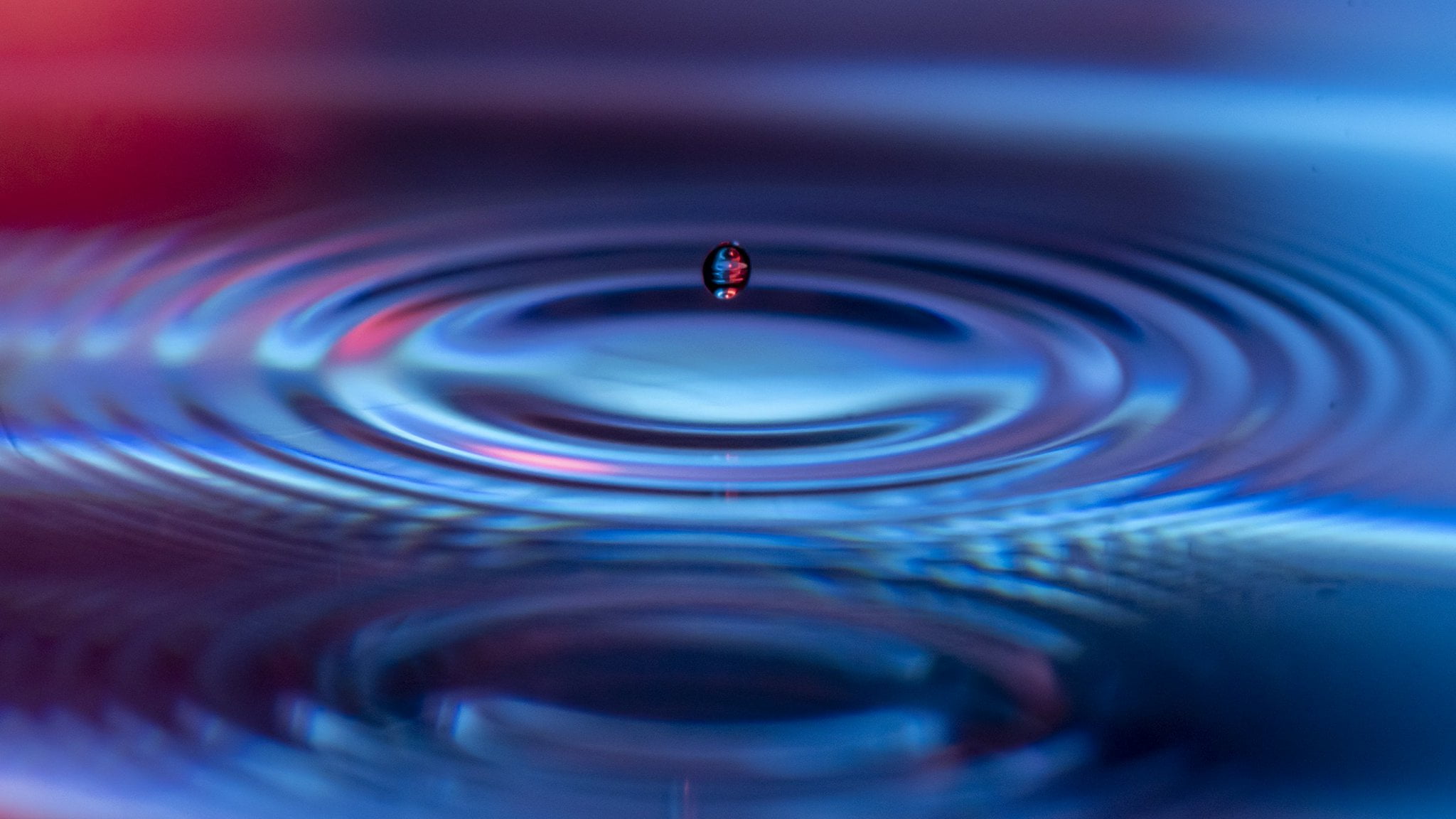
A droplet falling on a liquid bath may, if slow enough, rebound off the surface. Its impact sends out a string of ripples — capillary waves — on the bath’s surface and sends the droplet itself into jiggling paroxysms. A new pre-print study delves into this process through a combination of experiment, simulation, and modeling. Impressively, they find that the most of the droplet’s initial energy is not dissipated during impact. Instead it’s fed into the capillary waves and droplet deformation that follow. (Image and research credit: L. Alventosa et al.; via Dan H.)

A droplet falls on a bath, partially coalesces and rebounds. The process repeats until the droplet is small enough to coalesce completely. 
Landslide-Triggered Tsunamis


After the 2018 Anak Krakatoa eruption, a tsunami that ricocheted through the surrounding waters, killing hundreds on nearby islands. The source of that tsunami was a small landslide. Once the air cleared and researchers could assess how much material slid into the ocean, they were shocked that such a small volume created so much destruction.
Now new efforts are revealing the linkage between landslides and the waves they make. Researchers released glass beads into a tank of water, observing the waves that form as the beads run out. Depending on the relative initial height of the beads compared to the water depth, they observed three different kinds of waves. Not only that, they were able to connect the granular mechanics of the landslide to the hydrodynamic formation of waves, allowing predictions of the waves that will form for a given landslide.
Currently, the predictive model isn’t sophisticated enough to handle a geometry as complex as that of the Anak Krakatoa landslide, but it’s an important step toward understanding — and potentially mitigating the damage of — future oceanside landslides. (Image and research credit: W. Sarlin et al.; via APS Physics; submitted by Kam-Yung Soh)
Pistol Shrimp Snaps
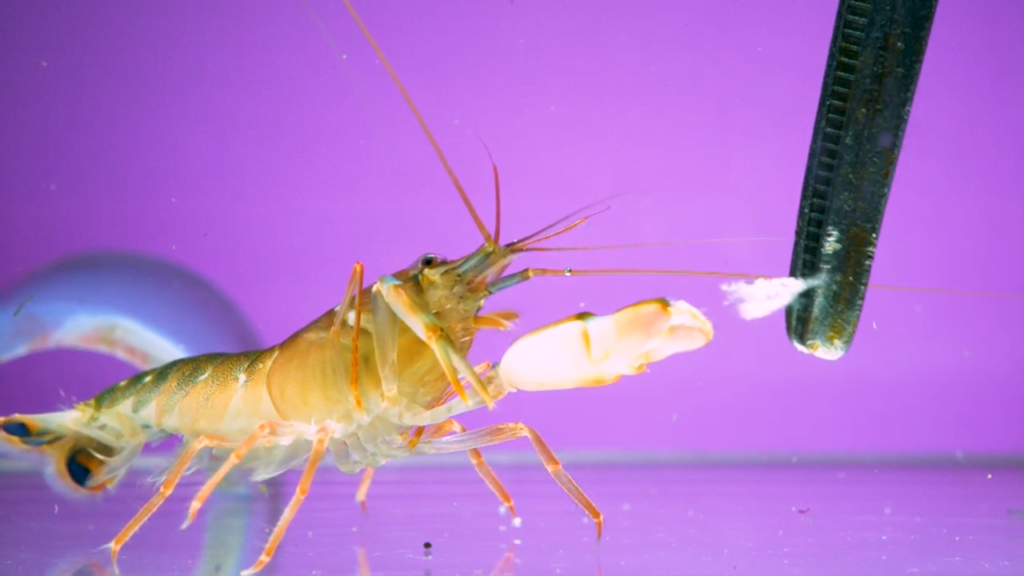

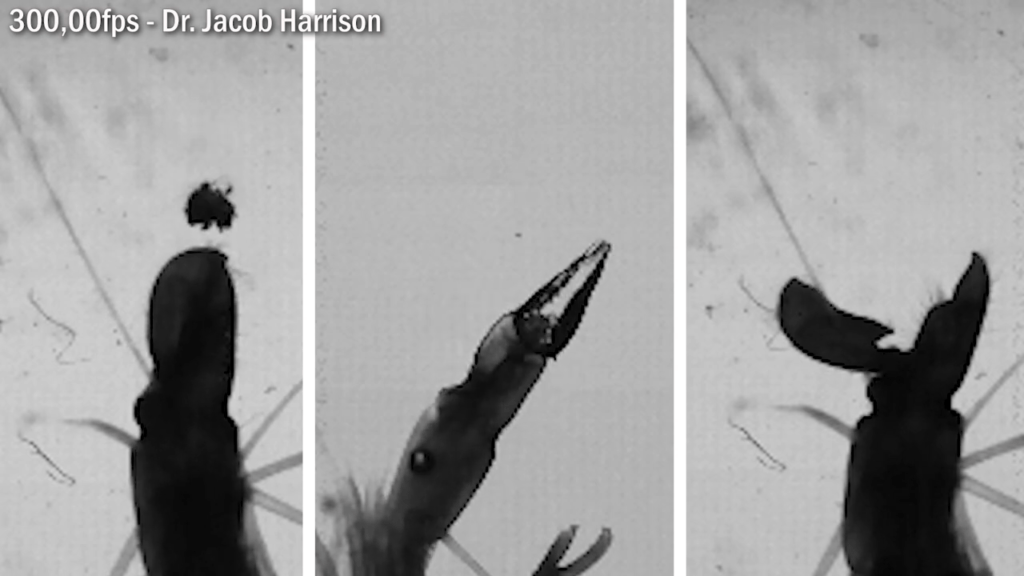


Gram for gram, few animals can match the power of a pistol shrimp’s snap. When its claw closes, the shrimp ejects a jet of water so fast that the water pressure drops below the vapor pressure, causing a cavitation bubble. Like other cavitation bubbles, this one is short-lived, growing and collapsing (and sending out shock waves!) in less than a millisecond. That’s enough to knock any predator or prey for a loop. (Image and video credit: Ant Lab)
Leaky Resonance


Some resonators aren’t perfect — nor are they meant to be! Here, researchers experiment with resonance using a disk shaking up and down over a pool of water. The disk never touches the water, but its movement makes the air above the water move in and out, like a miniature, changeable wind. The air flow distorts the water surface, creating waves just tens of microns high. Beneath the disk, the water forms standing waves, indicating resonance.
But the waves don’t stay under the disk. Beyond its edge, we see traveling waves moving outward, carrying some of the disk’s energy with them. This leakage is actually how many musical instruments, like a guitar, work. When the guitar strings are plucked, their vibrations are transmitted into the body of the guitar through its bridge, where the strings are anchored. The body acts as a resonator, amplifying the sound, some of which leaks out the sound hole. (Image and video credit: U. Jain et al.)
Fish-Scale Tides
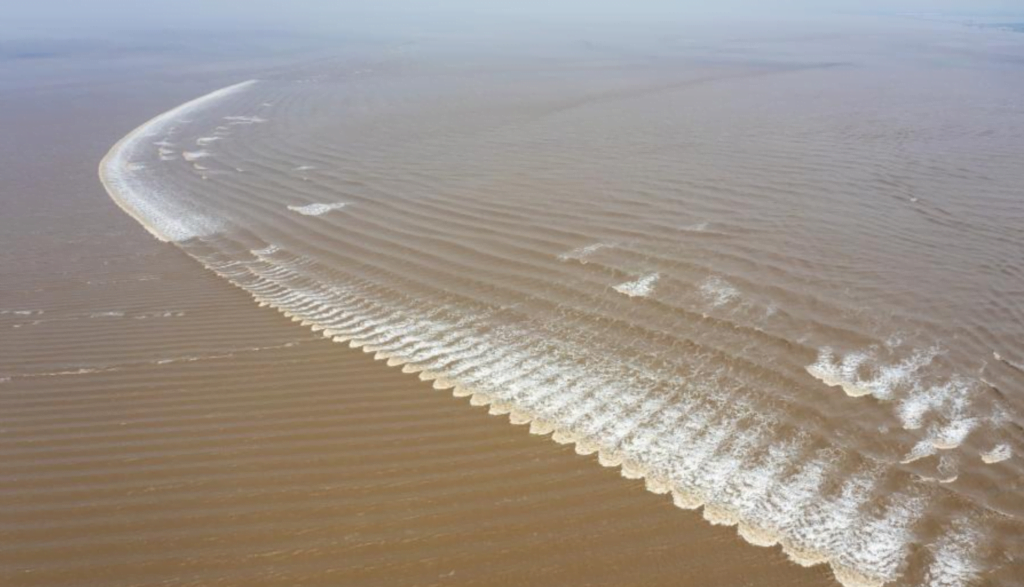
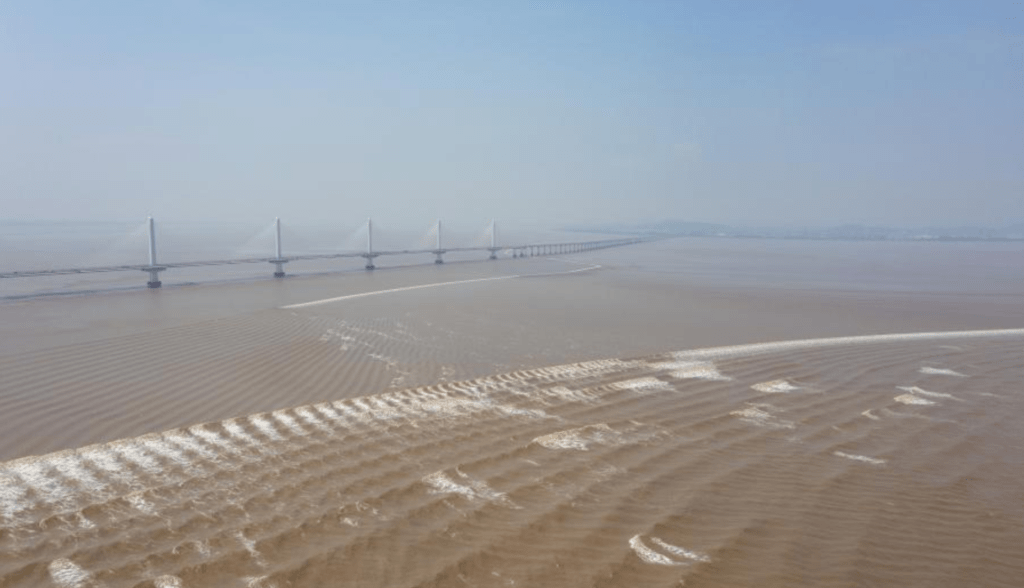
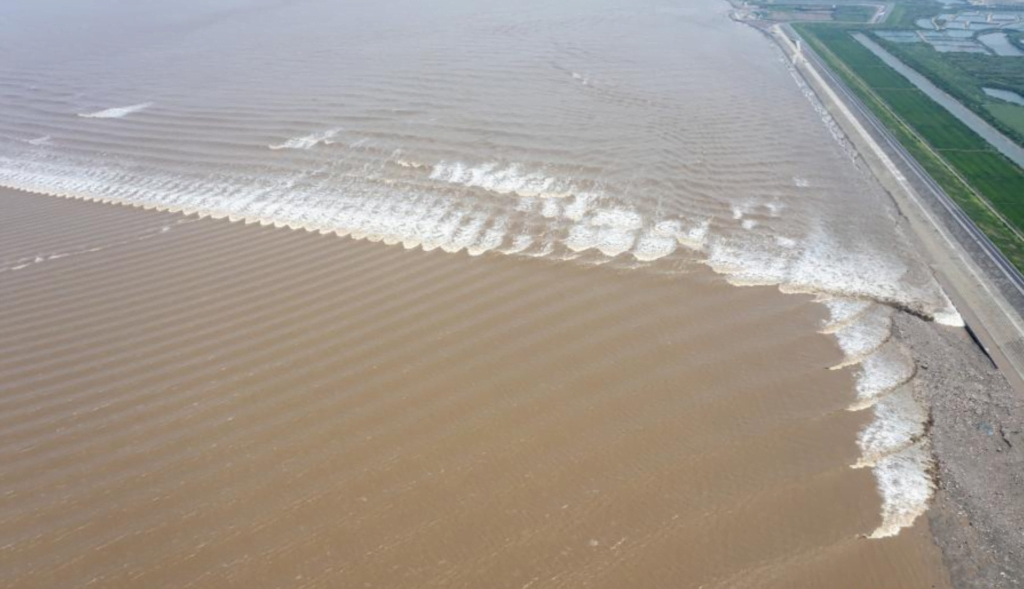
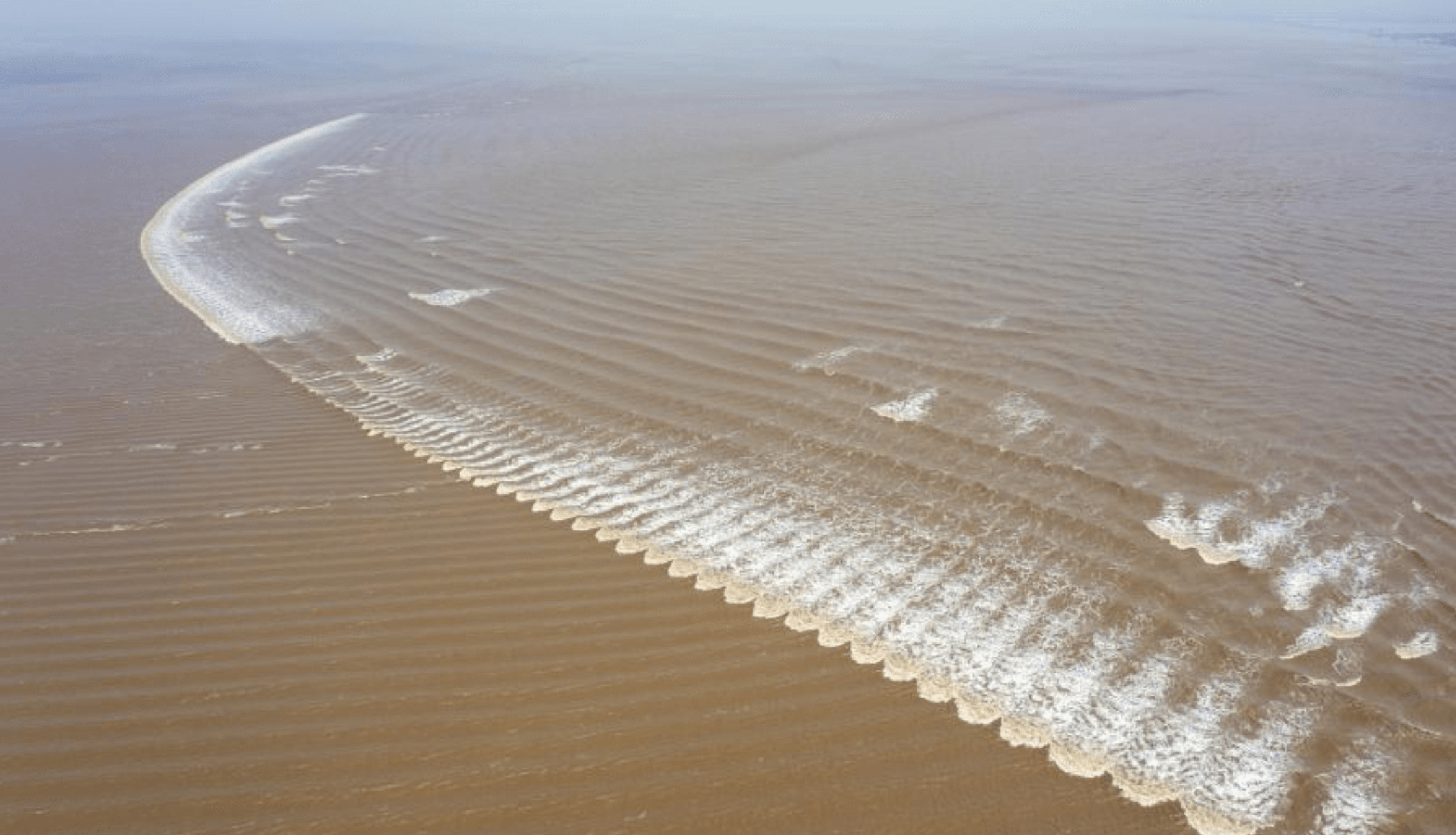
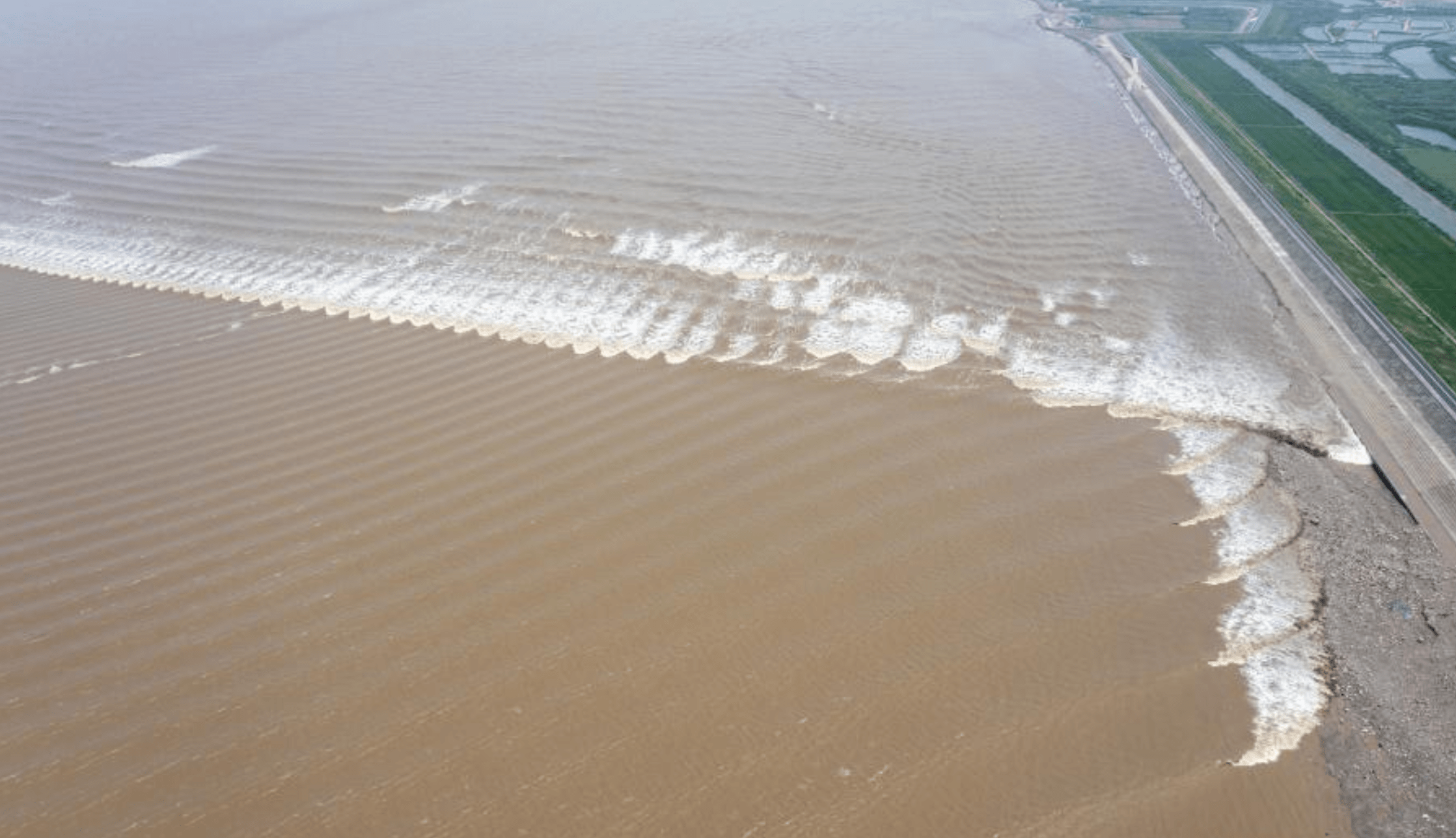
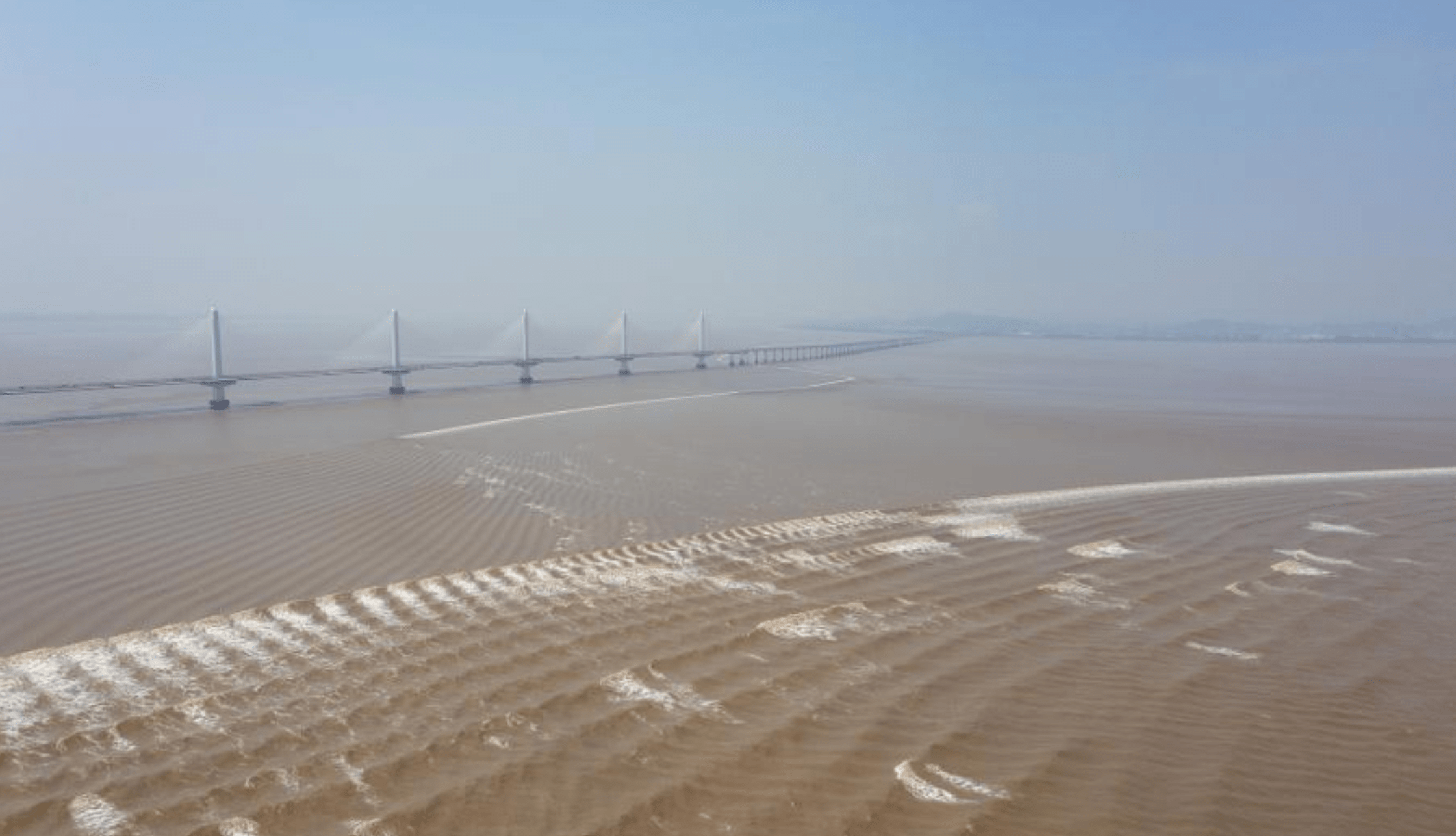
On 31 July 2022, an unusual tidal phenomenon, a fish-scale tide, took place on the Qiantang River’s estuary in Zhejiang Province, China. Here are a couple videos. I’ve not found any explanations for it thus far, so I’m assembling my own. The Qiantang River and its estuary, Hangzhou Bay, are home to the world’s largest tidal bores, reaching 9 meters in places. That means the area regularly sees trains of large waves moving upstream against the normal current.
The area is also known to have rotating currents, meaning that the tide does not simply move inland and then smoothly reverse direction. Instead, a rotating current can change its direction of flow over the course of a tidal cycle without changing its speed. Taken together, this makes the Qiantang River region perfect for winding up with groups of waves colliding at oblique angles, similar to a cross sea. I believe that’s what’s going on here with the fish-scale tide. Two sets of tidal-bore-induced waves are colliding at an angle, creating some gnarly conditions and a very cool pattern. (Image credit: VCG; submitted by Antony B.)