
Adding just a few polymers to a liquid can substantially change its behavior. The presence of polymers turns otherwise Newtonian fluids like water into viscoelastic fluids. When deformed, viscoelastic fluids have a response that is part viscous–like other fluids–and part elastic–like a rubber band that regains its initial shape. The collage above shows what happens to a thinning column of a viscoelastic fluid. Instead of breaking into a stream of droplets, the liquid forms drop connected with a thin filament, like beads on a string. In a Newtonian fluid, surface tension would tend to break off the drops at their narrowest point, but stretching the polymers in the viscoelastic fluid provides just enough normal stress to keep the filament intact. If the effect looks familiar, it may be because you’ve seen it in the mirror. Human saliva is a viscoelastic liquid! (Image credit: A. Wagner et al.)
Search results for: “water droplet”

Soap Film Physics
Soap films consist predominantly of water, yet their thin, virtually two-dimensional nature is impossible for water alone to achieve. The small amount of added soap acts as a surfactant, lowering the surface tension of the fluid and preventing it from bursting into droplets. When forming a film, the soap molecules align themselves along the outer surfaces of the film, with their hydrophilic heads among the water molecules and their hydrophobic tails oriented outward. For the most part, the water molecules stay sandwiched between the surfactant layers, forming a film only about as thick as the wavelength of visible light. In fact, the psychedelic colors of a soap film are directly related to the film’s thickness with the black regions being the thinnest. The video above shows a horizontal soap film at the microscopic scale and some of the dynamics exist therein. (Video credit: J. Hart)

Breaking Drops with Vibration
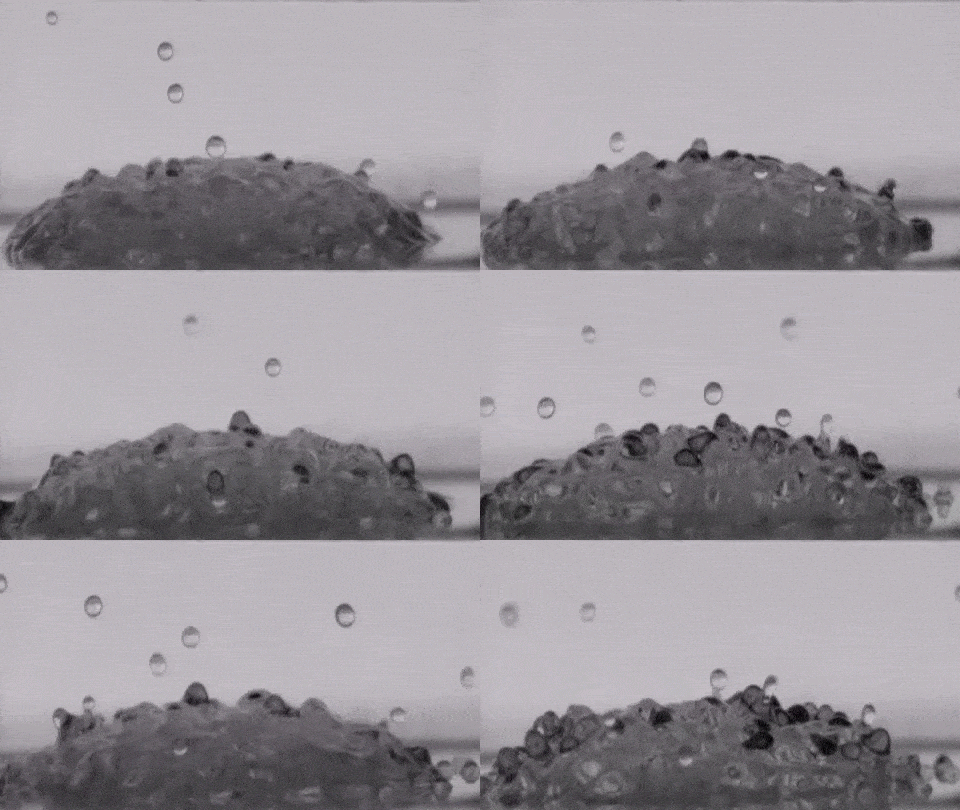
Atomization is the process of breaking a liquid into a spray of fine droplets. There are many methods to accomplish this, including jet impingement, pressure-driven nozzles, and ultrasonic excitement. In the images above, a drop has been atomized through vibration of the surface on which it rests. Check out the full video. As the amplitude of the surface’s vibration increases, the droplet shifts from rippling capillary waves to ejecting tiny droplets. With the right vibrational forcing, the entire droplet bursts into a fine spray, as seen in the photo above. The process is extremely quick, taking less than 0.4 seconds to atomize a 0.1 ml drop of water. (Photo and video credit: B. Vukasinovic et al.; source video)

The Real Shape of Raindrops
We often think of raindrops as spherical or tear-shaped, but, in reality, a falling droplet’s shape can be much more complicated. Large drops are likely to break up into smaller droplets before reaching the ground. This process is shown in the collage above. The initially spherical drops on the left are exposed to a continuous horizontal jet of air, similar to the situation they would experience if falling at terminal velocity. The drops first flatten into a pancake, then billow into a shape called a bag. The bags consists of a thin liquid sheet with a thicker rim of fluid around the edge. Like a soap bubble, a bag’s surface sheet ruptures quickly, producing a spray of fine droplets as surface tension pulls the damaged sheet apart. The thicker rim survives slightly longer until the Plateau-Rayleigh instability breaks it into droplets as well. (Image credit: V. Kulkarni and P. Sojka)
Rotational Effects
Rotation can cause non-intuitive effects in fluid dynamical systems. UCLA Spinlab’s newest video tackles the problem using four demonstrations. The first two deal with droplets released in air, first in a non-rotating environment and then in a rotating one. As one would expect, in a non-rotating environment, droplets fall through the tank in a straight line. When rotating, though, the droplets follow a deflected, straight-line path due to centrifugal effects. This is the same as the way passengers in a car feel like they’re being thrown to the outside of a turn on a curvy road. When the experiment is repeated with a tank of water instead of air, the results are different. The densities of the creamer and water are much closer to one another, so the droplet falls much slower than before. The tank now rotates faster than time it takes the drop to fall. This smaller timescale means that the droplet experiences more acceleration from Coriolis forces than centrifugal forces in the rotating tank of water. Thus, instead of being thrown outward, the drop now forms a column aligned with the axis of rotation. (Video credit: UCLA Spinlab; submitted by Jon B.)
Giant Bubbles
In their latest video, Gavin and Dan of The Slow Mo Guys demonstrate what giant bubbles look like in high-speed video from birth to death. Surface tension, which arises from the imbalance of intermolecular forces across the soapy-water/air interface, is the driving force for bubbles. As they move the wand, cylindrical sheets of bubble film form. These bubble tubes undulate in part because of the motion of air around them. In a cylindrical form, surface tension cannot really counteract these undulations. Instead it drives the film toward break-up into multiple spherical bubbles. You can see examples of that early in the video. The second half of the video shows the deaths of these large bubble tubes when they don’t manage to pinch off into bubbles. The soap film tears away from the wand and the destructive front propagates down the tube, tearing the film into fluid ligaments and tiny droplets (most of which are not visible in the video). Instead it looks almost as if a giant eraser is removing the outer bubble tube, which is a pretty awesome effect. (Video credit: The Slow Mo Guys)

Forming a Jet
Many situations can generate high-speed liquid jets, including droplet impacts, vibrated fluids, and surface charges. In each of these cases, a concave liquid surface is impulsively accelerated, which causes the flow to focus into a jet. The image above shows snapshots of a microjet generated from a 50 micron capillary tube visible at the right. This jet formed when the meniscus inside the capillary tube was disturbed by a laser pulse that vaporized fluid behind the interface. Incredibly, the microjets generated with this method can reach speeds of 850 m/s, nearly 3 times the speed of sound in air. Researchers have found the method produces consistent results and suggest that it could one day form the basis for needle-free drug injection. You can read more in their freely available paper. (Photo credit: K. Tagawa et al.)
Colliding in Microgravity
On Earth, it’s easy for the effects of surface tension and capillary action to get masked by gravity’s effects. This makes microgravity experiments, like those performed with drop towers or onboard the ISS, excellent proving grounds for exploring fluid dynamics unhindered by gravity. The video above looks at how colliding jets of liquid water behave in microgravity. At low flow rates, opposed jets form droplets that bounce off one another. Increasing the flow rate first causes the droplets to coalesce and then makes the jets themselves coalesce. Similar effects are seen in obliquely positioned jets. Perhaps the most interesting clip, though, is at the end. It shows two jets separated by a very small angle. Under Earth gravity, the jets bounce off one another before breaking up. (The jets are likely separated by a thin film of air that gets entrained along the water surface.) In microgravity, though, the jets display much greater waviness and break down much quicker. This seems to indicate a significant gravitational effect to the Plateau-Rayleigh instability that governs the jet’s breakup into droplets. (Video credit: F. Sunol and R. Gonzalez-Cinca)
Flowing Uphill
Science Friday takes an inside look at self-propelled Leidenfrost droplets like those we’ve featured previously. The Leidenfrost effect takes place when a liquid comes in contact with a surface much, much hotter than its boiling point. Part of the liquid is vaporized, creating a thin gas layer that both insulates the remaining liquid and causes it to move with very little friction. Over a flat surface, this underlying vapor will spread in any direction. But by covering the surface with ratchets, it’s possible to direct the vapor in a particular direction, which propels the droplet in the opposite direction. Check out the video and our previous posts for more! (Video credit: Science Friday; via io9 and submitted by Urs)
When Jets Collide
When two jets of a viscous liquid collide, they can form a chain-like stream or even a fishbone pattern, depending on the flow rate. This video demonstrates the menagerie of shapes that form not only with changing flow rates but by changing how the jets collide – from a glancing impingement to direct collision. When just touching, the viscous jets generate long threads of fluid that tear off and form tiny satellite droplets. At low flow rates, continuing to bring the jets closer causes them to twist around one another, releasing a series of pinched-off droplets. At higher flow rates, bringing the jets closer to each other creates a thin webbing of fluid between the jets that ultimately becomes a full fishbone pattern when the jets fully collide. The surface-tension-driven Plateau-Rayleigh instability helps drive the pinch-off and break-up into droplets. (Video credit: B. Keshavarz and G. McKinley)
