Search results for: “water droplet”

  • Featured Video Play Icon

    Freezing in a Microchannel

    Fluid mechanics at the microscale can behave quite differently than in our everyday experience. Microfluidic devices–sometimes known as labs on a chip–are becoming increasingly important in research and daily life. For example, the test strips used by diabetics to check their blood sugar levels are microfluidic devices.  In this video, researchers use a microfluidic channel to observe the freezing of supercooled water droplets. As the droplet first passes into the cold zone of the channel, it flash freezes, filling from the inside out with ice crystals. As it continues through the cold zone, the drop freezes fully, beginning at the outside surface and working inward. As it does so, the ice droplet fractures due to stresses. (Video credit: Stan et al)

  • Featured Video Play Icon

    Hot Spheres Sink Faster

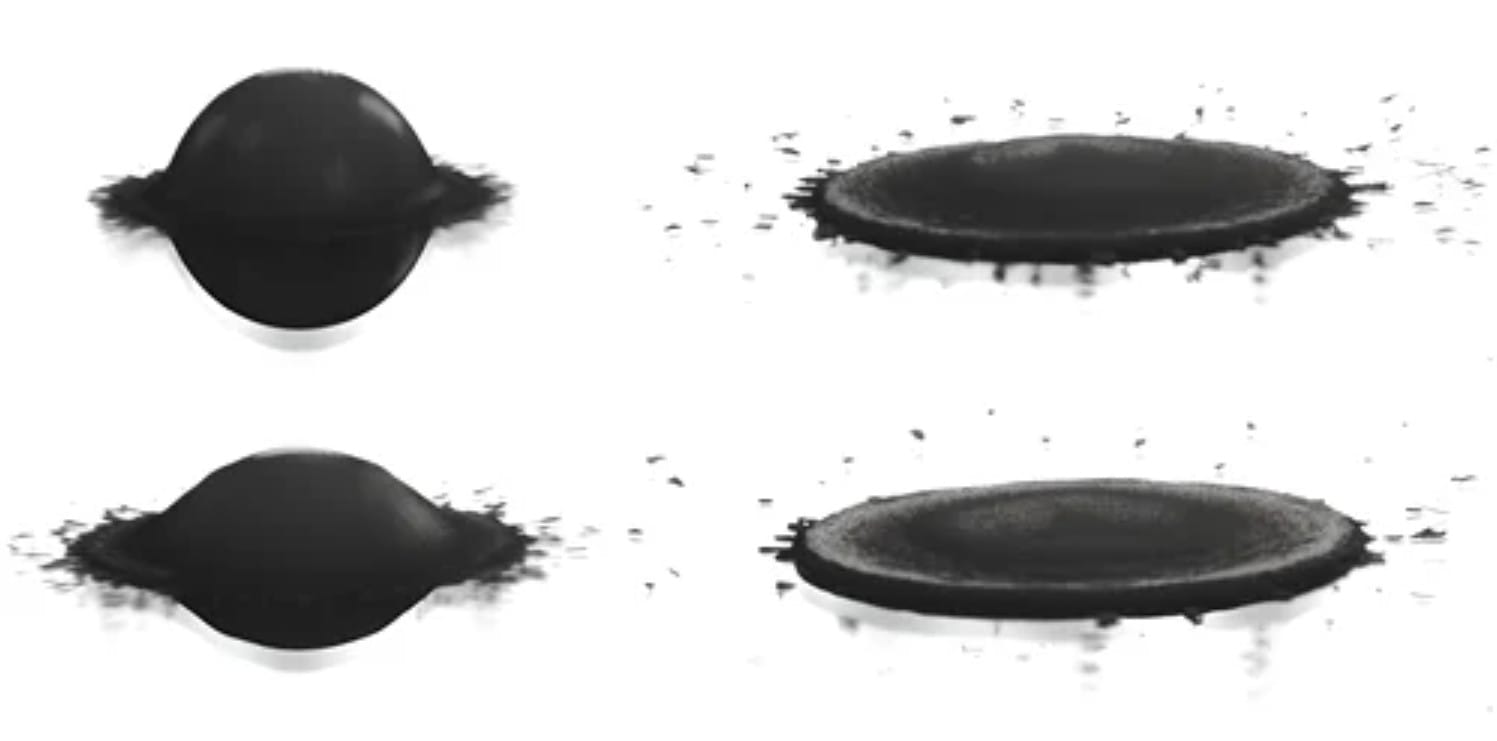
    New research shows that the Leidenfrost effect–which causes water droplets to skitter across a hot pan–can drastically reduce the drag on objects moving through a liquid. When raised to a high enough temperature, a sphere falling water will be coated in a protective layer of vapor (see video above) that acts like a lubricant as the sphere moves through the water. If the temperature of the object drops too low, the vapor layer will dissolve into a mess of bubbles (~35 secs into video). One way that this mechanism reduces drag is by keeping flow attached to the sphere for longer as shown in this video. Preventing this flow separation increases the pressure recovered after the point of lowest pressure (the shoulders of the sphere), which reduces overall drag.

    See also:

  • Frosting on Superhydrophobic Surfaces

    Frosting on Superhydrophobic Surfaces

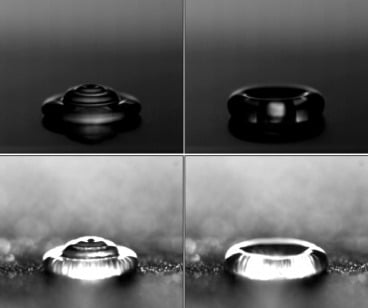
    Icing on airplane wings can be disastrous for lift and control, and thus how ice initially forms on a wing is an active area of research. New work shows that superhydrophobic (water-fearing) surfaces may actually promote ice buildup. Superhydrophobic surfaces are prone to frosting–collecting ice that forms directly from a vaporous state–and that fine layer of frost is conducive to further ice buildup from a liquid state. The photo above shows a water droplet striking a dry superhydrophobic surface (top) and a frosted superhydrophobic surface (bottom). (via Gizmodo) #

  • Airplanes Creating Snow

    Airplanes Creating Snow

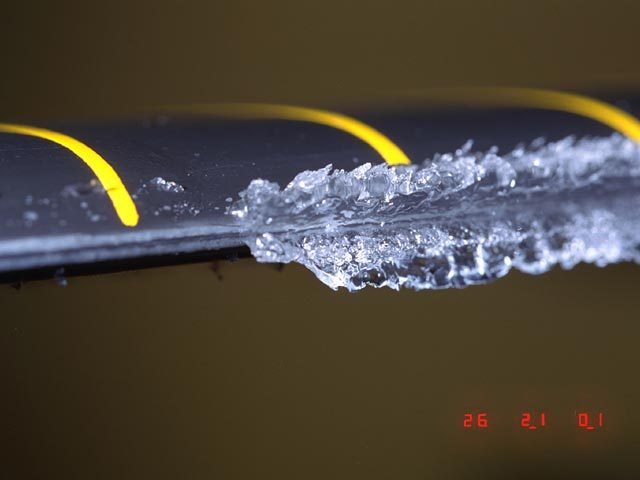
    Scientists now think that that airplanes may be responsible for increasing local snowfall by flash-freezing supercooled water vapor in clouds. Water droplets can persist in the atmosphere to temperatures of -42 degrees Celsius. But when an airplane’s wing passes through moist air, the acceleration of the air passing over the wing causes a pressure decrease that can drop the temperature by as much as 19 C, causing the water droplets to form ice crystals immediately. (The particulate matter in the aircraft exhaust probably also aids this process.) The same behavior can also create holes in clouds and cause ice to form on the wings. # (Related behavior: vapor cones)

    Photo credit: lhoon

  • Featured Video Play Icon

    Superhydrophobic Carbon Nanotubes

    Carbon nanotubes form a superhydrophobic (super water repellent) surface that interacts with water droplets in interesting ways. The droplet is unable to wet the surface and thus the bounces along. When the impact velocities are too great for surface tension to hold the decelerating mass together, it breaks into many, smaller droplets that also bounce along the surface. # (via @JetForMe and @Vinnchan)

  • Bursting Bubbles

    Bursting Bubbles

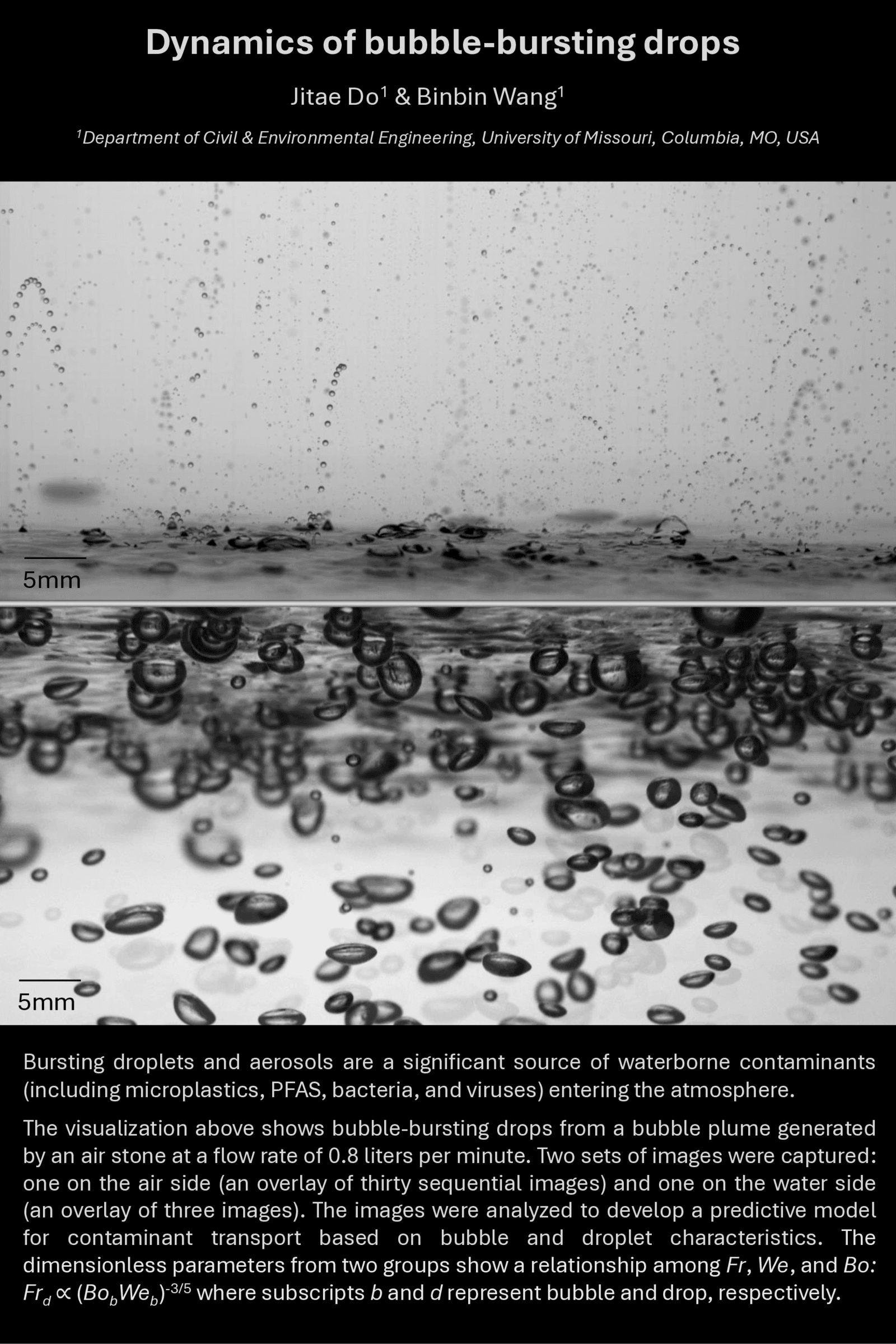
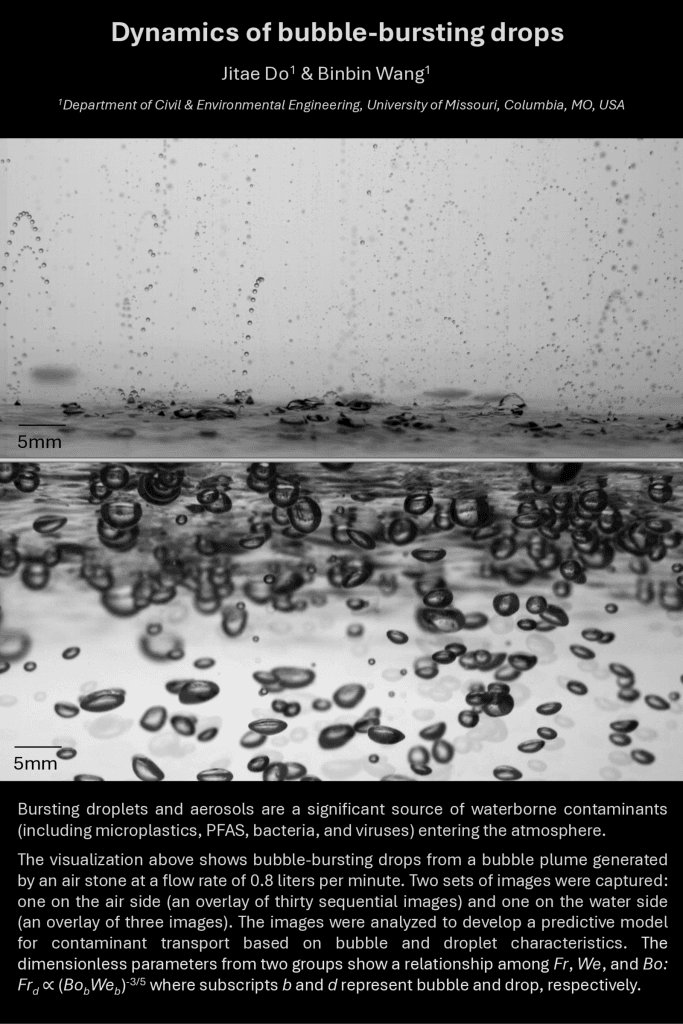
    When air bubbles rise through a liquid, they scavenge dust, viruses, microplastics, and other impurities as they go. Once at the surface, these contaminant-covered bubbles thin and burst, generating many tiny droplets that arc through the air above. You’re likely familiar with the sight and sensation from a glass of champagne or soda.

    Here, researchers have stacked two sets of sequential images to illustrate this complicated flowscape. Under the surface, a trio of photos are stacked to show bubbles rising and gathering at the surface. In the air, the researchers have stacked thirty sequential images, which together trace out the parabolic arcs of droplets sprayed by the bursting bubbles. (Image credit: J. Do and B. Wang)

    A research poster showing composite images of bubbles rising to a water-air interface and bursting, sending up a spray of microdroplets.
    Fediverse Reactions
  • “Frozen”

    “Frozen”

    For tiny invertebrates like this one, water is a very different substance than we’re used to. At this scale, surface tension is a force as powerful–or more so–than gravity. Droplets remain spherical, caught on long, spike-like hairs. Even the surface of a pond is different, forming a trampoline creatures can skim but that requires special techniques to escape. (Image credit: N. Baumgartner/CUPOTY; via Colossal)

  • “Liquid Colors”

    “Liquid Colors”

    Light shining through misty spray creates a liquid rainbow in this photo by Ronja Linssen. Although mists and sprays–from waterfalls, waves, and more–seem insubstantial, they can be a major source of material transfer between the water and atmosphere. Teratons of salt, biomass, and even microplastics make their way yearly from the ocean into the sky through droplets launched from popping bubbles. (Image credit: R. Linssen/CUPOTY; via Colossal)

  • Bouncing Indefinitely

    Bouncing Indefinitely

    On the surface of a gently vibrating liquid, a droplet can bounce indefinitely without coalescing, kept aloft by an air film too small to see. As long as the droplet lifts off before the air layer drains out from under it, the droplet won’t contact the water below. Now scientists have shown that this is possible with a solid surface, too.

    Using an atomically smooth mica plate, researchers were able to bounce a droplet indefinitely without wetting the surface. At higher vibration rates (below), the droplet essentially hovers in place, bouncing so quickly that we simply see its shape vibrating in response to the surface. (Image and research credit: L. Molefe et al.; via APS)

    At a high vibrational frequency, a bouncing droplet effectively hovers in space and changes its shape rather than bouncing.
    Fediverse Reactions