This gorgeous high-speed video captures bubbles, droplets, wakes, cavitation, coalescence, jets, and lots of surface tension at 7000 fps. The authors unfortunately haven’t indicated whether this is air in water or something more viscous, but regardless there are some great phenomena on display here. # (via Gizmodo)
Search results for: “water droplet”

Liquids Lens Breakup
A decane liquid lens floating on water (think drops of fat in chicken soup) displays different breakup and pinch-off than seen in three-dimensional droplet breakup. The pinch-off process in two dimensions relies on line tension rather than surface tension, and the quasi-2D liquid lens system is somewhere between these. The video above is a magnification of the filament connecting one liquid lens as it is broken into two smaller liquid lenses (the dark areas on the left and right of the screen). # (via scienceisbeauty)
Liquid Acrobatics
Imagine blowing through a straw into a nearly empty glass–we probably all did this as children and sent water, milk, and soda flying everywhere! In essence, this video shows that same act, but filmed by a high-speed camera. The “straw” blows a steady stream of helium into a shallow pool of silicone oil and slowly moves so that the angle the straw makes with the pool changes. As the angle changes, different regimes are visible. First waves appear on the surface of the pool, then a bulge forms, which develops into a droplet stream, then on into the chaos of bubbles and jets. It’s good I couldn’t see this in slow motion as a child or I would have never used my straw for drinking!

Reader Question: Surface Tension vs. Viscosity
lazenby asks:
How can superfluid liquid Helium have zero viscosity while retaining surface tension? (assuming something like surface tension is required for a liquid to form drops)
The short answer is that surface tension and viscosity are two totally separate properties for a fluid. To illustrate how one can exist without the other in a superfluid, we’ll imagine two different scenarios. For the first, imagine that you have a narrow vertical pipe. Any fluid you put in the pipe will flow downward due to the force of gravity. If you put water through the pipe, you’ll get some rate of outflow. Now imagine putting something like molasses through the pipe. Even with the same external forces on it, the molasses will never move through the pipe as quickly as the water does. This is because the molasses has higher viscosity and resists flowing. In a force balance, viscosity would act like friction, opposing the downward motion of the fluid.
Surface tension arises from a different balance of forces. Now imagine that you have a stationary droplet of one fluid (A) floating in a different fluid (B). Deep inside the droplet, each molecule of Fluid A is being pulled on all sides by other identical molecules of Fluid A. A molecule at the surface of the droplet, though, doesn’t experience that neighborly pull on all sides; it experiences different intermolecular forces from Fluid B. Our imaginary droplet is stationary, though, so all the forces on it and all the forces on its individual molecules have to balance, otherwise there’d be acceleration. Surface tension acts along the interface by pulling molecules of Fluid A in toward one another–much like the elastic of a balloon–thereby balancing the forces in the droplet and equalizing the force across the interface between Fluid A and Fluid B. (Illustration credit: Wikipedia)
In the superfluid, this balance of forces across the interface between air and helium-3 must still exist, despite the superfluid’s lack of viscosity.
Bouncing into a Pool
Here is another take on what happens when a drop of water falls into a larger pool.
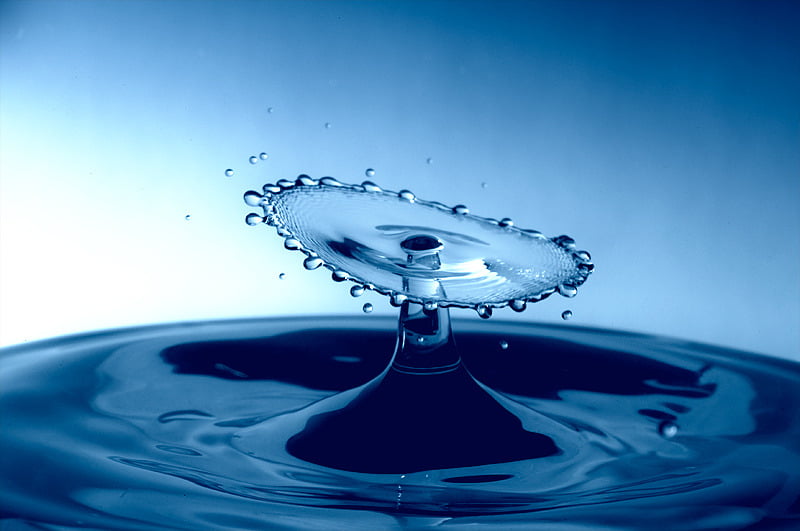
Liquid Umbrella
Droplet collisions, usually with water or milk, are popular with photographers for their artistic value. As stunning as these still images are, high-speed video makes the effect even better.
Photo credit; See also: Liquid sculpture and Flickr

