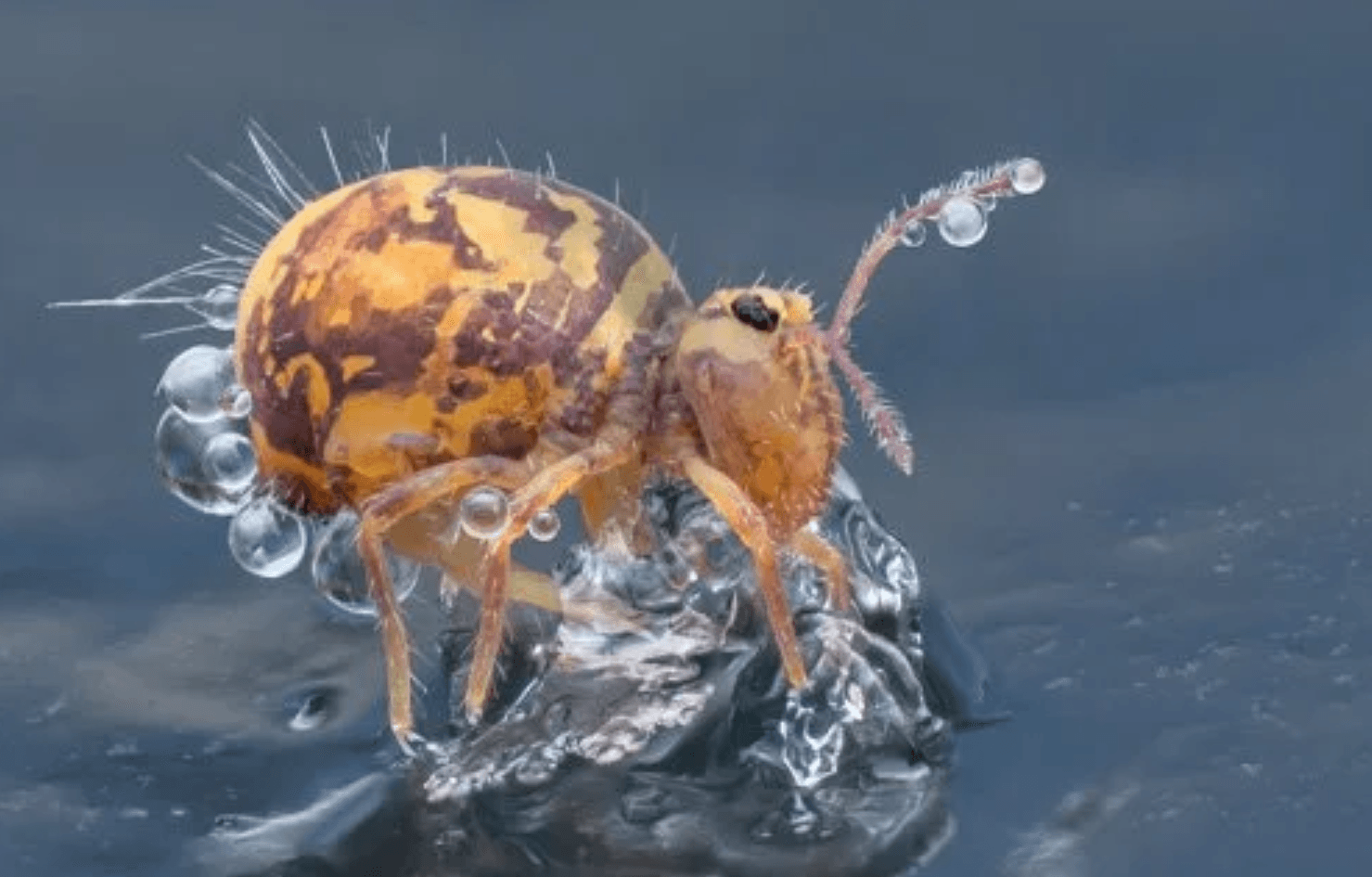
For tiny invertebrates like this one, water is a very different substance than we’re used to. At this scale, surface tension is a force as powerful–or more so–than gravity. Droplets remain spherical, caught on long, spike-like hairs. Even the surface of a pond is different, forming a trampoline creatures can skim but that requires special techniques to escape. (Image credit: N. Baumgartner/CUPOTY; via Colossal)
Search results for: “water droplet”

“Liquid Colors”
Light shining through misty spray creates a liquid rainbow in this photo by Ronja Linssen. Although mists and sprays–from waterfalls, waves, and more–seem insubstantial, they can be a major source of material transfer between the water and atmosphere. Teratons of salt, biomass, and even microplastics make their way yearly from the ocean into the sky through droplets launched from popping bubbles. (Image credit: R. Linssen/CUPOTY; via Colossal)
Bouncing Indefinitely
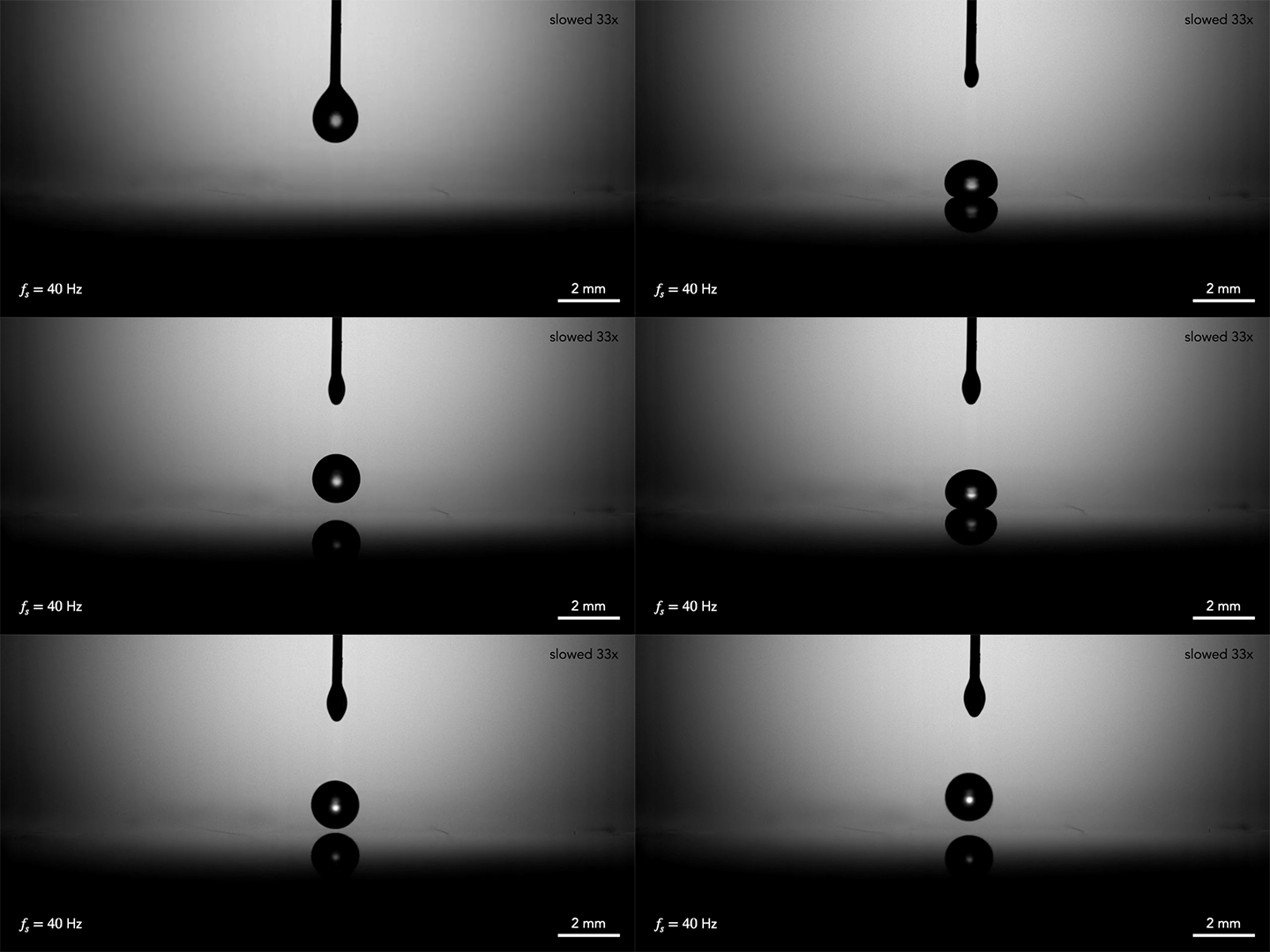
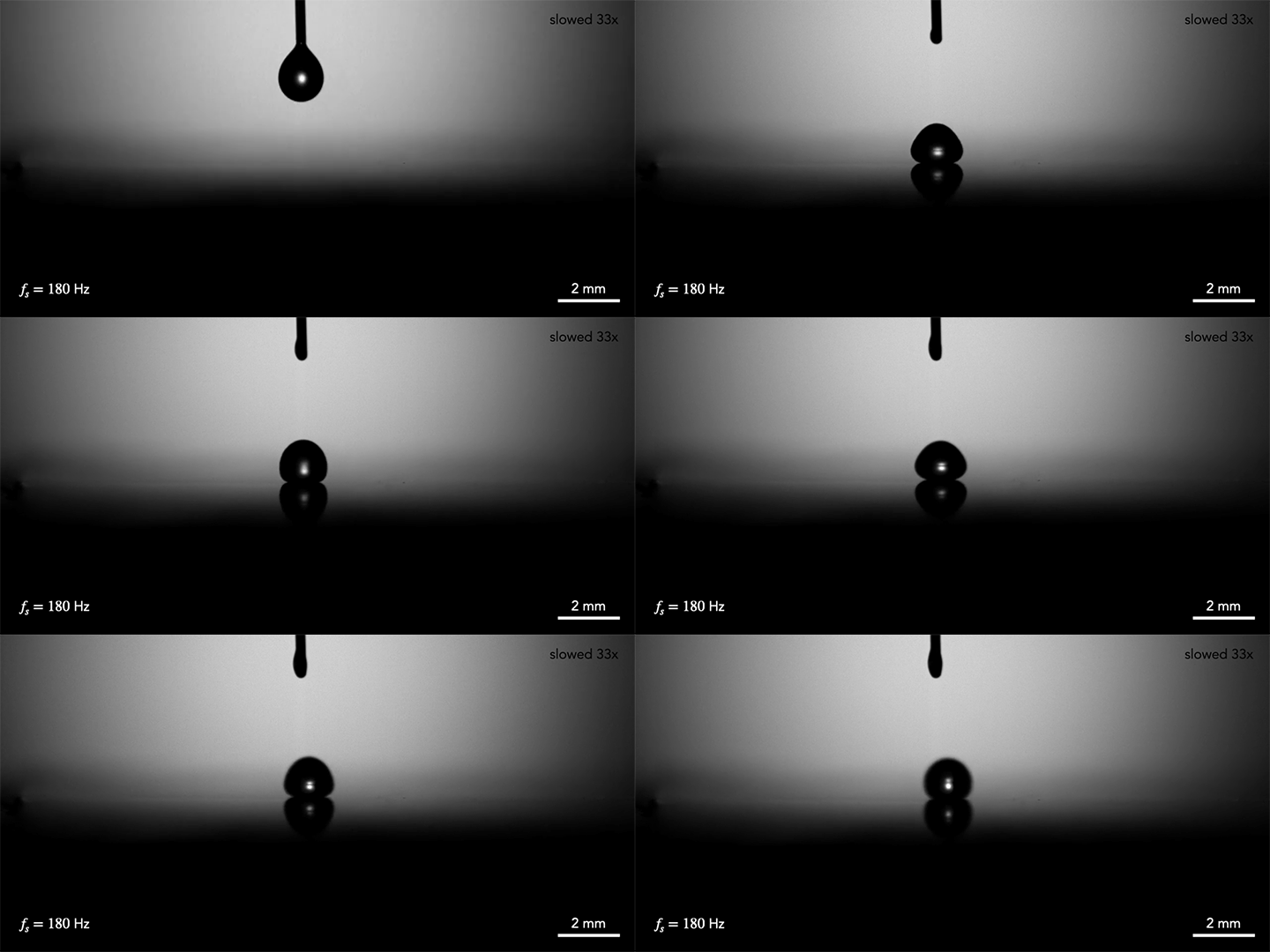
On the surface of a gently vibrating liquid, a droplet can bounce indefinitely without coalescing, kept aloft by an air film too small to see. As long as the droplet lifts off before the air layer drains out from under it, the droplet won’t contact the water below. Now scientists have shown that this is possible with a solid surface, too.
Using an atomically smooth mica plate, researchers were able to bounce a droplet indefinitely without wetting the surface. At higher vibration rates (below), the droplet essentially hovers in place, bouncing so quickly that we simply see its shape vibrating in response to the surface. (Image and research credit: L. Molefe et al.; via APS)
Fediverse Reactions
-

A Drop of Algae
Spheres of a Volvox colonial algae glow green inside a droplet in this award-winning microphotograph by Jan Rosenboom. Pinned on an inclined surface, the droplet is frozen in a balance between gravity and surface tension that keeps its shape–and its contact angles–asymmetric. Droplets will also take on a shape similar to this when air is blowing past them. (Image credit: J. Rosenboom; via Ars Technica)
Fediverse Reactions
-
“Legends of the Falls”
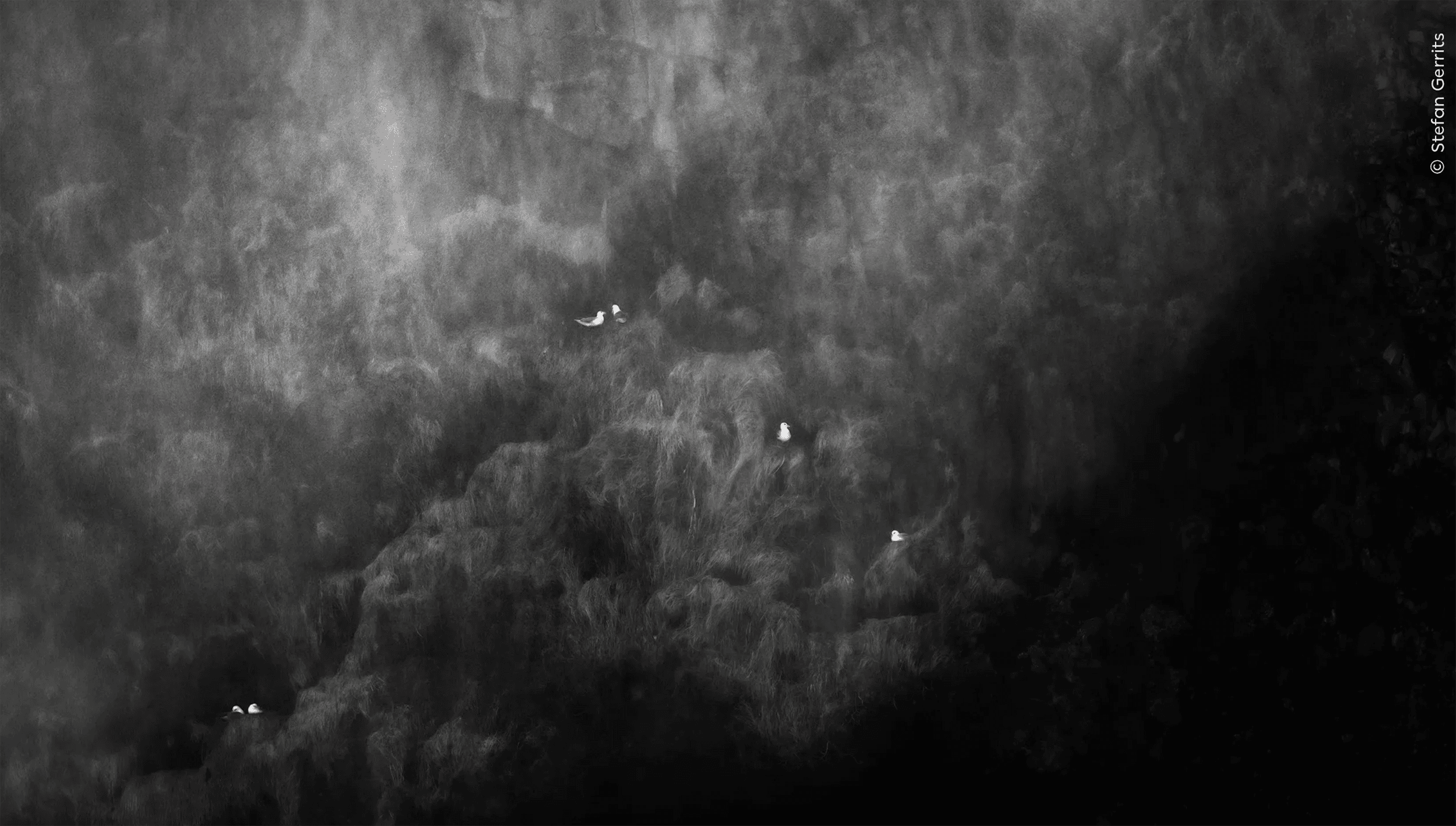
Strong winds blew curtains of mist across Skógafoss in this image of nesting northern fulmars by photographer Stefan Gerrits. Despite water’s high density compared to air, fine droplets are able to stay aloft for long periods, given the right breeze. Mists, fogs, and sea spray can float surprising distances; droplets exhaled from our lungs can persist even farther. (Image credit: S. Gerrits; via Colossal)
Fediverse Reactions
-
A Rough Day
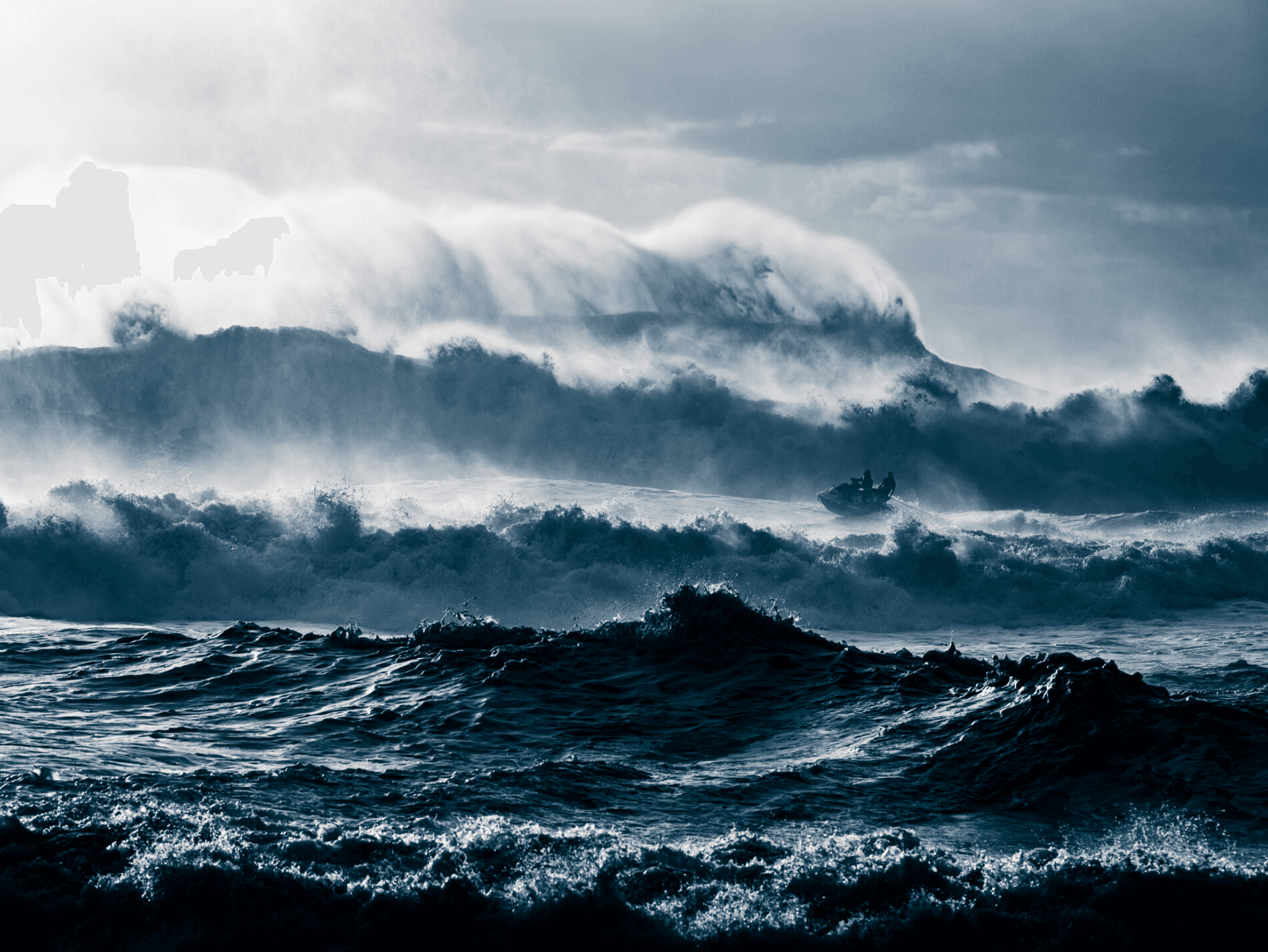
Winds from the north made for wild conditions at Nazaré in Portugal. Photographer Ben Thouard caught these crashing waves in the late afternoon, when the low sun angle illuminated the spray of the surf. Every year teratons of salt and biomass move from the ocean to the atmosphere, much of it through turbulent wave action driven by the wind. Here, the wind rips droplets off of wave crests, but smaller droplets reach the atmosphere when bubbles–trapped underwater by crashing waves–reach the surface and burst. (Image credit: B. Thouard/OPOTY; via Colossal)
Fediverse Reactions
-
Ice Discs Surf on Herringbones
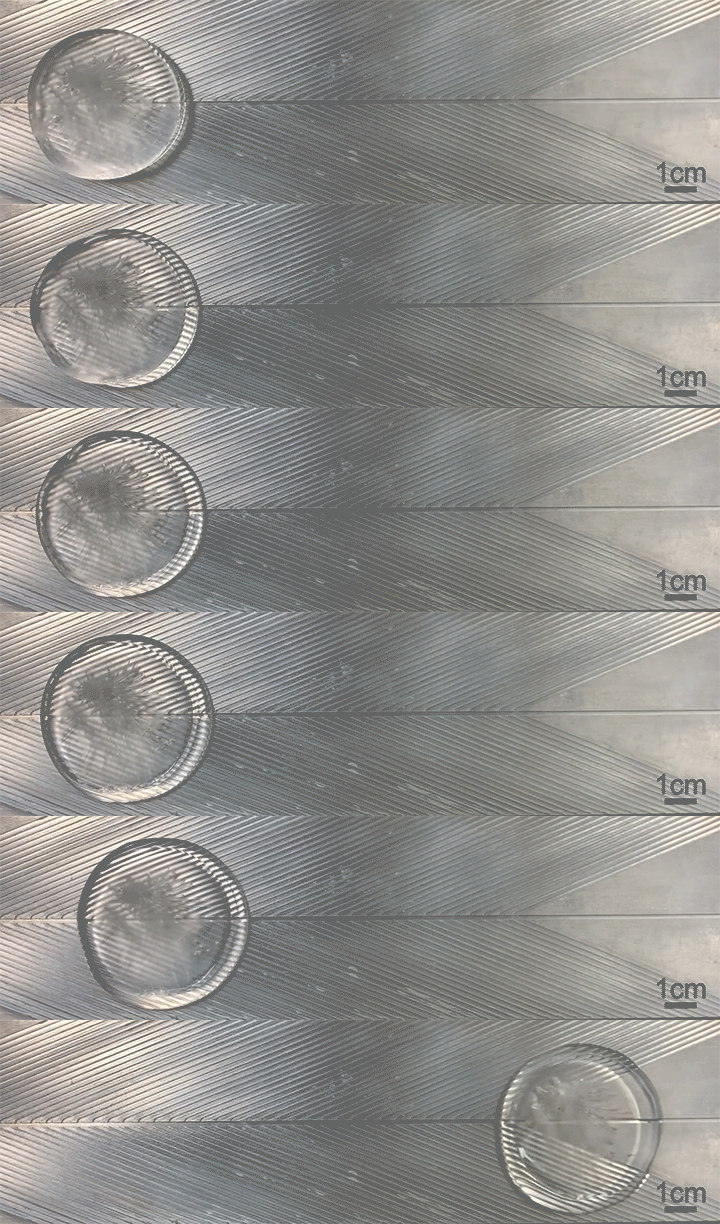
Inspired by the roaming rocks of Death Valley, researchers went looking for ways to make ice discs self-propel. Leidenfrost droplets can self-propel on herringbone-etched surfaces, so the team used them here, as well. On hydrophilic herringbones, they found that meltwater from the ice disc would fill the channels and drag the ice along with it.
But on hydrophobic herringbone surfaces, the ice disc instead attached to the crest of the ridges and stayed in place–until enough of the ice melted. Then the disc would detach and slingshot (as shown above) along the herringbones. This self-propulsion, they discovered, came from the asymmetry of the meltwater; because different parts of the puddle had different curvature, it changed the amount of force surface tension exerted on the ice. Thus, when freed, the ice disc tried to re-center itself on the puddle.
The team is especially interested in how effects like this could make ice remove itself from a surface. After all, it requires much less energy to partially melt some ice than it does to completely melt it. (Image and research credit: J. Tapochik et al.; via Ars Technica)
Fediverse Reactions
-
Oil-Slicked Bubble Bursts
When bubbles at the surface of the ocean pop, they can send up a spray of tiny droplets that carry salt, biomass, microplastics, and other contaminants into the atmosphere. Teratons of such materials enter the atmosphere from the ocean each year. To better understand how contaminants can cross from the ocean to the atmosphere, researchers studied what happens when a oil-coated water bubble pops.
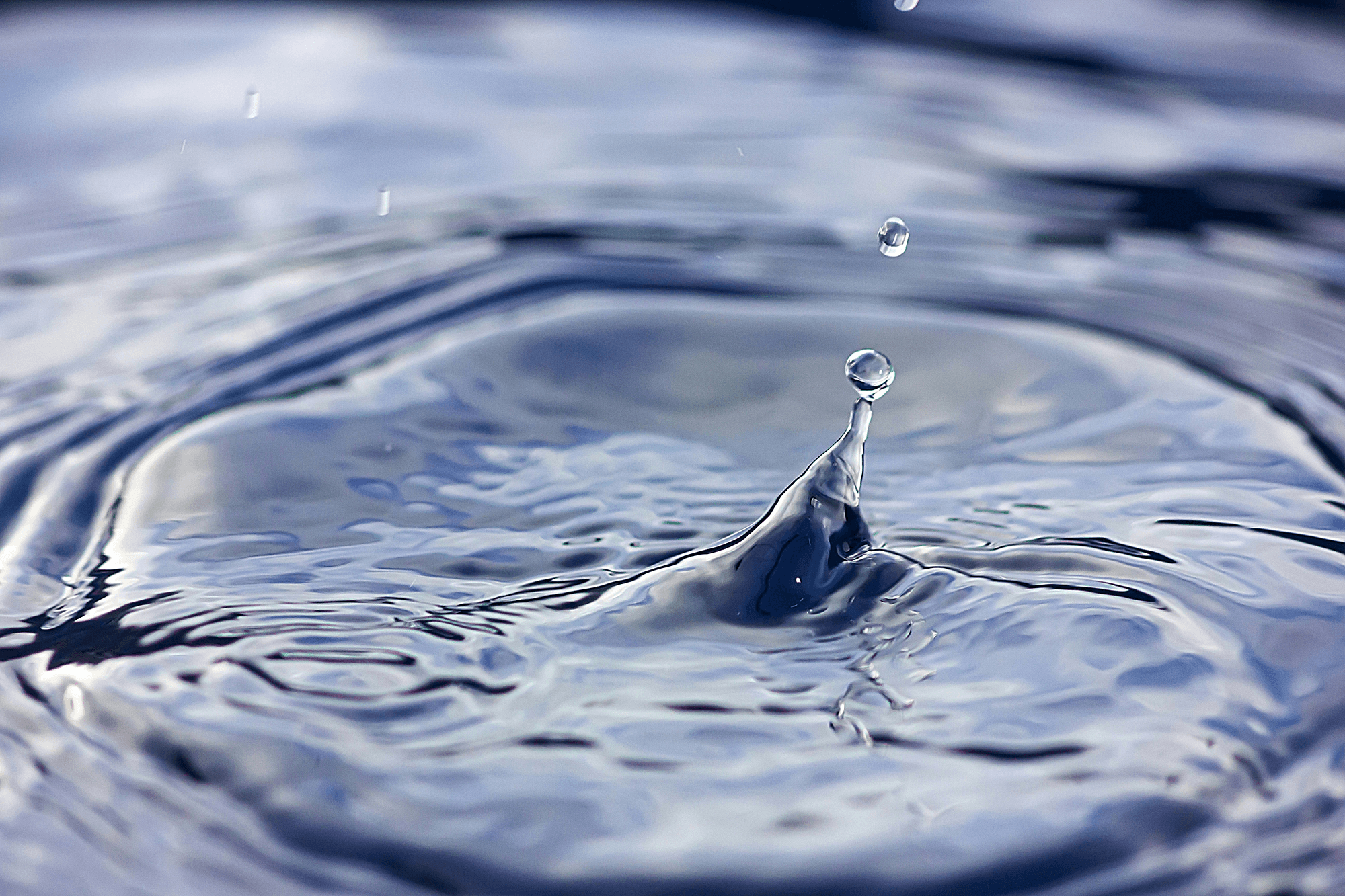
The team looked at bubbles about 2 millimeters across, coated in varying amounts of oil, and observed their demise via high-speed video. When the bubble pops, capillary waves ripple down into its crater-like cavity and meet at the bottom. That collision creates a rebounding Worthington jet, like the one above, which can eject droplets from its tip.
The team found that the oil layer’s thickness affected the capillary waves and changed the width of the resulting jet. They were able to build a mathematical model that predicts how wide a jet will be, though a prediction of the jet’s velocity is still a work-in-progress. (Image credit: Р. Морозов; research credit: Z. Yang et al.; via APS)
Fediverse Reactions
-
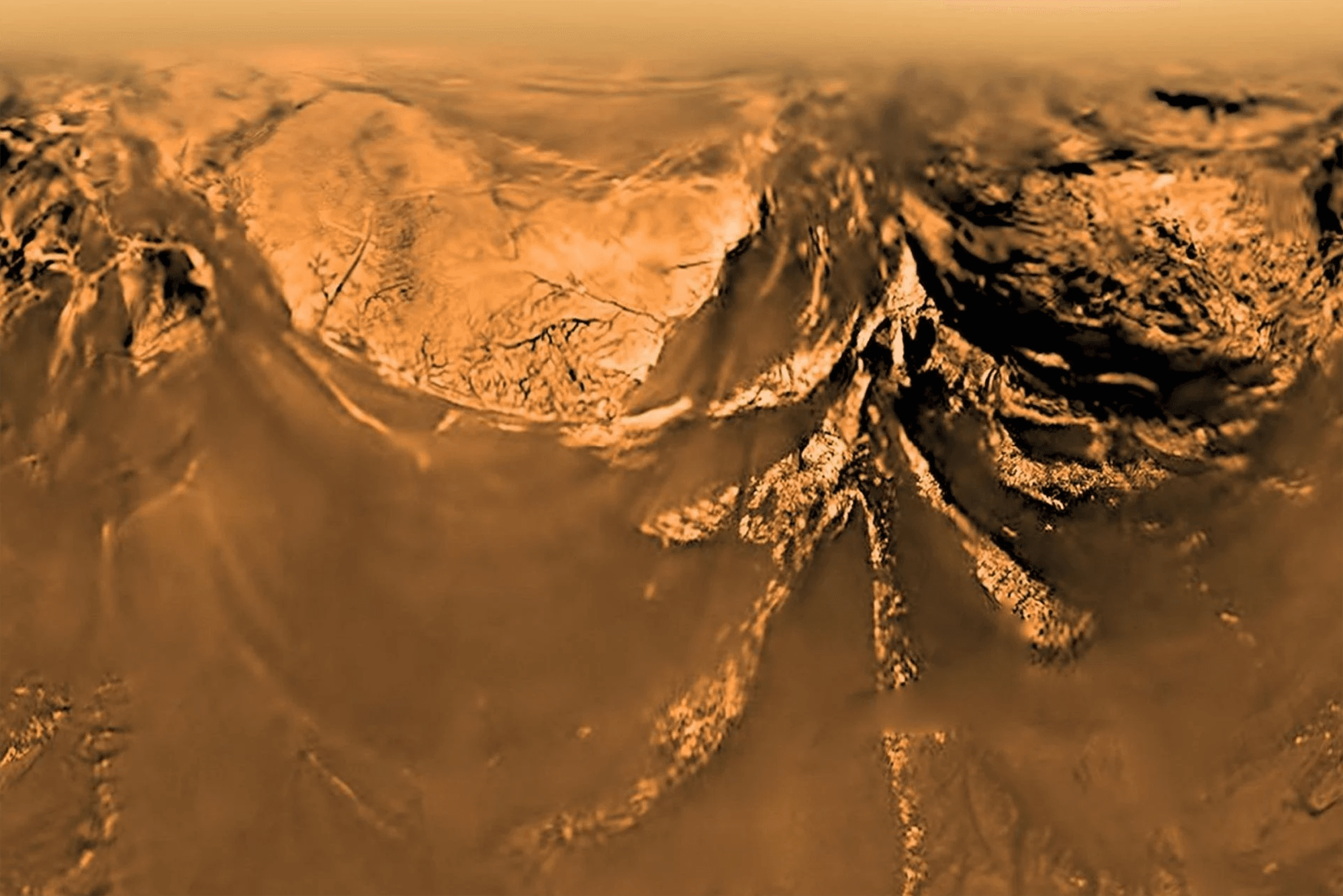
Forming Vesicles on Titan
Scientists are still debating exactly what shifts nature from chemical and physical reactions to living cells. But vesicles — small membrane-bound pockets of fluid carrying critical molecules — are a commonly cited ingredient. Vesicles help cluster important organic molecules together, increasing their chances of combining in the ways needed for life. Now scientists are suggesting that Titan, Saturn’s moon, could form vesicles of its own.
On Earth, molecules known as amphiphiles feature a hydrophilic (water-loving) end and a hydrophobic (water-fearing) one. When dispersed in water, amphiphiles crowd at the surface, placing their hydrophilic end in the water and their hydrophobic end outward toward the air. On Titan, the Cassini mission revealed organic nitrile molecules that behave similarly with methane rather than water.
Their two-sided structure means that these molecules — like Earth’s amphiphiles — will gather at the surface of Titan’s liquids. When methane rain falls on the Titan’s seas, the impact creates aerosol droplets that slowly settle back to the liquid surface. When that happens, the droplet’s molecular monolayer and the lake’s monolayer meet, enclosing the droplet’s contents in a double-layer of molecules that prevent contact between the droplet and the lake.
Within that newly-formed vesicle, all kinds of molecules can bump shoulders, creating new opportunities for complex chemistry. (Image credit: Titan – ESA/NASA/JPL/University of Arizona, illustration – C. Mayer and C. Nixon; research credit: C. Mayer and C. Nixon; via Gizmodo)
Fediverse Reactions
-
Crown Splash
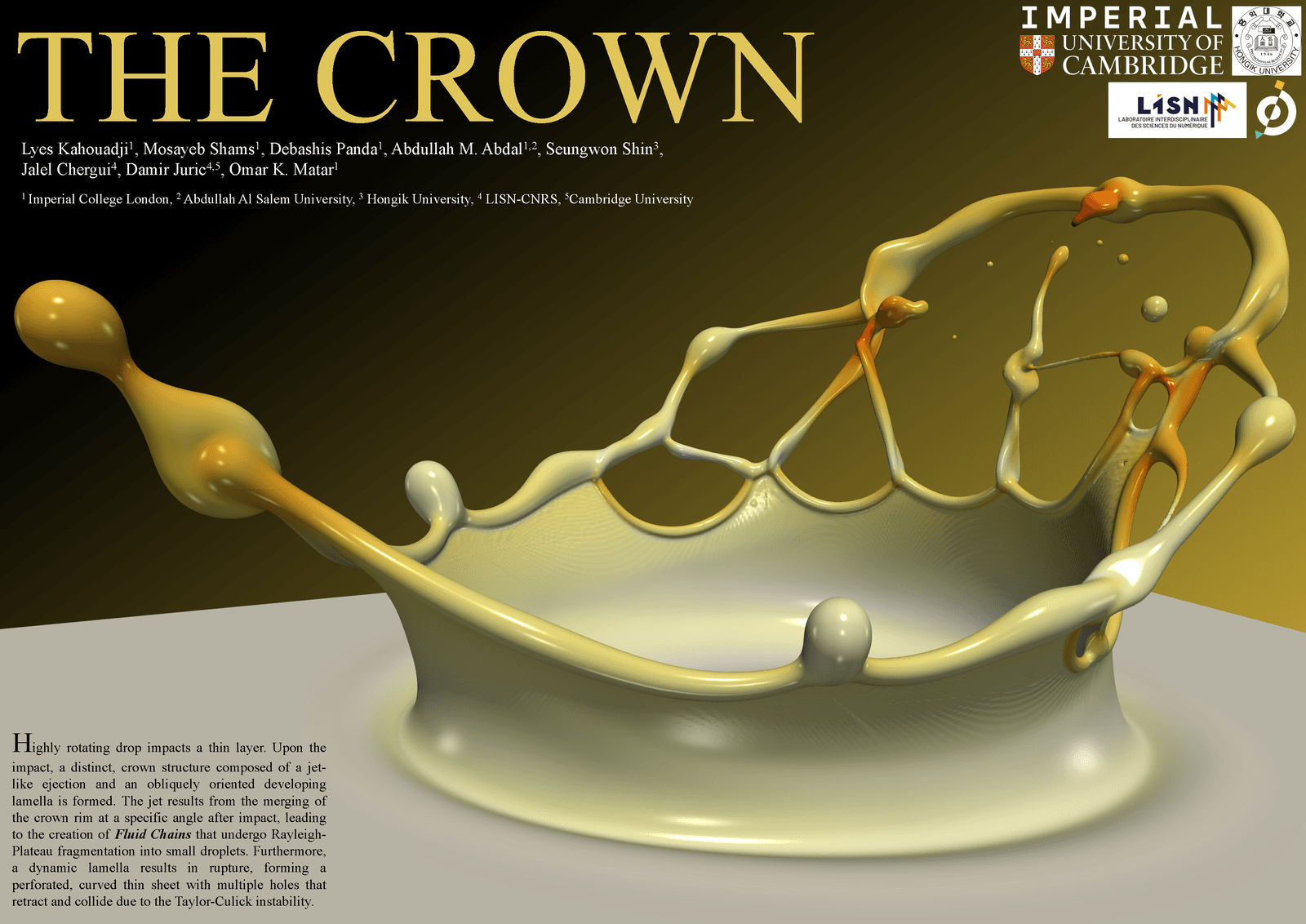
When a falling drop hits a thin layer of water, the impact sends up a thin, crown-shaped splash. This research poster shows a numerical simulation of such a splash in the throes of various instabilities. The crown’s thick edges are undergoing a Rayleigh-Plateau instability, breaking into droplets much the way a dripping faucet does. On the far side, the crown has rapidly expanding holes that pull back and collide. The still-intact liquid sheet at the base of the crown shows some waviness, as well, hinting at a growing instability there. (Image credit: L. Kahouadji et al.)
Fediverse Reactions
-