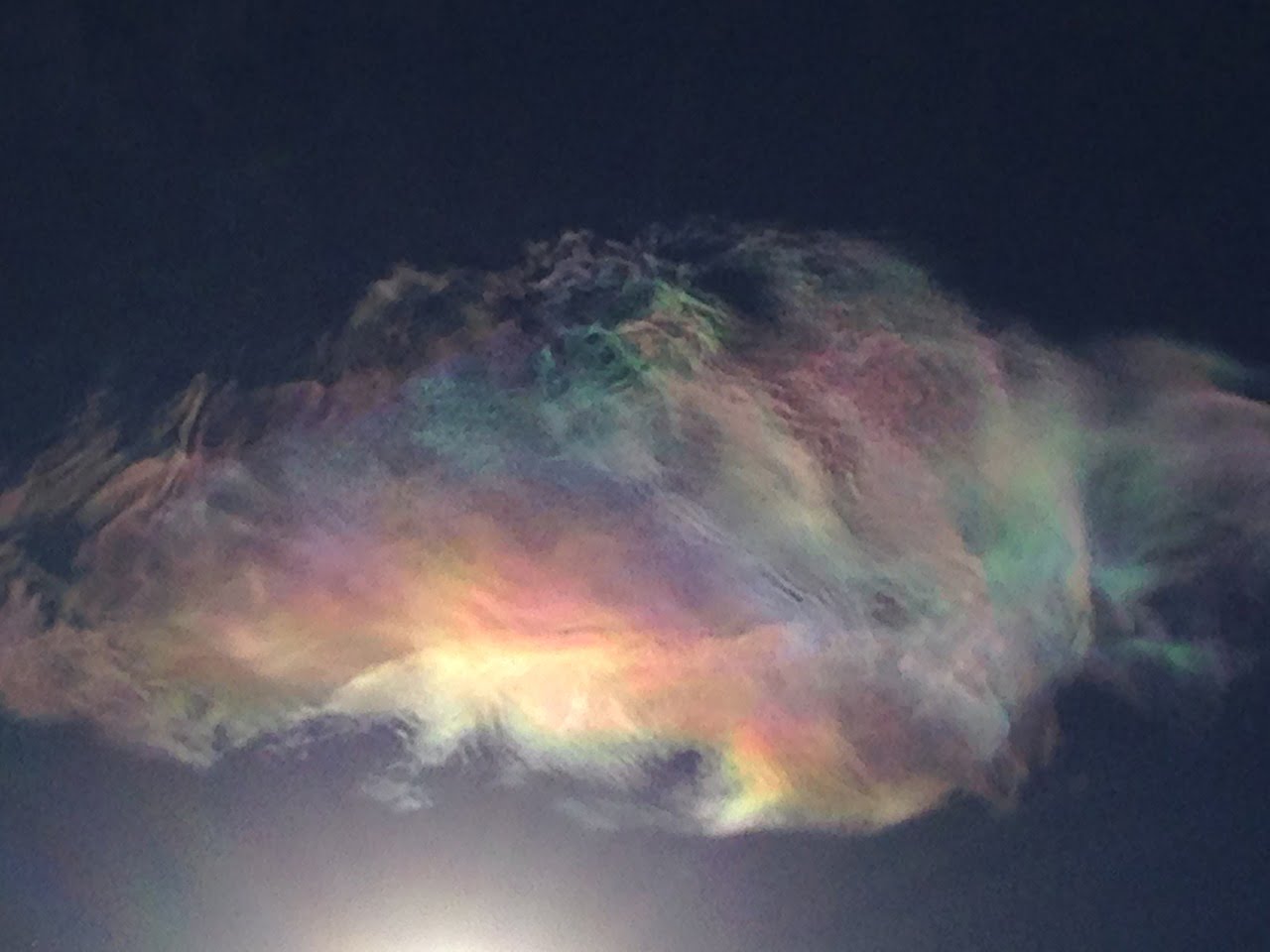
Look up at the clouds on the right day and you may catch a glimpse of a rainbow-like phenomenon known as cloud iridescence. These colors occur when sunlight is diffracted through small water droplets or ice crystals. For the effect to be apparent, the cloud must be optically thin, meaning that most of the rays of sunlight must pass through only a single droplet or ice crystal. This means the effect is usually visible only near the edges of clouds or as new clouds are forming. You can see more photos of the phenomenon here, and there’s a great video where cloud iridescence makes an appearance during a rocket launch in this previous entry. (Photo credit and submission: C. Havlin)
Search results for: “water droplet”

Bounce or Freeze?
Icing is a major problem for aircraft. When ice builds up on the leading edge of a wing it creates major disruptions in flow around the wing and can lead to a loss of flight control. One of the important factors in predicting and controlling ice building up is knowing when and where water droplets will freeze. The video above shows how surface conditions on the wing affect how an impacting droplet freezes. On a subzero hydrophilic surface, a falling droplet spreads and freezes over a wide area, which would hasten ice buildup. A hydrophobic surface is slightly better, with the droplet freezing over a smaller area, whereas a superhydrophobic surface shows no ice buildup. Unfortunately, at present superhydrophobic surfaces and surface treatments are extremely delicate, making them unsuitable for use on aircraft leading edges. (Video credit: G. Finlay)
Hydrophobicity and Viscous Flow
Hydrophobic surfaces are great for creating some wild behaviors with water droplets, but they make neat effects with other liquids, too. The viscous honey in the first segment of this Chemical Bouillon video is a great example. Because the honey doesn’t adhere to the hydrophobic surface, the viscoelastic fluid does not maintain the form it had when drizzled on the surface. Instead, the honey contracts, with surface tension driving Plateau-Rayleigh-like instabilities that break the contracting ligaments apart to form nearly spherical droplets of honey on the surface. (Video credit: Chemical Bouillon)
Healing Bubbles
Soap bubbles are ephemeral creations. The slightest prick will send them tearing apart in the blink of an eye. It may come as a surprise, therefore, that dropping a water droplet through a bubble will not break it. Instead, the bubble will heal itself using the Marangoni effect. In a soap bubble, the soap molecules act as a surfactant, lowering the surface tension of the water and allowing the fragile structure to hold together. When the water drop impacts the bubble, the local surface tension increases because of the relative lack of soap molecules. This increase in surface tension pulls at the rest of the bubble, drawing more soap molecules toward the point of contact. The effect evens out surface tension across the surface and stabilizes the bubble. You can test the effect at home, too. If you wet your finger, you can poke a soap bubble without popping it. (Video credit: G. Mitchell; via io9)
Distorted Rings
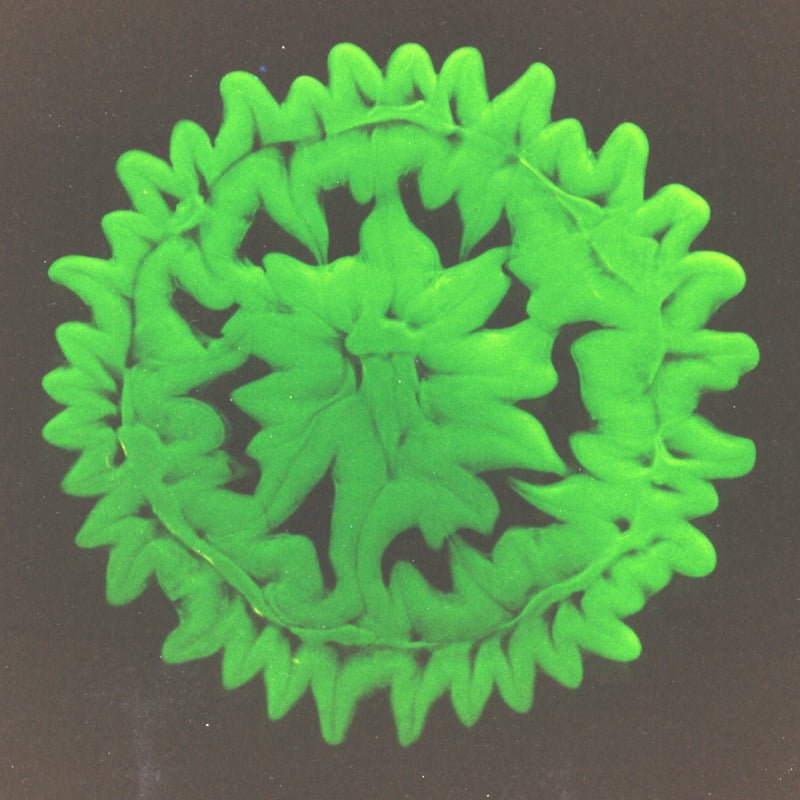
The Marangoni effect is generated by variations in surface tension at an interface. Such variations can be temperature-driven, concentration-driven, or simply due to the mixing between fluids of differing surface tensions as is the case here. The pattern in the image above formed after a dyed water droplet impacted a layer of glycerin. The initial impact of the drop formed an inner circle and outer ring. This image is from 30 seconds or so after impact, after the Marangoni instability has taken over. The higher surface tension of the water pulls the glycerin toward it, resulting in a flower-like pattern. (Photo credit: E. Tan and S. Thoroddsen)
Pointed Drops
When water droplets sit on a cold substrate, they freeze into a shape with a pointed tip. At first glance, this behavior seems very odd since surface tension usually acts to prevent such sharp protrusions. The shape is, however, a result of water’s expansion as it freezes. The droplet freezes from the substrate upward, with a concave shape to the solidification front. The angle of the point does not depend on the substrate temperature or the wetting angle between the water and surface. Instead, it turns out that this concave front shape and water’s expansion are the key factors that determine the pointed cusp’s angle, and that the final geometry of the cusp is essentially universal. (Video credit: M. Nauenberg; additional research credit: A. Marin et al.)
Vibrating on a Subwoofer
[original media no longer available]
Vibrating a liquid droplet produces some awesome behavior. The video above shows a water droplet vibrating on a subwoofer at real-time speeds. The behavior and shape of the droplet shifts with the frequency of vibration, which we hear as a change in pitch. To see more clearly the shapes a particular frequency induces, check out this high-speed video of vibrating water droplets. For a given driving frequency, the droplet’s shape, or mode, is distinct and consistent. For a droplet vibrating to a song, though, there is more than one frequency driving its motion. In this case, the droplet’s shape is a superposition of the individual modes, which is just a way of saying adding the shapes together. So frequency determines the droplet’s shape. The vibration amplitude, or audible volume, affects how energetic the drop’s motion is. And the fluid’s surface tension and viscosity act as dampers to the system, controlling how quickly the drop can change shape as well as how well it holds together. (Video credit: A. Read)
Rebounding
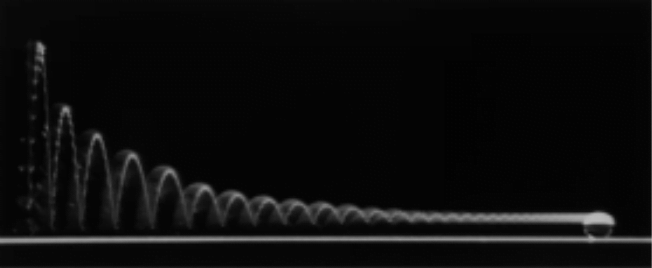
A water droplet can rebound completely without spreading from a superhydrophobic surface. The photo above is a long exposure image showing the trajectory of such a droplet as it bounces. In the initial bounces, the droplet leaves the surface fully, following a parabolic path with each rebound. The droplet’s kinetic energy is sapped with each rebound by surface deformation and vibration, making each bounce smaller than the last. Viscosity damps the drop’s vibrations, and the droplet eventually comes to rest after twenty or so rebounds. (Image credit: D. Richard and D. Quere)

Holiday Fluids: Snowflakes


Just about everyone wishes for a White Christmas, but even when that happens, it’s rare to get a good look at the beauty of individual snowflakes. Alexey Kljatov’s macro photography of snowflakes is simply stunning and highlights the incredible variety of forms snowflakes take. A snowflake forms when a water droplet freezes onto dust or other particles and grows as more water vapor freezes onto the initial crystal. The symmetry of the snowflakes, as with any crystal, comes from the internal order of its water molecules. The shape and features that form vary due to the local temperature and humidity level while vapor is freezing onto the crystal. Check out this handy graph showing which shapes form for various situations. Since snowflakes can encounter wildly different conditions on their path to the ground, it’s rare or next-to-impossible to find any two alike. Join us all this week at FYFD as we look at holiday-themed fluid dynamics. (Photo credit: A. Kljatov)

Explosive Boiling
A superheated liquid can reach temperatures higher than its boiling point without actually boiling – similar to how liquids can be supercooled below their freezing point without solidifying. The photo sequence above shows how explosive the boiling of a superheated water droplet submersed in sunflower oil can be. Image (a) in the lower left shows the superheated droplet resting on the bottom of its container. Then droplet vaporizes explosively in (b), expanding dramatically. The bubble overexpands and and begins to oscillate around its equilibrium radius. This triggers a Rayleigh-Taylor instability in the bubble’s interface, creating the large lobes in © and enlarged in the upper image. Finally, the bubble fragments in (d). See the original paper for more on superheated droplet boiling. (Image credit: M. A. J. van Limbeek et al.; via @AIP_Publishing)