Search results for: “viscous”

  • Featured Video Play Icon

    The Shape of Rain

    In our collective imagination, a raindrop is pendant shaped, wide at the bottom and pointed at the top. But, in fact, a falling raindrop experiences much more complicated shapes. Here, researchers blow a jet of air onto a still droplet, a good facsimile for a raindrop falling through the atmosphere. The jet of air first squishes the drop, then inflates it into a shape known as a bag. The thin sides of the bag stretch and eventually break, spraying tiny droplets. As the disintegration continues, the thick rim of the bag breaks up into big droplets. As the video demonstrates, viscosity and viscoelasticity can affect the break-up, too. (Image and video credit: I. Jackiw and N. Ashgriz)

  • Shaped Splashes

    Shaped Splashes

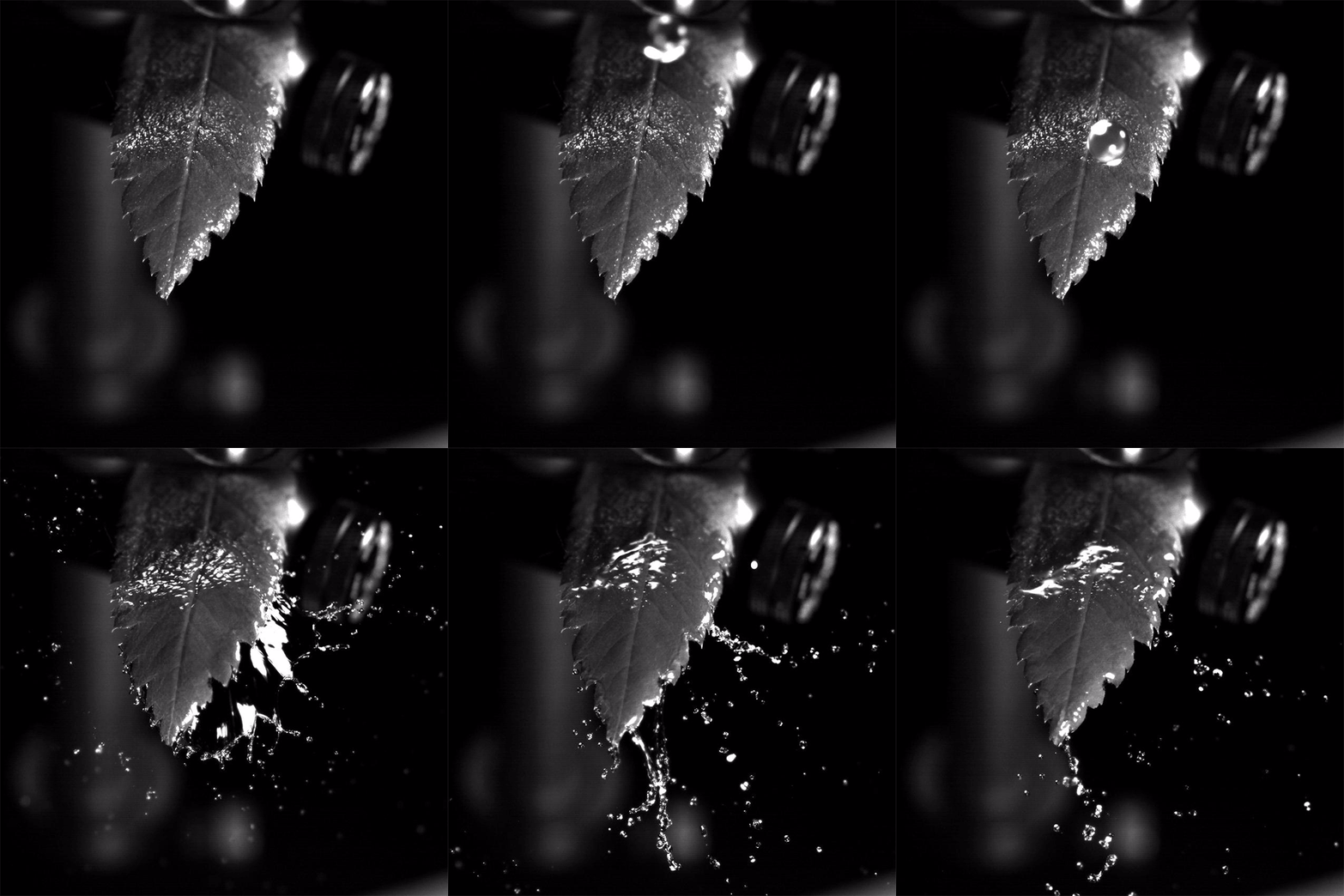
    When a raindrop hits a leaf, it spreads out into a rimmed sheet that breaks up into droplets. These tiny drops can carry dust, spores, and even pathogens as they fly off. But many leaves aren’t smooth-edged; instead they have serrations or teeth. How does that affect a splash? That’s the question at the heart of today’s study.

    A water drop hits a star-shaped pillar and breaks up.
    A water drop hits a star-shaped pillar and breaks up.

    To simplify from a leaf’s shape, the team studied water dropping onto star-shaped pillars. As seen above and below, the pillar’s edge shaped the splash sheet, with the sheet extending further in the edge’s troughs. This asymmetry extends into the rim also, concentrating the liquid — and the subsequent spray of droplets — along lines that extend from the edge’s troughs and peaks.

    A viscous water-glycerol drop hits a star-shaped pillar, spreads, and breaks into droplets.
    A viscous water-glycerol drop hits a star-shaped pillar, spreads, and breaks into droplets.

    The team found that, in addition to sending drops along a preferred direction, the shaped edge made the droplets larger and faster than a smooth edge did. (Image and research credit: T. Bauer and T. Gilet)

  • Featured Video Play Icon

    “Emitter”

    For this latest experimental film, artist Roman De Giuli provides a glimpse of the unique fluid art machine he’s built over the last 3.5 years. With 10 channels driven by peristasltic tube pumps and stepper motors, his “printer” drips up to 10 colors on a paint-covered, tilted canvas to create these beautiful images. As he says in his description of the invention, the set-up produces paint layering that’s almost impossible to create by hand. Fluid dynamically speaking, we’re seeing gravity currents like a lava flow or avalanche that are mixing together viscously. There’s also some added effects from density differences between different layered paint colors. Artistically, this machine offers an infinite palette of visual opportunities; financially, though, De Giuli admits its an absolute beast at consuming paint! (Image and video credit: R. De Giuli)

  • Sensing Sound Like Spiderwebs

    Sensing Sound Like Spiderwebs

    Most microphones — like our ears — work by sensing the tiny pressure changes caused by a sound wave‘s passing. But for microphones built this way, the smaller they get, the more sensitive they are to thermal noise. That’s one reason that the tiny microphones in a laptop or webcam just don’t sound as good as larger mics.

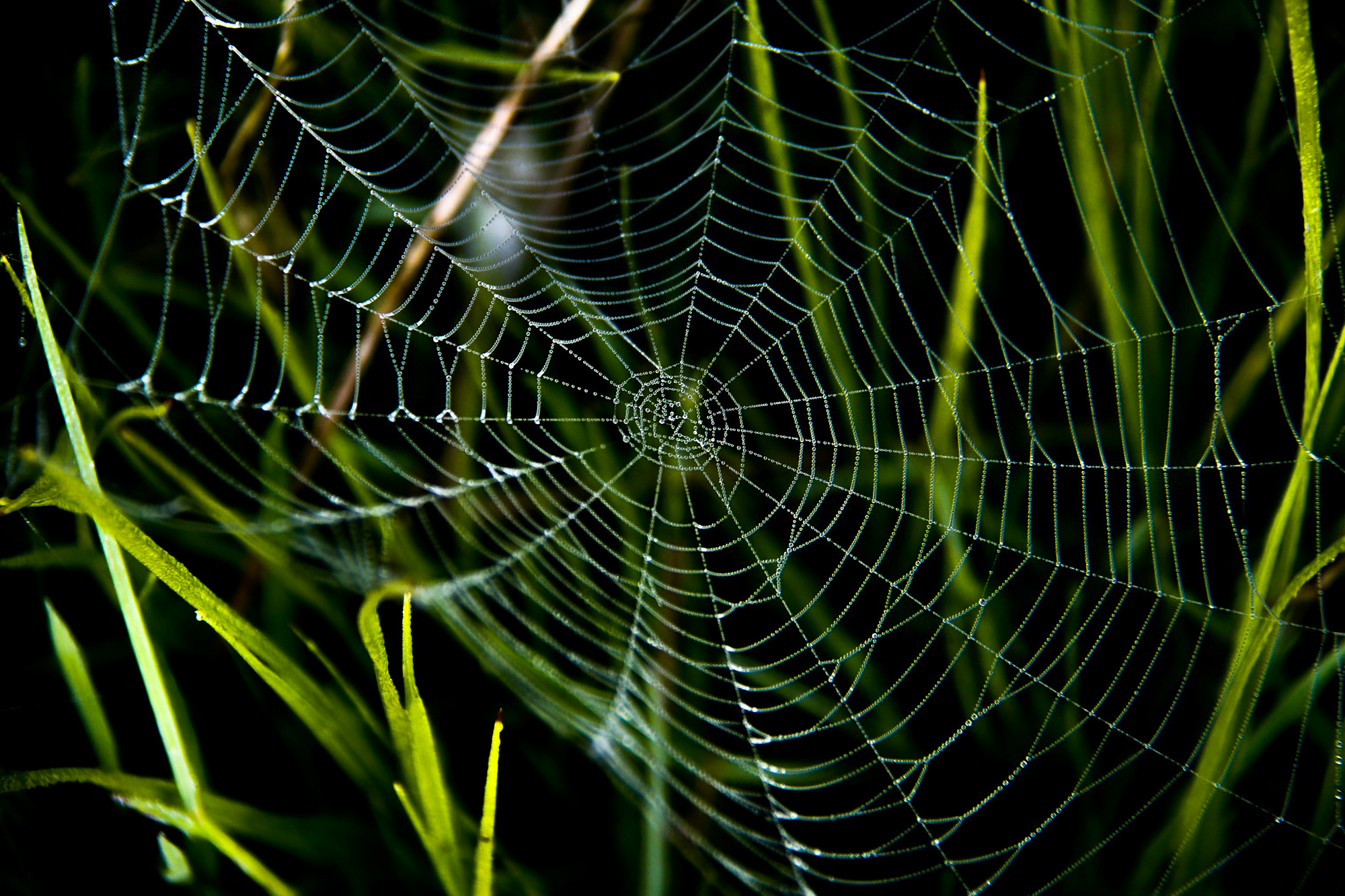
    Researchers turned to nature to look for alternative ways to measure sound and zeroed in on the mechanism spiders use. Spiders “listen” to their web’s vibrations; the tiny strands of silk quiver as air flow from a sound moves past. Instead of being pressure-based, this mechanism uses viscous drag to register a sound.

    The team fabricated an array of microbeams to test the concept of a viscosity-based microphone and found that tiny beams sensed sounds just as well as larger ones. That means these microphones can get smaller without sacrificing performance. For now, they’re not as sensitive as conventional microphones, but that’s not surprising, given that engineers have been improving pressure-based microphones for 150 years. It’s a promising start for a new technology, though. (Image credit: N. Fewings; research credit: J. Lai et al.; via APS Physics)

  • Dripping Viscoelastics

    Dripping Viscoelastics

    An ultrasoft viscoelastic fluid drips in this research poster from the Gallery of Soft Matter. Complex materials like this one have stretchy, elastic behaviors typical of a solid along with the flowing, viscous properties of a fluid. Here, gravity overcomes the material’s elasticity, leaving it to sag and flow. As that happens, the fluid must slide past air, and the density difference between the two fluids creates the small distortions seen on the liquid sheet. This is an example of a Rayleigh-Taylor instability. (Image credit: J. Hwang et al.)

  • Featured Video Play Icon

    Building In a Stingless Hive

    Honeybees, with their stingers, get lots of attention, but the Americas have plenty of stinger-less honeymakers, too. These stingless bees are native to Mexico, where beekeepers cultivate them for pollination. Without stingers and venom, the bees use their building prowess to keep out unwanted visitors. Much of the hive — from the entrance’s nightly gate to the pods where young are stored — is built from cerumen, a substance the bees create by mixing wax with resins they collect from nearby trees. Just as they do with pollen, worker bees collect drops of resin and store them on their hind legs before flying back to the hive. The viscous fluid sticks well, until a swipe of a leg shears it enough to lower its viscosity and slide it off. (Video and image credit: Deep Look)

  • Evolving Fingers

    Evolving Fingers

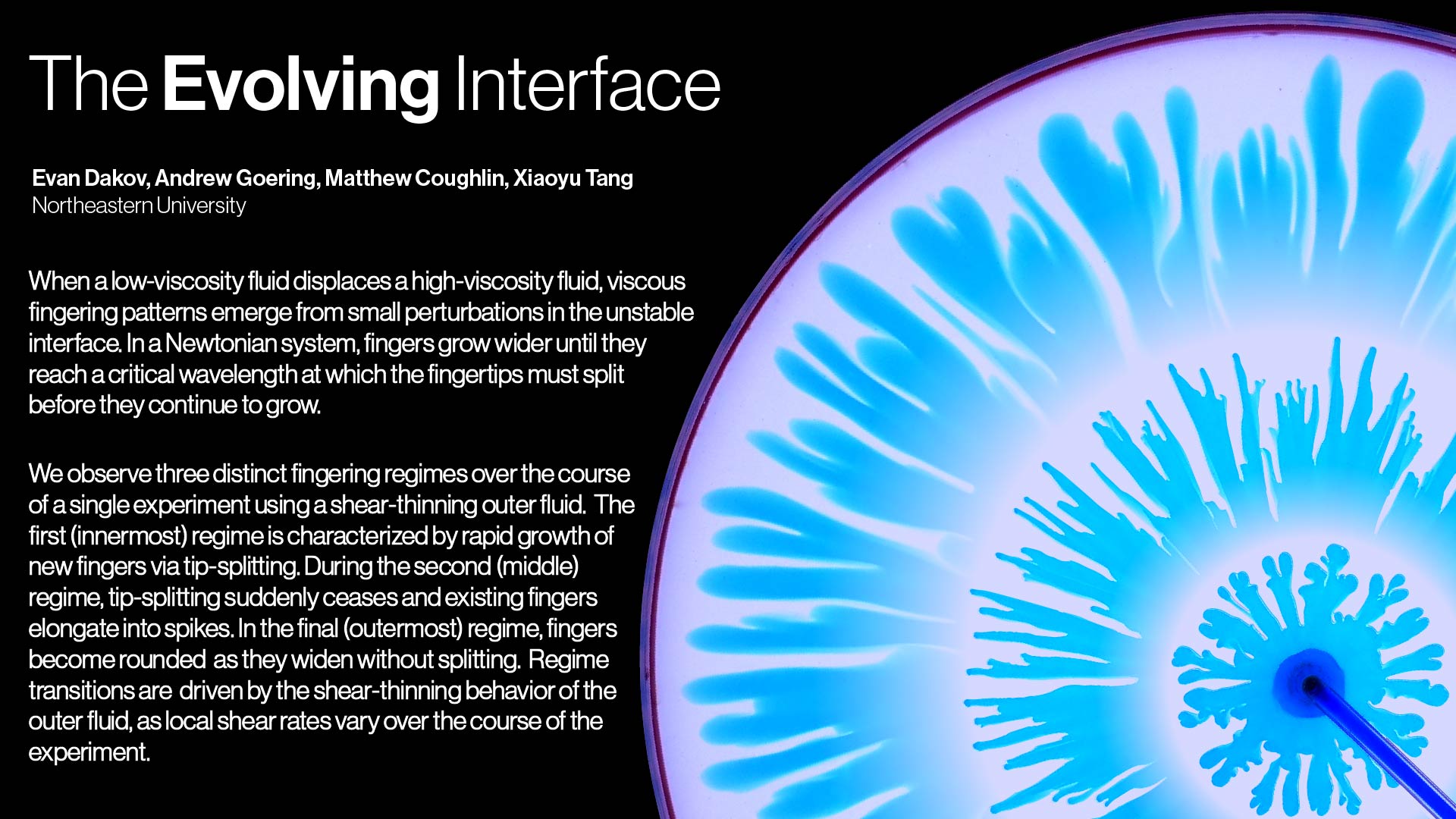
    If you sandwich a viscous fluid between two plates and inject a less viscous fluid, you’ll get viscous fingers that spread and split as they grow. This research poster depicts that situation with a slight twist: the viscous fluid (transparent in the image) is shear-thinning. That means its viscosity drops when it’s deformed. In this situation, the fingers formed by the injected (blue) fluid start out the way we’d expect: splitting as they grow (inner portion of the composite image). But then, the tip-splitting stops and the fingers instead elongate into spikes (middle ring). Eventually, as the outer fluid’s viscosity drops further, the fingers round out and spread without splitting (outer arc of the image). (Image credit: E. Dakov et al.; via GoSM)

  • Mocha Diffusion

    Mocha Diffusion

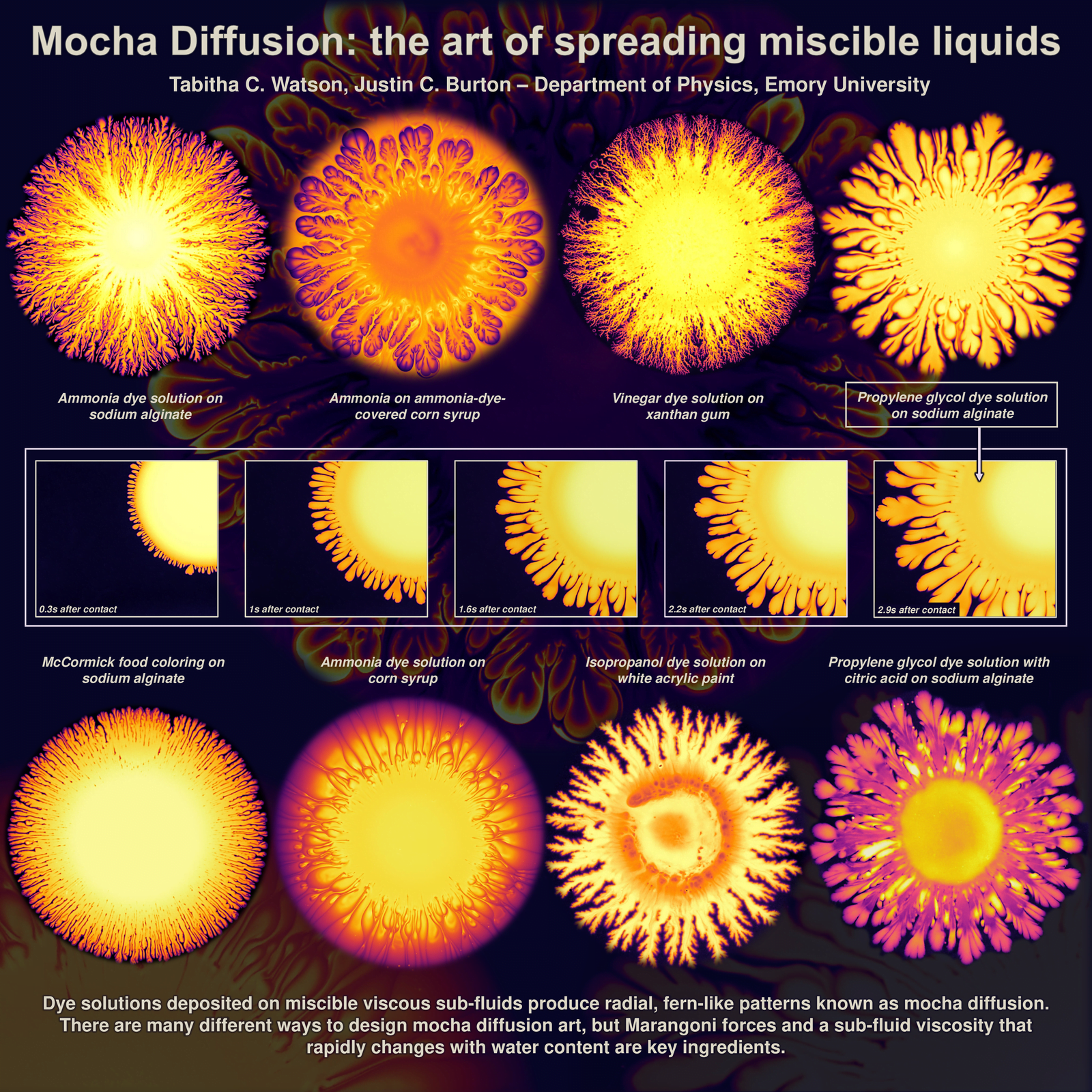
    These firework-like patterns spread when dyes are added atop a viscous but miscible lower fluid layer. Here, researchers use lower layers like corn syrup and xanthan gum; then they spread dye mixtures including ammonia and vinegar atop those layers. Because the upper and lower layers of fluid are miscible and can diffuse into one another, they together form elaborate patterns. The mixing of the two layers creates gradients in surface tension that can drive the flow and create these mocha diffusion patterns. (Image credit: T. Watson and J. Burton)

  • Featured Video Play Icon

    “Alive”

    In “Alive,” filmmaker Christopher Dormoy explores acrylic paints and the variety of ways in which the medium can be used. From a fluids perspective, there’s dripping, viscous flow, turbulent eddies, billowing plumes, and “accidental painting” due to density-driven instabilities. It’s a fun tour of fluid phenomena in art. What examples do you spot? (Video and image credit: C. Dormoy)

  • Frictional Fingers

    Frictional Fingers

    Air pushes into a thin gap filled with water and granular particles in the labyrinth-like image above. The encroaching air pushes grains like a bulldozer’s blade, building up a compacted wall. The invasion continues until the pressure of the air is countered by the combined capillary and frictional forces of the wet grains. Researchers built an analytical model that explains how these frictional fingers form and grow. Unlike Saffman-Taylor fingering patterns, which depend on long-range viscous forces, these patterns depend entirely on short-range forces from surface tension and friction. (Image and research credit: E. Flekkøy et al.)