Search results for: “viscous”

  • Squeeze or Splatter?

    Squeeze or Splatter?

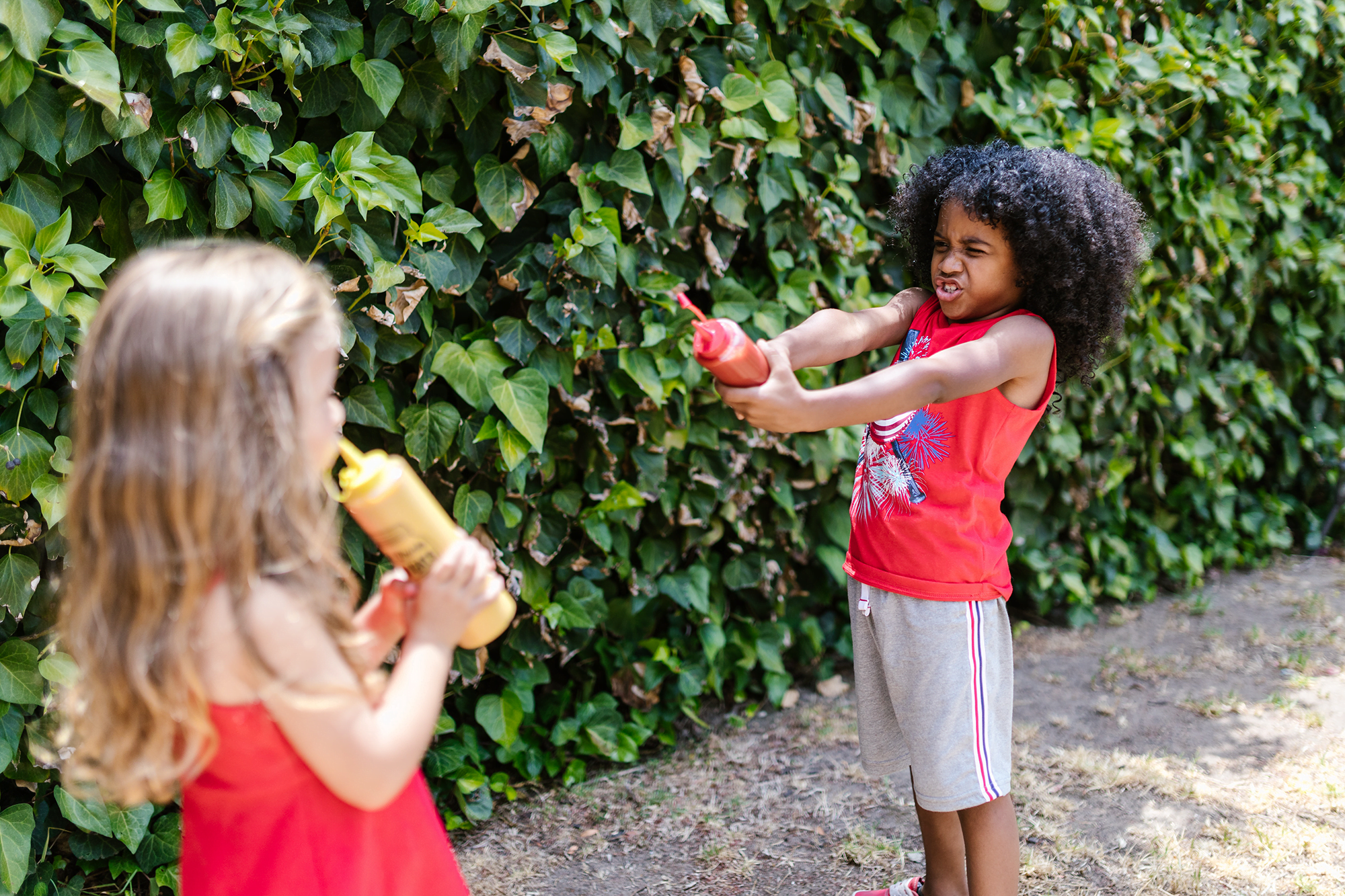
    Many a white shirt has met the disaster of a nearly-empty condiment bottle. One moment, you’re carefully squeezing out ketchup, and the next — sppplltlttt — you’re covered in red splatters. This messy phenomenon of gas displacing a liquid is widespread, showing up in condiments, some volcanic eruptions, and even the reinflation of a collapsed lung. Researchers have now constructed a mathematical model to fully capture and explain the process.

    When you squeeze a container with both air and a liquid — like ketchup — in it, the air is easily compressed but the liquid is not. The extra pressure of the air creates a driving force that pushes the liquid out, despite its viscous resistance. Most of the time, these two forces are balanced, and the ketchup flows smoothly out of the container. But when the volume of ketchup is small compared to the air, squeezing can overpressurize the air, driving the ketchup out in an uncontrolled burst.

    Luckily, the mathematics also suggest a solution to this problem: squeeze more slowly and double the size of the nozzle. You can also, they note, simply remove the top to avoid splatter. (Image credit: Rodnae Productions; research credit: C. Cuttle and C. MacMinn; via Ars Technica; submitted by Kam-Yung Soh)

  • Featured Video Play Icon

    Draining a Bottle

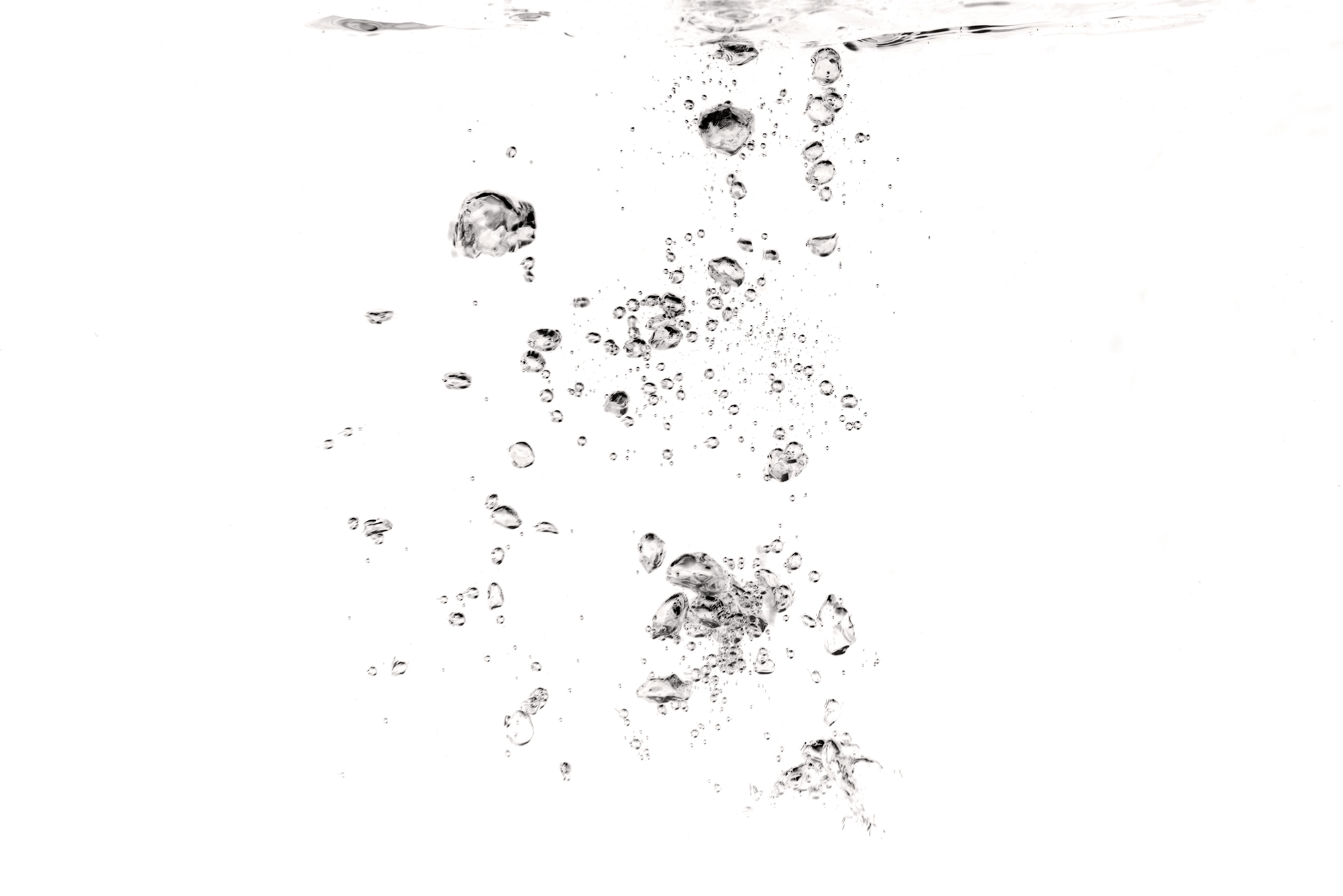
    Turn a bottle upside-down to empty it, and you’ll hear a loud glug-glug-glug as the liquid in the bottle empties and air rushes in. In this video, researchers aim a high-speed camera at the very first bubble that forms during the process. Once the bubble reaches the wider area of the bottle, it tends to pinch off in the bottle’s neck. That creates a narrow jet that pierces the bubble and flies all the way to the other side, leaving a column of liquid inside the rising bubble. Increasing the fluid’s viscosity has remarkably little effect, at least until the liquid is extremely viscous. (Image and video credit: H. Mayer et al.)

  • Saffman-Taylor Instability

    Saffman-Taylor Instability

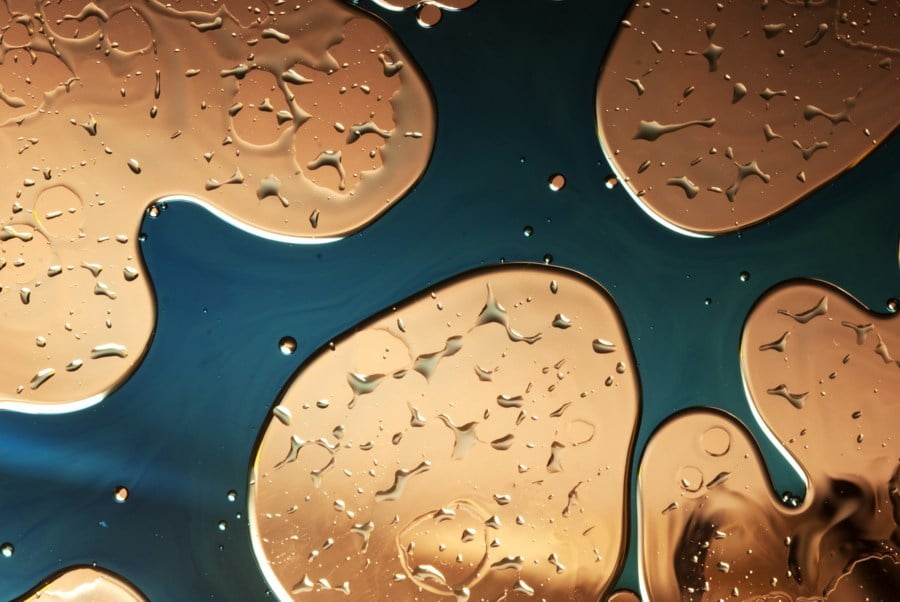
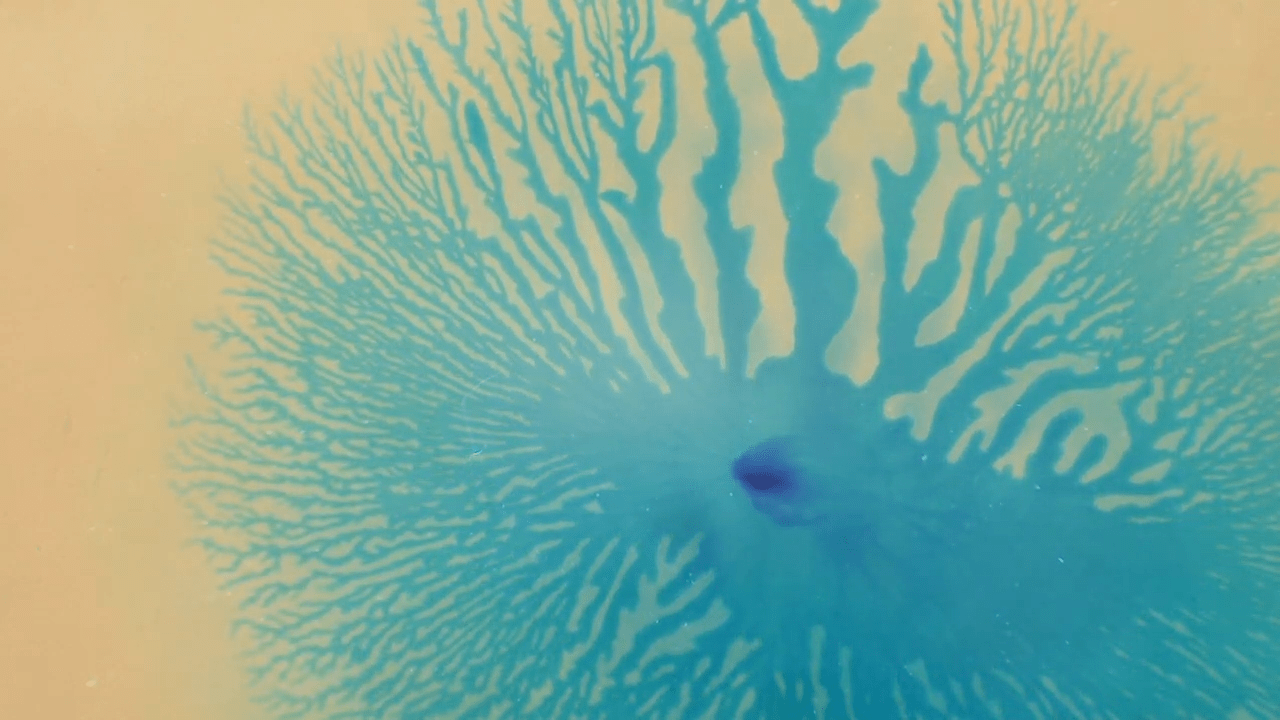
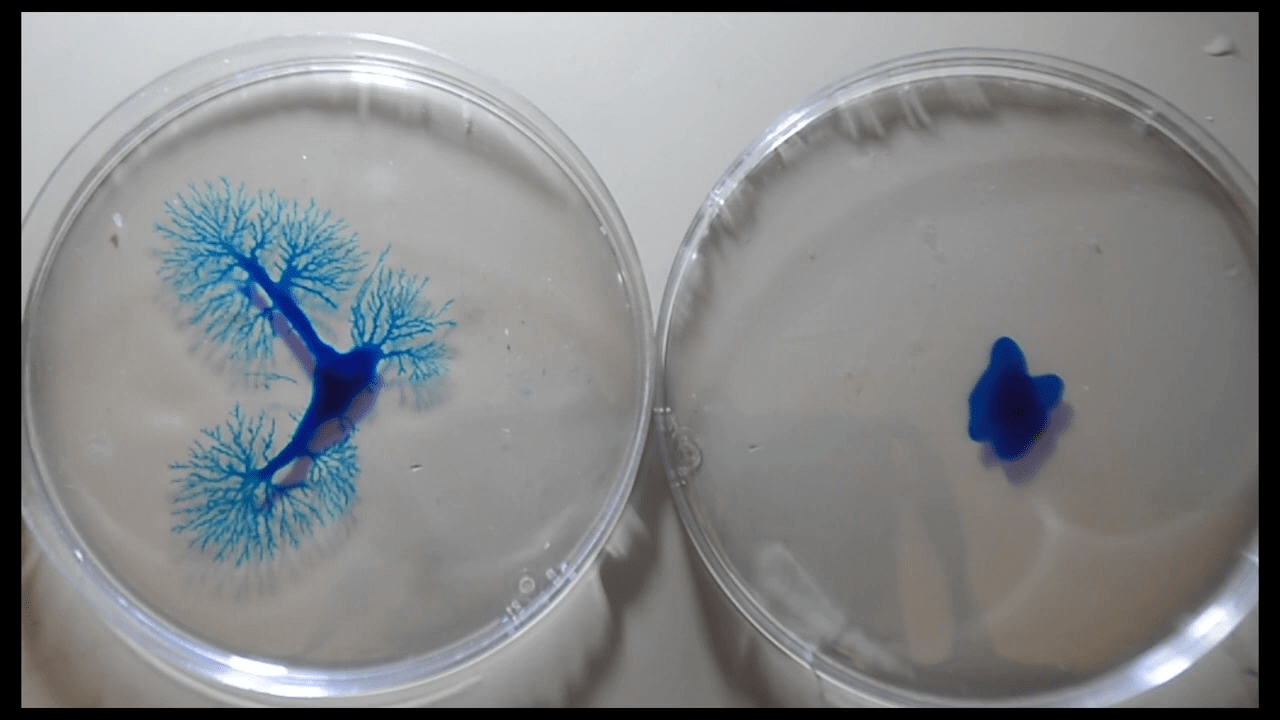
    Air and blue-dyed glycerin squeezed between two glass plates form curvy, finger-like protrusions. This is a close-up of the Saffman-Taylor instability, a pattern created when a less viscous fluid — here, air — is injected into a more viscous one. If you reverse the situation and inject glycerin into air, you’ll get no viscous fingers, just a stable, expanding circle. Although you sometimes come across this instability in daily life — like in a cracked smartphone screen — the major motivation for studying this phenomenon historically has been oil and gas extraction. (Image credit: T. Pohlman et al.)

  • Featured Video Play Icon

    Seeing the Flow

    Experimentalists often need a sense for the overall flow before they can decide where to measure in greater detail. For such situations, flow visualization techniques are a powerful tool since they provide quick ways to see and compare flows.

    Here, researchers paint a viscous oil atop their flying wing model and observe how the oil moves once the air flow starts up. This oil flow visualization shows the large-scale shifts in how air flows over the craft as the angle of attack increases. The disadvantage is that these techniques often give only a qualitative sense of the flow. But they can allow experimentalists to test many different conditions to decide which specific cases they should examine quantitatively. (Image and video credit: V. Kumar et al.)

  • Bubbles in Turbulence

    Bubbles in Turbulence

    In nature and industry, swarms of bubbles* often encounter turbulence in their surrounding fluid. To study this situation, researchers used numerical simulation to observe bubbles across a range of density, viscosity, and surface tension values relative to their surroundings. They found that density differences between the two fluids made negligible changes to the way bubbles broke or coalesced.

    In contrast, viscosity played a much larger role. More viscous bubbles were less likely to deform and break, thanks to their increased rigidity. When looking at small deformations along the bubble interface, both density and viscosity had noticeable effects. With increasing bubble density, they observed more dimples on the interface; increasing the viscosity had the opposite effect, making the bubbles smoother. (Image credit: Z. Borojevic; research credit: F. Mangani et al.)

    *We usually think of bubbles as air or another gas contained within a liquid. But this study’s authors use the term “bubble” more broadly to mean any coherent bits of fluid in a different surrounding fluid. Colloquially, this means their results apply to both bubbles and drops.

  • Featured Video Play Icon

    Fast Fractal Fingers

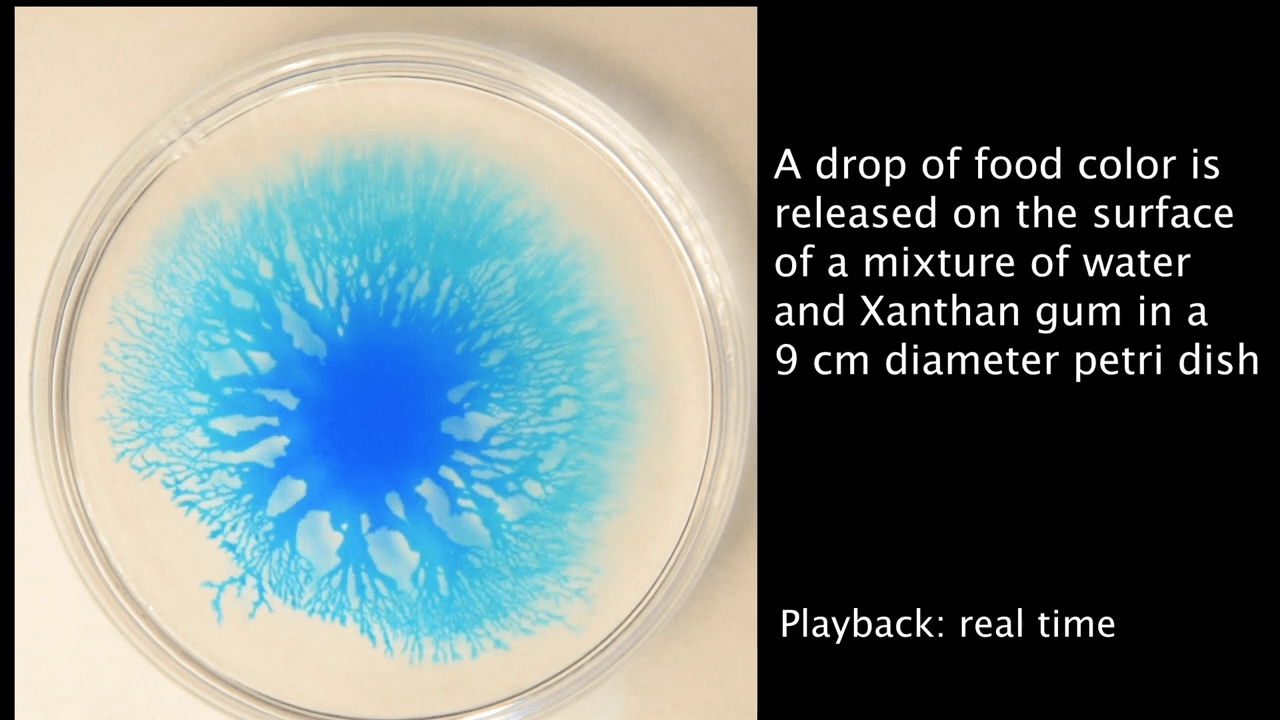
    With the right balance of viscosity and surface tension, many fluid combinations can form fractal or dendritic patterns. Here, researchers use a drop of food coloring atop a mixture of water and xanthan gum. Depending on the concentration of gum (and the age of the viscous fluid) different fractal patterns spread quickly across the surface. (Image and video credit: R. Camassa et al.)

  • Featured Video Play Icon

    Eruption in a Box

    In layers of viscous fluids, lighter and less viscous fluids can displace heavier, more viscous liquids. Here, researchers demonstrate this using four fluids sandwiched between layers of glass and mounted in a rotating frame. (Think of those liquid-air-sand art frames found in museums but bigger!)

    In their first example, each layer of fluid is denser than the one beneath it, so buoyancy forces the lowest layer — air — to rise. The air pushes its way through the more viscous layer of olive oil, then slowly makes its way through the even more viscous glycerin before bursting through the last layer in an eruption. As the team varies the viscosity and miscibility of the layers, the movement of the buoyant fluids through the viscous layers changes dramatically. (Image and video credit: A. Albrahim et. al.)

  • Beijing 2022: Why Are Ice and Snow Slippery?

    Beijing 2022: Why Are Ice and Snow Slippery?

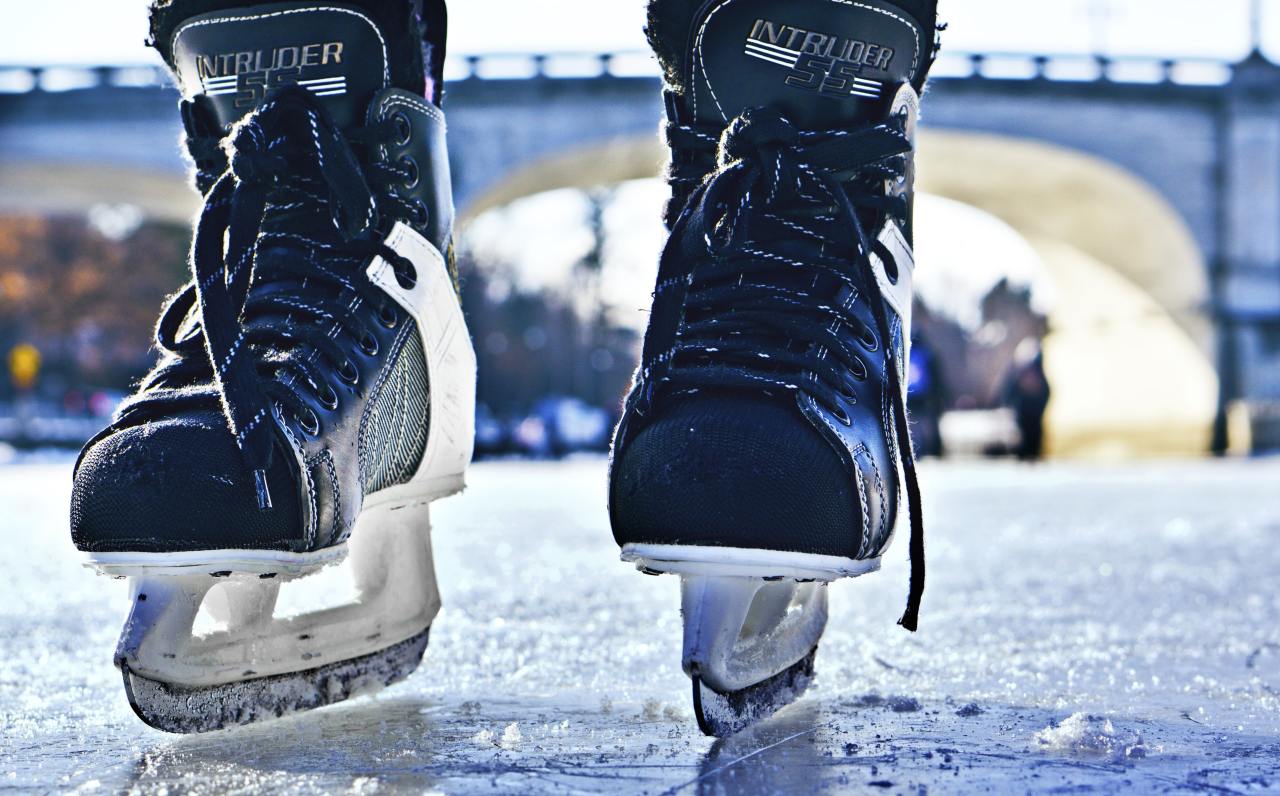
    Although every Olympic winter sport relies on the slippery nature of snow and ice, exactly why those substances are so slippery has been an enduring mystery. Michael Faraday hypothesized in the nineteenth century that ice may have a thin, liquid-like layer at its surface, something that modern studies have repeatedly found.

    One recent study used an entirely new instrument to probe the characteristics of this lubrication layer and found that it is only a few hundred nanometers thick. But the fluid in this layer is nothing like the water we’re used to. Instead it has a viscosity more akin to oil and its response to deformation is shear-thinning and viscoelastic, more like the complex fluids in our kitchens and bodies than pure, simple water. They found that using a hydrophobic probe modified the interfacial viscosity even further, which finally provides a hint at the mechanism behind waxing skis and skates. 

    Fortunately for us, we’ve found plenty of ways to employ and enjoy water’s slipperiness, even as the mystery of it slowly gives way to understanding. (Image credit: M. Fournier; research credit: L. Canale et al.; via Physics World; submitted by Kam-Yung Soh)

  • Featured Video Play Icon

    Acrylic Paint Fractals

    Here’s a simple fluids experiment you can try at home using acrylic paints, ink, isopropyl alcohol and a few other ingredients. When dropped onto diluted acrylic paint, a mixture of black ink and alcohol spreads in a fractal fingering pattern. The radial (outward) flow is driven by the alcohol’s evaporation, which increases the local surface tension and draws fluid outward. The shape and density of the fingers depends, at least in part, on the viscosity of the underlying paint layer; more viscous paint layers grow smaller and denser fractal patterns. (Image and video credit: S. Chan et al.)

  • Solving the Teapot Effect

    Solving the Teapot Effect

    The teapot effect — that tendency for liquid to dribble down the outside of the spout when pouring — is a frustration to many tea drinkers. Unraveling the fluid dynamics of this phenomenon has taken various researchers decades, but a team now believe they’ve captured the problem fully. Their full mathematical description is quite dense, but it boils down to a subtle interplay of capillary, viscous, and inertial forces.

    Essentially, they found that droplets will always form just under the lip of the spout, thereby keeping that area wetted. The flow rate of the pour (along with the geometry and surface characteristics of the spout) determines how large those droplets can grow. At low flow rates, the droplets can grow large enough to redirect the entire stream around the spout’s edge, creating a hugely frustrating mess. You can see this flow rate effect in the high-speed video below. (Image credit: S. Ferrari; video and research credit: B. Scheichl et al.; via Ars Technica; submitted by Kam-Yung Soh)