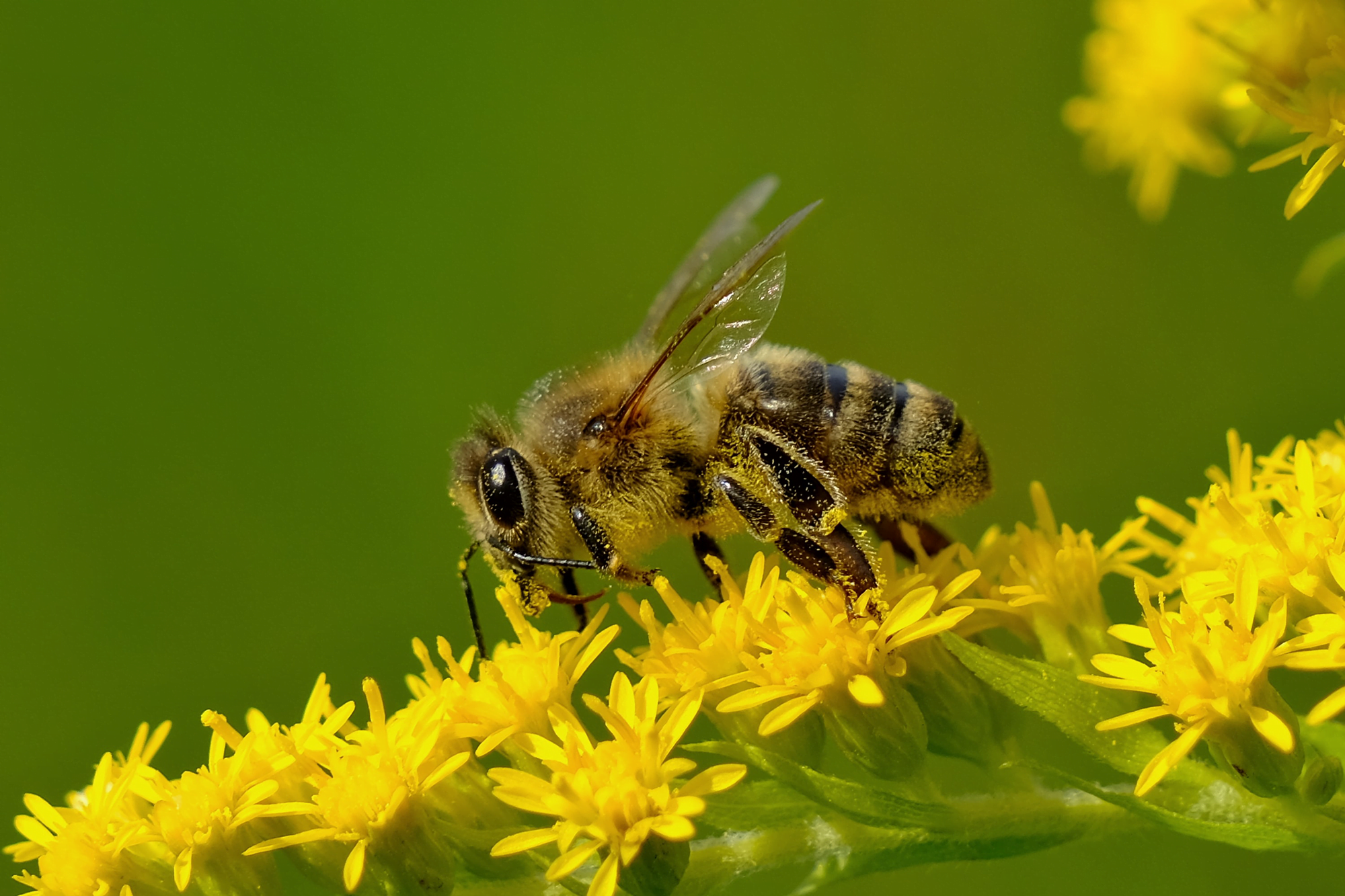
Honeybees, with their stingers, get lots of attention, but the Americas have plenty of stinger-less honeymakers, too. These stingless bees are native to Mexico, where beekeepers cultivate them for pollination. Without stingers and venom, the bees use their building prowess to keep out unwanted visitors. Much of the hive — from the entrance’s nightly gate to the pods where young are stored — is built from cerumen, a substance the bees create by mixing wax with resins they collect from nearby trees. Just as they do with pollen, worker bees collect drops of resin and store them on their hind legs before flying back to the hive. The viscous fluid sticks well, until a swipe of a leg shears it enough to lower its viscosity and slide it off. (Video and image credit: Deep Look)
Tag: bees

“Mason Bee at Work”
Mason bees like this one build landmarks to help them navigate as they construct a shelter for their eggs. Even hauling materials, these bees can easily stay aloft. This is in contrast to an old misconception that physics can’t explain how a bee flies. It’s true that bees don’t fly using the same mechanisms as a typical airplane — no fixed wings here! But they, like every other flyer aerodynamicists study, still produce lift and drag and thrust. The flapping of a bee’s wings generates much unsteadier quantities of these things, but at its small size, that is no hindrance to its ability to control its flight and even carry cargo. (Image credit: S. Zankl; via Wildlife POTY)

Honeybee Feeding
Busy bees feed on millions of flowers for each kilogram of honey they produce. To gather nectar, bees use their hairy tongues, which project out of a sheath-like cover. Protraction (i.e., sticking their tongue out) is relatively fast because all the hairs on the tongue initially lie flat. In the nectar, those hairs flare out, creating a miniature forest that traps viscous nectar and drags it back into the bee during retraction.

Bees feed by projecting their tongues into nectar. Tongue extension is faster because the tongue’s hairs lie flat. During the slower retraction phase, the hairs flare out, trapping nectar and pulling it back into the bee. Through modeling and experiments, researchers found that the time it takes a bee to retract its tongue depends on the bee’s overall mass. Smaller bees are slower to the retract their tongues, likely to allow enough time for their shorter tongues to capture enough nectar. With bee populations on the decline, the team’s predictions may help communities select flowers with nectar concentrations that best fit their local bees’ needs. (Image credits: top – J. Szabó, bee eating – B. Wang et al.; research credit: B. Wang et al.; via APS Physics)

Sandsculpting Bees
Building sandcastles is more than a pastime for the bumblebee-mimic digger bee. This species of bee collects water into an abdominal pouch, then uses it to wet sand to help her sculpt her nest. She’ll use the material she digs out to create a protective turret over the nest’s entrance, and once her eggs are laid and stocked with food, she’ll deconstruct the turret to rebury the nest and keep her brood safely hidden. (Image and video credit: Deep Look)

The Best of FYFD 2019
2019 was an even busier year than last year! I spent nearly two whole months traveling for business, gave 13 invited talks and workshops, and produced three FYFD videos. I also published more than 250 blog posts and migrated all 2400+ of them to a new site. And, according to you, here are the top 10 FYFD posts of the year:
- The perfect conditions make birdsong visible
- Pigeons are impressive fliers
- The water anole’s clever method of breathing underwater
- 100 years ago, Boston was flooded with molasses
- The BZ reaction is some of nature’s most beautiful chemistry
- The labyrinthine dance of ferrofluid
- 360-degree splashes
- The extraordinary flight of dandelion seeds
- Dye shows what happens beneath a wave
- Bees do the wave to frighten off predators
Nature makes a strong showing in this year’s top posts with five biophysics topics. FYFD videos also had a good year: both my Boston Molasses Flood video and dandelion flight video made the top 10!
If you’d like to see more great posts like these, please remember that FYFD is primarily supported by readers like you. You can help support the site by becoming a patron, making a one-time donation, or buying some merch. Happy New Year!
(Image credits: birdsong – K. Swoboda; pigeon take-off – BBC Earth; water anole – L. Swierk; Boston molasses flood – Boston Public Library; BZ reaction – Beauty of Science; ferrofluid – M. Zahn and C. Lorenz; splashes – Macro Room; dandelion – N. Sharp; dyed wave – S. Morris; bees – Beekeeping International)

Surfing Honeybees
Honeybees have superpowers when it comes to their aerodynamics and impressive pollen-carrying, but their talents don’t end in the air. A new study confirms that honeybees can surf. Wet bees cannot fly–their wings are too heavy for them to get aloft when wet–but falling into a pond isn’t the end for a foraging honeybee.
Instead, the bee flaps its wings, using them like hydrofoils to lift and push the water. This action generates enough thrust to propel the bee three body lengths per second. It’s a workout the bee can only maintain for a few minutes at a time, but researchers estimate honeybees could cover 5-10 meters in that time. Once ashore, the bee spends a few minutes drying itself, and then flies away no worse for the wear. (Image and research credit: C. Roh and M. Gharib; via NYTimes; submitted by Kam-Yung Soh)

Doing the Wave
Not everything that behaves like a fluid is a liquid or a gas. In particular, groups of organisms can behave in a collective manner that is remarkably flow-like. From schools of fish to fire-ant rafts, nature is full of examples of groups with fluid-like properties.
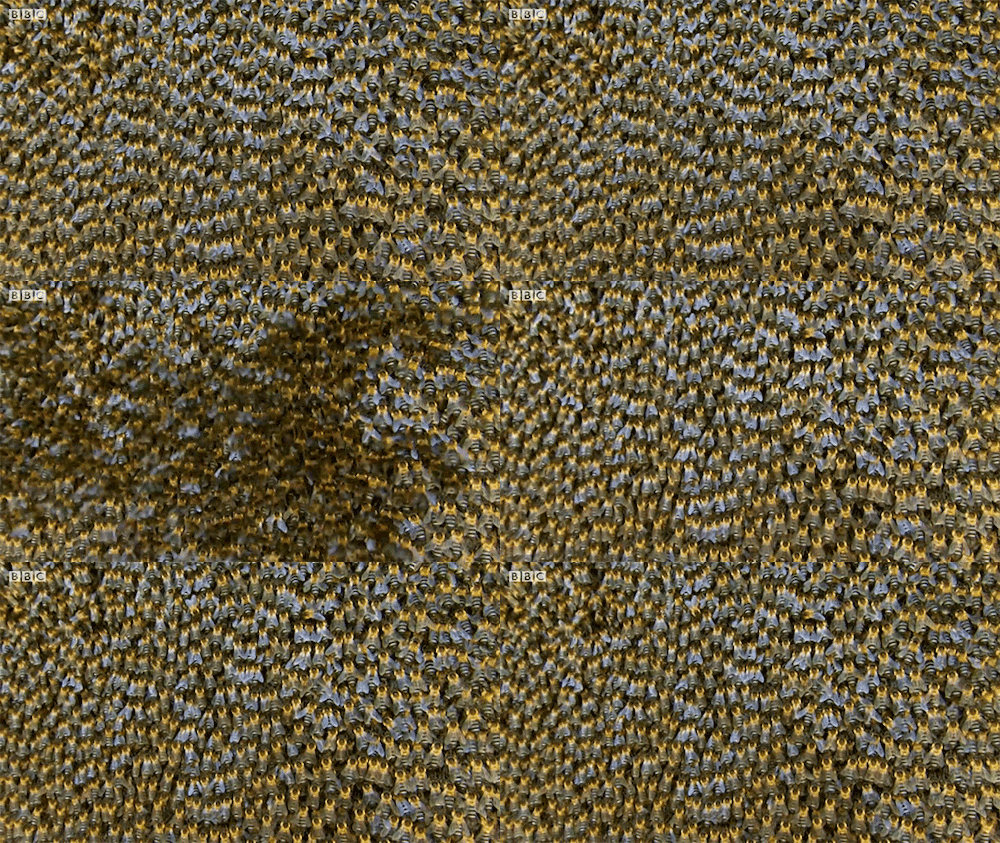
One of the most mesmerizing examples are these giant honeybee colonies, which essentially do “the wave” to frighten away predators like wasps. Researchers are still trying to understand and mimic the way these groups coordinate such behaviors. Can even complicated patterns be generated by a simple set of rules an individual animal follows? That’s the sort of question active matter researchers investigate. Check out the video above to see a whole cliff’s worth of bee colonies shimmering. (Image and video credit: BBC Earth)


Collective Motion: Waving Bees
Giant honeybees live in huge open nests. To protect themselves, they’ve developed a mesmerizing wave-like defense known as shimmering. When shimmering, the bees in a hive, beginning from a distinct spot, will flip over to expose their abdomens. Taken together, this creates large-scale patterns like those seen above.
Scientists have connected the behavior to the presence of wasps that prey on the bees. It seems that shimmering helps to repel the wasps without putting individual bees in danger. If shimmering doesn’t ward off the wasps, the bees can also use their flight muscles to heat the area around the intruder to a wasp-lethal temperature – or, individuals bees can sacrifice themselves by stinging the wasp. (Image credit: Beekeeping International, source; research credit: G. Kastberger et al.; via Gizmodo)
This post is part of our series on collective motion. Check out our previous posts about how crowds are like sand, the fluid properties of worms, and why a lack of randomness makes predicting group behaviors hard.

Martian Bees, Canopies, and Dandelion Seeds
The latest FYFD/JFM video is out! May brings us a look at the incredible flight of dandelion seeds, numerical simulations that reveal the flow above forest canopies, and a look at bee-inspired flapping wing robots being developed for exploring Mars! Learn about all this in the video below, and, if you’ve missed other videos in the series, you can catch up here. (Image and video credit: N. Sharp and T. Crawford)

Bees, Squid, and Oil Plumes
It’s time for another JFM/FYFD collab video! April’s video brings us a taste of spring with research on how bees carry pollen, squid-inspired robotics, and understanding the physics of underwater plumes like the one that occurred in the Deepwater Horizons spill eight years ago. Check it all out in the video below. (Image and video credit: T. Crawford and N. Sharp)