
Blowing bubbles in your fruit juice is a bad idea when you’re in space, as astronaut Jack Fischer demonstrates. On Earth, gravity dominates water’s behavior, except when things are very small. But in microgravity, a liquid’s other characteristics become more obvious. Adhesion between the straw and juice guides it up and onto Fischer’s face. Surface tension is strong enough to hold the expanding juice bubble together. Capillary action, the ability of fluids to climb up narrow spaces, is far more apparent in microgravity as well, although it’s not important for this demo. We sometimes forget how powerful these forces can be, but microgravity is a good reminder that fluids are more complicated than we think. (Image credit: J. Fischer, source)
Search results for: “surface tension”
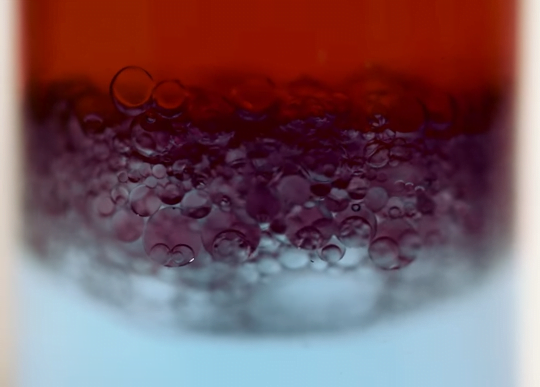
Emulsions By Condensation
Oil and water are hard to mix, as any salad dressing aficionado will attest. Technically, the two fluids are immiscible – they won’t mix with one another – but one way around this is to emulsify them by distributing droplets of one in the other. This is usually accomplished by shaking or using sound waves to vibrate the mixture, but the results are typically short-lived. The larger a droplet is, the more gravity affects it, causing the buoyant oil to rise and separate from the water.
The key to making an emulsion last is creating tiny droplets, which a new study accomplishes energy efficiently through condensation. Instead of mixing the oil and water immediately, the researchers used a surface covered in a mixture of oil and surfactant and cooled it in a humid chamber. As the temperature dropped, water condensed onto the oil and became encapsulated, creating nanoscale emulsion droplets. At such a tiny scale, buoyant forces are unable to overcome surface tension, so the emulsion remains stable for months. (Image credit: MIT, source; research credit: I. Guha et al.; via MIT News)
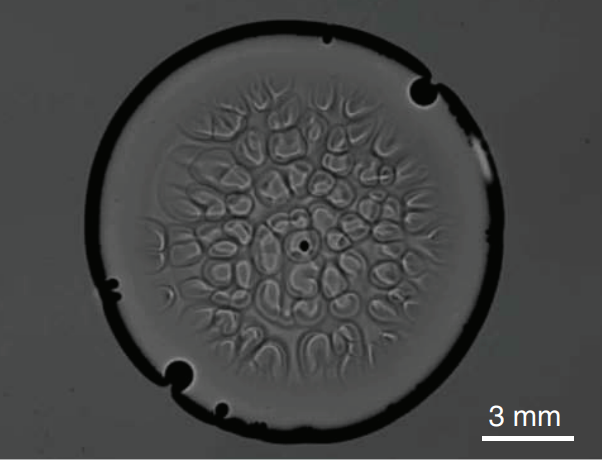
Convection Without Heat
Glycerol is a sweet, highly viscous fluid that’s very good at absorbing moisture from the ambient air. That’s why a drop of pure glycerol in laboratory conditions quickly develops convection cells – even when upside-down, as shown above. This is not the picture of Bénard-Marangoni convection we’re used to. There’s no temperature or density change involved; in fact, there’s no buoyancy involved at all! This convection is driven entirely by surface tension. As glycerol at the surface absorbs moisture, its surface tension decreases. This generates flow from the center of a cell toward its exterior, where the surface tension is higher. Conservation of mass, also known as continuity, requires that fresh, undiluted glycerol get pulled up in the wake of this flow. It, too, absorbs moisture and the process continues. (Image credit: S. Shin et al., pdf)

The Cheerios Effect
You’ve probably noticed that cereal clumps together in your breakfast bowl, but you may not have given much thought as to why. This tendency for objects at an interface to attract is known as the Cheerios effect, although it happens in more than just cereal, as Joe Hanson from It’s Okay to Be Smart explains. The effect is a combination of buoyancy, gravity, and surface tension acting in concert.
When air, a liquid, and a solid meet, they form a meniscus, the curvature of which depends on characteristics of their interaction. Light, buoyant cereal and the walls of your bowl both have upward-curving menisci. Denser objects, like the tacks shown below, stay at the surface only because surface tension holds them up. Their meniscus curves downward.
Objects with a similar meniscus curvature will attract. For cereal approaching a wall, the light Cheerio is buoyant enough that there’s an upward force on it, but it’s constrained to stay at the interface. It cannot rise, but that buoyancy is enough to let it climb the meniscus at the wall. The two tacks attract one another for similar reasons, except this time their weight helps them fall into one another. Check out the full video to see more examples of this effect in nature! (Video and image credit: It’s Okay to Be Smart; research credit: D. Vella and L. Mahadevan, pdf)


Bouncing Off a Film
Surface tension is the result of an imbalance between intermolecular forces near an interface. Imagine a water molecule far from the surface; it is surrounded on all sides by other water molecules and feels each of those pulling on it. Since all the nearby molecules are water, the tugs from every direction balance and there is no net force. Now imagine that water molecule near the air interface. Instead of being influenced on all sides by water, our molecule now feels water in some directions and air molecules in another. The water molecules tug harder on it than air, leaving a net force that pulls along the interface. This is surface tension, and, for a liquid-gas interface, it behaves somewhat like an elastic sheet. Surface tension is even strong enough to let a jet of soap solution bounce repeatedly off a soap film. Each bounce deforms the interface, like a trampoline dimpling when someone jumps on it, but surface tension keeps the interface taut enough for the jet to skip off without breaking it. (Image credit: C. Kalelkar and S. Phansalkar, source)

Detergency


Have you ever wondered just how detergents are able to get grease and oil off a surface? This simple example demonstrates one method. In the top image, a drop of oil sits attached to a solid surface; both are immersed in water. An eyedropper injects a surfactant chemical near the oil drop. This lowers the surface tension of the surrounding water and allows the mixture to better wet the solid. That eats away at the oil drop’s contact with the surface. It takes awhile – the middle animation is drastically sped up – but the oil droplet maintains less and less contact with the surface as the surfactant works. Eventually, in the bottom image, most of the oil drop detaches from the surface and floats away. (Image credits: C. Kalelkar and A. Sahni, source)
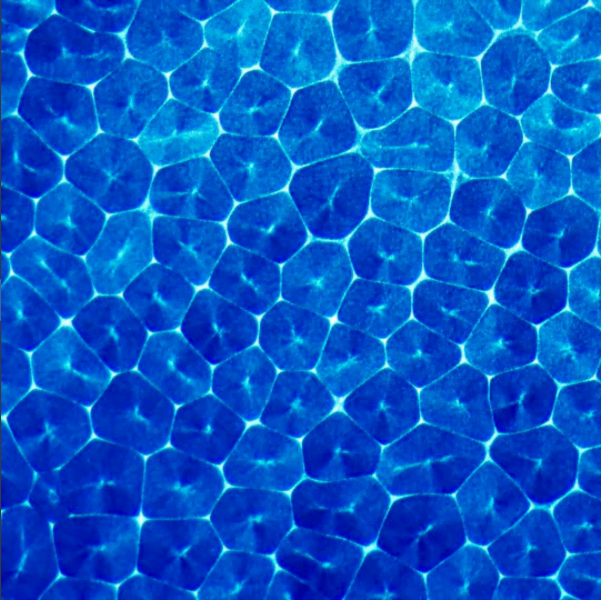
Convection
Blue paint in alcohol forms an array of polygonal convection cells. We’re accustomed to associating convection with temperature differences; patterns like the one above are seen in hot cooking oil, cocoa, and even on Pluto. In all of those cases, temperature differences are a defining feature, but they are not the fundamental driver of the fluid behavior. The most important factors – both in those cases and the present one – are density and surface tension variations. Changing temperature affects both of these factors, which is why its so often seen in Benard-Marangoni convection.
For the paint-in-alcohol, density and surface tension differences are inherent to the two fluids. Because alcohol is volatile and evaporates quickly, its concentration is constantly changing, which in turn changes the local surface tension. Areas of higher surface tension pull on those of lower surface tension; this draws fluid from the center of each cell toward the perimeter. At the same time, alcohol evaporating at the surface changes the density of the fluid. As it loses alcohol and becomes denser, it sinks at the edges of the cell. Below the surface, it will absorb more alcohol, become lighter, and eventually rise at the cell center, continuing the convective process. (Image credit: Beauty of Science, source)

Self-Healing Bubbles
Soap films have the remarkable property of self-healing. A water drop, like the one shown above, can pass through a bubble (repeatedly!) without popping it. This happens thanks to surfactants and the Marangoni effect. Surfactants are molecules that lower the surface tension of a liquid and congregate along the outermost layer of a soap film. When water breaks through the soap film, its lack of surfactants causes a higher surface tension locally. This triggers the Marangoni effect, in which flow moves from areas of low surface tension toward ones of high surface tension. That carries surfactants to the region where the drop broke through and helps stabilize and heal the soap film. Incidentally, the same process lets you stick your finger into a bubble without popping it as long as your hand is wet! (Image credit: G. Mitchell and P. Taylor, source)
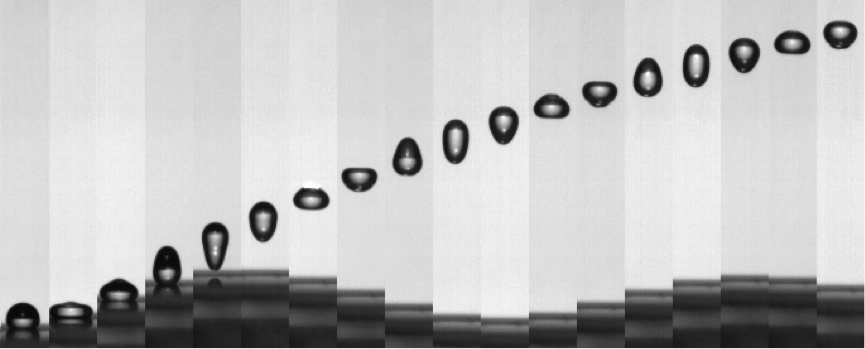
Elastic Bounces
A rigid ball accelerated by a moving surface can only ever move as fast as the surface propelling it. But that’s not true for squishy objects like a water droplet. The composite image above shows the trajectory of a water droplet launched from a moving superhydrophobic surface. As the surface starts rising, it squishes the droplet like a pancake, triggering a deformation cycle where the droplet will squish and extend repeatedly. How quickly the drop changes shape depends on factors like its size and surface tension. The researchers found that a droplet’s launch was strongly affected by the ratio of the droplet’s shape-changing frequency and the frequency of the plate’s motion. When the drop’s shape changed three times faster than the surface’s motion, it would catapult off the surface with 250% of the kinetic energy of a rigid ball!
Launching elastic balls works the exact same way as droplets, indicating that the phenomenon depends on the way the projectiles deform. The process is similar to jumping on a trampoline. If a trampolinist times her jump just right, she’ll get more energy from the trampoline and fly higher. The droplet does the same when its deformation is properly tuned to its catapult. (Image credit: C. Raufaste et al.; via APS Physics; submitted by Kam-Yung Soh)
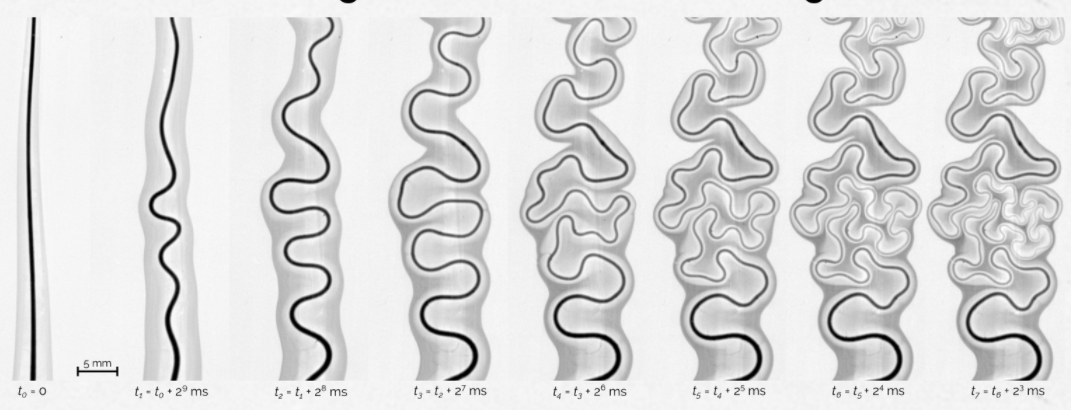
Wriggling Threads
A thread of mineral oil laid across a pool of water twists and turns like a river run wild. Because the oil has a lower surface tension than the water, Marangoni forces spread it outward (far left). Small variations in the thread make the areas of highest oil concentration start to bend just a bit. Inside the bends, the gradient of surface tension – the difference between the lowest and highest surface tensions – is very high, which pulls at these regions more than others. So bends beget more bends, causing the entire thread to wrinkle. Although the behavior is driven by a completely different process than the one that causes rivers to meander, the end result looks remarkably similar; this is because, in both cases, forces act to make each bend increasingly sinuous. (Image credit: B. Néel et al., source)
Editor’s note: Starting tomorrow I’ll be on a trip that takes me out of range of the Internet until next week. Regular posts are queued up and should post as usual, but we’ll all have to trust Tumblr to handle everything because I won’t be able to check. Thanks!