Water striders are masters of life at the interface of water and air. Their spindly legs are skinnier than the capillary length of water, meaning that, at their size, surface tension is strong enough to overcome gravitational effects. Thus, their feet leave dimples on the interface, but the water itself holds them up. To keep from getting accidentally drenched (and thus weighed down), the striders are covered in tiny hairs that trap a layer of air that makes them hydrophobic or water-repellent. To get around, these masters of the interface use their middle legs in a manner similar to oars. They push against the dimple around their legs, which generates vortices under the surface and helps propel them. Even more impressive, the water strider can jump off the surface, a feat that requires remarkable adaptation in order to maximize the jump without breaking surface tension. (Video credit: Deep Look)
Search results for: “surface tension”

Burning a Rocket Underwater
In a recent video, Warped Perception filmed a model rocket engine firing underwater. Firstly, it’s no surprise that the engine would still operate underwater (after its wax waterproofing). The solid propellant inside the engine is a mixture of fuel and oxidizer, so it has all the oxygen it needs. Fluid dynamically speaking, though, this high-speed footage is just gorgeous.
Ignition starts at about 3:22 with some cavitation as the exhaust gases start flowing. Notice how that initial bubble dimples the surface when it rises (3:48). At the same time, the expanding exhaust on the right side of the tank is forcing the water level higher on that side, triggering an overflow starting at about 3:55. At this point, the splashes start to obscure the engine somewhat, but that’s okay. Watch that sheet of liquid; it develops a thicker rim edge and starts forming ligaments around 4:10. Thanks to surface tension and the Plateau-Rayleigh instability, those ligaments start breaking into droplets (4:20). A couple seconds later, holes form in the liquid sheet, triggering a larger breakdown. By 4:45, you can see smoke-filled bubbles getting swept along by the splash, and larger holes are nucleating in that sheet.

The second set of fireworks comes around 5:42, when the parachute ejection charge triggers. That second explosive triggers a big cavitation bubble and shock wave that utterly destroys the tank. If you look closely, you can see the cavitation bubble collapse and rebound as the pressure tries to adjust, but by that point, the tank is already falling. Really spectacular stuff! (Video and image credit: Warped Perception)
Equatorial Streaming

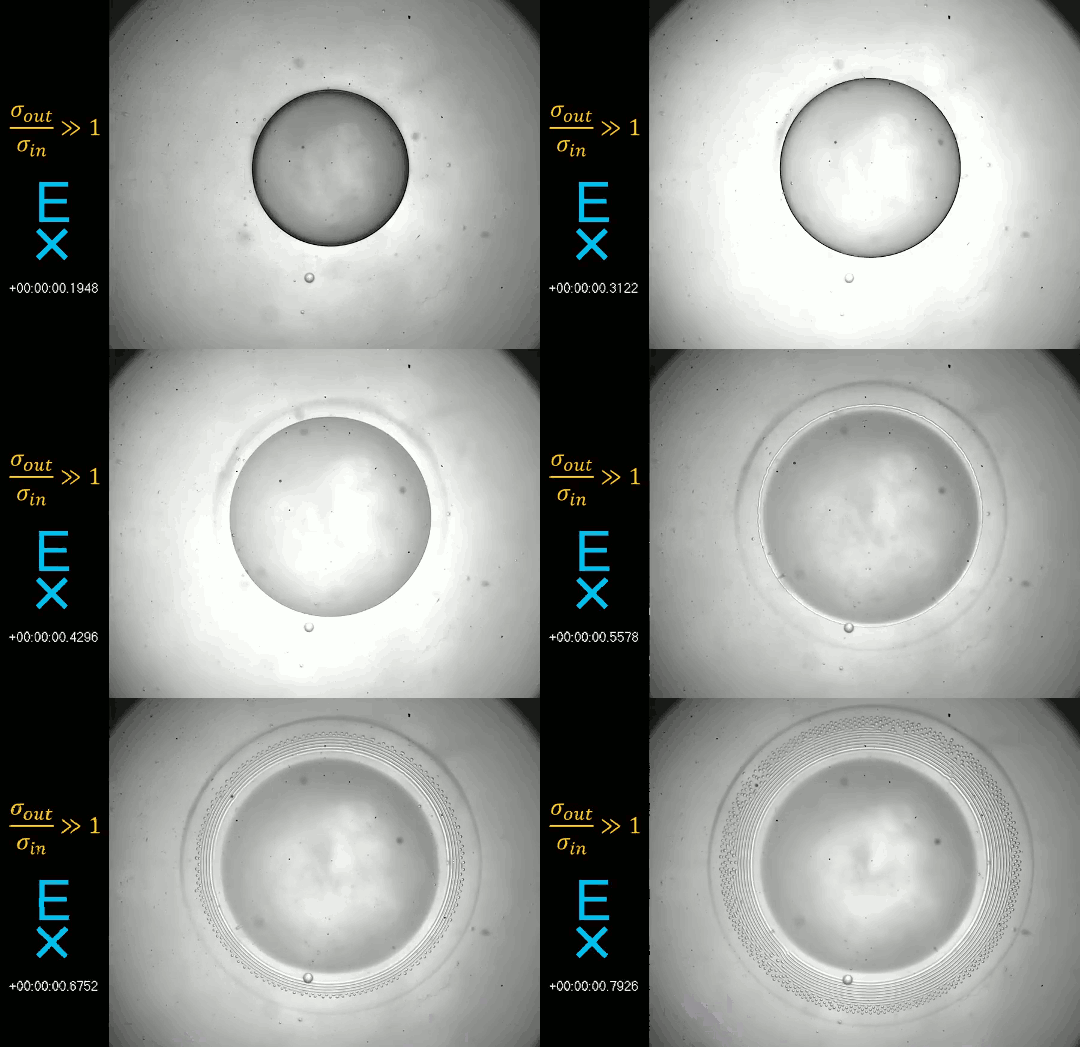
Here you see a millimeter-sized droplet suspended in a fluid that is more electrically conductive than it. When exposed to a high DC electric field, the suspended drop begins to flatten. A thin rim of fluid extends from the drop’s midplane in an instability called “equatorial streaming”. As seen in the close-up animation, the rim breaks off the droplet into rings, which are themselves broken into micrometer-sized droplets thanks to surface tension. The result is that the original droplet is torn into a cloud of droplets a factor of a thousand smaller. This technique could be great for generating emulsions of immiscible liquids–think vinaigrette dressing but with less shaking! (Image credit: Q. Brosseau and P. Vlahovska, source)
Graphene Swirls
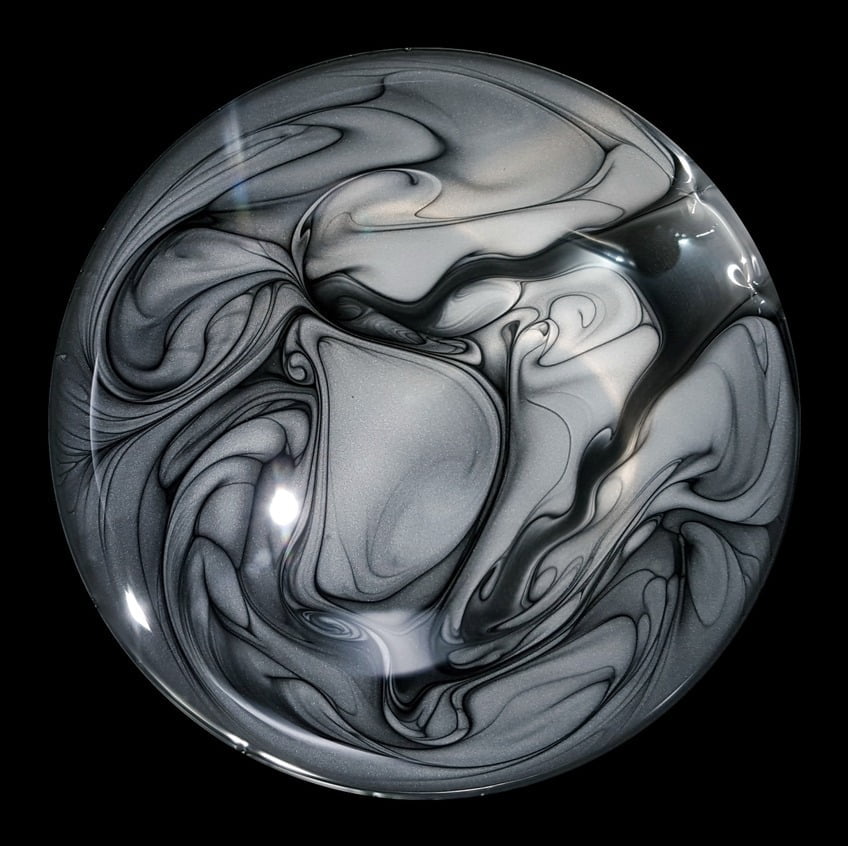
Graphene powder swirls in alcohol in this prize-winning photo from this year’s Engineering and Physical Sciences Research Council photography competition in the UK. The image was captured while producing graphene ink that can print circuits directly onto paper. According to the researcher’s description, this ink is forced through micrometer-sized capillaries at high pressure to rip the layers apart and produce a smooth, conductive ink in solution. In this photo, we seem to see more conventional mixing driven by the powder’s injection and the variations in surface tension due to the alcohol and its evaporation. The graphene leaves behind beautiful streaklines that highlight its path as it mixes. (Image credit: J. Macleod; via Discover)

Capillary Action in Microgravity
On Earth, gravity dominates over many fluid effects, but in microgravity a different picture emerges. This animation shows a two-channel apparatus partially filled with silicone oil being dropped. While in free-fall, the liquid experiences microgravity conditions and the height of the fluid in the two connected channels changes. The oil meniscus climbs up the walls of the tubes thanks to capillary action. This is the result of intermolecular forces between the liquid and solid walls. Capillary action is most effective in narrow tubes where surface tension and the adhesion between the liquid and solid can actually propel liquid up the walls, as seen here. On Earth we mostly ignore capillary action, except in very small spaces, but for space systems, it is a major force to reckon with in designing flows. (Image credit: NASA Glenn Research Center, source)

Stabilizing Films

Liquids don’t typically survive very long as thin films. If you try to make one from water, gravity drains it away immediately. (Not so in space.) To make a liquid film stick around, we add surfactants like soap. These extra molecules congregate at the surface of the film and provide a stabilizing force to oppose gravity’s drainage. Exactly what that stabilizing force is depends on the surfactant.
Surfactants that are insoluble are often quite viscous. These molecules distribute themselves across the interface and then they stay. They resist both gravity or even just moving thanks to their high viscosity. That produces a soap film pattern like the one on the right – symmetric and slow to change.
Other surfactants may be soluble in the film and have no appreciable viscosity themselves. These surfactants constantly move and shift on the interface as surface tension variations occur. When weak spots form, the surfactant molecules shift, via the Marangoni effect, to stabilize the film. This creates a film pattern like the familiar one on the right, with an ever-shifting palette of colors. (Image and research credit: S. Bhamla et al., source; submission by S. Bhamla)

A Drip’s Vortex


Drip food coloring into water and you can often see a torus-shaped vortex ring after the drop’s impact. That vortex rings form during droplet impact has been well known for over a century, but only recently have we begun to understand the process that leads to that vortex ring. Part of the challenge is that the vortex formation is very small and very fast, but recent work with x-ray imaging has allowed experimentalists to finally capture this event.
When a drop impacts a pool, surface tension draws some of the pool liquid up the sides of the drop. At the same time, the impact causes ripple-like capillary waves down the sides of the drop. This causes pool liquid to penetrate sharply into the drop, triggering the spirals that mark the forming vortex ring. When drops impact with even higher momentum, multiple vortex spirals can form, as seen on the lower right image. The authors observed as many as four rings during an impact. For more, check out the (open access) article. (Image and research credit: J. Lee et al., source)

Blue Man Group in Slow Mo


In their latest video, the Slow Mo Guys team up with the Blue Man Group for some high-speed hijinks, some of which make for great fluidsy visuals. Their first experiment involves dropping a bowling ball on gelatin. The gelatin goes through some massive deformation but comes out remarkably unscathed. Gelatin is what is known as a colloid and essentially consists of water trapped in a matrix of protein molecules. This gives it both solid and liquid-like properties, which means that the energy the bowling ball’s impact imparts can be dissipated through liquid-like waves ricocheting through the gelatin before the elasticity of the protein matrix allows it to reform in its original shape.
The video ends with buckets of paint flung at Dan. The paints form beautiful splash sheets that expand and thin until surface tension can no longer hold them together. Holes form in the sheet and eat outward until the paint forms thin ligaments and catenaries. As those continue to stretch, surface tension drives the paint to break into droplets, though that break-up may be countered to some extent by any viscoelastic properties of the paint. (Image and video credit: The Slow Mo Guys + Blue Man Group, source)
The Coalescence Cascade and Surfactants
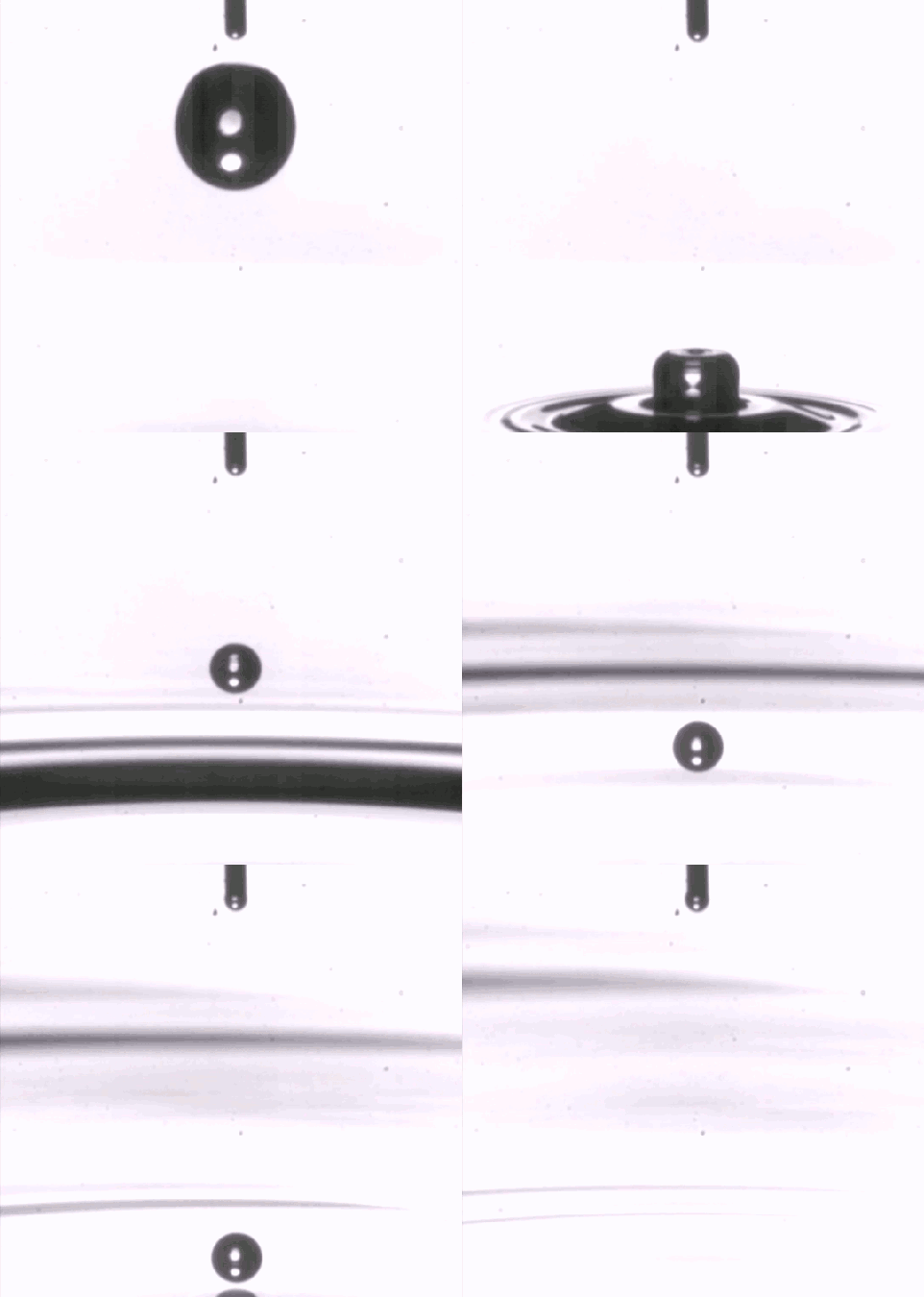
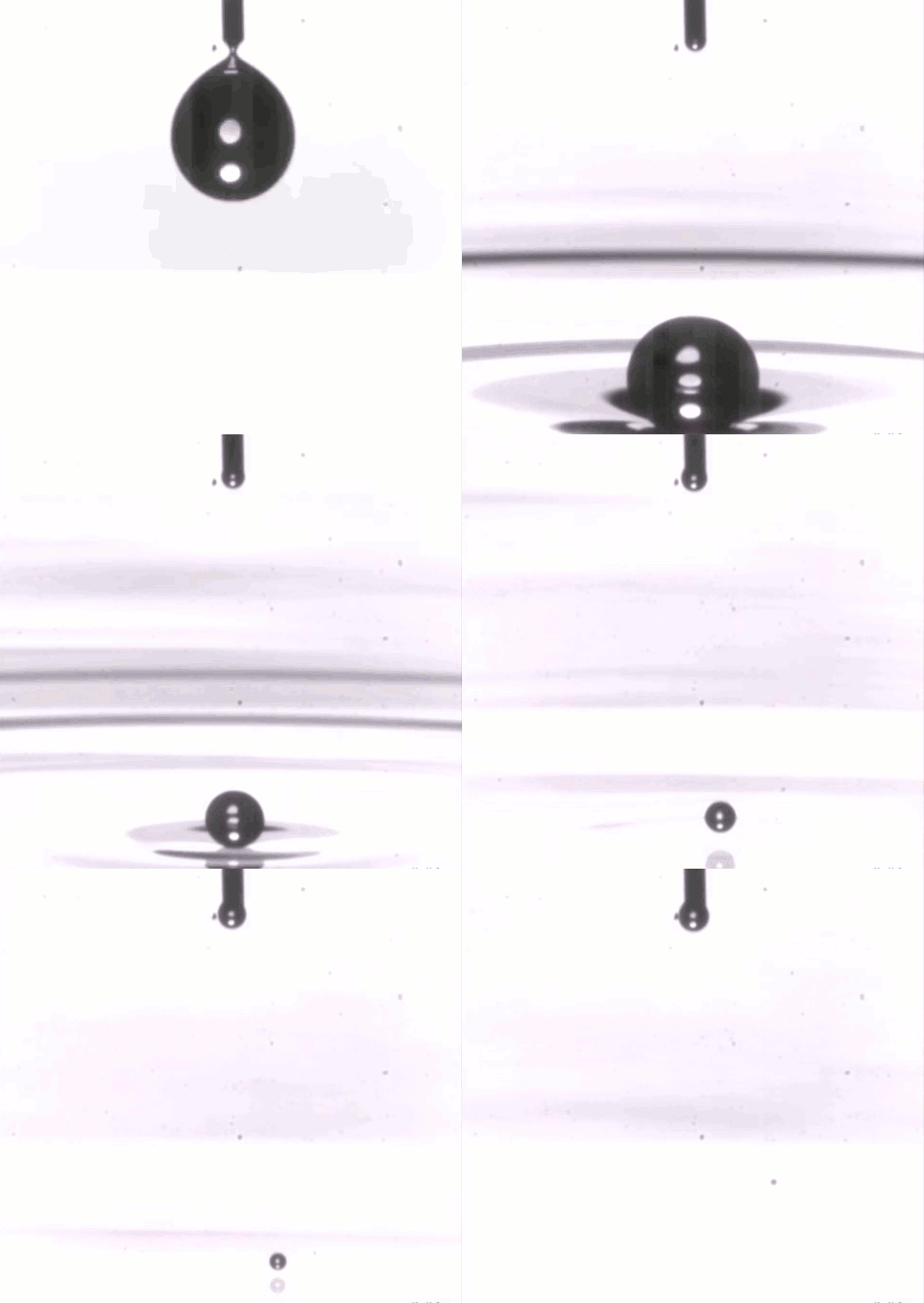
Drops of a liquid can often join a pool gradually through a process known as the coalescence cascade (top left). In this process, a drop sits atop a pool, separated by a thin air layer. Once that air drains out, contact is made and part of the drop coalesces. Then a smaller daughter droplet rebounds and the process repeats.
A recent study describes a related phenomenon (top right) in which the coalescence cascade is drastically sped up through the use of surfactants. The normal cascade depends strongly on the amount of time it takes for the air layer between the drop and pool to drain. By making the pool a liquid with a much greater surface tension value than the drop, the researchers sped up the air layer’s drainage. The mismatch in surface tension between the drop and pool creates an outward flow on the surface (below) due to the Marangoni effect. As the pool’s liquid moves outward, it drags air with it, thereby draining the separating layer more quickly. The result is still a coalescence cascade but one in which the later stages have no rebound and coalesce quickly. (Image and research credit: S. Shim and H. Stone, source)

The Colorful Dissolution of Candies


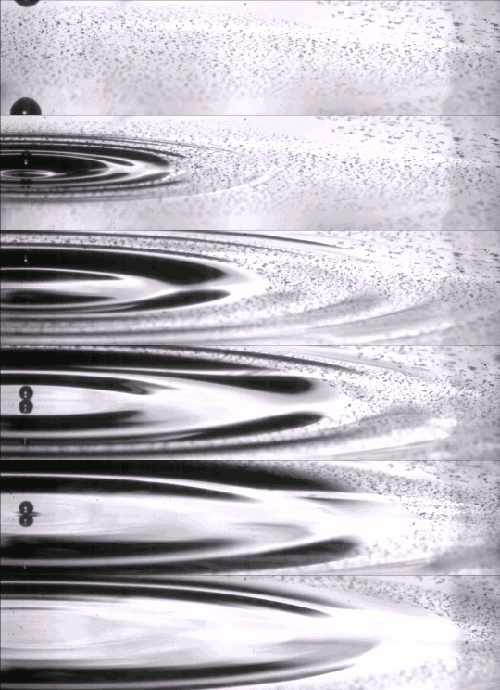
Many solids can dissolve in liquids like water, and while this is often treated as a matter of chemistry, fluid dynamics can play a role as well. As seen in this video by Beauty of Science, the dissolving candy coating of an M&M spreads outward from the candy. This is likely surface-tension-driven; as the coating dissolves, it changes the surface tension near the candy and flow starts moving away thanks to the Marangoni effect. With multiple candies dissolving near one another, these outward flows interfere and create more complex flow patterns.
These flows directly affect the dissolving process by altering flow near the candy surface, which may increase the rate of dissolution by scouring away loose coating. They can also change the concentration of dissolved coating in different areas, which then feeds back to the flow by changing the surface tension gradient. (Video and image credit: Beauty of Science)