Search results for: “surface tension”

  • Wrapping Up

    Wrapping Up

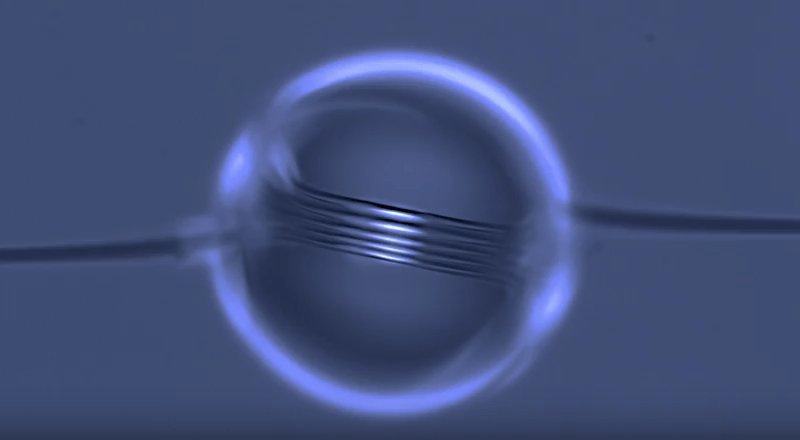
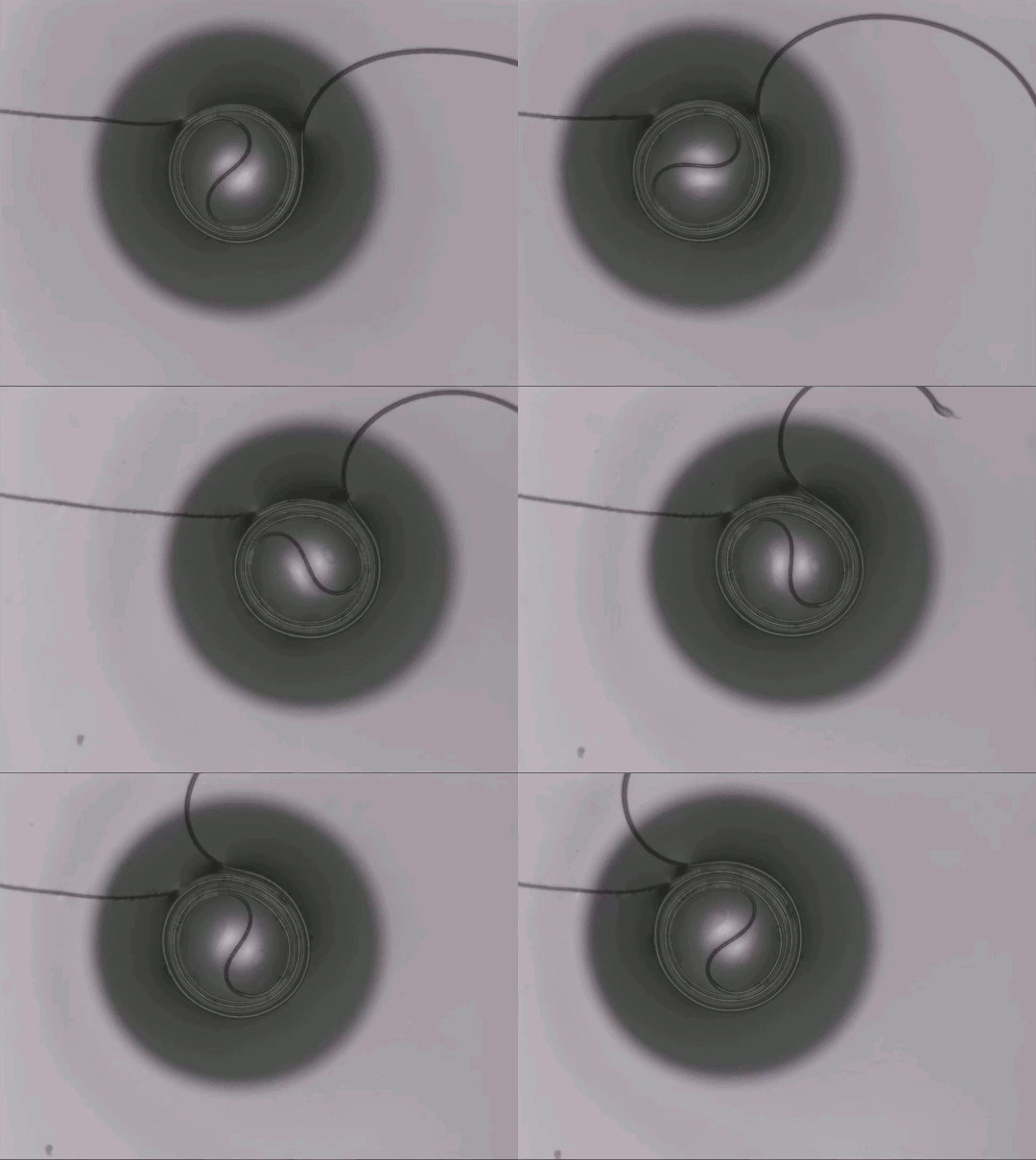
    It’s often at the intersection of topics that we can learn something new and fascinating. The latest video from The Lutetium Project shows examples of this at the intersection of solid mechanics and fluid dynamics with a look at elastocapillarity. Breaking that word down, that’s where elasticity – that stretchy quality associated with solids – meets capillarity – the surface-tension-dominated behavior of a fluid. In particular, they explore some of the mind-boggling and surprising interactions that happen between drops, bubbles, and thin flexible fibers smaller than the width of a human hair. Check out the full video below. (Images credit: K. Dalnoki-Veress et al.; video credit: The Lutetium Project)

  • 1500 Posts!

    1500 Posts!

    This is FYFD’s 1500th post! Can you believe it? Fifteen hundred posts is a heck of a lot of fluid dynamics. I’ve covered everything from the teeny tiniest scales to the astronomically huge, from events that happen in the blink of an eye to ones that require decades of patience. Today I encourage you to check out the archives whether by scrolling the visual archive, digging in by keyword, or by clicking here for something random.

    Whether you’ve been here for 1 post or for all 1500, thank you! And special thanks, of course, to my Patreon patrons. If you’re a fan and want to help FYFD keep flowing and growing, please consider becoming a patron, too. (There’s cool perks available.) Here’s to the next 1500 posts!

    P.S. Big thanks also to Randy Ewoldt and his lab for their fantastic viscoelastic FYFD timelapse. Isn’t it awesome?! (Image credits: N. Sharp – top image, Ewoldt Research Group – bottom image)

  • From Dripping to Beading

    From Dripping to Beading

    When water drips, it quickly breaks up into a string of smaller droplets due to a surface-tension-driven instability called the Plateau-Rayleigh instability. But adding just a tiny bit of polymer to the fluid changes the behavior entirely. Instead of breaking into droplets, a narrow filament dotted with tiny satellite droplets forms between the larger drops. This is known as the beads-on-a-string instability. The viscoelasticity the polymers add is one key to seeing this behavior. Polymers consist of large molecule chains that, when stretched, act a little like rubber bands–they pull back against the stretch, providing an elastic effect. Without this elasticity, the tiny filament connecting the drops would break up immediately. (Image credit: M. Berman, source; research credit: P. Bhat et al.)

  • Top 10 FYFD Posts of 2014

    Top 10 FYFD Posts of 2014

    It’s only fitting to take a moment to look back at 2014 as we step into the New Year. It was a big year in many respects – we hit 1000 posts and broke 200,000 followers; I started producing FYFD videos on our YouTube channel; and, on a personal note, I finished up my PhD. But since we’re all about the science around here, I will give you, without further ado, the top 10 FYFD posts of 2014:

    1. Bioluminescent crustaceans use light for defense
    2. What happens when you step on lava
    3. Flapping flight deconstructed
    4. Wingtip vortices demonstrated
    5. Saturn’s auroras
    6. Raindrops’ impact on sand
    7. Water spheres in microgravity
    8. The surreal undulatus asperatus cloud
    9. Inside a plunging breaker
    10. A simply DIY Marangoni effect demo

    I can’t help but notice that 9 out of the 10 posts feature animated GIFs. Oh, Tumblr, you rascals. Happy New Year! (Image credits: BBC; A. Rivest; E. Lutz; Nat. Geo/BBC2; ESA/Hubble; R. Zhao et al.; D. Petit; A. Schueth; B. Kueny and J. Florence; Flow Visualization at UC Boulder)

  • Featured Video Play Icon

    When Jets Collide

    When two jets of a viscous liquid collide, they can form a chain-like stream or even a fishbone pattern, depending on the flow rate. This video demonstrates the menagerie of shapes that form not only with changing flow rates but by changing how the jets collide – from a glancing impingement to direct collision. When just touching, the viscous jets generate long threads of fluid that tear off and form tiny satellite droplets. At low flow rates, continuing to bring the jets closer causes them to twist around one another, releasing a series of pinched-off droplets. At higher flow rates, bringing the jets closer to each other creates a thin webbing of fluid between the jets that ultimately becomes a full fishbone pattern when the jets fully collide. The surface-tension-driven Plateau-Rayleigh instability helps drive the pinch-off and break-up into droplets. (Video credit: B. Keshavarz and G. McKinley)

  • Featured Video Play Icon

    Holiday Fluids: Cocoa Convection

    If you make a proper cup of hot chocolate this holiday, watch carefully and you just may catch some Rayleigh-Benard convection like the video above. (Note, video playback is 3x.) The canonical Rayleigh-Benard problem is one in which fluid is heated from below and cooled from above. For the cup of hot chocolate, the cooling comes from the colder, ambient air at the cocoa’s surface. Because cooler fluid is denser than warmer fluid, the cocoa near the surface will tend to sink down, allowing warmer cocoa to rise. As that warm cocoa reaches the surface, it too will cool and sink back down, continuing the cycle. The effect relies on buoyancy and, by extension, gravity; on the International Space Station, for example, astronauts would not observe such convection. The distinctive shape of the cells depends on the boundaries of the cup. This post is part of our weeklong holiday-themed fluid dynamics series. (Video credit: Armuotas)

  • Featured Video Play Icon

    Vibrating Paint

    Paint is probably the Internet’s second favorite non-Newtonian fluid to vibrate on a speaker–after oobleck, of course. And the Slow Mo Guys’ take on it does not disappoint: it’s bursting (literally?) with great fluid dynamics. It all starts at 1:53 when the less dense green paint starts dimpling due to the Faraday instability. Notice how the dimples and jets of fluid are all roughly equally spaced. When the vibration surpasses the green paint’s critical amplitude, jets sprout all over, ejecting droplets as they bounce. At 3:15, watch as a tiny yellow jet collapses into a cavity before the cavity’s collapse and the vibration combine to propel a jet much further outward. The macro shots are brilliant as well; watch for ligaments of paint breaking into droplets due to the surface-tension-driven Plateau-Rayleigh instability. (Video credit: The Slow Mo Guys)

  • Foam Array

    Foam Array

    Soap foams represent an interplay of gravitational, capillary, interfacial, and viscous forces, none of which is easily isolated in a laboratory experiment. This makes it difficult to sort out the various effects governing the foam since individual variables cannot be controlled independently. The image above is of a special foam, one in which the liquid phase has been replaced with a ferrofluid. This adds an additional parameter–external magnetic fields–to the problem, but, unlike the others, this is an independent variable. By manipulating the external magnetic field, researchers can control the foam’s drainage rate and even the structure it takes on. (Photo credit: E. Janiaud)

  • Featured Video Play Icon

    Fano Flow

    Adding polymers to fluids can lead to strangely counter-intuitive behavior. Here two examples of bizarre extensional flow, sometimes called Fano flow, are shown. First, in the “tubeless siphon” fluid is drawn into a syringe from the level of the free fluid surface.  When the syringe is raised above the free surface of the fluid, the polymer-laden fluid continues to flow upward and into the syringe.  A similar effect is shown in the “open channel siphon” where, once initiated, the flow up and over the side of a beaker continues after the free surface of the fluid has fallen below the level of the beaker’s spout. In both of these cases, the cross-linking and entanglement of polymers within the fluid makes it capable of exerting normal stress when extensionally strained (e.g. stretching a rubber band). In other words, when the syringe is drawn out of the pool, the stretching of the fluid causes the polymers to exert a force that counteracts the weight of the fluid column, enabling the flow to continue upward despite gravity.

  • Fluid Sculpture

    Fluid Sculpture

    Droplet collisions captured instantaneously create beautiful fluid sculptures that, though common, are too fast for the human eye. Here a bubble was blown onto the surface of the fluid, then a droplet was released to fall into the center of the bubble, bursting it. As that droplet rebounded in a Worthington jet, a second droplet was released and impacted the jet, creating the umbrella-like shape in the center. See Liquid Droplet Art for more photos. (Photo credit: Corrie White and Igor Kliakhandler) #