Search results for: “shear”

  • Wave Clouds Over the Galapagos

    Wave Clouds Over the Galapagos

    This dramatic example of Kelvin-Helmholtz clouds was taken near the Galapagos Islands last week. The shark-fin-like clouds are the result of two air layers moving past one another. The velocity difference at their interface creates an unstable shear layer that quickly breaks down. The resemblance of the clouds to breaking ocean waves is no coincidence – the wind moving over the ocean’s surface generates waves via the same Kelvin-Helmholtz instability. In the case of the clouds above, the lower layer of air was moist enough to condense, which is why the pattern is visible. Clouds like these don’t tend to last for long because the disturbances that drive the instability grow exponentially quickly, leading to turbulence. (Image credit: C. Miller; via Washington Post; submitted by @jmlinhart)

    ——————

    Help us do some science! I’ve teamed up with researcher Paige Brown Jarreau to create a survey of FYFD readers. By participating, you’ll be helping me improve FYFD and contributing to novel academic research on the readers of science blogs. It should only take 10-15 minutes to complete. You can find the survey here.

  • Featured Video Play Icon

    The Kelvin-Helmholtz Instability

    The Kelvin-Helmholtz instability is a pattern frequently found in nature. It has a distinctive shape, like a series of breaking ocean waves that curl over on themselves to create a string of vortices. The instability shows up when there is a velocity difference between two fluid layers. The unequal shear between the two layers magnifies any disturbance to their interface, which manifests in the fractal, overturning whorls seen in the numerical simulation above. You can find the Kelvin-Helmholtz instability in the lab, in the sky, in the oceanon Jupiter and Mars–even on the sun! For more information on the methods used to create the simulation above, check out the full paper. (Video and research credit: K. Schaal et al.)

  • Sharkskin Instability

    Sharkskin Instability

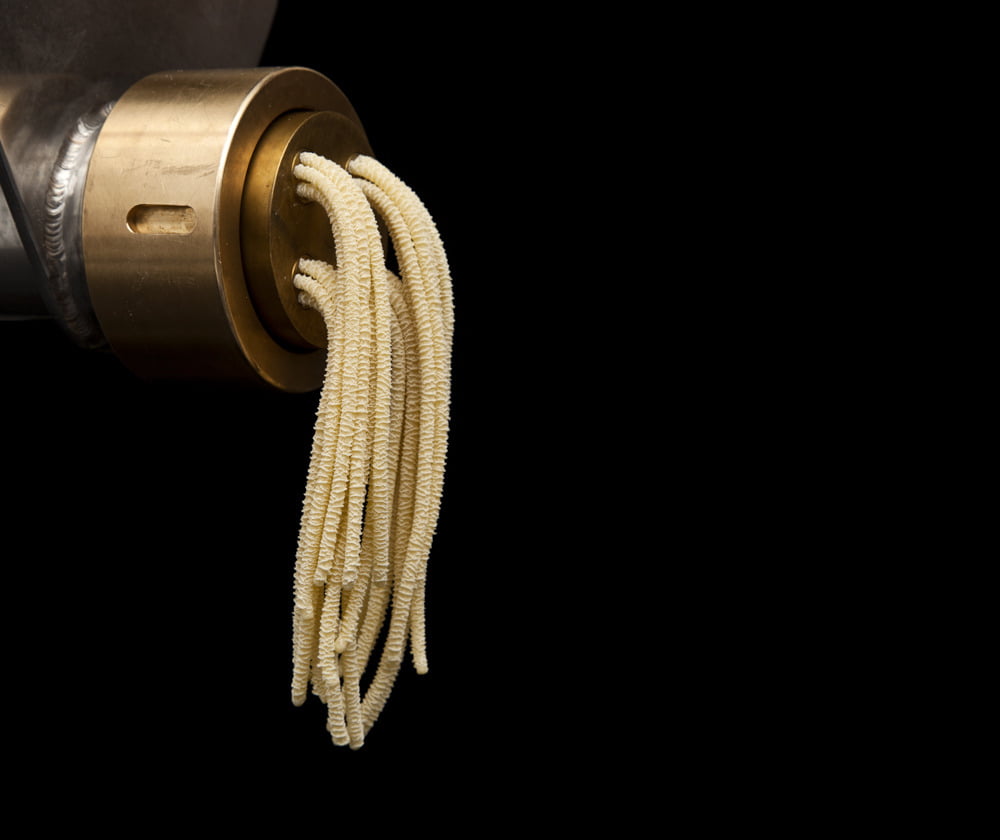
    Homemade spaghetti noodles exhibit a roughened surface that’s the result of viscoelastic behavior known as the sharkskin instability. It’s usually observed in the industrial extrusion of polymer plastics. In the case of spaghetti, the long, complex polymer molecules necessary for the instability come from the proteins in eggs. The characteristically rough surface of the extruded material is caused by the transition from flow through the die to air. Inside the die, friction from the walls exerts a strong shear force on the outer part of the fluid while the inner portion flows freely. When the material exits the die, the sudden lack of friction on the outer portion of the fluid causes it to accelerate to the same velocity as the middle of the flow. This acceleration stretches the polymers until they snap free of the die; after the strained polymers relax, the material keeps a rough, saw-tooth pattern. In industry, the sharkskin instability can be prevented by regulating temperature or flow speed. In the case of spaghetti, though, Modernist Cuisine suggests the roughness is desirable because it helps trap the pasta sauce. Bon appetit!  (Image credit: Modernist Cuisine)

  • How Eyelashes Work

    How Eyelashes Work

    New research shows that eyelashes divert airflow around the eye, serving as a passive filter that reduces dust collection and controls evaporation. Mammal hairs in places like the nose act as ram filters that trap the particles that hit them and which require regular cleaning via sneezing. Eyelashes, on the other hand, prevent dust collection by altering airflow at the surface of the eye. At the optimal length of roughly 1/3rd the width of an eye, eyelashes create a stagnation zone near the eye surface that forces air to travel above rather than through the eyelashes. This results in lower shear stress and lower flow speeds at the eye surface, both of which help reduce evaporation and shield the eye from dust. Lashes can get too long, though; the researchers found that longer lashes tended to channel higher flow speeds toward the eye surface, leading to faster evaporation rates. Thus, donning longer fake eyelashes may dry out your eyes. (Image credit: G. Diaz Fornaro; research credit: G. Amador et al.; via skunkbear)

  • Kelvin-Helmholtz Clouds

    Kelvin-Helmholtz Clouds

    When differing layers of fluid move past one another, friction between them causes shear. This shear quickly transforms a simple flat interface between fluid layers into a wavy unstable boundary that resembles a series of breaking ocean waves. This effect is known as the Kelvin-Helmholtz (KH) instability. In the atmosphere, this instability causes air layers with differing temperatures and moisture content to form wave-like clouds where the two layers meet. Other examples of the effect are widespread. On earth, many ocean waves are generated by wind shearing the water; elsewhere in our solar system, the cloud bands of Jupiter are lined with spinning eddies from the KH instability. (Photo credit: H. Bondo)

  • The Kaye Effect

    The Kaye Effect

    Those who have poured viscous liquids like syrup or honey are familiar with how they stack up in a rope-like coil, as shown in the top row of images above. What is less familiar, thanks to the high speed at which it occurs, is the Kaye effect, which happens in fluids like shampoo when drizzled. Shampoo is a shear-thinning liquid, meaning that it becomes less viscous when deformed. Like a normal Newtonian fluid, shampoo first forms a heap (bottom row, far left). But instead of coiling neatly, the heap ejects a secondary outgoing jet. This occurs when a dimple forms in the heap due to the impact of the inbound jet. The deformation causes the local viscosity to drop at the point of impact and the jet slips off the heap. The formation is unstable, causing the heap and jet to collapse in just a few hundred milliseconds, at which point the process begins again. (Image credit: L. Courbin et al.)

  • Undulatus Asperatus

    Undulatus Asperatus

    This surrealistic timelapse doesn’t show an ocean in the sky. These are undulatus asperatus clouds rolling over Lincoln, Nebraska. Also known simply as asperatus, this cloud formation has been proposed as but not yet recognized as a distinctive cloud type. Their speed is much slower than shown in the animation, but the wave-like motion is accurate and is the source of the cloud’s name, which comes from the Latin word aspero, meaning to make rough. Though they appear stormy, asperatus clouds do not usually produce storms. They form under conditions similar to those of mammatus clouds, but wind shear at the cloud level causes the undulations to form. (Maybe some Kelvin-Helmholtz instabilities going on there?) You can check out many more images of asperatus clouds at the Cloud Appreciation Society’s gallery. (Image credit: A. Schueth, source video; submitted by leftcoastjunkies)

  • “Smoke”

    “Smoke”

    Ethereal forms shift and swirl in photographer Thomas Herbich’s series “Smoke”. The cigarette smoke in the images is a buoyant plume. As it rises, the smoke is sheared and shaped by its passage through the ambient air. What begins as a laminar plume is quickly disturbed, rolling up into vortices shaped like the scroll on the end of a violin. The vortices are a precursor to the turbulence that follows, mixing the smoke and ambient air so effectively that the smoke diffuses into invisibility. To see the full series, see Herbich’s website.  (Image credits: T. Herbich; via Colossal; submitted by @jchawner@__pj, and Larry B)

    P.S. – FYFD now has a page listing all entries by topic, which should make it easier for everyone to find specific topics of interest. Check it out!

  • Supernova Explosion

    Supernova Explosion

    Type 1a supernovae occur in binary star systems where a dense white dwarf star accretes matter from its companion star. As the dwarf star gains mass, it approaches the limit where electron degeneracy pressure can no longer oppose the gravitational force of its mass. Carbon fusion in the white dwarf ignites a flame front, creating isolated bubbles of burning fluid inside the star. As these bubbles burn, they rise due to buoyancy and are sheared and deformed by the neighboring matter. The animation above is a visualization of temperature from a simulation of one of these burning buoyant bubbles. After the initial ignition, instabilities form rapidly on the expanding flame front and it quickly becomes turbulent. (Image credit: A. Aspden and J. Bell; GIF credit: fruitsoftheweb, source video; via freshphotons)

  • Paint on Speakers

    Paint on Speakers

    Paint seems to dance and leap when vibrated on a speaker. Propelled upward, the liquid stretches into thin sheets and thicker ligaments until surface tension can no longer hold the the fluid together and droplets erupt from the fountain. Often paints are shear-thinning, non-Newtonian fluids, meaning that their ability to resist deformation decreases as they are deformed. This behavior allows them to flow freely off a brush but then remain without running after application. In the context of vibration, though, shear-thinning properties cause the paint to jump and leap more readily. For more images, see photographer Linden Gledhill’s website. (Photo credit: L. Gledhill; submitted by pinfire)