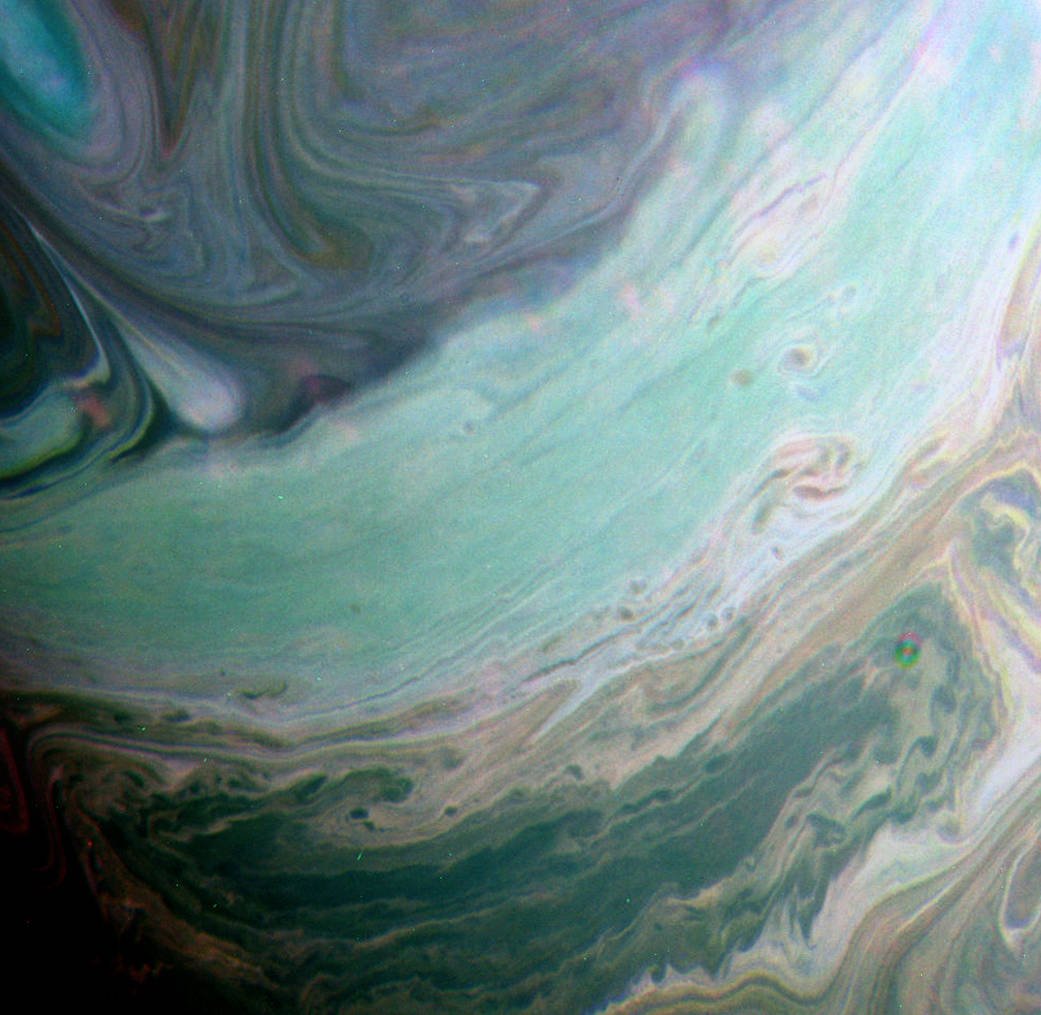
It may look like an oil slick, but the photo above actually shows the clouds of Saturn. The false-color composite image reveals the gas giant in infrared, at wavelengths longer than those visible to the human eye. NASA uses this infrared photography to identify different chemical compositions in Saturn’s atmosphere based on how they reflect sunlight. You can see an example of how they construct these images here. This detail shot appears to show cloud bands of different compositions mixing. You can see hints of shear instabilities forming along the edges where the light and dark bands meet. (Image credit: NASA; via Gizmodo)
Search results for: “shear”
Swirling Pollen
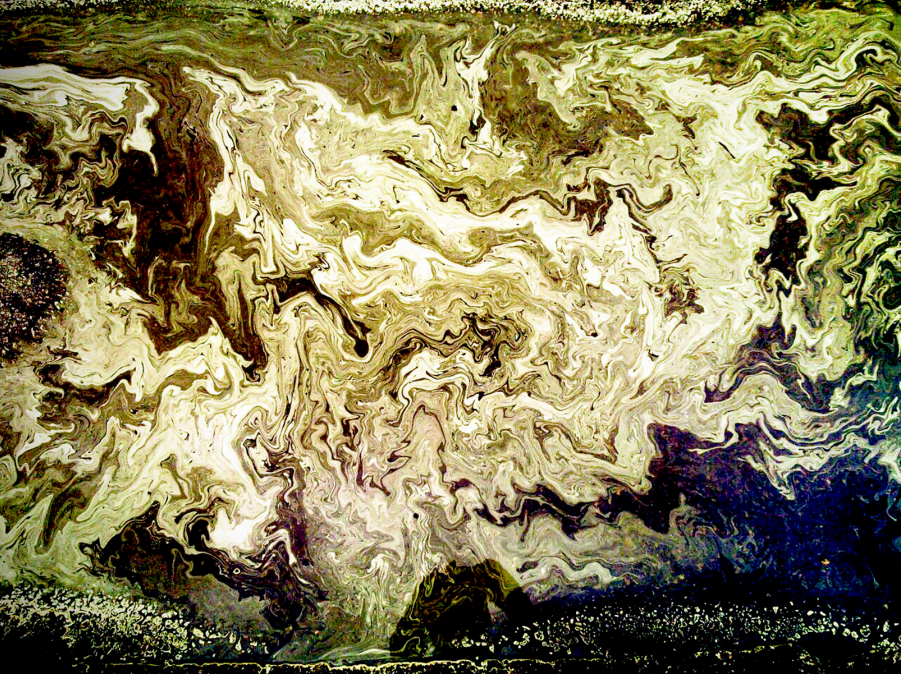
This photo captures the chaotic mixing present in a simple puddle. Pine pollen strewn across the puddle’s surface acts as tracer particles, revealing some of the motion of the underlying water. As wind blows across the puddle, it moves the water through the formation of ripples and by shearing the surface. That deformation on the top of the puddle will cause further motion beneath the surface. With time and changing wind direction, the resulting pattern of flow can be very complex! (Photo credit: K. Jensen, original)

Crushing Oobleck
Oobleck is probably the Internet’s favorite non-Newtonian fluid. People vibrate it, run across it, shoot it, drop it, and even use it to fix potholes. But how does oobleck hold up to a hydraulic press? Fortunately, that’s been covered, too. Oobleck is a mixture of cornstarch and water, and it’s a bit unusual in that it is a shear-thickening material. That means that the faster you try to deform it, the more it will resist that deformation. Knowing this makes the above video’s results make more sense. When they try to crush the balloon full of oobleck, the deformation happens pretty slowly, so the fluid just flows away.
The same thing happens initially with the pot full of oobleck; it overflows much like any other liquid. But as the press pushes deeper, the oobleck gets confined by the pot’s walls and things change. Research has shown that the shear-thickening of oobleck comes from cornstarch particles jamming up in the fluid. By confining the oobleck, the pot and hydraulic press magnify this jamming effect, causing a spurt of semi-solid cornstarch fingers and leaving the press tool thoroughly trapped by the jammed particles. (Video credit: Hydraulic Press Channel)
Hagfish Escape Mechanisms

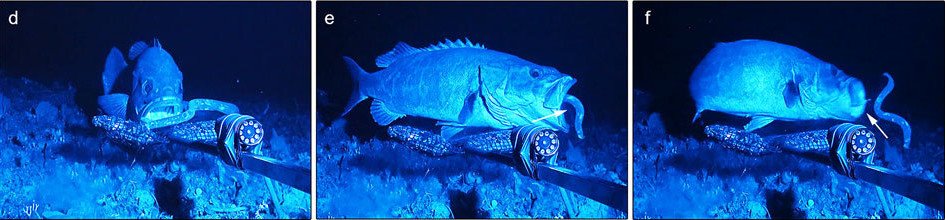
The hagfish is an eel-like creature that has not changed much in the past 300 million years in part because the hagfish is very good at escaping would-be predators. When attacked, the hagfish excretes mucins that combine with seawater to form slime. This gel-like viscoelastic fluid forms quickly and has some handy properties. For example, when stretched, the slime becomes extremely viscous. Many fish feed using a suction method, in which they thrust their jaws forward and enlarge their mouths to suck water and prey inside. This strong unidirectional flow stretches the slime, which thickens it and clogs the fish’s gills. Suddenly, the fish is much more concerned with being unable to breathe, allowing the hagfish to flee.
Being surrounded by all that slime could smother the hagfish, too, if it were not for another clever feature of the slime. When sheared, hagfish slime collapses, losing its viscosity. The hagfish actually ties itself in a knot to create this shear and slide the slime right off. (Image credit: V. Zintzen et al.; L. Böni et al., source)

Bioluminescent Plankton

The blue-outlined dolphins you see above get their glow from microorganisms called dinoflagellates. They are a type of bioluminescent plankton, shown in the lower image, that can be found in oceans around the world. Their glow comes from combining two chemicals: luciferase and luciferin. The dinoflagellates suspended in the ocean do this when they are disturbed–specifically, when the water around them transmits a shear stress above a certain threshold. Typically, this is caused by something larger–a potential predator–moving past, although it can also be stimulated by breaking waves. The higher the shear stress, the more intense the glow, but the dinoflagellates only use their bioluminescence sparingly. If you apply shear stress and keep applying it, their glow fades away without reactivating. After all, they can only produce so much chemical fuel. (Image credit: BBC from Attenborough’s Life That Glows; h/t to Gizmodo; research credit: E. Maldonado and M. Latz)

Striking Oobleck
Mixing cornstarch and water creates a fluid called oobleck that has some pretty bizarre properties. Oobleck is a shear-thickening, non-Newtonian fluid, which means its viscosity increases when you try to deform it with a shearing, or sliding, force. But as the Backyard Scientist demonstrates above, striking oobleck with a solid object produces some spectacular and very non-fluid-like results. The golf ball’s impact blows the oobleck into pieces that look more like solid chunks than liquid droplets. This solid-like behavior occurs because the impact jams the suspended cornstarch particles together, creating a solidification front that travels ahead of the golf ball. Imagine how a snow plow pushes a denser region of snow ahead of it as it drives; the cornstarch behaves similarly but only in a region near the impact. Once that impact force dissipates, the particles unjam and the mixture responds fluidly again. (Image credit: The Backyard Scientist, source; research credit: S. Waitukaitis and H. Jaeger, pdf)
A New Cloud
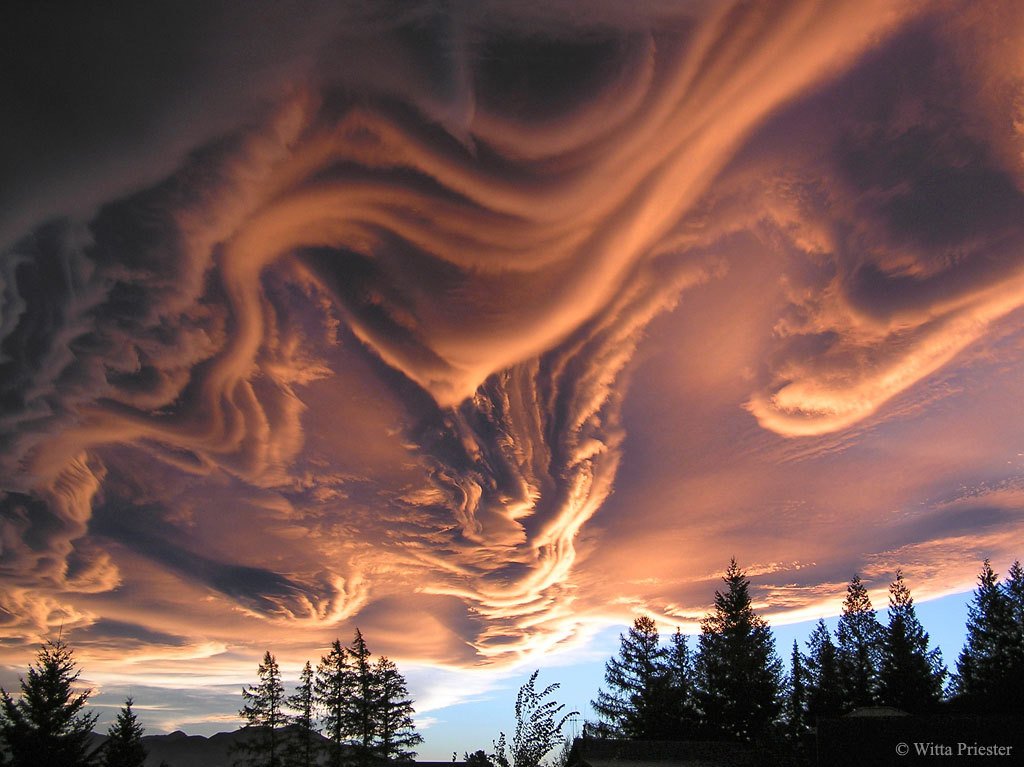
These unusual and spectacular clouds are known as undulatus asperatus. Though they have been proposed as a new type of cloud, they are as yet officially unrecognized. Despite their dramatic appearance, these clouds are not associated with storms. Instead, they’re thought to form in a process similar to mammatus clouds, where wind shear at the cloud level causes undulations to form. This wave-like structure is especially visible in the photo above thanks to a low sun angle illuminating the underside of the clouds. (Image credit: W. Priester; via APOD)

Wrinkling Fluids
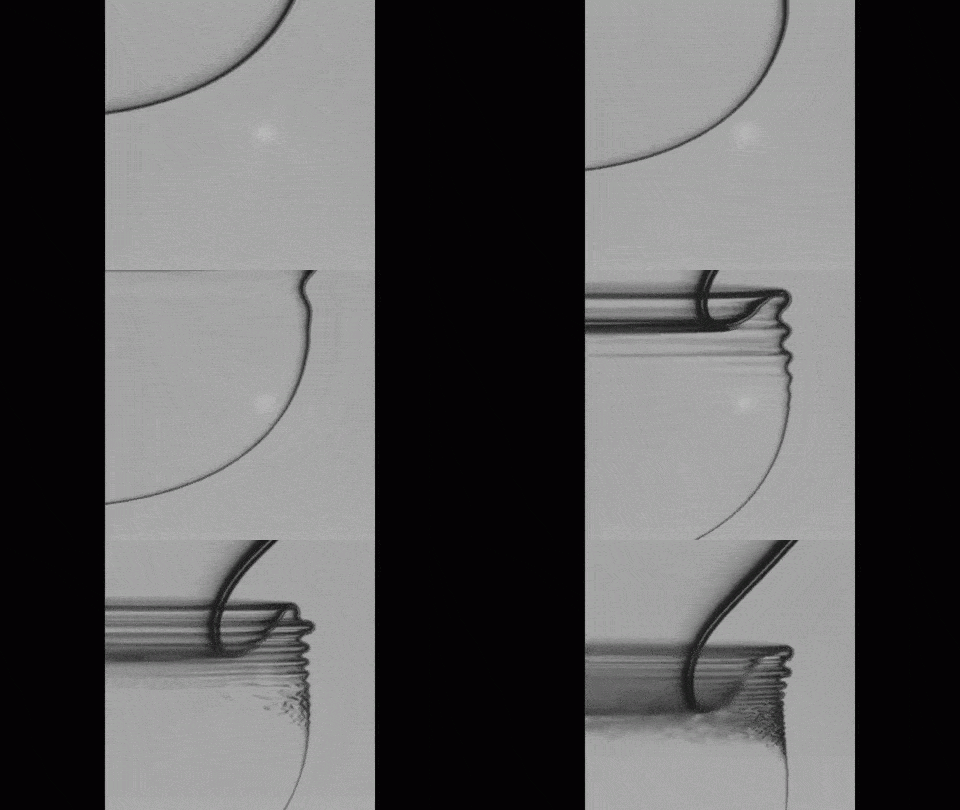
What you see here is a viscous drop falling into a less viscous fluid. Shear forces between the drop and the surrounding fluid cause the drop to quickly deform into a shape like an upside-down mushroom as it descends. The cap forms a vortex ring that curls the viscous fluid back on itself. As it does, that motion compresses the viscous sheet, causing it to wrinkle, as seen in the close-up in the bottom animation. Check out the full video here. (Image credit: E. Q. Li et al., source)
Pyroclastic Flow
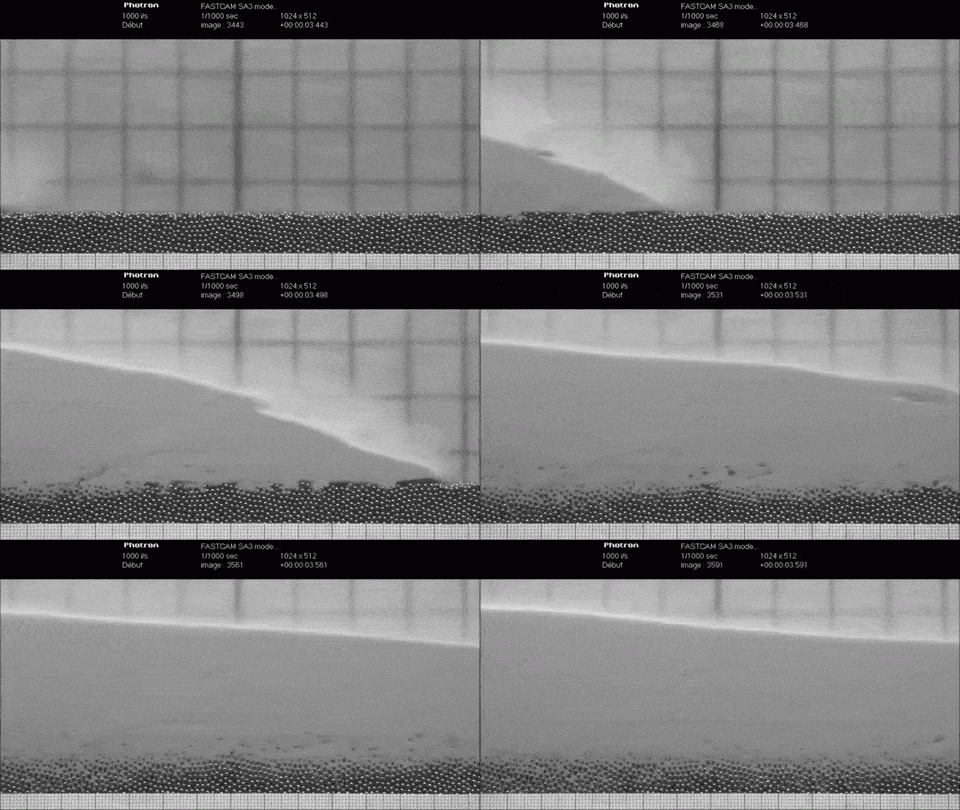
Major volcanic eruptions can be accompanied by pyroclastic flows, a mixture of rock and hot gases capable of burying entire cities, as happened in Pompeii when Mt. Vesuvius erupted in 79 C.E. For even larger eruptions, such as the one at Peach Spring Caldera some 18.8 million years ago, the pyroclastic flow can be powerful enough to move half-meter-sized blocks of rock more than 150 km from the epicenter. Through observations of these deposits, experiments like the one above, and modeling, researchers were able to deduce that the Peach Spring pyroclastic flow must have been quite dense and flowed at speeds between 5 – 20 m/s for 2.5 – 10 hours! Dense, relatively slow-moving pyroclastic flows can pick up large rocks (simulated in the experiment with large metal beads) both through shear and because their speed generates low pressure that lifts the rocks so that they get swept along by the current. (Image credit: O. Roche et al., source)

Turbulent Convection
These golden lines reveal the complexity of turbulent convective flow. They come from a numerical simulation of turbulent Rayleigh-Benard convection, a situation in which fluid trapped between two plates is heated from below and cooled from above. This situation would typically create convection cells similar to those seen in clouds or when cooking. Inside these cells, warm fluid rises to the top, cools, and sinks down along the sides. With large enough temperature differences, instabilities will occur and cause the flow to become turbulent so that the clear structure of convection cells breaks down into something more chaotic. Such is the case in this simulation. This visualization shows skin friction on the bottom (heated) plate in a flow of turbulently convecting liquid mercury. The bright lines are areas with large velocity changes at the wall, an indication of high shear stress and vigorous convective flow. (Image credit: J. Scheel et al.; via Gizmodo)
