
Jupiter’s atmosphere is fascinatingly complex and stunningly beautiful. This close-up from the Juno spacecraft shows a region called STB Spectre, located in Jupiter’s South Temperate Belt. The bluish area to the right is a long-lived storm that’s bordering on very different atmospheric conditions to the left. Shear from these storms moving past one another creates many of the curling waves we see in the image. These are examples of the Kelvin-Helmholtz instability, which generates ocean waves here on Earth, creates spectacular clouds in our atmosphere, and is even responsible for waves in galaxy clusters. Check out some of the other amazing images Juno has sent back of our solar system’s largest planet. (Image credit: NASA/JPL-Caltech/SwRI/MSSS/R. Tkachenko; via Gizmodo)
Search results for: “shear”
Jupiter On Display
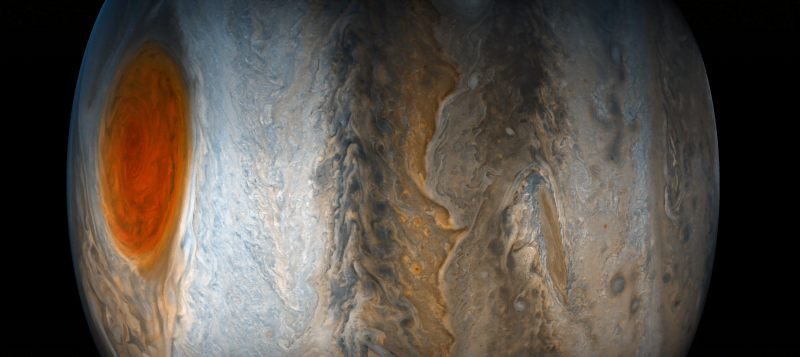
The rich detail of Jupiter’s atmosphere is on full display in this enhanced-color image from the Juno spacecraft. (Full resolution version here – trust me, you want to click that link.) To the north, on the left side of the image, Jupiter’s Great Red Spot swirls. To the center and right, the cloud bands of Jupiter’s southern region are coming into view. The color enhancements really highlight eddies on the edge of these bands. These are examples of Kelvin-Helmholtz instabilities caused by shear between cloud bands moving at different speeds. Within the bands, smaller vortices spin. Some of these are anti-cyclones, high-pressure storm systems found all over the planet. Jupiter’s atmosphere still holds many mysteries for scientists, but I love how every gorgeous image Juno sends back shows fluid physics written larger than life across our solar system’s biggest planet. (Image credit: NASA/JPL-Caltech/SwRI/MSSS/G. Eichstädt /S. Doran; via Gizmodo)
Wrinkling Drops
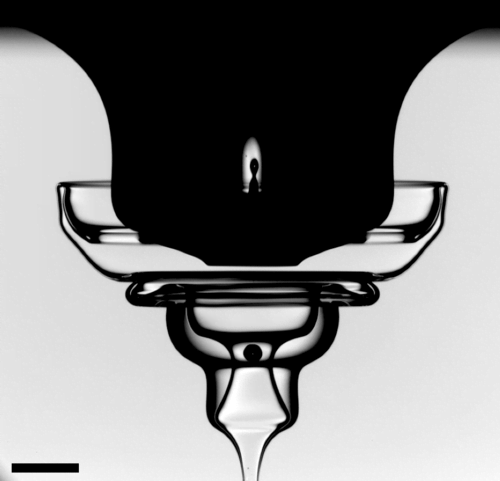
When a viscous drop falls into a pool of a less viscous liquid, the drop can deform into some beautiful and complex shapes. Typically, shear forces between the drop and its surroundings cause a vortex ring to roll up and advect downward, thereby stretching the remainder of the drop into thin sheets that can buckle and wrinkle. Here the drop is about 150 times more viscous than the pool and impacts at 1.45 m/s, making a rather energetic entry. The vortex ring (not visible) has stretched the drop’s remains downward while a buoyant bubble caught by the impact pulls some of the drop back toward the surface. As a result, the thin sheets of the drop’s fluid are buckling and folding back on themselves like an elaborate and delicate glass sculpture. This entire paper is full of gorgeous images and videos. Be sure to check them out! (Image and research credit: E. Q. Li et al.; see supplemental info zip for videos)

Kelvin-Helmholtz Instability
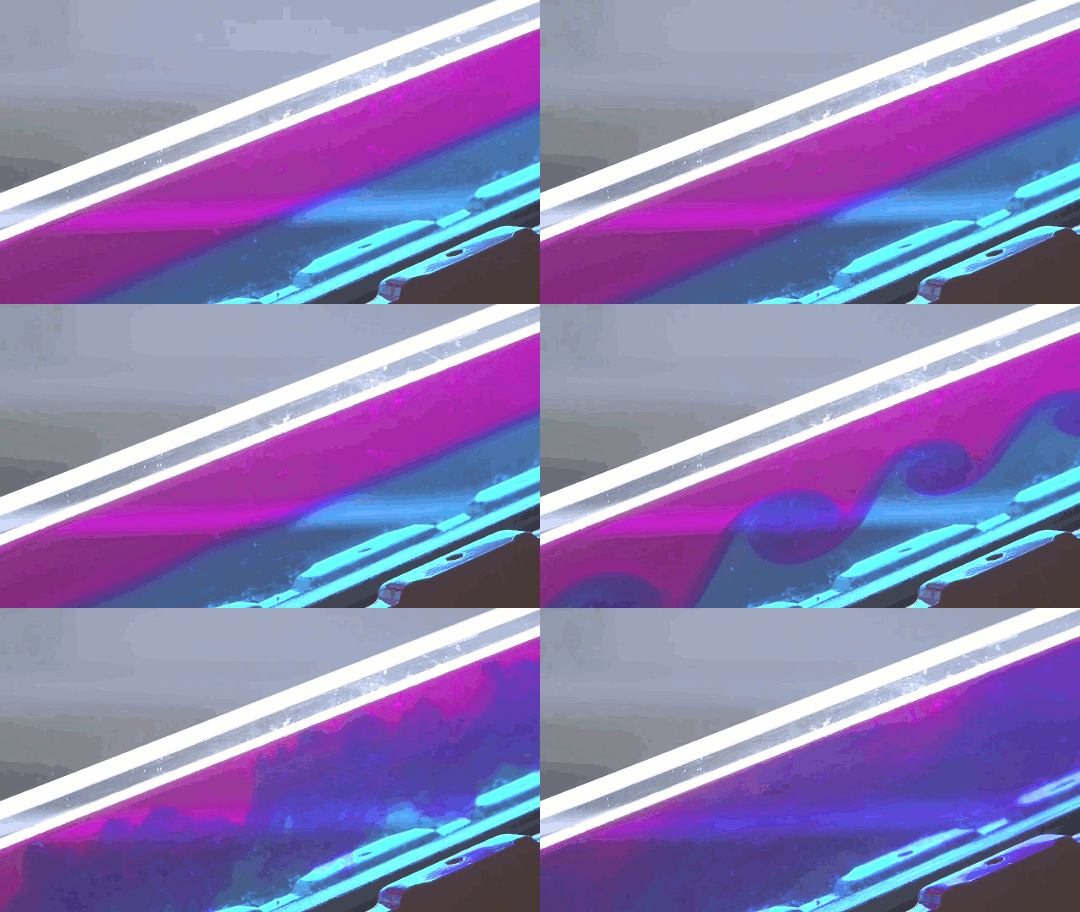
Sixty Symbols has a great new video explaining the laboratory set-up for demoing a Kelvin-Helmholtz instability. You can see a close-up from the demo above. Here the pink liquid is fresh water and the blue is slightly denser salt water. When the tank holding them is tipped, the lighter fresh water flows upward while the salt water flows down. This creates a big velocity gradient and lots of shear at the interface between them. The situation is unstable, meaning that any slight waviness that forms between the two layers will grow (exponentially, in this case). Note that for several long seconds, it seems like nothing is happening. That’s when any perturbations in the system are too small for us to see. But because the instability causes those perturbations to grow at an exponential rate, we see the interface go from a slight waviness to a complete mess in only a couple of seconds. The Kelvin-Helmholtz instability is incredibly common in nature, appearing in clouds, ocean waves, other planets’ atmospheres, and even in galaxy clusters! (Image and video credit: Sixty Symbols)

Hagfish Crash
Last week a flatbed truck in Oregon overturned and released 3400 kilograms of live hagfish on the highway and nearby cars. Hagfish are eel-like fish known for their impressive slime production. When threatened, the hagfish produce mucins that, when combined with water, form an extremely viscoelastic mucus. As it’s stretched, the mucus thickens and becomes more viscous. Normally, hagfish use this property to clog the gills of fish trying to eat them. The slime is weak, however, to shearing; hagfish actually tie themselves in knots to slide the slime off when there’s too much of it. The Oregon Department of Transportation managed to clear the road of mucus (and hagfish) using bulldozers and fire hoses, but it did take them several hours. For more photos and videos from the incident, check out Gizmodo and the Oregon State Police Twitter feed. (Image credit: Oregon State Police; via Gizmodo)
Perijove
The Juno spacecraft continues to send back incredible photos of Jupiter’s atmosphere. This video animates images from the sixth close pass of Jupiter to give you a sense of what Juno sees as it swoops by our system’s largest planet. The trajectory passes from the north pole to the south, showing Jupiter’s whitish zones, dark belts, and massive storms. Up close Jupiter looks like an Impressionist painting, all vortices and shear instabilities. The large white spots you see are enormous counterclockwise rotating vortices known as anticyclones – many of them larger than our entire planet. (Video credit: NASA / SwRI / MSSS / G. Eichstädt / S. Doran)
Breaking Waves in the Sky
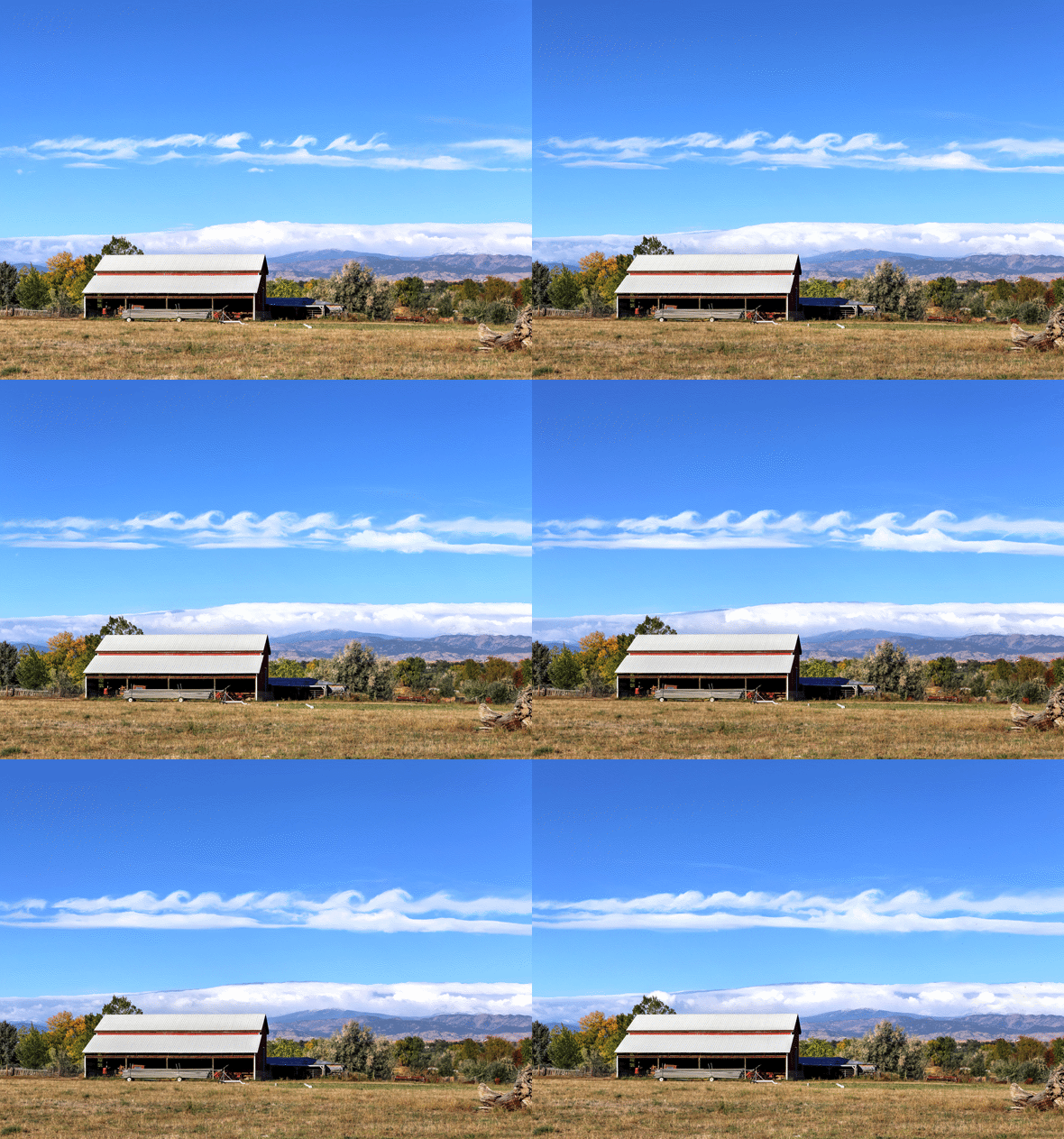
Under the right atmospheric conditions, clouds can form in a distinctive but short-lived breaking wave pattern known as a Kelvin-Helmholtz cloud. The animation above shows the formation and breakdown of such a cloud over the course of 9 minutes early one morning in Colorado’s Front Range region. Kelvin-Helmholtz instabilities occur when fluid layers with different velocities and/or densities move past one another. Friction between the two layers moving past creates shear and causes the curling rolls seen above.
In the background, you can also see a foehn wall cloud low to the horizon. This type of cloud forms downwind of the Rocky Mountains after warm, moist Chinook winds are forced up over the mountains, cool, and then condense and sink in the mountains’ wake. (Image credit and submission: J. Straccia, more info)

Vortex Impact

When a vortex ring impacts a solid wall (or a mirrored vortex ring), it expands and quickly breaks up. The animations above show something a little different: what happens when a vortex ring hits a water-air interface. As seen in the side view (top image), the vortex starts to expand, but its shear at the interface generates a stream of smaller vortices that disrupt the larger vortex. (They even look like a little string of Kelvin-Helmholtz vortices!) When viewed from above (bottom image), the vortex ring impact and breakdown look even more complicated. Mushroom-like structures get spat out the sides as those secondary vortices form, and the entire structure quickly breaks up into utter turbulence. There’s some remarkable visual similarities between this situation and some we’ve seen before, like a sphere meeting a wall and drop hitting a pool. (Image credit: A. Benusiglio et al., source)
Unboiling an Egg
Cooking is something we think of as a one-way process. You add heat to food, it changes forms, and there’s undoing that. But that process is less one-directional than we thought, at least in some cases. Take boiling an egg. When you add heat to egg whites, it breaks down bonds between the folded proteins and lets those proteins build more bonds with other sections of proteins, eventually solidifying into a seemingly unbreakable mess. You can’t break those bonds by adding or removing thermal energy, but you can shake the proteins apart and refold them into their original shapes.
Researchers accomplish this by putting the boiled egg whites in a solution of water and urea and spinning them. When they spin the fluid mixture, the fluid near the wall spins faster than the fluid in the center of the vial, which creates shear stress. That shear stress helps untangle the proteins and reform them into their original shape–thereby unboiling the egg white. Now you definitely don’t want to eat the results – urea is, of course, a component of urine – but it does demonstrate that fluid dynamics can be used to reverse chemical processes we thought were irreversible. And that surprising discovery nabbed the researchers an Ig Nobel Prize in 2015. (Video credit: TedEd/E. Nelson; research credit: T. Yuan et al.)
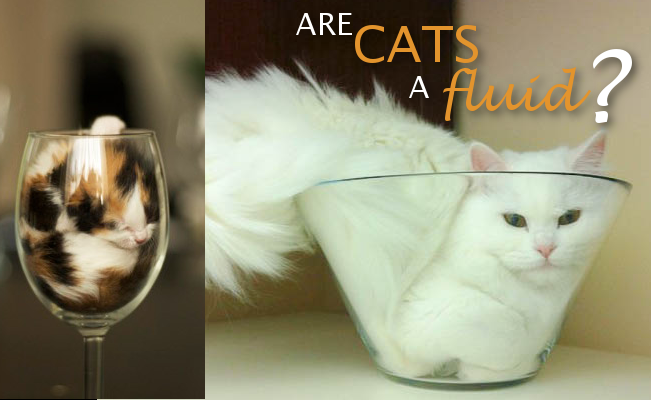
Are Cats a Fluid?
Are cats a fluid? It’s a question that has inspired many a meme. There are a few common definitions as to what makes a fluid. One is that a fluid changes its shape to that of its container. Another more technical definition is that a fluid deforms continuously under shear forces. But the real picture is messier than these seemingly simple definitions allow for. On the Improbable Research podcast, I tackle the question of whether cats are a solid or a fluid and what fluid dynamics–specifically, the subject of rheology–has to teach us about the topic. Give it a listen! (Original image credits: Huffington Post; imgur; research credit: M. A. Fardin, pdf – article begins on page 16)
Post-Thanksgiving bonus: Today is the traditional Science Friday broadcast of this year’s (abridged) Ig Nobel Prize ceremony. Check your local NPR station for broadcast times or listen to it on their website. You’ll hear me deliver a 24/7 lecture on the subject of “Fluid Dynamics” (and you may find me cropping up elsewhere, too). Alternatively, you can check out the full ceremony video on YouTube.

