Granular flows, which are made up of loose particles like sand, often display remarkably fluid-like behavior. Here researchers explore the behavior of granular flows when a solid impacts them at high speed. The sand, unlike a fluid, does not have surface tension, yet we still observe many of the same behaviors. Like a fluid, the sand splashes and creates cavities and jets as it deforms around the fallen object. The sand even “erupts” as submerged pockets of air make their way back to the surface.
Search results for: “jet”

Drops Through Drops
The splashes from droplets impacting jets create truly mesmerizing liquid sculptures. Corrie White is one of the masters of this type of high-speed macro photography. Her work captures the instantaneous battles between viscosity, surface tension, and inertia. The fantastic structure seen here through the falling droplets is created by a series of drops timed so that the later ones strike the Worthington jet produced by the initial drop’s impact. (Photo credit: Corrie White)
Flying Squid
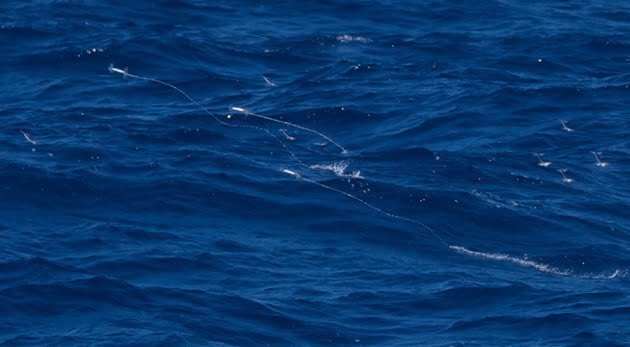
Ever seen a squid fly? Not many have, but the behavior may be more common than you think. Thanks to a set of photos from an amateur photographer, scientists have managed to estimate the velocity and acceleration of squid as they propel themselves out of the water by squirting a jet behind them. Researchers found that their speeds in air are roughly five times that in water, thanks to decreased drag. Previously it was thought that the flying behavior might be linked to escaping predators, but some now suggest that it enables migration over long distances by saving energy.

The Gobbling Drop
A little polymer goes a long way when it comes to changing a fluid’s behavior. Normally, a falling jet of fluid will develop waviness and be driven by surface tension and the Plateau-Rayleigh instability to break up into a stream of droplets. We see this at our water faucets all the time. But when traces of a polymer are dissolved in water, the behavior is much different. The viscoelasticity of the polymer chains creates a force that opposes the thinning effects caused by surface tension. So, instead of thinning to the point of breaking into droplets, a drop is able to climb back up the jet until it reaches a critical mass where it reverses direction, accelerates downward due to gravity and eventually breaks off the jet. Then the whole process begins again with a new terminal drop. (Video credit: C. Clasen et al)
Smoke Flow Viz
Smoke visualization, illuminated by a laser sheet, shows a 2D slice from an axisymmetric jet as it breaks down to turbulence. The flow is laminar upon exiting the nozzle, but the high velocity at the edge of the jet and low velocity of the surrounding air causes shear that leads to the Kelvin-Helmholtz instability. This instability leads to the formation of small vortices that grow as they are advected downstream until they are large enough to interrupt the jet and it breaks down into fully turbulent flow. (Video credit: B. O. Anderson and J. H. Jensen)
The Invisible Forces Behind a Lighter
This high-speed schlieren video reveals the ignition of a butane lighter. The schlieren optical technique exaggerates differences in refractive index caused by density variations, enabling experimentalists to see thermal eddies, shock waves, and other phenomena invisible to the naked eye. Here a jet of butane shoots upward from the lighter as a valve is released. Then the spark from the lighter ignites the butane gas near the bottom of the jet. A flame front the propagates outward and upward, completing the lighting process. (submitted by @Mark_K_Quinn)

Star-Shaped Nozzles
Efficient mixing of fluids is vital for many applications, including fuel injection for all types of combustion and masking the exhaust of stealth fighters. Star-shaped lobed nozzles can produce jets that mix more effectively than conventional jets. This photo shows cross-sections of the jet at several downstream distances from the nozzle exit. (Photo credit: H. Hu et al)

Splash Sheets
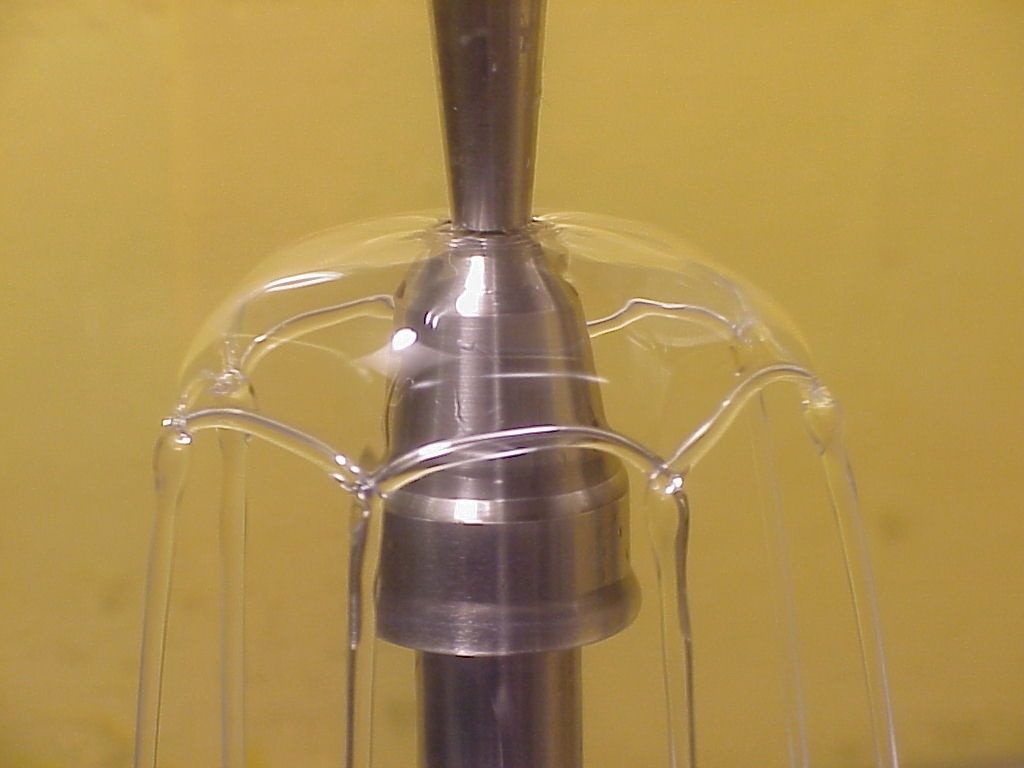
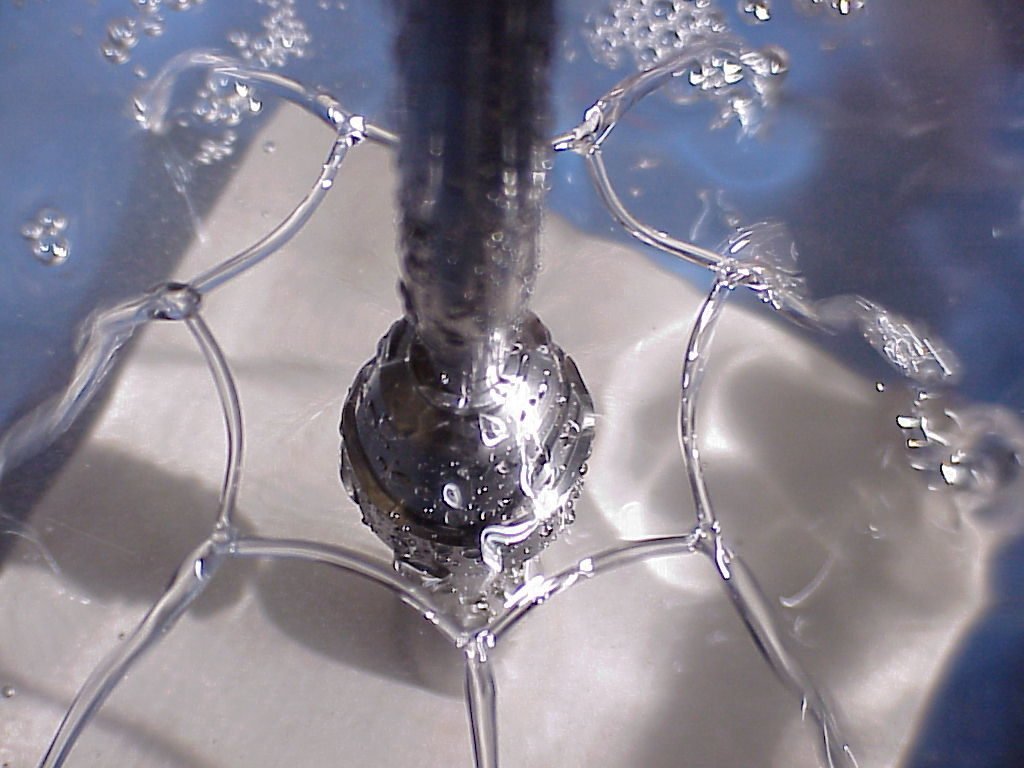


When a falling liquid jet hits a horizontal impacter, it is deflected into a sheet. The shape of the sheet is dependent upon the velocity of the jet and the viscosity of the fluid. At sufficiently high speeds the sheet will be circular; at lower speeds it may sag into a bell-shape. The circular sheets can also develop an instability that causes them to become polygonal, as shown in the photos above. The fluid then flows out along the sheet, into and along the rim, and then spouts outward in jets at the polygon’s corners. For some conditions, the jets at the corners even form a sort of fluid chain (top photo). (Photo credit: R. Buckingham and J. W. M. Bush; via 14-billion-years-later)
Viscoelastic Fluids in Space
In honor of astronaut Don Pettit’s launch to the International Space Station (and in the hope that he’ll do more neat microgravity fluids demonstrations while in space!), here’s a look a the behavior of viscoelastic fluids in microgravity. The elasticity of these fluids means that, when strained, the fluid deforms instantaneously and then returns to its initial shape when the strain is removed. Pettit demonstrates both Plateau-Rayleigh instability behavior, where a column of fluid breaks apart due to surface tension variations, and die swell, where a fluid jet expands beyond the diameter of nozzle from which it was extruded. Such swelling is commonly caused by the stretching and relaxation of polymers in the fluid as they react to forces caused by the nozzle opening.
Underwater Plumes
During 2010’s Deepwater Horizon oil spill there were reports of underwater plumes of oil escaping collection. This video demonstrates how such a plume can form. There are two clips shown here; in both the tank is filled with salt water of varying salinity, with denser saltwater at the bottom. The first jet is a green alcohol/water mixture and the second is a red gauge oil. Both jets have the same density and flow rate, but they vary in their Reynolds number. The first turbulent jet gets trapped at the interface between the denser and lighter saltwater while the less turbulent red jet passes the interface with no difficulty. The researchers suggest that strong turbulence can create an emulsion, a mixture of two normally immiscible fluids–imagine shaking a container of oil and vinegar really well–which can lead to underwater trapping.
