The vibration caused by rubbing a Tibetan singing bowl excites standing waves in a Faraday instability on the surface of water in the bowl. As the amplitude of excitation increases, jets roil across the surface, creating a spray of droplets, some of which actually bounce on the surface as it vibrates. For more see the BBC and SciAm articles.
Search results for: “jet”

High Hopes
This gorgeous high-speed video captures bubbles, droplets, wakes, cavitation, coalescence, jets, and lots of surface tension at 7000 fps. The authors unfortunately haven’t indicated whether this is air in water or something more viscous, but regardless there are some great phenomena on display here. # (via Gizmodo)
Droplet Impact
As a droplet impacts a pool, it deforms the surface before rebounding in a Worthington jet and releasing secondary droplets as ejecta. Although we witness this act dozens of times a day, seeing it at 5,000 fps drastically alters one’s perspective.
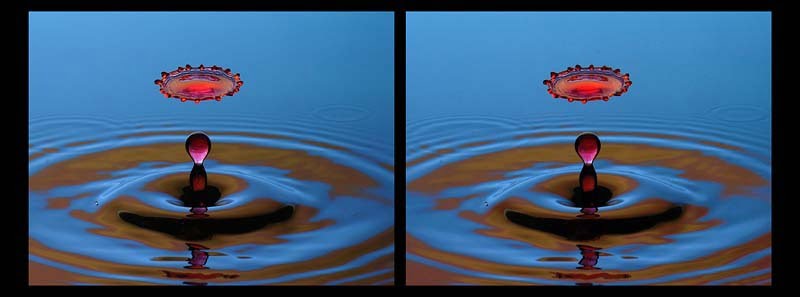
Stereo Liquid Sculpture
This stereo 3D photo shows the Worthington jet ejected when a droplet impacts a pool. The flat crowning drop is formed from an ejected droplet colliding with a falling droplet.
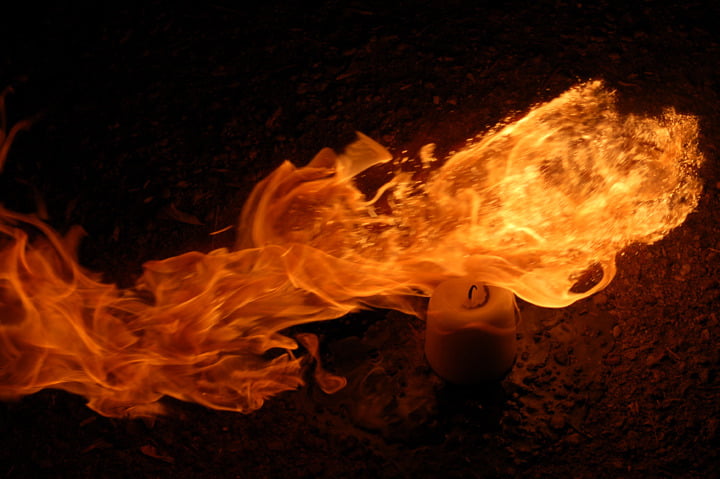
Combustion
Fluid dynamics are vital to combustion. Like here, many practical flames–such as those responsible for internal combustion in automobiles, jet engines, and rockets–are turbulent. The turbulence aids mixing of the fuel and oxidizer, resulting in more complete combustion and greater efficiency. #
Liquid Acrobatics
Imagine blowing through a straw into a nearly empty glass–we probably all did this as children and sent water, milk, and soda flying everywhere! In essence, this video shows that same act, but filmed by a high-speed camera. The “straw” blows a steady stream of helium into a shallow pool of silicone oil and slowly moves so that the angle the straw makes with the pool changes. As the angle changes, different regimes are visible. First waves appear on the surface of the pool, then a bulge forms, which develops into a droplet stream, then on into the chaos of bubbles and jets. It’s good I couldn’t see this in slow motion as a child or I would have never used my straw for drinking!

Rocket Exhaust
This image of the Apollo 11 launch shows the Saturn V’s underexpanded nozzle (identifiable by the excessive width of the exhaust jet) shortly after liftoff. The faint diamond shape of the exhaust is a series of shock waves and expansion fans that equalize the exhaust pressure to the ambient. In general, a rocket nozzle is most efficient when it expands the exhaust to ambient pressure, but, since ambient pressure changes with altitude, designers have to choose a particular altitude for peak efficiency or design a nozzle capable of changing its shape with altitude.
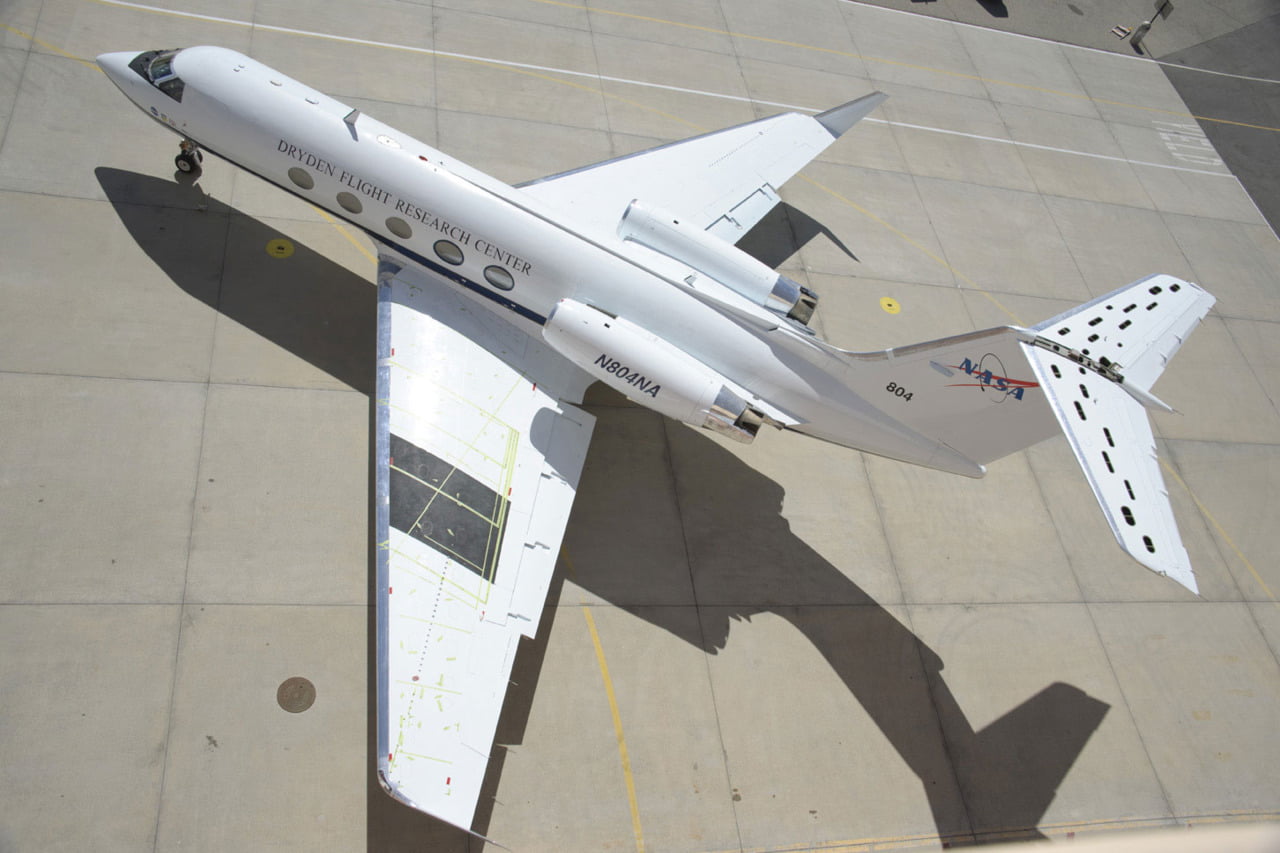
Laminar Flow Control
On Wednesday, March 30, 2011 at 3:00 EDT NASA engineers are holding an online chat about a current project to achieve laminar flow control on business jet-class airplanes. Keeping flow over an airplane’s wings laminar could decrease the total drag on an airplane by as much as 15%. In particular, this project involves placing tiny hockey-puck-shaped discrete roughness elements (DREs) along the front of the wing. These DREs are positioned such that they perturb the mean-flow over the wing at a higher frequency than the naturally most unstable frequency; as a result, flow actually remains laminar over a greater extent of the wing than would normally be the case. For more on the technical ideas, see this NASA blog post or feel free to ask questions in the comments. #
Full disclosure: This project is being conducted in joint with professors with whom I work, and the subject matter is related to my own research.
Air Force Gears Up For Hypersonic Missile Test
Air Force Gears Up For Hypersonic Missile Test
The U.S. Air Force has announced another test of the X-51 Waverider coming up on March 22nd. This will be the latest in only a handful of tests of a new supersonic combustion ramjet engine, also known as a scramjet. The test should involve flying at Mach 6 for about four minutes. Hopefully we’ll have see some exciting results from that test flight in a week or so.
High-Speed Cooking
I suspect demonstrating fluid mechanics was not what this cookbook had in mind when they filmed creamer poured into coffee at 2000 fps, but there’s some awesome droplet breakup, crowning, roiling turbulent mixing, and even some deformed Worthington jets here. It’s a reminder that, even though we may not notice it, fluid dynamics are all around.
