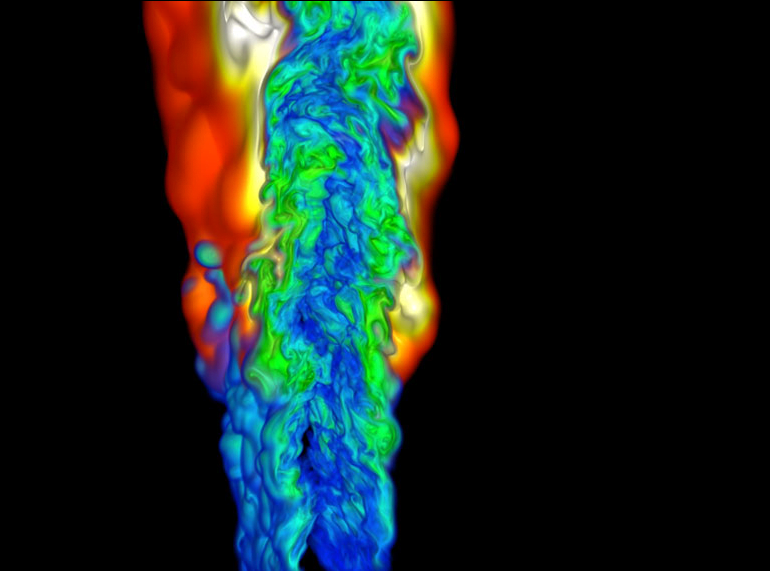
Many fluid dynamics problems are so complicated that they require supercomputers to calculate the mathematical and physical details. This image shows a computer simulation of a cold ethylene jet combusting in hot air. Different colors indicate different combustion by-products. Researchers use simulations like this one to investigate ideal flames that improve efficiency in applications like cars or jet engines. #
Search results for: “jet”

Airplanes Creating Snow
Scientists now think that that airplanes may be responsible for increasing local snowfall by flash-freezing supercooled water vapor in clouds. Water droplets can persist in the atmosphere to temperatures of -42 degrees Celsius. But when an airplane’s wing passes through moist air, the acceleration of the air passing over the wing causes a pressure decrease that can drop the temperature by as much as 19 C, causing the water droplets to form ice crystals immediately. (The particulate matter in the aircraft exhaust probably also aids this process.) The same behavior can also create holes in clouds and cause ice to form on the wings. # (Related behavior: vapor cones)
Photo credit: lhoon
Effects of Viscosity
[original media no longer available]
Today’s video demonstrates the effect of viscosity, which measures a fluid’s resistance to deformation. On the left is a column of highly viscous fluid; the fluids become less viscous as one moves right. When a jet of dye is released into the highly viscous fluid, the jet is very slow to penetrate, whereas, in the rightmost column, the dye expands quickly into a turbulent jet. Between these extremes, we see a laminar dye jet entering the liquid. The mushroom-like shape the laminar jet takes is the result of the Rayleigh-Taylor instability, which occurs when a denser fluid is on top of a lighter fluid in a gravitational field.

Superhydrophobic Carbon Nanotubes
Carbon nanotubes form a superhydrophobic (super water repellent) surface that interacts with water droplets in interesting ways. The droplet is unable to wet the surface and thus the bounces along. When the impact velocities are too great for surface tension to hold the decelerating mass together, it breaks into many, smaller droplets that also bounce along the surface. # (via @JetForMe and @Vinnchan)
Canon Sound Sculptures
In a new series of ads for Canon, colorful paints are placed on a speaker cone and filmed at high speed to create beautiful “sound sculptures”. Paint, like oobleck, is a non-Newtonian fluid but does not react the same when excited by sound because it is shear-thinning. (When painting, you want the paint to run off the brush easily but not drip when it’s on the wall; hence, shear-thinning.) Both the photos and videos are lovely examples of fluid mechanics as art. Watch how they did it. # (Via jshoer, @ftematt, @JetForMe)
Breaking up in Crossflow
This video shows some instabilities that occur when a liquid jet impinges on a flowing cross stream. Note how the jet breaks down into droplets in a fashion similar to the Plateau-Rayleigh instability but the broken tip remains stable for some time thereafter. #
Bubble Art
Bubbles are all about surface tension and minimizing energy. Arrange things just right and you can even make square ones. (via JetForMe)
Whipping Instabilities
When jets of liquid are introduced into an electrified medium in a process known as electrospinning, they can exhibit behavior known as whipping instabilities.
Dripping into Droplets
The Plateau-Rayleigh instability is one that just about everyone has witnessed. It describes how a liquid jet breaks up into droplets. Notice the waviness in the jet before breakdown. The tiniest curvature in the jet causes an imbalance in the liquid’s pressure due to surface tension. Because the system is unstable, any small changes will become larger, ultimately resulting in the jet breaking into droplets.
Can a Squid Fly?
Evidence is mounting that several kinds of squid will use jets of water to propel themselves into the air where they can actively fly some 50 times their body length.