Search results for: “jet”

  • Featured Video Play Icon

    Pinch-Off

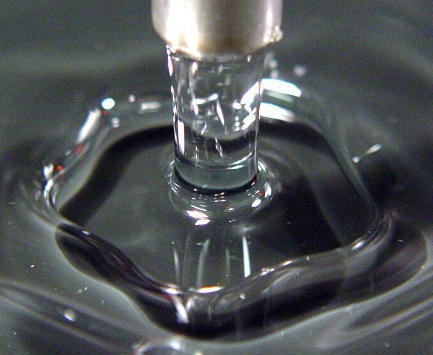
    This high-speed video reveals a fascinating bit of kitchen sink physics.  When a water droplet pinches off from the nozzle, the thin filament of fluid that connected the droplet to the water on the nozzle often breaks off as well.  Surface tension snaps the filament together into a sphere, causing wild oscillations and even ejection of microjets in the tiny satellite droplet. (Video from S. Thoroddsen et al. 2008’s Annual Review)

  • Featured Video Play Icon

    Atmospheric Dynamics in the Lab

    One way to explore some of the large-scale atmospheric dynamics we observe here on earth is through table-top demonstrations such as this one. Here a platform with a water tank is rotating at a constant velocity. The camera rotates with the tank; this is why the hand in the video seems to spin. At the center of the tank, ice in a can cools the water, while the warmer air along the periphery provides heating. The green dye marks initially cooler fluid while the red dye marks the warmer fluid from the outside of the tank. The dense cooler fluid sinks and moves outward while warmer water moves in to replace it. This creates radial circulation; the thermal gradients and rotation cause the eddies and jets seen from this top view, in much the same way that they form in the mid-latitudes of earth’s atmosphere.  (Video credit: Marshall Lab, MIT)

  • Viscous Dripping

    Viscous Dripping

    Artist Skye Kelly’s “Creep (strain)” sculpture shown above is made from toffee. The viscous fluid deforms under the force of gravity, resulting in elongated drips and slow jets that buckle and coil upon reaching the floor. (Photo credits: Skye Kelly; via freshphotons)

  • Splash Rebound

    Splash Rebound

    A ball dropped onto a puddle loses some of its rebound momentum to fluid motion.  On impact, a splash curtain and radial jet form as the fluid is displaced by the ball.  As the ball rebounds, the splash curtain is drawn inward into a column of fluid drawn up by the ball, reminiscent of the way cats and dogs drink.  Eventually, when the gravity’s force on the fluid column overcomes the force of the ball’s inertia, the fluid column pinches off and falls back downwards, leaving the ball free to utilize its remaining kinetic energy as it flies upward. (Photo credit: T. Killian, K. Langley, and T. Truscott)

  • Featured Video Play Icon

    Honey Coiling

    The liquid rope coiling effect occurs in viscous fluids like oil, honey, shampoo, or even lava when they fall from a height. The exact behavior of the coil depends on factors like the fluid viscosity, the height from which the fluid falls, the mass flow rate, and the radius of the falling jet. Here Destin of the Smarter Every Day series outlines the four regimes of liquid coiling behavior commonly observed. As with many problems in fluid dynamics the regimes are described in terms of limits, which can help simplify the mathematics.  The viscous regime (2:34 in the video) exists in the limit of a small drop height, whereas the inertial regime (3:15) exists in the limit of large drop height. Many complicated physical problems, including those with nonlinear dynamics, are treated in this fashion. For more on the mathematics of the coiling effect, check out Ribe 2004 and Ribe et al. 2006. (Video credit: Destin/Smarter Every Day; submitted by inigox5)

  • Rocket Engine Test

    [original media no longer available]

    In this static test of XCOR Aerospace’s Lynx rocket engine, Mach diamonds (shown at the top of the frame) are visible in the rocket exhaust. The distinctive pattern is a result of the over- or under-expansion of the exhaust jet with respect to the ambient air; in other words, the gases exiting the rocket are either too high or too low in pressure relative to the surrounding air. A series of shock waves and expansion fans forms in the exhaust jet until the pressure is equalized to ambient. It is these compressions and expansions that form the diamond pattern. (Video credit: XCOR Aerospace)

  • Floral Still Life

    Floral Still Life

    Fluid motion is captured as a floral still life in these high-speed photos by Jack Long. The artist keeps mum about his set-up but notes that these are single capture events, not constructed composites. It looks as if the blossoms are created from the impact of a falling fluid with the upward jet that forms the stem. The leaves and vase appear to be created from upward splashes, but whether those are generated by vibration or dropping an object is unclear. See Long’s Flickr page for more. (Photo credit: Jack Long via Gizmodo)

  • Featured Video Play Icon

    Egg Spinning

    Spin a hard boiled egg in a puddle of milk and you get a sprinkler. But how? The science starts at the surface. When the egg spins, the fluid touching its surface is dragged along due to friction, and, because of the fluid’s viscosity, other parts of the fluid will also be spun. Dynamics tells us that the velocity at the surface of the object varies with radius; the velocity at the bottom of a spinning sphere is much smaller than that at its equator because a particle at the equator traverses a larger distance in a single rotation. Likewise, the fluid touching the bottom of the egg is spun slower than the fluid just above it. Bernoulli’s principle tells us that, for an incompressible fluid, the pressure decreases as velocity increases, meaning that a favorable pressure gradient exists along the spinning convex surface. It is this pressure gradient that draws the fluid up the sides of the object. Near the equator, the pressure gradient is weakest and centrifugal force flings the the fluid outward. Surface tension, angular velocity, and viscosity all play a role in the jets and sheets created by the sprinklers. (Video credit: NPR Science Friday with Tadd Truscott et al)

  • Reader Question: Fire as a Fluid?

    Reader Question: Fire as a Fluid?

    Reader David L asks:

    I understand that fire is a form of energy rather than a fluid in the physical/tangible sense. However, is it possible for fire to exhibit fluid-like behaviours to a certain extent.

    In other words, could the dynamic properties of fire be described with pseudo-variables analogical to variables that describe a physical fluid (i.e. viscosity, density, Re, etc.)?

    Actually, combustion is a major topic of research among fluid dynamicists. Since the part of fire that we identify as visible flame is a reacting mixture of gas and some solid particles, it moves according to the same equations of motion as any other gas. However, when studying combustion thermodynamical equations and chemical reactions must also be tracked in addition to mass and momentum, which makes modeling fire very difficult. Combustion plays a major role in internal flows like those in car, jet, and rocket engines. (Photo credit: master.blitzy)

  • Featured Video Play Icon

    Bursting Bubbles

    Sometimes bursting one bubble just leads to more bubbles. This high-speed video shows how popping a bubble sitting on a fluid surface can lead to a ring of daughter bubbles. When the surface of the bubble is ruptured, filaments of the liquid that made up the surface are drawn back toward the pool by surface tension, trapping small pockets of the air that had been inside the bubble. A dimple forms on the surface and rebounds as a jet that lacks the kinetic energy to eject droplets. Watch as the jet returns to the interface, and you will notice the tiny bubbles around it. At 56 ms, one of the daughter bubbles on the left bursts. See Nature for more. (Video credit: J. Bird et al)