When a solid object is driven into a quiescent liquid, a cavity is formed. As the cavity collapses jets–a type of singularity–form. In this video, researchers explore the effect of the geometry of a disk being driven into water on the shape of the cavity formed and how it collapses. As in this video of droplet impacts on posts of different geometries, there’s a lovely symmetry in the results. (Video credit: O. Enriquez et al)
Search results for: “jet”

Bullet Shock Wave and Cavitation
A 9mm bullet impacts a falling jet of water. High-speed video reveals the formation of a shock wave inside the jet. Because this shock wave is confined inside the jet, it causes strong secondary cavitation–the bubble that seems to explode in front of the bullet.
Smoke Transition
Smoke issuing from a round jet undergoes transition from laminar to turbulent flow. As the smoke moves past the unmoving ambient air, the friction between these two layers creates shear and triggers a Kelvin-Helmholtz instability, recognizable by the formation and roll up of vortices along the edges of the jet. Those vortices then roll together in pairs, detach, and devolve into a generally turbulent flow. Because turbulence is far more efficient at mixing than a laminar flow is, the smoke seems to disappear.
Coughing Contagions
Schlieren imaging has applications even in public health. This video demonstrates the spread of contagion via coughing with and without a mask on. Although air from the cougher’s lungs escapes the sides of the mask, it mostly rises on a thermal plume rather than projecting 1 to 2 meters forward in a turbulent jet as in the maskless case. Flu season is just starting. Don’t forget to get your flu shot!

Impinging Without Coalescing

Three impinging jets of silicone oil rebound without coalescence due to thin-film lubrication between the jets. The motion of the oil replenishes the thin layer of air separating the streams. The same phenomenon keeps droplets from coalescing as well. (Photo credit: BIF Lab, Department of Engineering Science and Mechanics, Virginia Tech) #
Atomization
Atomization–breaking a flowing liquid into a fine spray–is important for fuel injection in a variety of engines, including automobiles, jet engines, ramjets, scramjets, and rockets. The more effectively a liquid fuel can be dispersed as a spray in an engine, the more efficient and stable the combustion will be. The apparatus in this high-speed video injects an annular water sheet with concentric jets of air on either side of the water. The video series shows the effects of increasing the outer and inner air velocities relative to the water on the breakup of the liquid. What to the naked eye looks like a deluge, high-speed video reveals as a complex undulating structure.

Fluid Sculpture
Droplet collisions captured instantaneously create beautiful fluid sculptures that, though common, are too fast for the human eye. Here a bubble was blown onto the surface of the fluid, then a droplet was released to fall into the center of the bubble, bursting it. As that droplet rebounded in a Worthington jet, a second droplet was released and impacted the jet, creating the umbrella-like shape in the center. See Liquid Droplet Art for more photos. (Photo credit: Corrie White and Igor Kliakhandler) #
The Barus Effect
Non-Newtonian fluids are full of all kinds of unusual behaviors. Here a highly viscoelastic non-Newtonian fluid exhibits the Barus effect, in which extruding the fluid causes the falling jet to swell to several times larger than the diameter of the opening through which it was extruded. This is caused by the stretching and relaxation of polymers in the fluid as it passes through the opening.
Carboy Combustion
Lighting a thin layer of ethyl alcohol in a jug produces some beautiful pulse jets and a moving wall of flame that shifts and flows according to the changing pressures inside the jug. Like the video’s author, we do NOT recommend trying this combustion demo yourself.
As for the video’s questions, firstly, blowing into the jar helps the flame because humans do not exhale pure CO2. With regard to the second question, the interior of the jug is initially thinly coated in ethyl alcohol vapor. Combustion starts at the top of the jug and the sheet of flame moves downward as the fuel at the top is spent. As that flame moves downward, however, it’s heating the air inside the jug, which expands and is forced out the opening. When the flame goes out in the upper part of the jug, that does not mean all of the fuel has combusted, simply that the ratio of air/fuel is insufficient for continued combustion. I suspect the flame persists at this opening because the air/fuel mixture is concentrated at that point. Any residual ethyl alcohol in the container is forced out through that narrow opening, and the resulting concentration of fuel there may be high enough to keep the flame burning there. (idea submitted by davidbenque #)
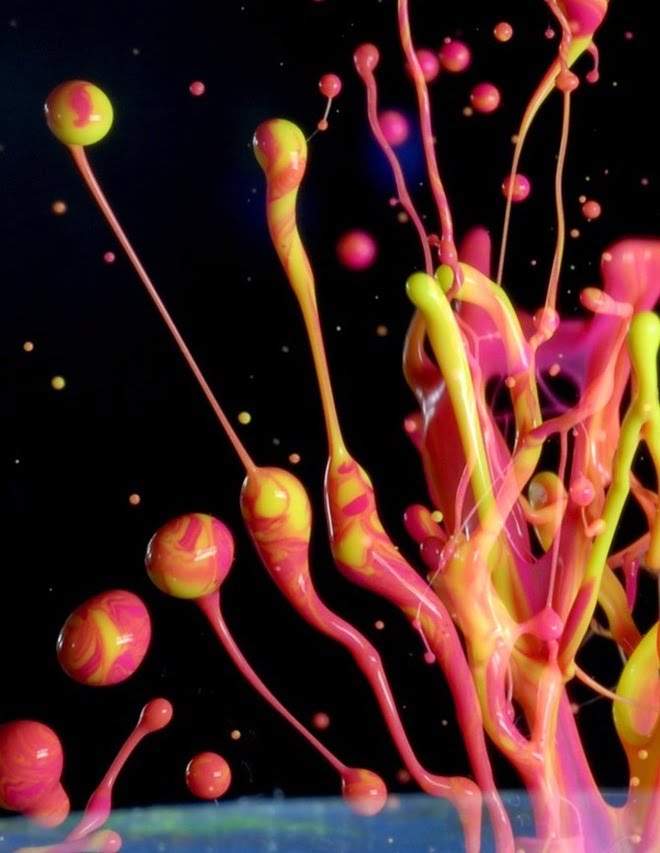
Paint Vibrations
Paint vibrated on a loud speaker explodes in multi-colored jets and droplets. Most paints are shear-thinning non-Newtonian fluids (like ketchup, shampoo, or whipped cream), meaning that their viscosity decreases as they are sheared. This allows them to flow more readily once they are perturbed. #