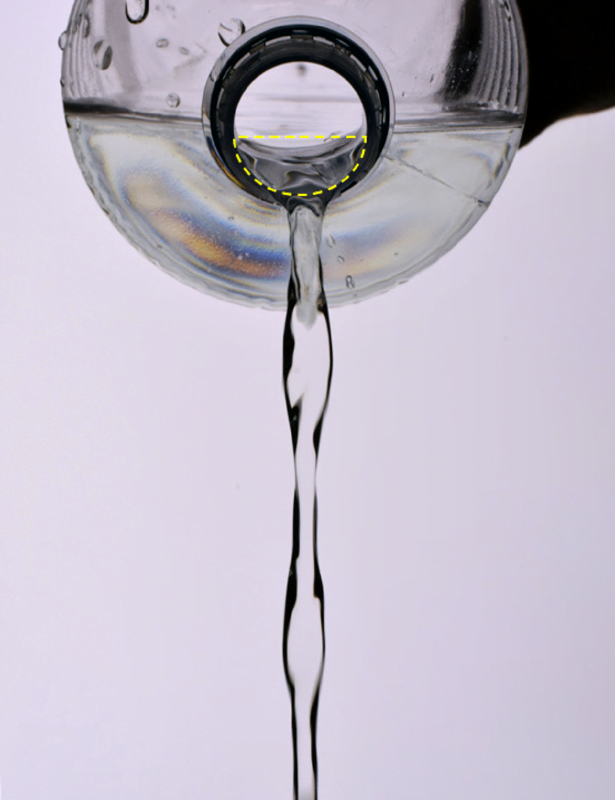
A leak can actually stop itself, as shown in this video. To demonstrate, the team used a tube pierced with a small hole. When filled, water initially shoots out the hole in a jet. The pressure driving the jet comes from the weight of the fluid sitting above the hole. As the water level drops, the pressure drops, causing the jet to sag and eventually form a rivulet that wets the side of the tube. As the water level and driving pressure continue to fall, the rivulet breaks up into discrete droplets, whose exact behavior depends on how hydrophobic the tube is. Eventually, a final droplet forms a cap over the hole and the leak stops. At this point, the flow’s driving pressure is smaller than the pressure formed by the curvature of the capping droplet. (Image and video credit: C. Tally et al.)
Search results for: “jet”

Surf’s Up!
Inspired by honeybees and their ability to surf on capillary waves of their own making, researchers have developed SurferBot, a low-cost, untethered, vibration-driven surf robot. Built on a simple 3D-printed platform, the bot has a vibration motor powered by a simple coin cell battery. As the motor vibrates, it propels the bot forward (Image 2). With the motor placed off-center, the bot’s vibrations create larger capillary waves at the rear of the bot than at the front (Image 3). It’s this asymmetry that drives the robot forward. The flow pattern created by the bot’s propulsion is impressively strong (Image 4) and consists of a pair of counter-rotating vortices trapped ahead of the bot and a strong central jet in its wake.
Best of all: SurferBot is a great platform for educational experimentation, costing <$1 apiece! (Image and submission credit: D. Harris; research credit: E. Rhee et al.)

Superhydrophobic Drag
Using air or bubbles to reduce drag on boats is a popular idea, whether using supercavitation, the Leidenfrost effect, or superhydrophobic coatings. But most of the experiments done thus far use spheres rather than realisitic boat shapes. In this study, the researchers used two model boats — one with a hydrofoil and the other in a conventional motorboat shape — and applied superhydrophobic coatings to different parts of the model to see how superhydrophobicity affected the overall drag.
Perhaps surprisingly, they found that superhydrophobic coatings can actually increase the drag! The effect was particularly stark for the hydrofoil boat (Image 2), where the surface jets (lower half) caused by the superhydrophobic coating slowed the boat by 30% compared to its unmodified speed (upper half).
For the speedboat, a superhydrophobic hull made no overall difference in its drag, though it changed how water splashed in its wake. And coating the boat’s propeller was particularly detrimental, resulting in a speed up to three times slower. Overall, the study suggests that superhydrophobic coatings may be useful in some circumstances, but they have to be applied carefully, as they can have negative impacts, too. (Image credits: top – S. Anghan, others and research credit: I. Vakarelski et al.)

Luminous Fruits
Light shines through citrus and melon in this
photographicphotorealistic series of paintings from artist Dennis Wojtkiewicz. The strong illumination reveals the underlying structure of pith, pulp, and juice. The deformable pockets of fluid in the peel of citrus fruits are the source of some incredible microjets. When the peel bends, it compresses these tiny fluid-filled pockets, creating incredibly high pressures that eventually drive a burst of oil at g-forces comparable to those felt by a bullet fired from a gun. Learn more about citrus jets here and see more of Wojtkiewicz’s work and purchase prints here on his site. (Image credit: D. Wojtkiewicz; via Colossal)ETA: Thanks to A.J. for pointing out that Wojtkiewicz is, in fact, a painter (and not a photographer), making his work all the more astounding! We regret the error.

Opera Singer Air Flow
What does the air flow from a trained opera singer look like? That’s the question behind this study, which combines music and fluid dynamics. Using an infrared camera tracking carbon dioxide (CO2) exhalations from a singer during a performance allowed researchers to identify several important flow features. When breathing, air flows out the singer’s nose in a tight, downward jet with an initial velocity around 1 m/s.
While singing, air leaves the mouth at a much lower velocity, especially during vowels where the mouth is open. With less momentum behind these exhalations, they can drift upward on the buoyant warmth of the singer’s breath. During consonants — especially plosives like t, k, p, b, d, and g — a rapid burst of air leaves the mouth, traveling at nearly 10 m/s. From the perspective of COVID-19 safety, it’s these plosive jets that are likely to spread contaminated droplets. (Image and video credit: MET Orchestra; research credit: P. Bourrianne et al.; via Improbable Research; submitted by Kam-Yung Soh)
Liquid Umbrellas
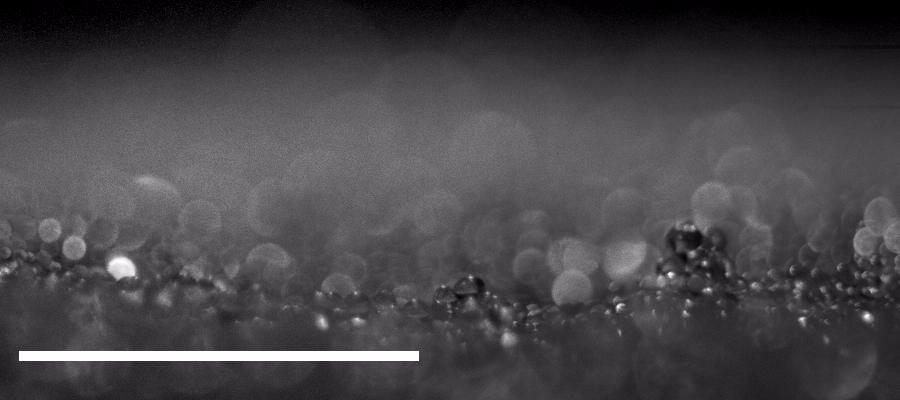
Two well-timed and properly aligned droplets combine to create these umbrella-like fluid sculptures. The initial drop creates a jet that shoots upward. When the second drop hits that jet, it forms an expanding sheet of liquid like a miniature parasol. The higher the viscosity of the drops, the less lacy and unstable the sheet’s rim will be.
Although set-ups for these sorts of pictures can be finicky, they’re very doable, even for amateur photographers. In fact, the techniques used here have been around for about a century! (Image and research credit: A. Kiyama et al.)

Pressure At The Dam
Hydrostatic pressure in a fluid is based on the fluid’s depth. You’ll rarely see a more dramatic example of that power than with a water release from a dam. Here we see the outlet of the Verbund Hydro Power dam in Austria. With 190 meters of water behind the dam, the outlet jet is massive. It moves 20,000 liters of water per second at a speed of 50 meters per second. Imagine what it would be like to stand next to that! (Image and video credit: Discovery UK; submitted by Olwyn B.)

Really, Really Slow Mo Fluids
Fluid dynamics is a perfect subject for high-speed video. So much goes on at speeds that are far too quick for our eyes and brains to perceive. But there is such a thing as too slow – a concept explored in this Slow Mo Guys video, which takes everyday activities like turning on a faucet or splashing into a pool and slows them down a speed where one second lasts an hour. The video I’ve embedded here isn’t nearly that long; it speeds up and slows down. But if you really want to, you can watch Gav fall into a pool for a full hour. (Image and video credit: The Slow Mo Guys)

Breaking Up Is(n’t) Hard to Do
Engineers often need to break a liquid jet up into droplets. To do so quickly, they surround the jet with a ring of fast-moving air in a set-up known as a coaxial jet. Shear between the gas and liquid creates instabilities that quickly distort the jet’s initial cylinder into sheets and ligaments. Those formations then undergo their own instabilities to break up into drops. The method is, as you can see in the high-speed images above, quite effective, though the breakup mechanism itself is tough to quantify. (Image credit: G. Ricard et al.)

Fish Versus Bird
You’ve seen birds catch fish, but have you ever seen a fish that catches birds? In this video, giant trevally fish hunt fledgling terns — including those in flight! To do so, the fish must correctly assess the bird’s speed and trajectory across the water interface, a feat reminiscent of the archer fish’s aim. They also need the power and control to leap from the water and catch the birds in their mouth without relying on the suction technique so many fish use underwater. (Image and video credit: BBC Earth, from “Blue Planet II”)